
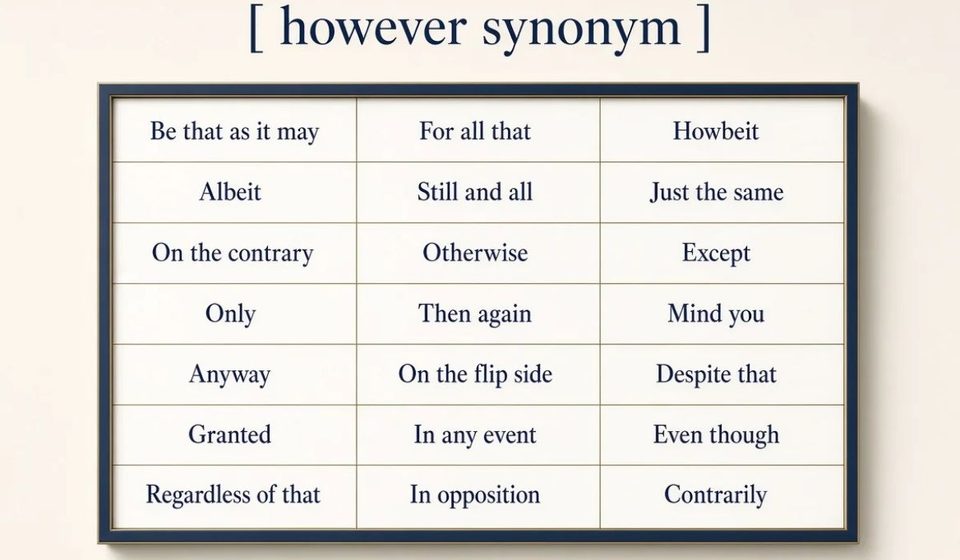

Finding a good however synonym is easy once you know what “however” is doing. It usually signals contrast. Sometimes it means “no matter how.”
Each alternative has its own tone, grammar, and strength. Some need a new sentence structure. This guide shows you which word to pick and why.
What Does However Mean?
“However” has two main meanings. Know which one you need before you swap it.
- Contrast: It introduces an idea that differs from the one before it. “The plan was good. However, it cost too much.”
- Manner: It means “in whatever way” or “no matter how.” “However you solve it, show your steps.”
Most searches for another word for “however” are about the first meaning. The second meaning has its own alternatives, covered later in this guide.
However: Grammar Role and Punctuation Rules
In its contrast sense, “however” is a conjunctive adverb. It is not a coordinating conjunction like “but.” That difference drives the punctuation.
- At the start of a sentence: Add a comma after it. “However, we chose another vendor.”
- Between two full clauses: Use a semicolon or a period before it. “We wanted to go; however, we were busy.”
- In the middle of a clause: Set it off with commas. “The results, however, were mixed.”
A comma alone creates a comma splice. “I wanted to go, however I was busy” is incorrect. Fix it with a period or a semicolon, or switch to “but.”
You can start a sentence with “however.” It is correct and common in good writing.
How to Choose a Replacement for However
Pick the word by the relationship between your two ideas. Do not pick the longest or fanciest word.
| Relationship | Good options |
| Simple contrast | but, yet, still, though |
| Concession (true despite the obstacle) | nevertheless, nonetheless, even so, all the same |
| Mild qualification | that said, having said that |
| Comparing two cases | in contrast, by contrast |
| Reverse relationship | conversely |
| Direct rejection | on the contrary |
| A second side or option | on the other hand |
| “No matter how” | regardless of how, no matter how |
This table also separates false equivalents. Words like “meanwhile,” “likewise,” and “by the way” do not replace “however.” They do other jobs.
Formal, Neutral, and Casual Tone
Register matters as much as meaning.
- Formal: nevertheless, nonetheless, notwithstanding, conversely, albeit
- Neutral: still, yet, even so, that said, on the other hand, in contrast
- Casual: but, though, all the same, having said that
Use formal words in essays, legal text, and research. Use neutral words in business emails and reports. Use “but” and “though” in blogs, chats, and spoken English.
Do You Need a Transition at All?
Sometimes the best replacement is nothing. A contrast word only works when two ideas truly clash.
Look at this example: “The study had 200 participants. However, recruitment took six weeks. However, 80 percent responded.” Nothing here conflicts. These are plain facts in a row. Delete both, and the paragraph reads better.
Ask one question before you add any contrast word: does the second idea really push against the first? If not, cut it.
22 However Synonyms With Meaning, Examples and Pronunciation
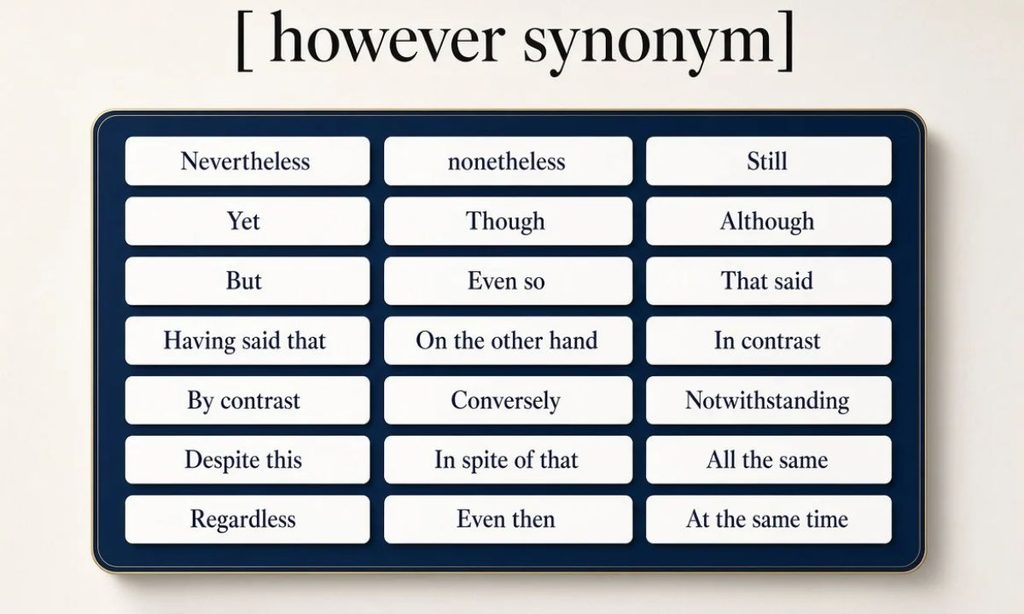
Each entry below gives the meaning, the communication value, two example sentences, a real-life fit, and a pronunciation guide. Entries 1 to 20 cover contrast. Entries 21 and 22 cover the “no matter how” sense.
1. But
Meaning: A short, direct word that joins two opposing ideas.
“But” sounds natural and honest. It keeps your tone relaxed and your message easy to follow. Readers feel you are speaking to them, not at them.
Examples:
- I like the design, but the price is too high.
- She wanted to join us, but she had a deadline.
When It Fits: Texting a friend that you cannot make dinner.
Pronunciation: BUT
2. Yet
Meaning: A compact word that links two contrasting ideas, often with a note of surprise.
“Yet” adds a gentle twist to a sentence. It tells the reader the second idea is unexpected. That small surprise keeps attention high.
Examples:
- The room was small, yet it felt warm and bright.
- He studied little, yet he passed with ease.
When It Fits: Describing a surprising result in a blog or story.
Pronunciation: YET
3. Still
Meaning: Shows that something remains true despite what you just said.
“Still” sounds calm and practical. It lets you admit a problem without losing your point. Readers see you as balanced and fair.
Examples:
- The hotel was noisy. Still, we slept well.
- It rained all day. Still, the match went ahead.
When It Fits: Chatting about a trip that had small problems but turned out fine.
Pronunciation: STIL
4. Though
Meaning: Introduces a softer contrast and can sit at the end of a sentence.
“Though” is relaxed and flexible. It softens your point instead of challenging the reader. That makes disagreement feel friendly.
Examples:
- The soup was plain. It was filling, though.
- Though it was late, she kept working.
When It Fits: Adding a small positive note in casual conversation.
Pronunciation: THOH
5. Although
Meaning: A subordinating conjunction that opens a dependent clause showing contrast.
“Although” builds a careful, thoughtful sentence. It lets you place both ideas in one flow. Readers follow your logic without a break. Note that it needs a rewrite, not a simple swap.
Examples:
- Although the test was hard, most students passed.
- We stayed, although the music was too loud.
When It Fits: Writing a balanced sentence in a school essay or report.
Pronunciation: awl-THOH
6. Nevertheless
Meaning: A formal word meaning “in spite of that.”
“Nevertheless” carries weight. It tells readers the point stands even after a strong obstacle. It signals confidence and seriousness.
Examples:
- The budget was cut. Nevertheless, the team finished on time.
- The risks are real; nevertheless, the plan is sound.
When It Fits: Formal essays and professional reports.
Pronunciation: nev-er-thuh-LES
7. Nonetheless
Meaning: A formal word that means nearly the same as “nevertheless.”
“Nonetheless” feels measured and polished. It shows you have weighed the objection and still hold your view. Readers sense careful thinking.
Examples:
- The data is limited. Nonetheless, the trend is clear.
- She was tired; nonetheless, she led the meeting.
When It Fits: Academic writing and formal emails.
Pronunciation: nun-thuh-LES
Explore More Synonyms Guide
Synonyms for Love: 40 Words for Romance, Care, and Devotion
Experience Synonym: 30 Better Words for Every Context
25 Other Ways to Say “Nuance”: Examples and Usage
25 Synonyms for “Proud” With Examples
8. Even so
Meaning: Shows that a conclusion holds despite a stated limit.
“Even so” is calm and clear. It acknowledges the problem and moves forward. Readers feel you are being fair, not defensive.
Examples:
- The service was slow. Even so, the food was excellent.
- The plan has flaws. Even so, it is our best option.
When It Fits: Reviewing a restaurant or product.
Pronunciation: EE-vun SOH
9. That said
Meaning: Adds a counterpoint or qualification to what you just stated.
“That said” is smooth and modern. It lets you balance a view without sounding harsh. Readers feel you are open-minded.
Examples:
- The software is powerful. That said, it takes time to learn.
- I like the offer. That said, I need to check the terms.
When It Fits: Giving balanced feedback in a work meeting.
Pronunciation: THAT SED
10. Having said that
Meaning: A slightly longer form of “that said,” used to qualify a point.
“Having said that” sounds thoughtful and fair. It gives the reader a moment to shift views. It builds trust because it admits both sides.
Examples:
- The report is clear. Having said that, a few figures need checking.
- Having said that, I understand why they chose it.
When It Fits: Replying to a colleague’s idea with a small concern.
Pronunciation: HAV-ing SED THAT
11. All the same
Meaning: Means “despite that,” with a relaxed, everyday tone.
“All the same” feels warm and human. It shows you accept the facts but keep your stance. Readers hear steady, friendly resolve.
Examples:
- It was a long shot. All the same, we gave it a try.
- I know you disagree. All the same, I appreciate your help.
When It Fits: Encouraging a friend to try something despite the odds.
Pronunciation: AWL thuh SAYM
12. Despite this
Meaning: Introduces a result that continues in spite of a stated fact.
“Despite this” is clear and neutral. It keeps the focus on cause and effect. Readers get a quick, tidy link between ideas.
Examples:
- Sales fell early in the year. Despite this, profits rose.
- Despite this, the trial continued as planned.
When It Fits: Business summaries and project updates.
Pronunciation: dih-SPYD THIS
13. In spite of that
Meaning: A fuller, slightly more emphatic form of “despite this.”
“In spite of that” adds a touch of drama. It highlights how strong the obstacle was. Readers feel the effort behind the result.
Examples:
- The team was short on staff. In spite of that, it hit every target.
- In spite of that, she never gave up.
When It Fits: Praising someone who overcame a tough situation.
Pronunciation: in SPYT uv THAT
14. Notwithstanding
Meaning: A very formal word meaning “in spite of.” It often takes a noun.
“Notwithstanding” sounds official and exact. It shows legal or contract-style care. Use it sparingly, or it can feel stiff.
Examples:
- Notwithstanding the delay, the event was a success.
- The rule applies, notwithstanding any earlier agreement.
When It Fits: Contracts, policies, and legal documents.
Pronunciation: not-with-STAN-ding
15. Albeit
Meaning: Means “although” and sits inside a sentence before a word, phrase, or short clause.
“Albeit” adds quiet elegance. It lets you admit a small limit without breaking the flow. Readers notice a refined, careful style. It cannot start a sentence like “however.”
Examples:
- The plan worked, albeit slowly.
- It was a useful, albeit short, course.
When It Fits: Polished writing, such as essays or feature articles.
Pronunciation: awl-BEE-it
16. On the other hand
Meaning: Introduces a second side, option, or view.
“On the other hand” shows balance. It tells readers you see more than one angle. That fairness builds credibility. Use it for real alternatives, not just any contrast.
Examples:
- Renting is flexible. On the other hand, buying builds equity.
- Remote work saves time; on the other hand, it can feel lonely.
When It Fits: Weighing two choices, such as two job offers.
Pronunciation: on thee UTH-er HAND
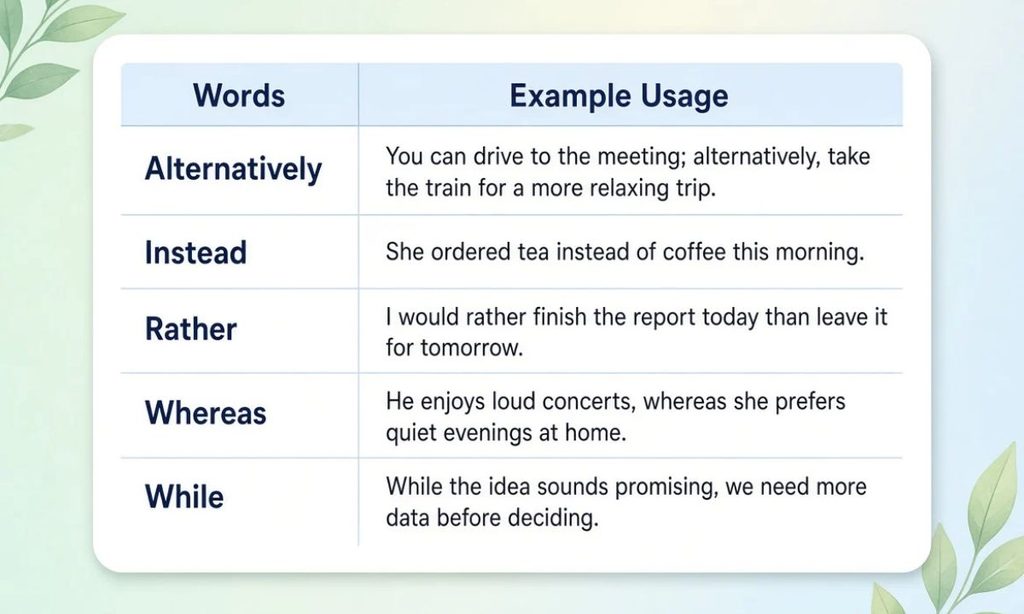
17. In contrast
Meaning: Compares two different cases or conditions.
“In contrast” makes differences easy to see. It organizes information for the reader. That clarity helps people remember your point.
Examples:
- City rents are high. In contrast, rural rents are low.
- The first group improved. In contrast, the second group did not.
When It Fits: Comparing two products, places, or results.
Pronunciation: in KON-trast
18. By contrast
Meaning: A close twin of “in contrast,” used to set two items side by side.
“By contrast” feels crisp and analytical. It sets up a clean comparison. Readers can scan the difference at a glance.
Examples:
- Our old system took hours. By contrast, the new one takes minutes.
- By contrast, the smaller firm grew steadily.
When It Fits: Reports and presentations that compare options.
Pronunciation: by KON-trast
19. Conversely
Meaning: Shows the reverse relationship is also true.
“Conversely” signals a neat mirror image. It shows you have thought the idea through both ways. Readers feel the logic is tight.
Examples:
- More sleep improves focus. Conversely, too little sleep harms it.
- Prices rise when demand grows; conversely, they fall when demand drops.
When It Fits: Explaining cause and effect in an essay.
Pronunciation: kun-VERS-lee
20. On the contrary
Meaning: Directly rejects what was just said.
“On the contrary” is firm and clear. It corrects a wrong idea fast. Use it only when you truly deny the earlier claim, since it can sound sharp.
Examples:
- The task was not easy. On the contrary, it was very hard.
- I am not upset. On the contrary, I am thrilled.
When It Fits: Correcting a mistaken assumption in conversation.
Pronunciation: on thuh KON-trair-ee
21. No matter how
Meaning: Replaces “however” in its manner sense, meaning “to any degree.”
“No matter how” sounds determined and encouraging. It tells the listener that effort or conditions will not change the result. That promise feels reassuring.
Examples:
- No matter how hard it gets, we will finish.
- No matter how you ask, the answer is the same.
When It Fits: Motivating a friend before a hard challenge.
Pronunciation: NOH MAT-er HOW
22. Regardless of how
Meaning: A slightly more formal way to say “in whatever way.”
“Regardless of how” sounds fair and steady. It shows a rule or result does not depend on the method. Readers feel the standard is consistent.
Examples:
- Regardless of how you travel, arrive by noon.
- Regardless of how the work is done, quality must stay high.
When It Fits: Setting a clear rule at work or school.
Pronunciation: rih-GARD-less uv HOW
However Compared With Similar Words
These pairs cause the most confusion.
However vs. but: “But” joins two clauses and is more casual. “However” is a bit more formal and needs stronger punctuation.
However vs. nevertheless: “Nevertheless” is more formal and stronger. It suits a real obstacle, not a mild contrast.
However vs. nonetheless: They are almost the same. “Nonetheless” is slightly less common.
However vs. although: “Although” opens a dependent clause. You must rewrite the sentence, not just swap the word.
However vs. on the contrary: “However” adds a different idea. “On the contrary” denies the earlier one.
Side-by-Side Rewrites
Here is one original sentence and several correct rewrites.
Original: The hotel was cheap. However, it was very clean.
But: The hotel was cheap, but it was very clean.
Still: The hotel was cheap. Still, it was very clean.
Nevertheless: The hotel was cheap; nevertheless, it was very clean.
Although: Although the hotel was cheap, it was very clean.
Albeit: The hotel was cheap, albeit very clean.
Each version keeps the meaning. Each one changes the tone or the structure.
Examples for Different Kinds of Writing
Match the word to the place you are writing.
Academic essay: “The results were promising; nevertheless, the sample was small.”
Business email: “The timeline is tight. That said, we can deliver by Friday.”
Report: “Costs rose last quarter. In contrast, revenue stayed flat.”
Blog post: “It looks simple, but there is a catch.”
Resume: “Led a small team, yet exceeded every sales target.”
Casual message: “It was a long day, though I enjoyed it.”
Common Mistakes With However Alternatives
Avoid these errors.
- False contrast. Do not add a contrast word when two ideas agree.
- Comma splices. Do not join two full clauses with only a comma before “however.”
- Wrong register. “Notwithstanding” in a text message sounds odd.
- Overusing one word. Repeating “nevertheless” is as tiring as repeating “however.”
- Ignoring grammar. “Although” and “albeit” need different sentence shapes.
There is no fixed limit on how often you can use “however.” Use it whenever a real contrast exists. If your page reads choppy, vary the structure or cut the transition.
Frequently Asked Questions
What is another word for however?
“But,” “yet,” “still,” “nevertheless,” and “nonetheless” are the most common alternatives.
What is a formal synonym for however?
“Nevertheless,” “nonetheless,” and “notwithstanding” are the best formal choices.
Can you start a sentence with however?
Yes, and you should follow it with a comma, as in “However, we agreed.”
Do you use a comma before however?
Use a semicolon or period before it when it links two full clauses, not a comma alone.
What is a casual word for however?
“But,” “though,” and “still” sound natural in casual writing.
Conclusion
The best however synonym is the one that matches your meaning, your grammar, and your tone. Start by naming the relationship between your two ideas: simple contrast, concession, comparison, reversal, rejection, or “no matter how.”
Then pick a word like but, still, nevertheless, in contrast, or on the contrary, and check that the punctuation fits. If the ideas do not truly clash, remove the transition and let the facts speak. Practice with a few of the 22 options above, and your writing will flow more clearly and sound more natural.

-
-
-
-
-
Show Comments[…] However Synonym: 22 Smart Alternatives and How to Use Them […]
[…] However Synonym: 22 Smart Alternatives and How to Use Them […]
[…] However Synonym: 22 Smart Alternatives and How to Use Them […]
[…] However Synonym: 22 Smart Alternatives and How to Use Them […]
[…] However Synonym: 22 Smart Alternatives and How to Use Them […]