
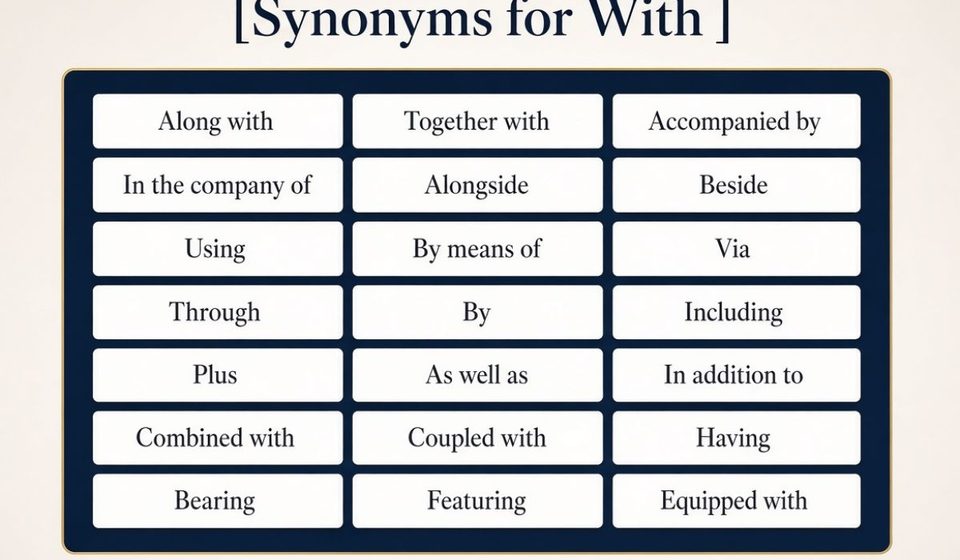

You use “with” all the time. It shows up in almost every email, essay, and chat. Repeating it makes your writing feel flat. The fix is simple. Pick a word that matches what “with” means in your sentence.
This guide gives you 40 alternatives. Each one has a meaning, two examples, a use case, and a pronunciation. Read the short guide first, then jump to the word you need.
Quick Answer: What Is Another Word for With?
The best synonyms for with are alongside, together, using, including, and having. Which one works depends on the meaning.
Use alongside or together for company. Use “using” or “by means of” for tools. Use “including” or “plus” for addition. Use “having” or “featuring” for traits.
Always check the meaning first. A swap that sounds fancy can change your point.
With a Glance
| Detail | Information |
| Word | With |
| Part of speech | Preposition |
| Pronunciation | wihth (one syllable) |
| Old English root | wið, meaning “against” or “opposite” |
| Core meanings | Company, tools, addition, traits, manner, cause |
| Common patterns | With care, with a friend, with a pen |
| Formality | Neutral, works in casual and formal writing |
| Best replacement rule | Match the relationship, not just the sound. |
How to Pick the Right Synonym for With
Ask one question: what is “with” doing in this sentence?
- Company: Use alongside, together, or accompanied by.
- Tool or method: Use using, by means of, or through.
- Addition: Use including, plus, or as well as.
- Traits: Use having, featuring, or bearing.
- Teamwork: Use in collaboration or in partnership.
- Cause or contrast: Use because of, due to, or despite.
Sometimes “with” is already the best choice. Fixed phrases like “pleased with” or “angry with” should stay as they are. A shorter sentence often beats a clever swap.
Another Word for With: 40 Clear Alternatives
Alongside
Meaning: Next to someone or doing something at the same time as them. It shows shared effort without sounding stiff. It tells the reader you see the other person as an equal. That makes your sentence feel warm and fair. It also adds a little movement to plain writing.
Examples:
- She worked alongside her brother for ten years.
- The nurses stood alongside the doctors during the long shift.
When It Fits: Describing teammates who share a task at work.
Pronunciation: uh-LONG-side
Together
Meaning: In a group or as one unit. It carries a feeling of closeness and shared purpose. Readers sense unity right away. It builds trust because it signals nobody is left out.
Examples:
- We cooked dinner together on Sunday.
- The kids finished the puzzle together.
When It Fits: Talking about family time or group plans.
Pronunciation: tuh-GETH-er
Accompanied by
Meaning: Joined by someone or something on a trip or event. It sounds polished and a bit formal. It gives the sentence a calm and respectful tone. Use it when you want to sound careful, not casual.
Examples:
- The singer arrived accompanied by her manager.
- The soup was accompanied by fresh bread.
When It Fits: Reporting who attended an event or meeting.
Pronunciation: uh-KUM-puh-need by
Beside
Meaning: Physically next to something. It paints a clear picture in the reader’s mind. It feels calm and simple. It works best for location, not for teamwork.
Examples:
- He sat beside his grandmother at the table.
- Your keys are beside the lamp.
When It Fits: Telling someone where an object or person is.
Pronunciation: bih-SIDE
Among
Meaning: In the middle of a group of three or more. It makes a person feel part of the crowd. That sense of belonging helps readers connect with the scene. It also avoids the one-to-one feel of “beside.”
Examples:
- She felt at home among her old classmates.
- There was one honest voice among the critics.
When It Fits: Describing a person inside a larger group.
Pronunciation: uh-MUNG
Amid
Meaning: Surrounded by or in the middle of something, often noise or change. It adds drama and mood. Readers feel the pressure or calm around the subject. Use it when the setting matters to the story.
Examples:
- He stayed calm amid the chaos.
- The team smiled amid the cheers.
When It Fits: Writing news-style or story-style scenes with a lot going on.
Pronunciation: uh-MID
In the company of
Meaning: Being in the presence of someone. It sounds graceful and slightly old-fashioned. It shows respect for the other person. That makes it a kind choice for formal or heartfelt writing.
Examples:
- She felt safe in the company of good friends.
- He spent the evening in the company of artists.
When It Fits: Writing a thank-you note or a speech.
Pronunciation: in the KUM-puh-nee of
Side by side
Meaning: Next to each other, working or standing as equals. It paints a strong picture of teamwork. It tells the reader there is no boss and no follower. That feeling of fairness is powerful.
Examples:
- The two rivals worked side by side after the storm.
- We walked side by side down the quiet road.
When It Fits: Describing partners or friends facing a task together.
Pronunciation: side by side
Using
Meaning: Doing something through a tool or method. It is short and direct. It cuts clutter, so your reader gets the point fast. Clear writing builds trust.
Examples:
- She fixed the shelf using a small hammer.
- Students can submit work using the online form.
When It Fits: Giving everyday instructions or steps.
Pronunciation: YOO-zing
By means of
Meaning: Through a certain method or tool. It sounds formal and exact. It signals that you care about the details of how something happened. Use it in reports and essays where tone matters.
Examples:
- The data was collected by means of a short survey.
- He reached the top by means of steady effort.
When It Fits: Writing an essay or a formal report.
Pronunciation: by MEENZ of
Via
Meaning: By way of a route or channel. It is quick and tidy. It saves space and keeps the sentence clean. Readers like short words that still sound professional.
Examples:
- I sent the file via email.
- The train goes to Paris via Lyon.
When It Fits: Mentioning how a message or trip travels.
Pronunciation: VEE-uh or VY-uh
Through
Meaning: By going from start to finish, or by using a path or method. It suggests effort and progress. It makes the result feel earned. That adds a quiet sense of pride.
Examples:
- She learned the piano through daily practice.
- They solved the problem through teamwork.
When It Fits: Talking about growth over time.
Pronunciation: throo
By
Meaning: Shows the person who did something, or the way it was done. It is short and sharp. It makes the doer clear. Clear credit helps readers follow the story.
Examples:
- The cake was made by my aunt.
- We travel to work by bus.
When It Fits: Crediting a person or naming a type of transport.
Pronunciation: by
Explore More Synonyms Guide
However Synonym: 22 Smart Alternatives and How to Use Them
Experience Synonym: 30 Better Words for Every Context
Smart Synonym: 30 Better Words and When to Use Them
Popular Synonym: 25 Better Words and When to Use Them
Utilizing
Meaning: Making practical use of something. It is a step more formal than “using.” It suggests skill and purpose. Use it sparingly so it does not sound stiff.
Examples:
- The lab succeeded by utilizing recycled materials.
- She cut costs by utilizing free tools.
When It Fits: Writing a professional update or a resume line.
Pronunciation: YOO-tuh-ly-zing
Employing
Meaning: Putting a method or tool to work. It sounds smart and deliberate. It tells readers the choice was planned. That adds a sense of control and care.
Examples:
- The team solved it by employing a simpler method.
- He won the debate by employing clear facts.
When It Fits: Describing strategy in a report or pitch.
Pronunciation: em-PLOY-ing
Thanks to
Meaning: Because of the help of someone or something. It carries gratitude. Readers feel the warmth of credit given freely. It builds goodwill in just two words.
Examples:
- We finished early thanks to your quick work.
- Thanks to the map, we found the trail.
When It Fits: Appreciating a friend or coworker.
Pronunciation: THANKS too
Including
Meaning: Having something as part of a larger group. It opens the list and keeps the sentence smooth. Readers see the full picture without extra words. That clarity feels helpful.
Examples:
- The box has many toys, including a red train.
- Everyone, including the manager, joined the call.
When It Fits: Listing items or people in a group.
Pronunciation: in-KLOO-ding
Plus
Meaning: Adding one more thing. It is casual and quick. It adds energy and a bit of friendly punch. Use it when you want to sound light.
Examples:
- The room has a big window, plus a small desk.
- I bought bread, plus a jar of jam.
When It Fits: Chatting or writing a friendly note.
Pronunciation: pluss
As well as
Meaning: In addition to. It adds an extra item without a heavy tone. It makes your sentence feel full and fair. Readers sense that nothing was left out.
Examples:
- She speaks French as well as Spanish.
- The kit has a map as well as a compass.
When It Fits: Listing skills or items in a calm voice.
Pronunciation: az WELL az
In addition to
Meaning: Adding something on top of what was already named. It sounds formal and clear. It signals that more value is coming. That keeps the reader interested.
Examples:
- In addition to cash, we accept cards.
- In addition to her job, she studies at night.
When It Fits: Writing emails, reports, or job applications.
Pronunciation: in uh-DISH-un too
Combined
Meaning: Joined into one. Use it when two things blend. It shows that the whole is stronger than the parts. That idea feels hopeful and smart.
Examples:
- Hard work, combined with luck, led to success.
- The two teams combined their skills.
When It Fits: Describing a mix of ideas, skills, or flavors.
Pronunciation: kum-BYNED
Having
Meaning: Showing that someone or something owns a trait or object. It is plain and strong. It helps the reader see the subject clearly. It fits when you want facts, not flair.
Examples:
- A house having three rooms is enough for us.
- She is a teacher having ten years of experience.
When It Fits: Describing a home, a product, or a person’s background.
Pronunciation: HAV-ing
Possessing
Meaning: Owning or holding a quality. It sounds formal and a little proud. It stresses that the trait truly belongs to the subject. Use it in profiles and reviews.
Examples:
- He is a leader possessing rare calm.
- The software, possessing many tools, suits large teams.
When It Fits: Writing a formal profile or review.
Pronunciation: puh-ZESS-ing
Bearing
Meaning: Carrying a mark, name, or feature. It adds weight and depth. It makes the subject feel important or marked by history. That draws readers in.
Examples:
- The box was bearing a small red label.
- She walked in bearing good news.
When It Fits: Describing an object with a visible mark, or someone arriving with news.
Pronunciation: BAIR-ing
Featuring
Meaning: Showing a key part or trait. It sounds modern and bright. It tells readers where to look. That focus makes descriptions easier to enjoy.
Examples:
- We stayed in a cabin featuring a stone fireplace.
- The app, featuring a clean design, is easy to use.
When It Fits: Describing a hotel, product, or event.
Pronunciation: FEE-chur-ing
Carrying
Meaning: Holding or having something on your person. It feels physical and real. Readers can picture the scene. It gives small moments a sense of life.
Examples:
- He came in carrying two heavy bags.
- She left the house carrying her umbrella.
When It Fits: Telling a short scene or story.
Pronunciation: KAIR-ee-ing
Wearing
Meaning: Having clothing or an item on the body. It is vivid and personal. It lets readers see the person quickly. That helps characters feel alive.
Examples:
- The girl wearing a yellow coat waved at us.
- He arrived wearing a worn leather hat.
When It Fits: Describing someone in a crowd.
Pronunciation: WAIR-ing
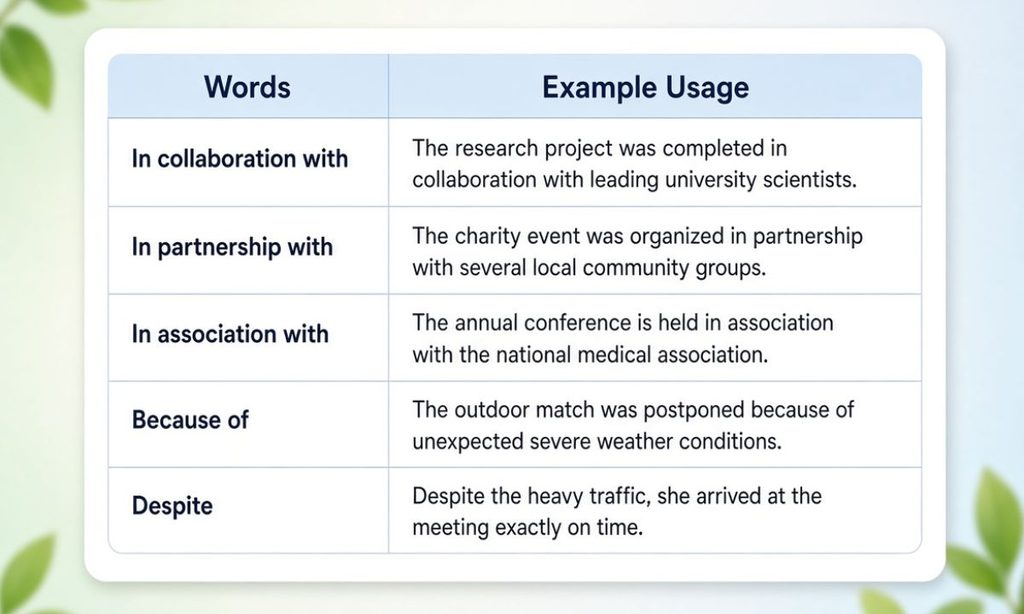
In collaboration
Meaning: Working jointly on a shared project. It sounds professional and open. It shows respect for every partner. That tone builds trust. Add “in collaboration” before a name when a team shares credit.
Examples:
- The book was written in collaboration with two experts.
- The study was done in collaboration with a local school.
When It Fits: Crediting joint work in a report.
Pronunciation: in kuh-lab-uh-RAY-shun
In partnership
Meaning: Working together under a shared plan or agreement. It feels steady and official. It tells readers the bond is serious. That builds confidence in the work.
Examples:
- The charity runs the program in partnership with the city.
- We built this tool in partnership with our users.
When It Fits: Announcing a long-term team-up.
Pronunciation: in PART-ner-ship
Jointly
Meaning: Done together by two or more parties. It is short and clear. It shows fairness and shared duty. That makes it a good fit for formal papers.
Examples:
- The two firms jointly own the patent.
- They jointly wrote the report.
When It Fits: Describing shared ownership or shared authorship.
Pronunciation: JOYNT-lee
Linked to
Meaning: Connected in a way that readers can follow. It shows a clear path between two ideas. That helps readers understand cause and context. It is neutral and safe in most writing.
Examples:
- The illness is linked to poor sleep.
- Her success is linked to years of practice.
When It Fits: Explaining how two facts relate.
Pronunciation: LINKT too
Connected to
Meaning: Joined to a person, place, or idea. It feels human and plain. It shows a bond that readers can feel. That adds warmth to a factual sentence.
Examples:
- He feels deeply connected to his hometown.
- The printer is connected to the main computer.
When It Fits: Describing people, devices, or places.
Pronunciation: kuh-NEK-tid too
Because of
Meaning: Showing the cause of something. It is clear and simple. Readers get the reason without effort. That makes your writing easy to trust.
Examples:
- The game ended early because of rain.
- She smiled because of his kind note.
When It Fits: Giving a quick reason in daily talk.
Pronunciation: bih-KUZ of
Due to
Meaning: Caused by something. It sounds a bit more formal than “because of.” It lends a neutral, calm tone. That is useful when news is not good.
Examples:
- The flight was late due to heavy fog.
- Sales rose due to a new design.
When It Fits: Writing a notice or business update.
Pronunciation: DOO too
Owing to
Meaning: Because of. It feels formal and slightly British. It adds a polite touch. Use it when you need to explain a delay with care.
Examples:
- Owing to a power cut, the class was moved.
- The event closed early owing to bad weather.
When It Fits: Apologizing for a change of plan.
Pronunciation: OH-ing too
Despite
Meaning: Despite something. It points to a result that went against the odds. That shows strength and resilience. Readers often feel inspired.
Examples:
- She finished the race despite a sore knee.
- Despite the rain, we had a great day.
When It Fits: Telling a short story of effort or luck.
Pronunciation: dih-SPITE
In spite of
Meaning: Even though something stood in the way. It is a little softer and more spoken than “despite.” It makes the sentence feel natural. That is good for everyday storytelling.
Examples:
- In spite of the cold, they hiked all day.
- He smiled in spite of his worries.
When It Fits: Chatting about a hard day that ended well.
Pronunciation: in SPITE of
Notwithstanding
Meaning: Despite. It is very formal. It tells readers you are writing in a legal or official voice. Use it with care, because too much of it sounds heavy.
Examples:
- Notwithstanding the delay, the project was a success.
- The rule applies, notwithstanding any past notice.
When It Fits: Reading or writing a contract or policy.
Pronunciation: not-with-STAN-ding
Regarding
Meaning: About or concerning a topic. It opens a subject politely. Readers know right away what the note is about. That saves time and shows respect.
Examples:
- I’m writing regarding your order.
- She had questions regarding the new schedule.
When It Fits: Starting an email about a specific issue.
Pronunciation: rih-GAR-ding
Containing
Meaning: Having something inside it. It is exact and neutral. It tells readers what to expect. That clarity feels honest and helpful.
Examples:
- The bag, containing two books, sat by the door.
- He opened a box containing old photos.
When It Fits: Describing the contents of a package or file.
Pronunciation: kun-TAY-ning
Frequently Asked Questions
What is another word for with?
Alongside, together, and using are the most common, depending on whether you mean company, tools, or method.
What is a formal synonym for with?
By means of, in collaboration, and in addition to are strong formal picks.
What can I use instead of within in an essay?
Try using, through, including, or by means of, as long as the meaning stays the same.
Can “using” replace “with”?
Yes, but only when “with” means a tool or method, as in “cut it using scissors.”
When should I keep “with” instead of replacing it?
Keep it in fixed phrases like “pleased with” or whenever a swap makes the sentence longer or less clear.
Conclusion
Good writing does not mean avoiding “with” at all costs. It means choosing the word that fits the meaning, the tone, and the reader. Use alongside or together for company, using or through for methods, including or plus for addition, and having or featuring for traits.
Check each swap by reading the sentence out loud, and keep “with” when it already sounds right. A small, careful change makes your message clearer, warmer, and easier to trust.

[…] Synonyms for With: 40 Alternative Words and Phrases by Context […]
[…] Synonyms for With: 40 Alternative Words and Phrases by Context […]