

You’ve seen it in a news headline. You’ve seen it in a text from a friend. Both spellings look plausible, and spellcheck doesn’t always catch the difference. So which one actually belongs in your writing — and which one is quietly wrong almost every time it’s used?
Is It Unfazed or Unphased?
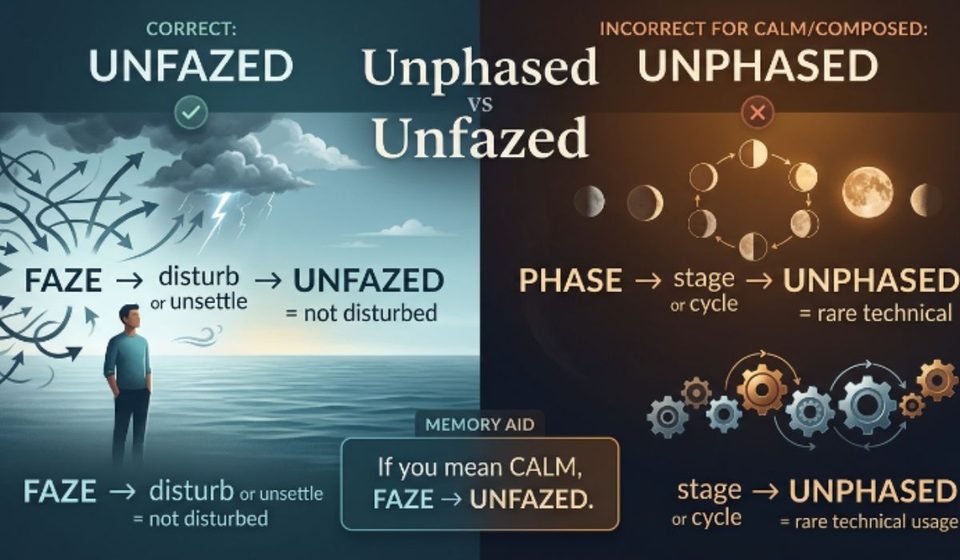
Here’s the short version: “unfazed” is the standard, correct spelling when you mean “not disturbed, not worried, not surprised.” “Unphased” is, in almost every everyday sentence, a mistake.
| Spelling | Status | Typical meaning |
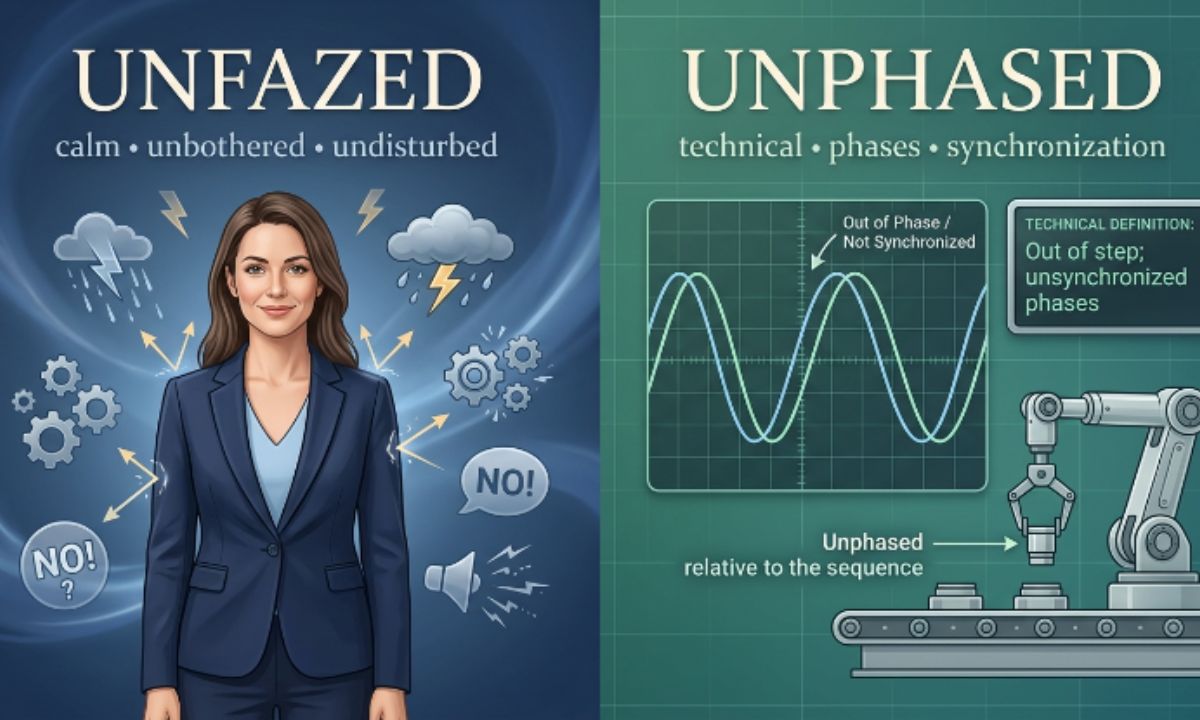
| Unfazed | Correct, standard | Calm, undisturbed, unbothered |
| Unphased | Usually incorrect | Rare/technical: not divided into stages, not out of phase |
If you’re describing someone who stayed calm under pressure, kept their cool during criticism, or didn’t flinch at bad news, you want unfazed. Every major dictionary agrees on this. There’s no US vs UK split here either — American and British English both use “unfazed” for this meaning.
Unphased isn’t pure fiction, though. It shows up occasionally in technical writing, where it means something completely different. That distinction is the whole key to understanding this word pair.
What Do Unfazed and Unphased Actually Mean?
Unfazed: not disturbed or worried
Unfazed comes from the verb “faze,” meaning to disturb, upset, or unsettle someone. Add the prefix “un-” and the past-tense “-d,” and you get a word describing someone who remained calm despite something that could have rattled them.
Key traits of unfazed:
Describes a person’s reaction, not the event itself.
Usually follows linking verbs: be, seem, appear, remain, and look.
Almost always paired with the preposition “by” — unfazed by criticism, unfazed by the news.
Doesn’t necessarily mean someone felt nothing internally — it means they didn’t show disturbance.
Typical situations where unfazed fits naturally:
- Criticism or harsh feedback
- Unexpected problems or sudden changes
- Difficult questions in an interview
- Pressure during competition
- Bad news or a stressful event
Unphased: not divided into phases (rare, technical)
Unphased connects to the noun/verb phase — a stage, period, or cycle. In its rare legitimate use, “unphased” describes something that wasn’t broken into stages, or, in physics and engineering, something that isn’t “out of phase” relative to a wave or signal.
Examples of this narrow, technical usage:
- “The company chose an unphased rollout rather than introducing changes gradually.”
- “The signal remained unphased as it passed through the circuit.”
This is a completely different concept from emotional composure. If you’re not writing about implementation stages, wave synchronization, or electrical signals, you almost certainly don’t need “unphased” at all.
Why the Confusion Happens
Faze vs. phase: same sound, different job
This mix-up isn’t really about spelling carelessness — it’s about two words that sound identical but come from separate roots:
Faze (verb): to disturb or unsettle. Example: “Nothing seems to faze him.”
Phase (noun/verb): a stage in a process or a position in a cycle. Example: “The project entered its final phase.”
Because they’re pronounced the same way — both roughly “fayz” — your ears give you zero help when deciding which spelling to use.
Why “unphased” feels like the obvious choice
There’s a simple reason so many people default to “unphased”:
Phase is a common, everyday word — used in business (“phased rollout”), tech, and school.
Faze is comparatively rare. Most people rarely use it outside this exact expression.
“Unphased” looks like a logical opposite of “phased,” so it feels intuitively correct.
Seeing the misspelling repeatedly — in social posts, casual writing, and even some published articles — normalizes it over time.
Spellcheckers don’t always flag it, since “unphased” is a technically valid word in the dictionary, just not for this meaning.
None of that makes it correct for describing composure. It just explains why the error is so persistent.
How to Use Unfazed Correctly
Common sentence patterns
Unfazed typically slots into one of these structures:
Subject + be + unfazed + by + noun → “She was unfazed by the delay.”
Subject + remain + unfazed → “He remained unfazed.”
Subject + seem/look/appear + unfazed → “The manager looked unfazed.”
Examples across everyday situations
“She stayed unfazed while the journalists fired difficult questions at her.”
“He looked unfazed after his flight got cancelled.”
“The goalkeeper remained unfazed after conceding an early goal.”
“Despite the technical glitch, the presenter seemed completely unfazed.”
“The new employee was unfazed by her first tough client call.”
Unfazed in professional and academic writing
Unfazed works well in business and academic contexts, describing composure under pressure:
- “The negotiator remained unfazed throughout the tense discussions.”
- “The researcher stayed unfazed despite pushback from peer reviewers.”
In a very formal or academic tone, you might occasionally swap it for “unaffected,” “undisturbed,” or “unperturbed”—these carry a slightly more clinical register, while “unfazed” feels a touch more conversational.
When (If Ever) Is Unphased Acceptable?
There are a few narrow lanes where “unphased” earns its place:
- Project and rollout descriptions. “The team implemented an unphased launch, releasing every feature at once instead of gradually.”
- Physics and engineering. Describing signals, waves, or systems that remain synchronized or aren’t split into stages.
- Names, titles, and brands. A band name, a product title, or a username spelled “Unphased” is a stylistic choice, not a grammar error — proper nouns don’t follow the same rule.
Outside those specific cases, if your sentence is about someone’s emotional reaction, “unphased” is the wrong word — full stop.
Explore More Grammar Guide
Time Flies or Time Flys: Which Spelling Is Correct?
Thier or Their: Which Spelling Is Correct?
Puting vs Putting: Which Spelling Is Actually Correct?
Synonyms and Antonyms of Unfazed
Synonyms (with subtle differences)
Calm — a general state of peace, not specific to a triggering event
Composed — emphasizes self-control and outward control of emotion
Unbothered — more casual, can hint at mild indifference
Unaffected — broader; can describe objects and systems, not just people
Unconcerned — focuses on lack of worry, sometimes implies not caring
Undisturbed — close synonym, slightly more formal
Unperturbed — formal, precise synonym often used in writing
Antonyms
- Direct opposite: fazed
- Others: worried, disturbed, unsettled, shaken, anxious, nervous, rattled, perturbed
Pronunciation and Spelling Tips
How to pronounce unfazed
- IPA: /ʌnˈfeɪzd/
- Sounds like: un-FAYZD
- Two syllables, with stress on “fazed”
Since faze and phase are pronounced identically, sounding the word out won’t help you spell it. You need to rely on meaning instead.
Simple memory tricks
“Faze” means “disturb,” so “unfazed” means “not disturbed.”
“Phase” means a stage, so “unphased” means not staged.
Quick substitution test: try swapping the word for “unbothered.” If the sentence still makes sense, you need to be unfazed.
Second test: try swapping it for “not carried out in stages. If that fits your sentence better, you might legitimately want unphased — though this will apply to very few everyday sentences.
Unfazed vs Similar Words
It helps to see how “unfazed” compares with near-synonyms, since they’re not perfectly interchangeable.
| Word | Best used for | Example |
| Unfazed | Reaction to a specific disturbing event | “She was unfazed by the criticism.” |
| Unbothered | Casual indifference, sometimes dismissive | “He’s unbothered by other people’s opinions.” |
| Unaffected | Broader — people, objects, or systems | “The bridge was unaffected by the storm.” |
| Composed | Self-control, especially visible behavior | “She remained composed during the crisis.” |
| Unconcerned | Lack of worry; can suggest apathy. | “He seemed unconcerned about the deadline.” |
Common Mistakes and How to Avoid Them
Writing “unphased” when you mean “unfazed.” This is the single most frequent error — almost always caused by “phase” being more familiar than faze.
Assuming both spellings are interchangeable, like color/colour. They’re not. They mean different things entirely.
Trusting autocorrect or spellcheck to catch it. Since “unphased” is a real word in its technical sense, most spellcheckers won’t flag it.
Copying the error from something you read. Published writing — even reputable outlets — occasionally gets this wrong, which reinforces the mistake for readers.
Overthinking the etymology. You don’t need a physics background to use this word correctly. If you’re talking about someone’s emotional reaction, the answer is always unfazed.
A quick editorial habit: whenever you type “unphased,” pause and ask whether you’re talking about a person’s composure or a technical process. Ninety-nine times out of a hundred, you’ll need to change it to “unfazed.”
Frequently Asked Questions
Is “unphased” a real word?
Yes, but only in a narrow technical sense related to stages or wave synchronization — not for describing calm or composure.
What is the difference between “phase” and “faze”?
“Faze” means to disturb or unsettle someone, while “phase” refers to a stage or period in a process.
How do you use “unfazed” in a sentence?
Pair it with “by” and a linking verb, as in “She remained unfazed by the unexpected setback.”
Is there a US vs UK difference in spelling?
No — both American and British English use “unfazed” identically for this meaning.
Which is more common: “unfazed” or “unphased”?
“Unfazed” is far more common and is the only correct choice for describing someone who stayed calm or undisturbed.
Conclusion
“Unfazed” is the word you want almost every time you’re describing someone who kept their cool, brushed off criticism, or stayed calm under pressure, while “unphased” should be reserved for the rare technical case of something not divided into stages or not out of phase — and once you remember that “faze” means “to disturb” while “phase” means “a stage,” the correct choice becomes automatic, no matter how often the wrong version shows up in what you read.


[…] Unphased vs Unfazed: Which Spelling Is Correct? […]
[…] Unphased vs Unfazed: Which Spelling Is Correct? […]