

Ever typed a word so fast that a letter just vanished? That’s exactly what happens with this one. One version shows up constantly in casual writing. Only one of them is actually real. Here’s how to stop guessing for good.
Quick Answer: Putting Is Correct
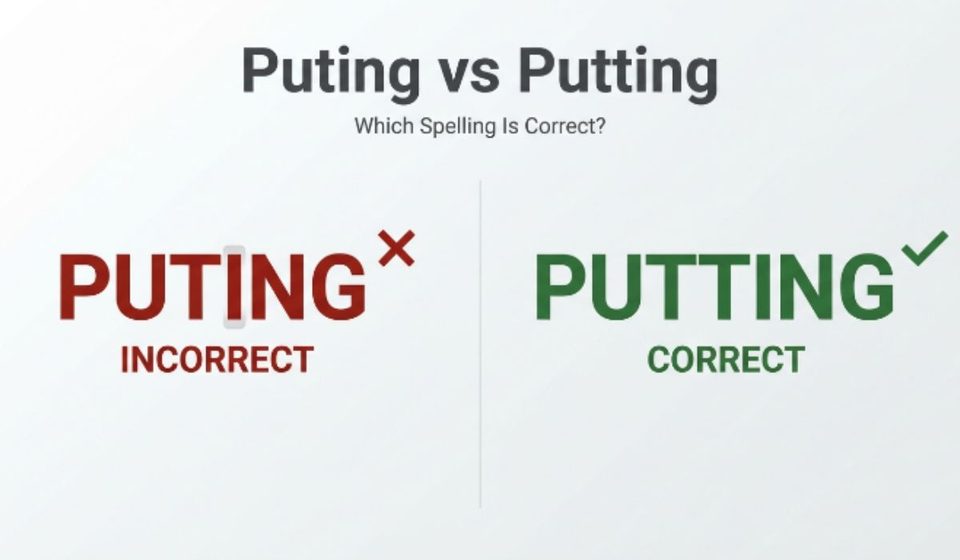
Putting is the correct spelling. Puting is not a real word. It’s a common typo that happens when someone adds “-ing” to “put” without doubling the final letter.
| Form | Status | Notes |
| Putting | Correct | Standard spelling in all contexts |
| Puting | Incorrect | Common misspelling, not a word |
If you remember nothing else from this page, remember that: two t’s, always.
Why Putting Has Two T’s
This isn’t a random spelling quirk. It follows a pattern English uses a lot, and once you see it, you’ll notice it everywhere.
The Base Word: Put
"Put" is a short, simple verb. It means to place, position, or move something somewhere. On its own, it's spelled with one t: p-u-t.
The confusion starts when you add “-ing” to turn it into “putting.” That’s where a spelling rule kicks in that a lot of people never learned explicitly, even if they use it correctly by instinct.
The One-Syllable Doubling Rule
Here’s the pattern in plain terms:
- Take a short verb with one syllable.
- Check if it ends in a single vowel followed by a single consonant.
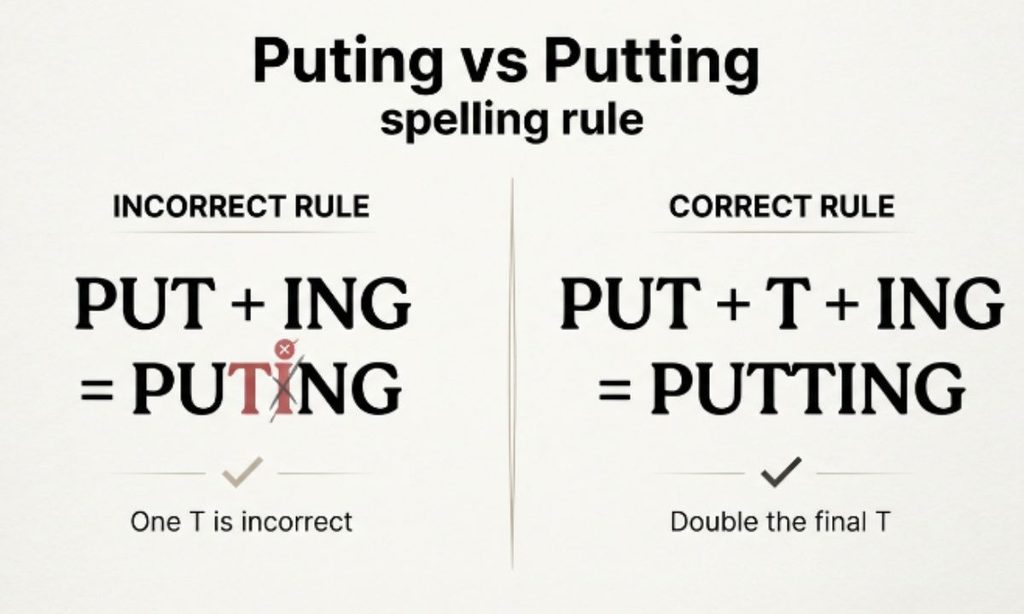
- If it does, double that final consonant before adding “-ing,” “-ed,” or similar endings.
“Put” fits this pattern exactly:
- P is a consonant.
- U is a vowel.
- T is a consonant.
That vowel-consonant ending means the final letter doubles. So “put” becomes “putting,” not “puting.”
You’ll see the same thing happen with other short verbs:
- Run becomes running, not runing.
- Sit becomes sitting, not siting.
- Cut becomes cutting, not cuting.
- Stop becomes stopping, not stoping.
Why the Doubling Matters for Pronunciation
The doubled consonant isn’t just decorative. It changes how the word sounds.
Without doubling, English readers tend to read a single consonant between two vowels as a signal that the first vowel is long. Think of a word like “hoping,” which comes from “hope” and carries a long O sound.
Double the consonant, and the first vowel stays short instead. That’s why “putting” keeps the short U sound from “put,” while a hypothetical “puting” would visually suggest a completely different, incorrect pronunciation.
So the second t isn’t extra. It’s doing real work.
Where the Rule Gets Tricky
Not every short verb doubles its final consonant, and that’s worth knowing before you assume the rule is universal.
Verbs ending in two consonants, like “help,” don’t double: it’s “helping,” not “helpping.” Verbs ending in a vowel-vowel-consonant pattern, like “read,” also don’t double: it’s “reading,” not “readding.”
The doubling rule specifically applies to short verbs ending in a single vowel plus a single consonant, with the stress landing on that final syllable. “Put” checks every box, which is exactly why it doubles.
What Does Putting Actually Mean?
“Putting” isn’t a one-meaning word. It shifts depending on context, and that’s part of why people search for it so often.
Putting as Placement or Movement
The most common use of "putting" describes moving something into a position or location. It's the present participle of "put," meaning the "-ing" form used with helping verbs like "is," "was," or "are."
Examples:
- She is putting the dishes away.
- He was putting his shoes on when the phone rang.
- They are putting the boxes in the garage.
- I’m putting my keys right here so I don’t lose them again.
Putting as Applying Effort
“Putting” also shows up in phrases about effort, energy, or commitment.
Examples:
- He’s putting a lot of work into this presentation.
- She’s putting her heart into the project.
- We’re putting extra time into training this quarter.
Putting in Common Idioms and Phrases
English uses “putting” inside several everyday expressions that don’t translate literally.
Putting someone on: joking with them or teasing them.
Putting something off: delaying or postponing it.
Putting up with something: tolerating a difficult situation.
Putting something away: saving it, often used with money.
Example: “Are you putting me on right now?” has nothing to do with placement. It means someone suspects they’re being teased.
Putting in Golf: A Completely Different Word Underneath
Here’s where things get genuinely interesting, and where a lot of quick spelling guides stop short.
Golf's "putting" looks identical to the placement version, but it comes from an entirely different root word: "putt," not "put."
What Is a Putt?
A putt is a short, gentle golf stroke used to roll the ball across the green and into the hole. “Putt” traces back to a Scottish word meaning “to shove,” used since at least the 1500s.
Add “-ing” to “putt,” and you get “putting,” following the exact same doubling logic as “put.” Since “putt” already ends in a doubled t, the “-ing” form simply keeps both.
Putting vs Putting: Same Spelling, Different Word
This is technically a case of two different words landing on the same written form. Linguists call this either a homograph (same spelling, different meaning) or, more precisely here, a heteronym (same spelling, different pronunciation and meaning).
| Version | Comes From | Meaning | Sound Pattern |
| Putting | Put | Placing or moving something | Short U, like “foot” |
| Putting | Putt | Golf stroke toward the hole | Short U, like “cut” |
The spelling is identical either way. Only context and pronunciation tell you which one you’re dealing with.
Golf Examples
- Her putting has improved a lot this season.
- He struggled with putting under pressure.
- The course has three practice putting greens.
- A confident putt from ten feet won them the match.
Putting as a Gerund vs a Present Participle
This is a distinction that often gets skipped, but it’s genuinely useful for writing clearly.
Present participle: “putting” paired with a form of “be,” describing an ongoing action. Example: “She is putting the mail on the table.”
Gerund: “putting” acting as a noun by itself. Example: “Putting requires patience and a steady hand,” where “putting” is the subject of the sentence.
Same word, same spelling, two different grammatical jobs. Recognizing which one you’re using isn’t necessary for spelling correctly, but it helps if you’re trying to fix awkward sentence structure.
Related Forms of “Put”
Knowing the full family of related words makes the spelling stick better.
| Word | Form |
| Put | Base verb |
| Puts | Third-person singular present |
| Putting | Present participle/gerund |
| Put | Past tense |
| Put | Past participle |
Notice something unusual there: “put” is an irregular verb. Its past tense and past participle don’t change at all. Unlike “walk” becoming “walked,” “put” stays exactly “put” no matter the tense.
- Today, I put the mail on the table.
- Yesterday, I put the mail on the table.
- I have put the mail on the table every day this week.
Same spelling, three different tenses. That’s part of why “putting” trips people up. There’s no obvious past-tense pattern to lean on for comparison.
Correct and Incorrect Examples Side by Side
Seeing both versions next to each other tends to lock the correct spelling in faster than any rule explanation.
| Incorrect | Correct |
| I am puting my clothes away. | I am putting my clothes away. |
| She’s puting effort into it. | She’s putting effort into it. |
| He was puting the boxes down. | He was putting the boxes down. |
| They’re puting money aside. | They’re putting money aside. |
| His puting needs work. | His putting needs work. |
A Simple Way to Remember the Rule
If the CVC explanation feels like too much to hold onto in the moment, try this shortcut instead: picture “run,” “sit,” and “cut.”
All three are short, one-syllable action words. All three double their last letter before “-ing.” “Put” behaves the same way. If you can spell “running” and “cutting” correctly without thinking twice, you already know the rule for “putting,” even if you’ve never named it.
Frequently Asked Questions
Is it puting or putting?
Putting is correct; puting is a common misspelling with no standard use in English.
Why does putting have two t’s?
Short verbs ending in a single vowel plus a single consonant, like “put,” double that consonant before adding “-ing.”
Is putting a gerund or a present participle?
It can be either, depending on whether it functions as a noun (gerund) or pairs with “is/was/are” to describe an action (present participle).
What is the past tense of put?
The past tense of put is put, since put is an irregular verb that doesn’t change across tenses.
Is golf putting pronounced differently from regular putting?
Yes, golf’s putting (from “putt”) and everyday putting (from “put”) are spelled the same but often pronounced with slightly different vowel sounds depending on regional accent.
Conclusion
The spelling question here has a short, firm answer: putting, always with two t’s, whether you’re talking about moving a coffee cup across a table or lining up a golf shot on the green. The one-t version isn’t a stylistic choice or a regional variation.
It’s simply a typo that skips a basic English doubling rule, one shared by dozens of other everyday verbs like running, sitting, and cutting. Once that rule clicks, the correct spelling stops being something you have to look up and starts being something you just know.



[…] Puting vs Putting: Which Spelling Is Actually Correct? […]
[…] Puting vs Putting: Which Spelling Is Actually Correct? […]