
You’ve probably typed this word a thousand times without a second thought. Then autocorrect flags it, or you catch yourself hesitating mid-sentence, and suddenly you’re not sure which letters go where. It’s one of the most commonly misspelled words in English, and the mix-up has a clear explanation. Here’s exactly why “their” is correct and “thier” never is.
Is “Thier” a Word?
No. “Thier” has no meaning in standard English. It’s not in any dictionary, and it doesn’t function as a noun, verb, or anything else.
Here’s the quick comparison:
| Form | Status |
| Their | Correct (possessive form of “they”) |
| Thier | Incorrect (misspelling, no meaning) |
You might occasionally see “Thier” as a surname or as part of a brand or username, since names don’t follow standard spelling rules. But in regular writing, whether it’s an email, an essay, or a text message, “thier” is always a mistake. There’s no context in everyday English where it’s the word you want.
What Does “Their” Mean?
“Their” is a possessive word. It shows that something belongs to, relates to, or was done by a group of people (or, in modern usage, a single person).
Grammatically, it’s classified as a possessive determiner when it comes before a noun, like in “their car.” Some older grammar books call it a possessive adjective or possessive pronoun, but “possessive determiner” is the clearest label for how it actually works in a sentence.
Their Shows Ownership
This is the most familiar use. “Their” tells you something belongs to a specific group.
- “Their house is at the end of the street.”
- “That’s their car in the driveway.”
- “Their dog barks every morning.”
Their Shows Association
Ownership isn’t always literal. “Their” also connects people to things they’re linked with, even without legal possession.
- “Their team won the championship.”
- “Their idea changed the whole project.”
- “Their manager approved the request.”
Singular “Their”
This is where a lot of people get tripped up, but it’s completely standard. “Their” can refer to one person when:
- The person’s gender is unknown
- The person doesn’t identify as strictly male or female
- You want to avoid awkward phrasing like “he or she”
Examples:
- “Everyone should bring their own lunch.”
- “Someone left their phone on the table.”
- “Each employee should submit their report by Friday.”
This usage isn’t new slang. Singular “they” and “their” have been used in English for centuries, and every major style guide today accepts it, including in formal and academic writing.
Why Is “Their” Spelled E Before I?
This is really the heart of the confusion, so it’s worth breaking down properly.
Most people learn the rhyme “i before e, except after c” in school. It works for words like “believe” and “receive.” The problem is that it doesn’t apply to nearly as many words as people think, and “their” is one of the clearest exceptions.
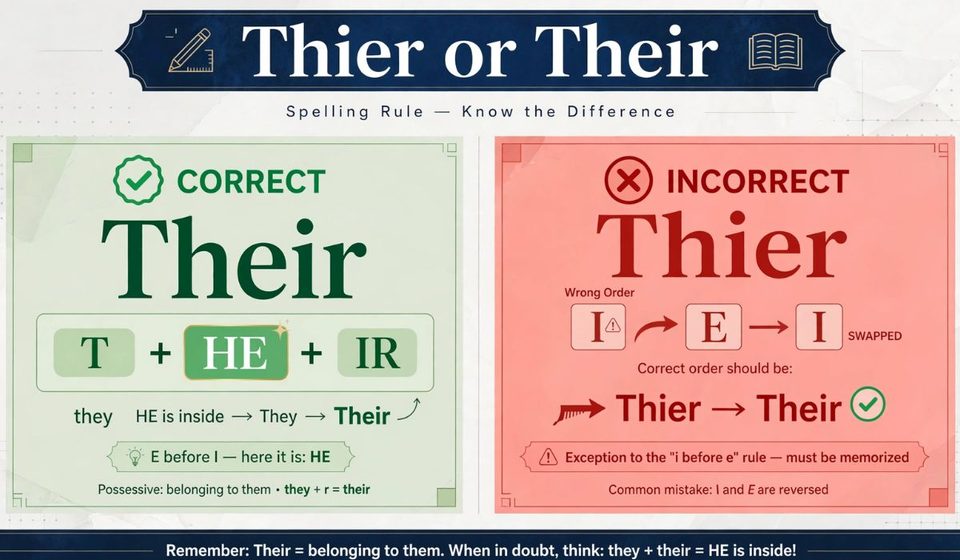
There’s no consonant-based rule that explains why “their” uses E before I. It’s simply how the word is spelled, and the best approach is to memorize it directly rather than force it into a rule that doesn’t fit.
A few ways to lock it in:
- The “he” trick: “Their” contains the word “he” right in the middle (t-he-ir). If you can spell “he,” you’re halfway there.
- The “heir” connection: “Their” looks and sounds are similar to “heir,” a word about inheriting or receiving something. Both ideas involve possession, which makes the link easier to remember.
- Build it from “they”: Start with “they,” drop the Y, and add “ir.” That gives you t-h-e-i-r, keeping the E before the I.
Any of these should be enough to stop the letters from flipping in your head.
Their vs. Thier: Examples in Context
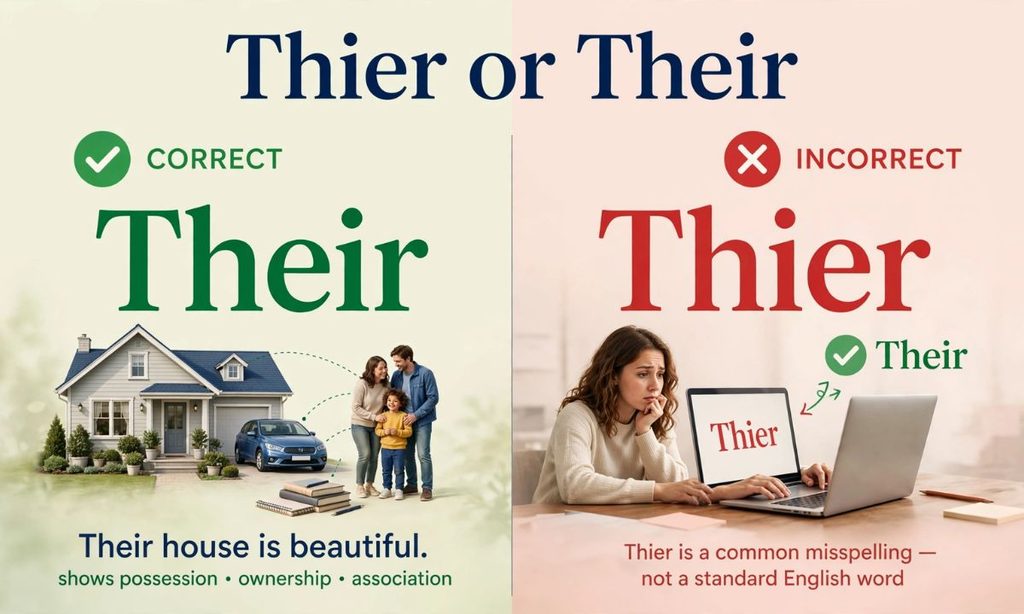
Seeing the mistake next to the correct version helps more than any rule. Here are common sentence patterns where the error shows up, corrected:
| Incorrect | Correct |
| I like thier new car. | I like their new car. |
| The students submitted thier work late. | The students submitted their work late. |
| Do you know thier address? | Do you know their address? |
| Thier dog is very friendly. | Their dog is very friendly. |
| We visited thier office last week. | We visited their office last week. |
The mistake tends to show up more in fast, casual writing, texts, chat messages, and quick emails, where there’s less time to double-check spelling. It’s rare in edited, published writing because proofreading and spell-check tools catch it almost every time.
Explore More Grammar Guide
Time Flies or Time Flys: Which Spelling Is Correct?
Take Effect or Take Affect? The Correct Phrase, Explained
Puting vs Putting: Which Spelling Is Actually Correct?
Their vs. There vs. They’re
These three words sound the same, which is exactly why they get mixed up so often. Pronunciation gives you zero clues here. You have to rely on meaning and grammar instead.
Their
Possession or association. Always followed by a noun.
- “Their flight leaves at noon.”
There
A place, direction, or a word used to introduce a sentence.
- “Put the boxes over there.”
- “There is no parking available.”
They’re
A contraction of “they are.” Always has an apostrophe.
- “They’re arriving tomorrow morning.”
Quick Substitution Test
If you’re stuck, try replacing the word with “they are.” If the sentence still makes sense, you need “they’re.”
“They’re late” → “They are late.” (Works, so “they’re” is correct.)
“Their late” → “They are late.” (Doesn’t work, so “their” is wrong here.)
This one test resolves most mix-ups instantly.
Their vs. Theirs
“Their” and “theirs” are related but used differently, and this distinction gets skipped over more than it should.
“Their” comes directly before a noun. “That is their house.”
“Theirs” stands completely on its own, with no noun after it. “That house is theirs.”
A mistake worth flagging separately: “their’s” is never correct. Unlike “it’s” (a contraction of “it is”), “theirs” never takes an apostrophe. It’s a standalone possessive pronoun, similar to “hers,” “his,” and “ours,” none of which use an apostrophe either.
| Subject | Before a noun | Standing alone |
| I | My | Mine |
| You | Your | Yours |
| He | His | His |
| She | Her | Hers |
| It | Its | Its |
| We | Our | Ours |
| They | Their | Theirs |
Notice the pattern across the whole list. None of the standalone forms use an apostrophe, and that includes “theirs.”
Why Do People Misspell “Their” So Often?
A few things make this particular word a repeat offender:
It’s a homophone with two other extremely common words (“there” and “they’re”), so the brain sometimes grabs the wrong spelling out of habit.
The “i before e” rule gets applied automatically, even though “their” doesn’t follow it.
Fast typing and texting leave less room for double-checking spelling.
Autocorrect doesn’t always catch “thier,” since some keyboards will accept it as a possible word or typo without flagging it clearly.
None of this means the mistake reflects poorly on someone’s writing ability. It’s genuinely one of the most common typos in English, largely because the word breaks a rule most people were taught to trust.
Is “Their” Formal or Informal?
“Their” works in every register of English. You’ll find it in legal documents, medical records, academic papers, casual texts, and everyday conversation without any restriction. It’s a core grammatical word, not slang or casual shorthand, so there’s no setting where you need to avoid it or replace it. The only version to avoid, in any context, is “thier.”
A Quick Proofreading Checklist
Before you send an email or publish something, run through this in your head if you’re unsure:
Does the word show ownership or connection to a group or person? Use “their.”
Does the word refer to a place, or could you say “it is” or “there is” in front of it? Use “there.”
Can you replace the word with “they are” and keep the sentence intact? Use “they’re.”
Is the word standing completely alone with no noun after it, and does it show possession? Use “theirs,” never “their’s.”
Running through these four questions takes a few seconds and clears up almost every mix-up.
Frequently Asked Questions
Is “thier” a real word?
No, “thier” has no meaning in standard English and is always a misspelling of “their.”
Is “their” a possessive pronoun?
“Their” is more precisely a possessive determiner, since it comes before a noun, while “theirs” is the standalone possessive pronoun.
Can “their” refer to one person?
Yes, singular “their” is standard and widely accepted when gender is unknown or unspecified.
What’s the difference between “their” and “there”?
“Their” shows possession or connection, while “there” refers to a place or introduces a sentence like “there is.”
Is “there’s” correct?
No, “theirs” never takes an apostrophe, unlike contractions such as “it’s” or “they’re.”
Conclusion
“Their” is the only correct spelling, and “thier” carries no meaning in standard English no matter how it’s used. The confusion mostly comes down to the unreliable “i before e” rule and the fact that “their,” “there,” and “they’re” all sound identical despite doing completely different jobs in a sentence.
Once you separate the three by meaning rather than sound- possession for “their,” place for “there,” and “they are” for “they’re,” the spelling stops being a guessing game, and a quick trick like spotting “he” inside “their” will keep the letters in the right order every time.