
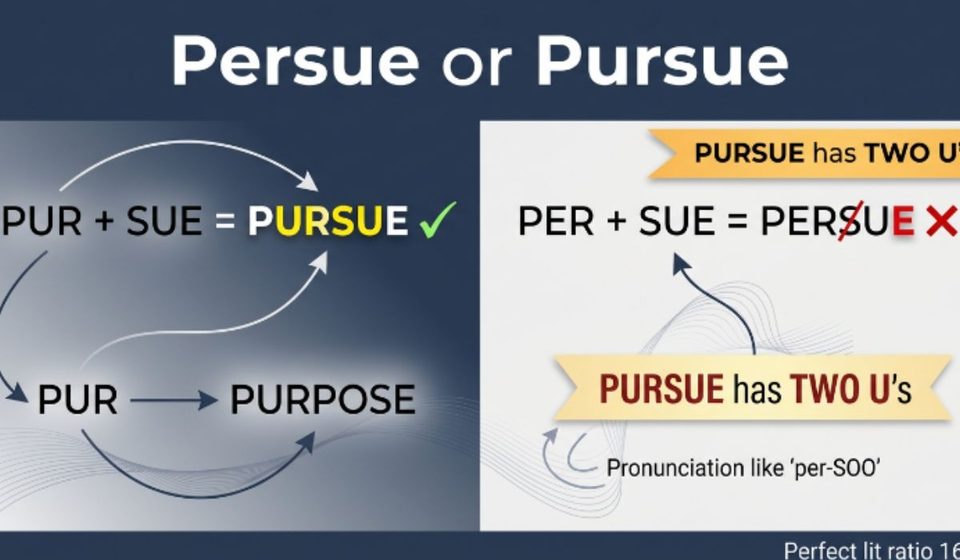

You know the word. You’ve probably said it out loud a hundred times. But the moment you go to type it, something feels off. Is it “persue” or “pursue”? This tiny spelling decision trips up more writers than you’d expect, and the reason comes down to how the word sounds versus how it’s actually built.
Is It Persue or Pursue?
The correct spelling is pursue. “Persue” is a misspelling in modern English. It’s not a regional variant, not an accepted alternative, and not something you’ll find in a current dictionary as standard usage.
Quick reference:
Correct: pursue
Incorrect: persue
Meaning: to follow, chase, seek, or work toward something
| Form | Correct Spelling | Incorrect Spelling |
| Base verb | Pursue | Persue |
| Present participle | Pursuing | Persuing |
| Past tense | Pursued | Persued |
| Noun (person) | Pursuer | Persuer |
| Noun (act) | Pursuit | Persuit |
Why Do People Spell Pursue as Persue?
This mistake almost always comes down to sound, not logic.
Pronunciation Is the Culprit
Say the word out loud. The first syllable comes out sounding like “per,” not “pur.” That’s because English often reduces unstressed vowels in casual speech, a phenomenon linguists call vowel reduction. The result is that “pursue” sounds close to “per-SOO,” even though it’s spelled with a u.
English Spelling Doesn’t Always Match Pronunciation
This isn’t unique to pursue. English is full of words where the way something sounds and the way it’s spelled don’t line up perfectly. If you relied purely on sound, you’d misspell dozens of common words. Pursue just happens to be one of the more frequent offenders because it shows up so often in career, education, and goal-related writing.
A Simple Memory Trick
Here’s an easy way to lock it in:
Think of the word as “pur + sue,” not “per + sue.”
Notice that “pursue” has two “u”s, one right after the “p” and one before the “e.”
Picture yourself “pursuing” something with purpose, and remember that “pur” looks like the start of “purpose.”
Once that visual sticks, you won’t second-guess it again.
What Does “Pursue” Actually Mean?
“Pursue” carries more weight than a simple word like “follow.” It implies effort, direction, and intent. There are two broad ways it’s used: literally and figuratively.
Literal Meaning: To Chase or Follow
This is the original, physical sense of the word.
- “The police pursued the stolen vehicle for several miles.”
- “The dog pursued the squirrel across the yard.”
- “Guards pursued the escaped prisoner through the woods.”
Figurative Meaning: To Seek or Work Toward
This is the more common use in everyday and professional writing.
“She pursued a career in nursing.”
“He is pursuing a degree in engineering.”
“The company pursued a new expansion strategy.”
“They pursued the matter until it was fully resolved.”
American vs British English
Pursue is spelled the same in American English and British English. The meaning, grammar, and common word forms are also essentially the same in both varieties.
| Feature | American English | British English |
|---|---|---|
| Base form | Pursue | Pursue |
| Present participle | Pursuing | Pursuing |
| Past tense | Pursued | Pursued |
| Noun form | Pursuit | Pursuit |
| Incorrect variant | Persue | Persue |
| Main meaning | Follow, seek, or work toward | Follow, seek, or work toward |
Spelling
There is no American-British spelling difference:
- American English: pursue
- British English: pursue
The spelling persue is not the standard form in either variety.
Pronunciation
The pronunciation may vary slightly by accent:
- American English: commonly approximately per-SOO.
- British English: commonly approximately per-SYOO or per-SOO.
Despite differences in accent, both varieties use the spelling pursue.
Usage Differences
The word is used in similar contexts in both forms of English:
- “She is pursuing a degree.”
- “The police pursued the vehicle.”
- “He pursued a career in finance.”
- “They pursued legal action.”
British English may use claimant more often in some legal contexts, while American English commonly uses plaintiff, but this does not change the spelling or meaning of pursue.
Related Forms in Both Varieties
- Pursue.
- Pursues.
- Pursuing.
- Pursued.
- Pursuit.
- Pursuer.
Examples:
- “The company pursues new opportunities.”
- “She is pursuing her goals.”
- “They pursued the matter further.”
- “His pursuit of knowledge continued.”
Important Difference from “Peruse”
The American and British spellings of pursue are identical, but pursue and peruse have different meanings:
- Pursue: Follow, seek, or work toward something.
- Peruse: Read or examine something carefully.
Examples:
- “She pursued a career in medicine.”
- “She perused the medical report.”
A person pursues a goal but peruses a document.
Pursue in Everyday Contexts

Pursue shows up across a wide range of situations. Here’s how it plays out in different areas of life.
| Context | Meaning | Example |
| Career | Work toward a profession | “He pursued a career in law.” |
| Education | Study toward a qualification | “She is pursuing a master’s degree.” |
| Goals | Work toward an ambition | “They pursued their long-term goals.” |
| Legal | Continue a case or claim | “The firm pursued legal action.” |
| Business | Continue a strategy or deal | “The company pursued new markets.” |
| Research | Investigate further | “The scientist pursued new evidence.” |
| Relationships | Try to build a connection | “He pursued her for months before asking her out.” |
| Law enforcement | Chase a suspect | “Officers pursued the suspect on foot.” |
| Hobbies | Engage in an interest | “She pursues painting in her free time.” |
Grammar Forms of Pursue
Here’s the full breakdown so you can use the word correctly no matter the tense.
| Form | Grammar Role | Example |
| Pursue | Base verb | “They plan to pursue new opportunities.” |
| Pursues | Present tense, third person | “She pursues every lead carefully.” |
| Pursuing | Present participle / gerund | “He is pursuing a promotion.” |
| Pursued | Past tense / past participle | “They pursued the case for years.” |
| Pursuer | Noun (person who pursues) | “The pursuer gave up after an hour.” |
| Pursuit | Noun (the act itself) | “The pursuit ended in a dead end street.” |
Is “Pursue To” Correct?
This one catches a lot of writers off guard. Saying “she pursued to become a doctor” sounds clunky, and most style guides would flag it. “Pursue” works better paired with a noun than with a to-infinitive.
Better options:
- “She pursued a career as a doctor.”
- “She pursued her goal of becoming a doctor.”
- “She worked to become a doctor.”
Stick to pursuing a noun phrase, and your sentence will read more naturally.
Pursue Versus Peruse: A Mix-Up Worth Knowing
This is one of the most overlooked confusions tied to this word, and it’s worth calling out clearly because the two words don’t mean anything alike.
“Pursue” means to follow, chase, or work toward something.
“Peruse” means to read or examine something, often closely.
Compare these two sentences:
- “She pursued a new job opportunity.” (She went after it.)
- “She perused the job listing.” (She read it carefully.)
A simple way to keep them straight: you pursue a goal, but you peruse a document. If the sentence involves reading, scanning, or reviewing, “peruse” is the word you want. If it involves chasing, seeking, or working toward something, pursue is correct.
Explore More Grammar Guide
Unphased vs Unfazed: Which Spelling Is Correct?
Thier or Their: Which Spelling Is Correct?
Puting vs Putting: Which Spelling Is Actually Correct?
Pursue Compared to Similar Words
English has several words that overlap with “pursue” but carry slightly different shades of meaning. Getting these right can sharpen your writing.
| Word | Tone | Best Used For |
| Pursue | Formal, deliberate | Long-term goals, careers, legal matters |
| Follow | Neutral, broad | Directions, instructions, general tracking |
| Chase | Informal, physical | Literal running after someone or something |
| Seek | Formal, exploratory | Trying to find or obtain something |
| Aim for | Conversational | Everyday goal-setting |
| Proceed | Formal, procedural | Continuing with a plan or process |
Notice that “pursue” almost always signals intention and sustained effort. Someone who pursues a goal isn’t just casually interested; they’re actively working toward it over time.
How to Pronounce Pursue
“Pursue” is typically pronounced per-SOO, with the stress on the second syllable. In some dialects, especially British English, the ending can sound closer to “per-SYOO.”
Here’s the key point: even though the first syllable sounds like “per,” the correct spelling still uses “pur.” Pronunciation is the reason for the mistake, not an excuse for it. Once you separate how the word sounds from how it’s spelled, the error becomes much easier to avoid.
Synonyms of “Pursue”
The best synonym for pursue depends on the context. When it means physically following someone, words such as chase, follow, and track work well. When it refers to achieving a goal, synonyms such as seek, work toward, strive for, and aim for are more natural.
| Context | Synonyms | Example |
|---|---|---|
| Follow or chase | Chase, follow, track, hunt, run after | “The police pursued the suspect.” |
| Try to achieve | Seek, aim for, strive for, work toward, aspire to | “She pursued her dream.” |
| Continue an activity | Continue, undertake, engage in, follow, carry on with | “They pursued the investigation.” |
| Seek information | Investigate, explore, research, examine, look into | “The journalist pursued the story.” |
| Seek an opportunity | Explore, seek, go after, target, pursue | “He pursued a new job opportunity.” |
| Pursue a relationship | Court, woo, date, seek, develop | “He pursued a romantic relationship.” |
| Pursue legal action | File, bring, initiate, continue, seek | “The company pursued legal action.” |
| Pursue a course or route | Follow, take, continue, travel along | “The ship pursued a northern route.” |
Common Synonyms
- Chase: To follow someone or something quickly in order to catch it.
- Follow: To go behind or after someone or something.
- Seek: To try to find, obtain, or achieve something.
- Strive for: To make a serious and continuous effort to achieve something.
- Aim for: To direct effort toward a specific result.
- Work toward: To gradually make progress toward a goal.
- Aspire to: To strongly hope or plan to achieve something, usually something ambitious.
- Investigate: To examine something carefully to discover facts.
- Continue: To keep doing or developing an activity.
- Go after: An informal expression meaning to try to obtain or achieve something.
Pursue in Physical Situations
When pursue describes a physical chase, the closest alternatives are:
- Chase.
- Follow.
- Track.
- Hunt.
- Run after.
- Go after.
- Trail.
For example:
- “The dog pursued the rabbit.”
- “The dog chased the rabbit.”
- “The officers tracked the suspect.”
- “The guard followed the intruder.”
However, pursue often sounds more formal than chase or run after.
Pursue in Goal-Related Situations
When pursue refers to an ambition, plan, or objective, suitable synonyms include:
- Seek.
- Strive for.
- Aim for.
- Work toward.
- Aspire to.
- Go after.
- Try to achieve.
- Endeavor to accomplish.
Examples:
- “She pursued a career in medicine.”
- “She worked toward a career in medicine.”
- “He pursued his ambition.”
- “He strived to achieve his ambition.”
- “They pursued a business opportunity.”
- “They sought a business opportunity.”
Pursue in Academic and Career Contexts
In education and professional writing, these alternatives may be appropriate:
- Study.
- Work toward.
- Seek.
- Aim for.
- Train for.
- Develop.
- Prepare for.
- Aspire to.
Examples:
- “He is pursuing a master’s degree.”
- “He is working toward a master’s degree.”
- “She pursued a career in law.”
- “She aspired to a career in law.”
“Pursue” is especially common with career, degree, education, profession, ambition, and goal.
Pursue in Legal and Investigative Contexts
When discussing legal or investigative matters, useful alternatives include:
- File.
- Bring.
- Initiate.
- Continue.
- Seek.
- Investigate.
- Examine.
- Look into.
- Follow up on.
Examples:
- “The family pursued legal action.”
- “The family filed a lawsuit.”
- “The detective pursued every lead.”
- “The detective investigated every lead.”
- “The company pursued a claim for damages.”
- “The company brought a claim for damages.”
Using Pursue in Professional and Everyday Writing
Pursue fits naturally into nearly every type of writing:
Academic writing: “The researcher pursued an alternative hypothesis.”
Professional emails: “We plan to pursue this partnership further.”
Legal documents: “The plaintiff intends to pursue damages.”
Resumes and cover letters: “I am eager to pursue this opportunity with your team.”
News articles: “Investigators are pursuing several leads.”
Casual conversation: “I’ve decided to pursue photography as a side hobby.”
There’s no context where “persue” is appropriate. If you’re proofreading a document and spot it, correct it every time.
A Quick Proofreading Checklist
Before you finalize any piece of writing, run through this:
Did you write “pursue,” not “persue”?
Does the sentence involve chasing, seeking, or working toward something? If it involves reading, you likely want “peruse” instead.
Are you using “pursuing,” not “persuing,” in continuous tense?
Is “pursued” used correctly for past tense, not “persued”?
If pairing pursue with a verb, did you use a noun form instead of “pursue to”?
Mini Quiz: Persue or Pursue?
Test yourself with these quick questions before you scroll down for the answers.
- She is ______ a career in medicine.
- The officers ______ the suspect through the alley.
- Which spelling is correct: “pursuit” or “persuit”?
- Which word means “to read carefully”: pursue or peruse?
- Fill in the blank: He ______ his dream of opening a bakery.
Answers:
- Pursuing
- Pursued
- Pursuit
- Peruse
- Pursued
If you got all five right, you’ve got this word locked in for good.
Frequently Asked Questions
Is it “persue” or “pursue”?
“Pursue” is the correct spelling; “persue” is a common misspelling with no accepted use in standard English.
Why does “pursue” have two “u”s?
The word is built from “pur” plus “sue,” and both syllables keep their u, unlike the incorrect “per” version.
What is the difference between “pursue” and “peruse”?
“Pursue” means to follow or work toward something, while “peruse” means to read or examine something closely.
Is “pursuing” or “persuing” correct?
“Pursuing” is correct; “persuing” follows the same misspelling pattern as “persue” and should always be avoided.
How do you pronounce pursue?
“Pursue” is pronounced “per-SOO,” with the stress on the second syllable, even though it’s spelled with “pur.”
Final Thoughts
Pursue is the only correct spelling, and the mix-up with “persue” almost always comes down to how the word sounds rather than how it’s built. Once you remember that it’s “pur” plus “sue,” not “per” plus “sue,” and that “pursue” means actively going after something, whether that’s a career, a goal, a relationship, or a suspect, the spelling stops being a guessing game. Keep the two-u rule in mind, watch out for the pursue-versus-peruse trap, and you’ll write this word correctly every single time.



[…] Persue or Pursue: Which Spelling Is Correct? […]
[…] Persue or Pursue: Which Spelling Is Correct? […]
[…] Persue or Pursue: Which Spelling Is Correct? […]