
You’ve typed it both ways and hit backspace more than once. One version looks familiar from restaurant menus. The other just feels right when you’re texting a friend about last night’s curry. So which one survives spellcheck — and which one quietly embarrasses you in an email?
Is It Spicy or Spicey?
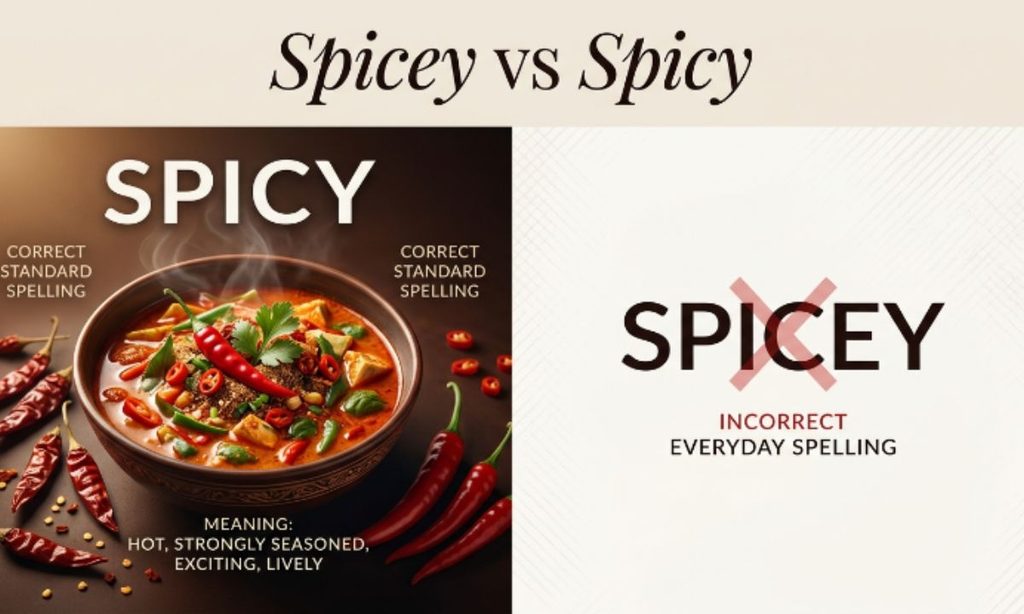
Let’s settle this fast: “spicy” is the correct, standard spelling in modern English. Spicey is the version most style guides, dictionaries, and editors flag as a mistake.
Here’s the quick breakdown:
| Spelling | Status | Where you’ll see it |
| Spicy | Correct, standard | Menus, recipes, articles, formal writing |
| Spicey | Non-standard, rare variant | Occasional casual writing, some names/usernames |
If you’re writing a school paper, a business email, a recipe blog, or literally anything meant for a wide audience, use spicy. It’s not close.
That said, “spicey” isn’t a total fabrication. A few major dictionaries list it as a minor historical variant of spicy — meaning it has shown up in print over the years, just not often enough to be considered acceptable today.
Think of it the way you’d think of “grey” versus “gray”: one region or era might use a slightly different form, but one clearly dominates modern usage. In this case, spicy dominates everywhere — American, British, Australian, and Canadian English all agree.
Why Is Spicy Spelled Without an E?
The word comes from “spice,” not from nowhere.
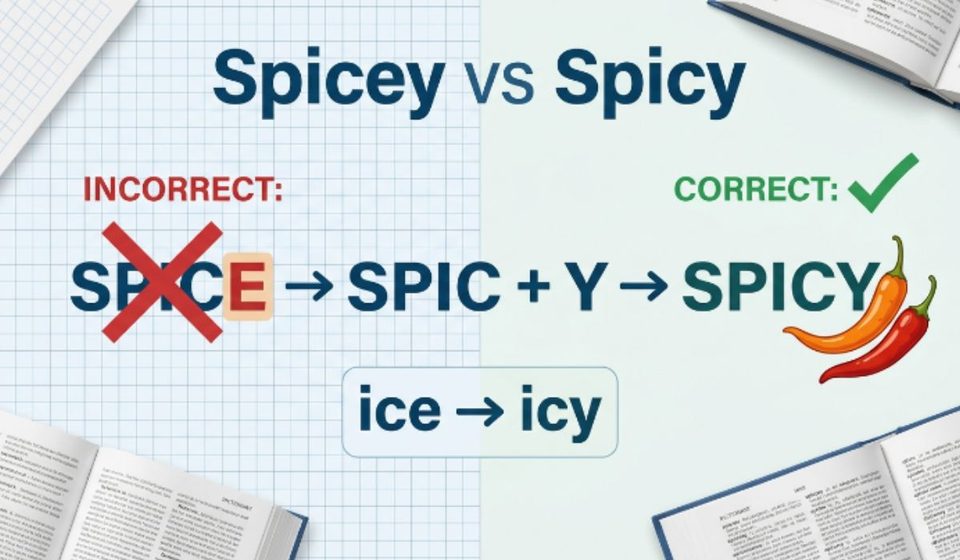
The adjective “spicy” is built from the noun “spice.” English has a common (though not universal) pattern where a silent final “e” gets dropped before adding a suffix that starts with a vowel — in this case, “-y.”
So the transformation looks like this:
- spice → drop the silent e → spic-
- add “y” → spicy
This isn’t a random rule invented for this one word. You’ll see the same pattern elsewhere:
- ice → icy
- price → pricy (or pricey, which is actually the more accepted exception — more on that below)
- grime → grimy
- shine → shiny
Why “spicey” feels tempting anyway
If you keep the “e,” you’re subconsciously trying to preserve the base word’s shape. It looks like it should connect more clearly to “spice.” That instinct isn’t wrong — it’s just not how this particular word evolved in standard English. Spelling isn’t always logical. It’s often just memorized.
A useful phrase to remember: “Spice loses the e before y.”
Worth noting: this “drop-e” pattern is a helpful memory aid, not an ironclad law of English. Language has plenty of exceptions, and spelling rules like this one are best treated as guidelines rather than guarantees.
What Does Spicy Actually Mean?
“Spicy” carries more than one meaning, and mixing them up can confuse writing.
Spicy as a food description
This is the most common use. It generally means one of two things:
Heavily seasoned — flavored with a generous mix of spices or herbs (a spicy curry, a spicy rub)
Hot to the taste — containing chili peppers or capsaicin that create a burning sensation (a spicy pepper, spicy wings)
These two meanings often overlap, but they’re not identical. A dish can be intensely seasoned without being hot. A dish can also be very hot without much complexity in its spice blend. Good food writing usually clarifies which one is meant.
Spicy as a figurative adjective
Outside the kitchen, “spicy” shifts meaning depending on context:
- Exciting or lively — “The debate got spicy near the end.”
- Provocative or risqué — “The novel had a few spicy scenes.”
- Scandalous or gossip-worthy — “She shared some spicy details about the breakup.”
- Confrontational or tense — “That match was spicy — tempers were high.”
Context does the heavy lifting here. “Spicy content” online often implies something sexual or controversial, while “a spicy conversation” at work usually just means it was heated or uncomfortable, not literally scandalous.
Is Spicey Ever Correct?
There are a few narrow situations where “spicey” isn’t automatically wrong:
Names and brands. If someone’s surname, a company name, or a product is spelled “Spicey,” that spelling should be respected — it’s a proper noun, not a spelling error.
Usernames and creative titles. Social handles, song titles, or stylized branding sometimes use “spicey” intentionally for visual distinction.
Historical or archaic texts. Older printed material occasionally used “spicey” before spelling conventions settled.
Outside of these cases, stick with spicy. In academic writing, journalism, business communication, and everyday content, “spicey” reads as a typo, not a stylistic choice.
Spicy vs Hot: Are They the Same Thing?
Not exactly, and mixing them up causes real confusion in food writing.
Spicy can describe seasoning intensity, aroma, and flavor complexity — it’s a broader term.
Hot specifically refers to the burning sensation caused by capsaicin, the compound found in chili peppers.
A garam masala blend might be very spicy (complex, layered, and fragrant) without being especially hot. A plain dish doused in ghost pepper sauce might be extremely hot without complex seasoning at all.
Quick comparison:
| Term | Refers to | Example |
| Spicy | Seasoning, flavor complexity, or heat | A spicy masala curry |
| Hot | Burning sensation from chili/capsaicin | A hot sauce made from ghost peppers |
Different cuisines lean on these differently:
Thai and Korean cooking often combine strong heat with bold, layered seasoning.
Indian cuisine frequently emphasizes complex spice blends, with heat as one part of the profile.
Mexican cuisine varies widely — some dishes are heat-forward, others are seasoning-forward.
Western cooking often treats “spicy” and “hot” as optional add-ons, like hot sauce on the side.
Explore More Grammar Guide
Time Flies or Time Flys: Which Spelling Is Correct?
Thier or Their: Which Spelling Is Correct?
Puting vs Putting: Which Spelling Is Actually Correct?
How to Pronounce Spicy
Pronunciation is simple and consistent across English dialects:
- IPA: /ˈspaɪ.si/
- Sounds like: SPY-see
- Two syllables, with stress on the first
There’s no version where the “e” in “spicey” changes the pronunciation — both spellings, if used, would sound identical. That’s actually part of why the misspelling is so easy to make; your ear can’t catch it.
Spicy Word Forms You Should Know
Spicy has a full family of related grammatical forms. Knowing them helps you avoid smaller spelling slips elsewhere.
| Form | Word |
| Base noun | Spice |
| Adjective | Spicy |
| Comparative | Spicier |
| Superlative | Spiciest |
| Noun (quality) | Spiciness |
| Adverb | Spicily |
Notice the pattern holds: spicier and spiciest also drop the “e” and change “y” to “i” before adding the suffix. There’s no “spiceier” or “spiceiest” in standard English.
Examples of “Spicy” in Sentences
Food examples
- The curry was spicy enough to make my eyes water.
- She ordered the spiciest wings on the menu.
- This salsa has a nice spicy kick.
- Sichuan cuisine is famous for its bold, spicy flavors.
- Add chili flakes if you want it spicier.
Figurative examples
- Their online argument got surprisingly spicy.
- The memoir includes a few spicy anecdotes about her early career.
- That rivalry match was spicy from the first minute.
Incorrect “spicey” examples
- ❌ “This curry is too spicey.” → ✅ “This curry is too spicy.”
- ❌ “She added spicey peppers.” → ✅ “She added spicy peppers.”
- ❌ “The conversation got spicey.” → ✅ “The conversation got spicy.”
Synonyms for Spicy
Not all synonyms mean the same thing. Choosing the right one sharpens your writing.
Hot — emphasizes heat, especially from peppers
Piquant — a pleasant, sharp flavor without necessarily being hot
Peppery — flavor or heat specifically linked to pepper
Zesty — fresh, lively, tangy
Pungent — strong smell or taste, not always hot
Tangy — sharp, slightly acidic flavor
Flavorful — rich taste, not specifically about heat
Fiery — intense heat, often used for very hot dishes
Lively — figurative use for conversation or energy
Provocative — figurative use for scandalous or edgy content
Using “hot” as an automatic substitute for “spicy” is common, but it’s not always accurate. A dish can be spicy (well-seasoned) without being hot at all.
How to Remember the Correct Spelling
A few quick memory tricks:
Repeat: “Spice loses the e before y.”
Compare it to other familiar words: ice → icy, and (with the notable exception) price → pricy/pricey.
Picture the word without its final syllable: “spic” + “y,” not “spice” + “y.”
If in doubt, search “spicy” in a dictionary. If it doesn’t autocomplete or gets flagged by spellcheck, you’ll know instantly.
One small exception worth knowing: “pricey” (with the e) is actually accepted as a common variant of “pricy” in many dictionaries — unlike “spicey.” English doesn’t apply this rule with perfect consistency, which is exactly why memorizing “spicy” as a fixed pattern is safer than relying on a blanket rule.
Frequently Asked Questions
Is spicey a real word?
It appears as a rare historical variant in some dictionaries, but spicy is the accepted standard spelling.
Why is spicy spelled without an e?
Because the base word “spice” drops its silent e before the suffix “-y” is added, similar to ice → icy.
Is spicy the same as hot?
No — spicy refers to flavor and seasoning generally, while hot specifically means the burning sensation from chili peppers.
What is the comparative form of spicy?
Spicier, not “spiceier” — the same e-dropping pattern applies before adding the comparative suffix.
Can spicy be used in formal writing?
Yes, spicy is fully acceptable in academic, journalistic, and professional writing; spicey should be avoided in those contexts.
Conclusion
Spicy is the spelling to trust, whether you’re writing a recipe, a review, a work email, or a casual text — and spicey should only survive as a name, a brand, or a rare historical footnote rather than an everyday choice; once you remember that “spice” simply loses its silent e before adding “y,” the correct form becomes second nature, and you’ll never have to second-guess it again.