

Ever typed “sueing” and had it underlined in red but couldn’t figure out why? You’re not alone. This is one of those words that looks right until you stare at it too long. The answer is simple, but the reasoning behind it is worth knowing so you never second-guess it again.
Is It Suing or Sueing?
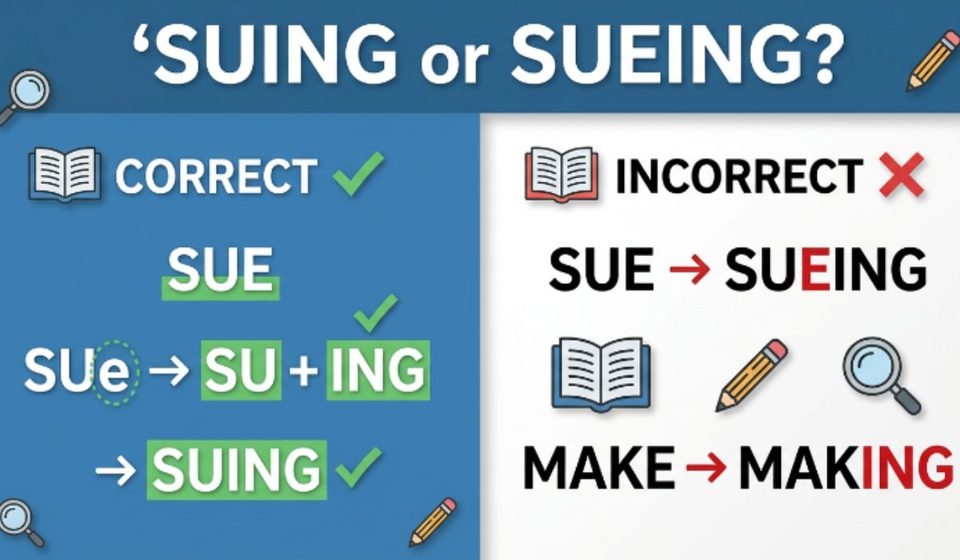
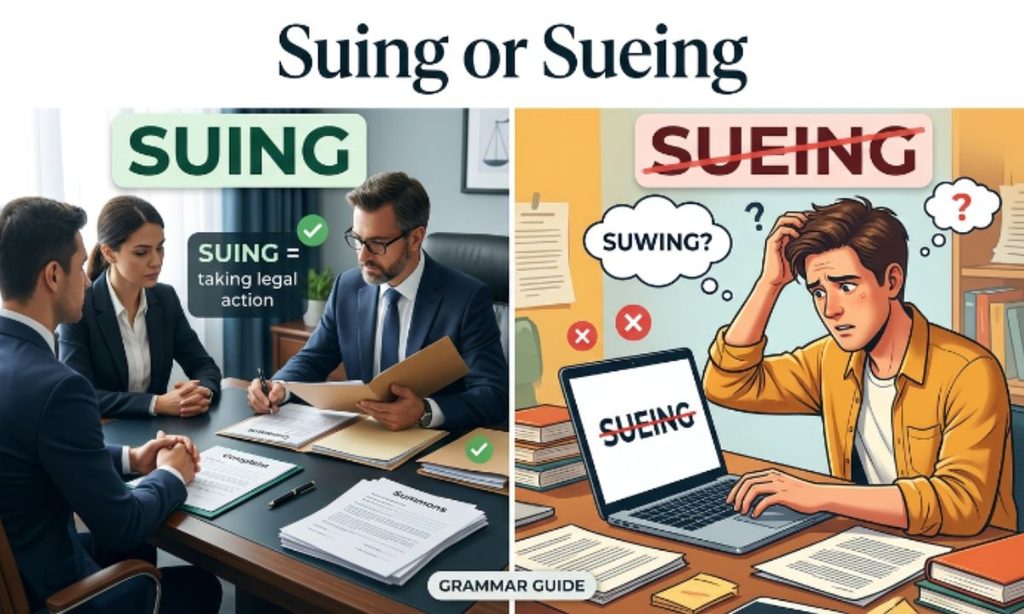
The correct spelling is suing. “Sueing” is a misspelling, full stop.
Here’s the quick version:
Correct: suing
Incorrect: sueing
Base verb: sue
Meaning: taking legal action against someone
If you remember nothing else from this article, remember that one line. Everything below just explains why.
Why People Get This Wrong
It’s an easy mistake to make. Most English speakers learn early on that you add “-ing” to a verb to describe an ongoing action: walk becomes walking, jump becomes jumping. So the brain assumes sue plus ing should just be sueing.
But sue doesn’t follow that simple pattern, because it ends in a silent e. And silent e’s have their own rule.
Why Suing Drops the E
English has a well-known spelling convention: when a verb ends in a silent e, you drop that e before adding a suffix that starts with a vowel, like -ing.
Watch what happens to other common verbs:
| Base Verb | + ing | Result |
| Make | ing | Making |
| Take | ing | Taking |
| Write | ing | Writing |
| Use | ing | Using |
| Move | ing | Moving |
| Come | ing | Coming |
| Sue | ing | Suing |
Sue is just following the crowd here. The e disappears, the -ing attaches directly to “su,” and you get “suing.”
The Exceptions That Confuse Everyone
English wouldn’t be English without a few words that break the pattern. Some verbs ending in e keep it before -ing, usually to avoid confusion with another word or to preserve the correct sound:
- See → seeing (not “sing”)
- Agree → agreeing (not “agring”)
- Dye → dyeing (kept to distinguish it from “dying”)
- Singe → singeing (kept to distinguish it from “singing”)
These exceptions exist for good reasons, mostly to prevent two different words from looking identical. Sue doesn’t have that problem. There’s no competing word called “suing” that it could be confused with, so it follows the standard rule and drops the e.
What Does Suing Actually Mean?
Suing means bringing a legal case against a person, company, or organization. It’s the present participle and gerund form of the verb sue.
In plain terms, when someone is suing another party, they’re asking a court to make things right, usually because they believe they’ve been harmed in some way.
What Someone Might Be Suing For
People and companies file lawsuits for all kinds of reasons. Some of the most common include:
- Personal injury after an accident
- Medical or professional negligence
- Breach of contract
- Defamation or libel
- Property and boundary disputes
- Copyright or trademark infringement
- Unpaid debts or invoices
- Unsafe working conditions
- Wrongful termination
In each case, the person suing (the plaintiff, or claimant in some legal systems) is asking a court to award money, enforce a right, or issue some other legal remedy against the person being sued (the defendant).
Suing vs. Filing a Lawsuit: What’s the Difference?
These two phrases get used interchangeably, but they’re not quite the same thing.
- Suing describes the action. It’s what a person is doing when they take legal steps against someone else.
- A lawsuit is the actual legal case itself, the formal proceeding that results from that action.
So you could say, “She is suing her landlord,” and separately say, “The lawsuit began in March.” One describes the act; the other describes the case that comes out of it.
It also helps to know the difference between a civil lawsuit and a criminal prosecution. Suing falls under civil law. It’s a dispute between private parties, usually over money or damages. Criminal prosecution, on the other hand, is brought by the state against someone accused of breaking the law, and it can result in penalties like fines or jail time. Suing someone doesn’t put them in jail. It’s about compensation, not punishment.
Grammar Forms of Sue
Here’s every form of the verb sue laid out so you can see how it works across different tenses.
| Form | Grammar Role | Example |
| Sue | Base verb | “They plan to sue.” |
| Sues | Present tense, third person | “The company sues suppliers over late payments.” |
| Suing | Present participle / gerund | “She is suing the landlord.” |
| Sued | Past tense / past participle | “He sued the manufacturer last year.” |
| Lawsuit | Noun, the legal case | “The lawsuit was settled out of court.” |
Explore More Grammar Guide
Unphased vs Unfazed: Which Spelling Is Correct?
Thier or Their: Which Spelling Is Correct?
Puting vs Putting: Which Spelling Is Actually Correct?
How to Use Suing in a Sentence
Suing shows up in two main grammatical roles: as part of a continuous verb tense, and as a gerund acting like a noun.
As a Present Participle
This is the most common use. It describes an action happening right now, or over a stretch of time.
- “The company is suing its former partner over the contract.”
- “They are suing the manufacturer for a faulty product.”
- “He was suing the newspaper for defamation.”
- “The family has been suing the care facility for over a year.”
As a Gerund
Here, suing acts as a noun and can be the subject or object of a sentence.
- “Suing is expensive and can take years to resolve.”
- “Suing the company felt like the only option left.”
- “They discussed suing for damages before deciding against it.”
- “Her lawyer advised against suing right away.”
Common Prepositions Used With Sue
You’ll usually see “sue” paired with one of these prepositions, depending on what’s being claimed:
- Sue for damages
- Sue for negligence
- Sue for libel or defamation
- Sue over a contract dispute
- Sue because of an injury
Both “sue for” and “sue someone for” are grammatically correct. “Sue for damages” focuses on what’s being claimed. “Sue someone for damages” adds who the claim is against.
How Do You Pronounce Suing?
Suing is pronounced roughly like “SOO-ing.” The first syllable rhymes with “shoe.” Since sueing isn’t a standard spelling, there’s no separate accepted pronunciation for it, people would say it the same way regardless of which spelling they typed.
Suing vs. Sewing: Don’t Mix These Up
This one trips people up in casual writing, especially with spellcheck sometimes not catching it. Suing and sewing look similar but mean completely different things.
Suing relates to legal action. “She is suing the airline for lost luggage.”
Sewing relates to stitching fabric with a needle and thread. “She is sewing a quilt for her daughter.”
If autocorrect ever swaps one for the other, it’s worth a second look before you hit send.
Why “Sueing” Still Shows Up Online and in Memes
Here’s something most grammar guides skip entirely: “sueing” isn’t just a typo; it’s also a deliberate spelling choice in certain corners of the internet.
Search video platforms, and you’ll find titles like “I’m Sueing CapCut” or “Elmo’s Is Suing.” These captions often use the incorrect spelling on purpose, or the creator simply didn’t know the correct form, and it stuck as part of the joke or the video’s identity.
This creates a small but real dilemma for writers and content creators:
If you’re writing standard content, an article, a legal document, a professional email, use “suing.” Always.
If you’re quoting or recreating a specific meme, video title, or piece of user-generated content, you can preserve the original spelling, including “sueing,” because changing it would alter the reference.
The key is knowing the difference between an intentional stylistic choice tied to internet culture and an actual grammar mistake in formal writing. One is fine in its own context. The other should be corrected.
A Quick Proofreading Checklist
Before you publish or send anything containing this word, run through this:
Did you write “suing,” not “sueing”?
Is the sentence about legal action, not sewing fabric?
Are you using “is suing,” “was suing,” or “has been suing” correctly based on the timeframe?
If using it as a noun (gerund), does the sentence still make sense grammatically?
If quoting a meme or informal source, is the misspelling intentional and clearly not your own error?
Mini Quiz: Suing or Sueing?
Choose the correct spelling in each sentence.
- The company is _ its former supplier for breach of contract.
- A. suing
- B. sueing
- Is “_” the correct spelling?
- A. Suing
- B. Sueing
- The family is _ the hospital for negligence.
- A. suing
- B. sueing
- Which form is the present participle of sue?
- A. suing
- B. sueing
Answer Key
- A. suing
- A. Suing
- A. suing
- A. suing
Rule: Remove the final silent e from sue before adding -ing: sue → suing.
Frequently Asked Questions
Is it suing or sueing?
Suing is the correct spelling; “sueing” is a common but incorrect variation.
Why is suing spelled without an e?
Sue ends in a silent e, and English drops that e before adding -ing, the same rule that turns “make” into “making.”
What is the past tense of sue?
The past tense and past participle of “sue” is “sued.”
Is suing a gerund?
Yes, suing can function as a gerund, acting as a noun, as in “Suing is expensive.”
What’s the difference between suing and filing a lawsuit?
Suing is the action a person takes, while a lawsuit is the formal legal case that results from it.
Final Thoughts
Suing is the only correct spelling of this word, and the reasoning comes down to a spelling rule most of us learned without ever really thinking about it: drop the silent e before adding -ing.
Sueing might still pop up in casual writing or internet captions, sometimes on purpose, sometimes by accident, but in any formal, legal, or professional context, suing is the form to use. Keep that silent e rule in mind, and you’ll never have to second-guess this one again.



[…] Suing or Sueing: Which Spelling Is Actually Correct? […]
[…] Suing or Sueing: Which Spelling Is Actually Correct? […]