
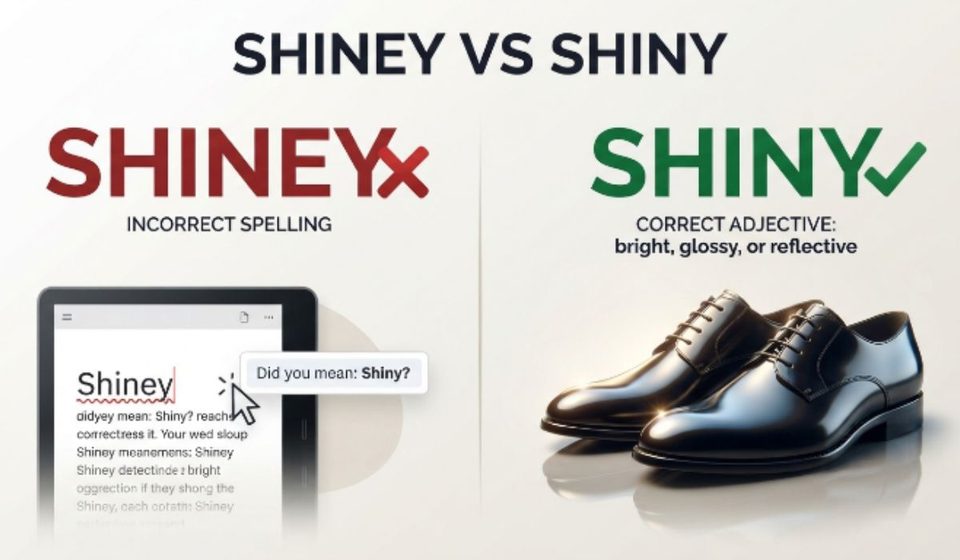

You’ve probably typed “shiney” without thinking twice. It looks fine. It sounds right when you read it back. But one of these words doesn’t exist in any dictionary, and it’s not the one you’d guess by pronunciation alone. Let’s settle this properly.
Shiny vs. Shiney: The Direct Answer
“Shiny” is correct. “Shiney” is a misspelling.
That’s it. There’s no regional exception, no informal carve-out, and no version of standard English where “shiney” is the accepted form.
Here’s the quick breakdown:
- “Shiny” is the dictionary-recognized adjective
- “Shiney” is a common typo, usually caused by how the word sounds
- Both are meant to describe the same thing: something bright, glossy, or reflective
- Only one of them should ever show up in your writing
| Form | Status | Meaning | Where to use it |
| Shiny | Correct | Bright, glossy, reflective | Everywhere, formal and casual |
| Shiney | Incorrect | Same intended meaning | Nowhere, unless it’s a name or brand |
What Does “Shiny” Actually Mean?
“Shiny” is an adjective, and it does a lot of work for a five-letter word. At its core, it describes anything that reflects light.
Dictionaries generally break its meaning into a few related ideas:
- Having a smooth, glossy surface
- Bright because it’s catching sunlight or another light source
- Polished or worn smooth through repeated rubbing
- Occasionally used for something naturally lustrous, like skin with a slight sheen
Beyond the literal sense, “shiny” also gets used figuratively. Something can be “shiny” without reflecting a single photon:
- A shiny new idea
- A shiny opportunity
- A shiny new job title
In this figurative sense, “shiny” usually implies something new, appealing, or exciting, sometimes with a slight hint of skepticism, as in “don’t get distracted by shiny new tools before you’ve mastered the basics.”
Why Is It “Shiny” and Not “Shiney”?
The answer comes down to a basic spelling pattern in English, not a random rule someone invented.
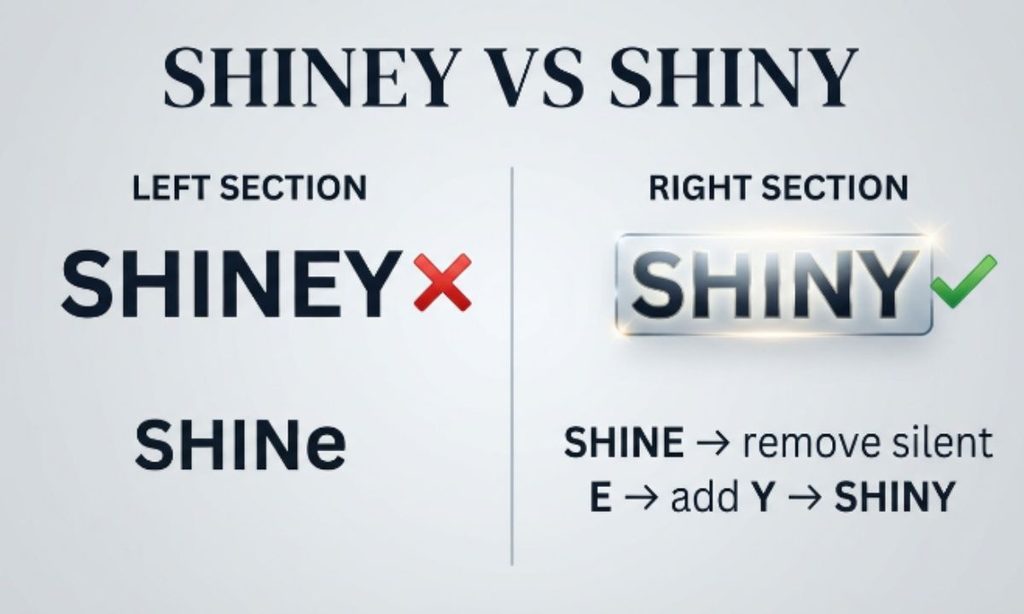
“Shiny” is built from the word “shine” plus the adjective-forming suffix “-y.” Here’s the transformation:
- Start with “shine”
- Drop the silent “e” at the end
- Add “-y”
- You get “shiny”
This is a standard move in English spelling. When a word ends in a silent “e,” and you add a suffix that starts with a vowel, the silent “e” typically disappears. You can see the same pattern elsewhere, though not every word behaves identically, so it’s worth treating “shine → shiny” as its own established case rather than assuming every silent-e word follows the same rule.
The confusion happens because “shine” clearly has an “e” in it, and people expect that letter to survive when they add an ending. It feels logical. It’s just not how English handles this particular word.
Why Do So Many People Write “Shiney”?
If “shiny” is objectively correct, why does “shiney” show up constantly online? A few real reasons:
Pronunciation confusion: The word sounds like it should have that “e” sitting right before the “y”
The base word bias: Writers see “shine” and want to keep the whole thing intact before adding a suffix.
Pattern borrowing: Some learners apply patterns from unrelated words, expecting endings to behave the same way across different words.
Autocorrect reinforcement: If you’ve typed “shiney” enough times, your keyboard starts suggesting it, which feels like validation even though it isn’t
Casual repetition online: Seeing a misspelling repeated in comments or captions can make it feel more legitimate than it is
None of these reasons make “shiney” correct. They just explain why the mistake is common.
Shiny in a Sentence: How It Actually Works
“Shiny” moves around a sentence more flexibly than people realize. Here’s how it typically shows up:
Before a noun:
- “She wore shiny black shoes to the interview.”
After a linking verb:
- “The floor looks shiny after mopping.”
- “His shoes became shiny once he polished them.”
With an intensifier:
- “That countertop is incredibly shiny.”
- “The finish is almost too shiny.”
In a figurative sense:
- “The company unveiled a shiny new app.”
- “Everyone got distracted by the shiny new strategy instead of finishing the old one.”
Notice that the sentence structure doesn’t change the spelling. Casual or formal, literal or figurative, it’s always “shiny.”
Shiny vs. Shining: They’re Not Interchangeable
This is one gap a lot of quick spelling guides skip entirely, and it trips people up more than the shiney/shiny mix-up does.
| Word | What it describes | Example |
| Shiny | A surface’s appearance, whether or not anything is actively happening | “The car is shiny.” |
| Shining | Active light being given off, or the present action of the verb “shine” | “The sun is shining.” |
You wouldn’t say “the sun is shiny” in most contexts; that phrasing sounds off because the sun is actively emitting light, not just sitting there with a glossy finish. Meanwhile, “the shining car” sounds slightly poetic or unusual compared to the more natural “the shiny car.”
Quick rule of thumb: if something is actively giving off light right now, “shining” usually fits better. If you’re describing a surface’s general quality, “shiny” is the natural choice.
Shiny vs. Glossy, Gleaming, and Lustrous
“Shiny” has plenty of company in the brightness department, but these words aren’t perfect substitutes for each other. Each one carries a slightly different shade of meaning.
Glossy – Leans toward a smooth, deliberately polished finish. Common with paint, paper, hair products, and magazine pages.
Gleaming – Suggests strong, clean brightness, often almost sparkling. Works well for freshly cleaned surfaces.
Glistening – Usually implies small points of reflected light, often tied to moisture, like glistening skin or dew on grass.
Lustrous – A more formal or literary word, often reserved for hair, fabric, or gemstones with a rich, deep shine.
Shiny – The broadest, most neutral term. It covers nearly all of the above without specifying texture, moisture, or intensity.
If you’re writing something more polished or descriptive, swapping in one of these alternatives can add variety. But for everyday, general-purpose brightness, “shiny” is usually the simplest and clearest choice.
Shiny vs. Shinny: A Different Word Entirely
Here’s a mix-up that rarely gets covered but genuinely trips people up: “shinny” is not just another spelling variant of “shiny.”
“Shinny” has its own separate meaning and pronunciation
It’s commonly used informally to describe climbing, as in “shinny up a tree or pole.”
In some regions, “shinny” also refers to a casual, informal version of hockey played without full rules or equipment
It is not an accepted alternate spelling for “bright” or “reflective.”
If you see “shinny” in a sentence about climbing or informal sports, that’s the correct word doing its own job, not a misspelling of “shiny.”
Comparative and Superlative Forms
Since “shiny” is a standard adjective, it follows regular comparative and superlative rules, adding “-er” and “-est.”
| Form | Correct | Incorrect |
| Positive | shiny | — |
| Comparative | shinier | shineyer |
| Superlative | shiniest | shineyest |
Example sentences:
- “This ring is shinier than the one I bought last year.”
- “That’s the shiniest car in the entire lot.”
Just like the base word, the comparative and superlative forms never bring back the silent “e” from “shine.”
Is “Shiney” Ever Acceptable?
There’s one caveat worth mentioning, and most spelling guides skip it entirely: “shiney” can still appear correctly as a proper noun.
- A person’s name or nickname
- A brand name or product label
- A username or handle
- A fictional character’s name
- Deliberate creative branding, like a stylized logo or song title
In these cases, “shiney” isn’t functioning as the adjective meaning “reflective.” It’s a name, and names don’t have to follow standard spelling rules. The distinction matters: as a standalone descriptive word for brightness, “shiney” is always wrong. As an intentional proper noun, it can exist just fine.
Explore More Grammar Guide
Vender or Vendor: Which Spelling Should You Actually Use?
Take Effect or Take Affect? The Correct Phrase, Explained
Register and Tone: Does Context Change the Spelling?
No, and this is worth stating clearly. “Shiny” itself is a neutral word. It works the same way whether you’re writing a technical product description or texting a friend about your new phone.
What actually shifts the tone isn’t the word “shiny” itself; it’s the noun paired with it:
“A shiny metal surface” reads as neutral and descriptive, fitting for technical or academic writing
“A shiny new toy” feels casual and conversational
“A shiny new strategy” often carries a figurative, slightly skeptical undertone, implying something flashy but possibly untested.
The spelling stays locked in place across all of these. Only the surrounding words and context shift the tone.
British vs. American English: Does Spelling Differ?
No meaningful difference exists here. “Shiny” is the standard spelling in both American and British English. Pronunciation may vary slightly by accent, but the written form doesn’t change based on region. “Shiney” isn’t treated as a recognized British variant or regional alternative in either version of the language.
Common Mistakes to Avoid
Writing “shiney” instead of “shiny,” especially out of habit from repeated typos
Assuming autocorrect suggestions confirm correct spelling
Using “shineyer” or “shineyest” instead of “shinier” and “shiniest”
Confusing “shiny” with “shining” in sentences describing active light
Confusing “shiny” with “shinny,” a completely different word
Preserving the silent “e” from “shine” when adding the “-y” suffix
Using “shiney” in professional documents, essays, or formal communication
A Simple Way to Remember the Spelling
If you want a fast mental check next time you’re unsure, run through this:
- Start with the base word: “shine”
- Drop the silent “e”
- Add “-y”
- Land on “shiny”
Or just remember the short version: “A thing that shines is shiny,” not “shiney.” Saying that sentence out loud a few times tends to lock the correct spelling into memory faster than any formal rule.
Frequently Asked Questions
Is it “shiny” or “shiney”?
“Shiny” is the correct spelling; “shiney” is a common misspelling.
Is “shiney” ever a real word?
Only as a proper noun, like a name, username, or brand, never as the standard adjective for brightness.
What’s the comparative form of shiny?
“Shinier,” not “shineyer.”
Is “shiny” the same as “shining”?
No, “shiny” describes a surface’s appearance while “shining” describes active light or the ongoing action of shining.
Is “shinny” another spelling of “shiny”?
No, “shinny” is a separate word tied to climbing or informal hockey, with its own meaning and pronunciation.
Conclusion
“Shiny” is the spelling you want, every time, in every context, whether you’re writing a formal report or a quick text about your newly washed car.
“Shiney” might feel intuitive because of how the word sounds, but it simply isn’t recognized in standard English outside of names and branding. Once you understand the shine-to-shiny transformation and keep an eye out for related mix-ups like “shining” and “shinny,” you’ll never have to second-guess this one again.


[…] Shiney vs Shiny: Which Spelling Is Actually Correct? […]