
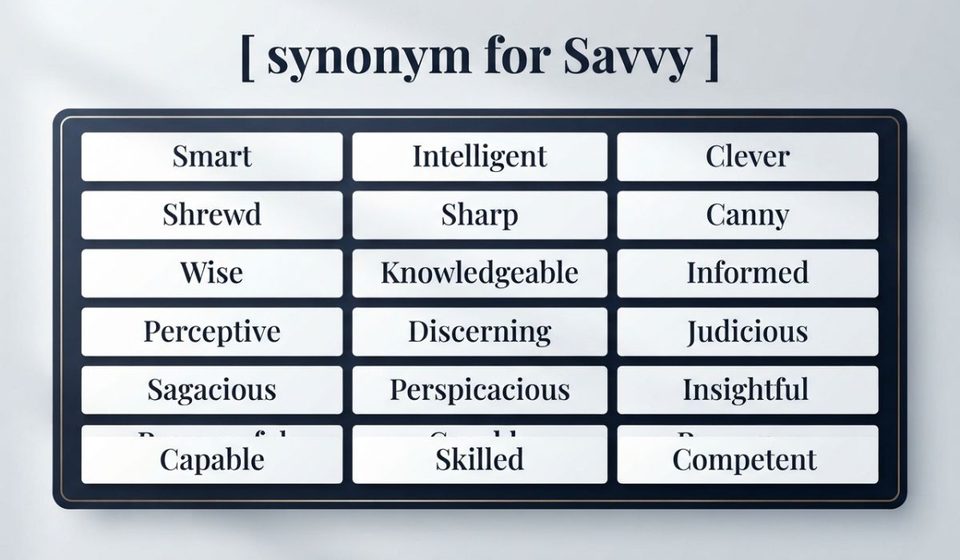

“Savvy” is a small word with a big job. It says someone knows how things work and acts on it. Yet many writers use it for everything from smart to skilled. That habit hides what you actually mean. This guide gives you 35 sharper alternatives, each with a meaning, examples, and a pronunciation. You will also learn which word fits knowledge, skill, judgment, or understanding.
What Is the Best Synonym for Savvy?
The best all-purpose synonym for “savvy” is “knowledgeable,” when you mean well-informed, and astute when you mean sharp in judgment. Use experience for real-world know-how. Use expertise or know-how when savvy works as a noun.
No single word covers every case. “Savvy” blends three ideas:
- What you know: facts, context, how a system works
- What you can do: practical skill built through experience
- How well you judge: spotting risks and opportunities early
Pick the idea you want to stress, then pick the word that carries it.
What Does Savvy Mean?
Savvy means having practical knowledge and good judgment. It rewards experience more than book learning. Someone can be brilliant and still lack savvy. Someone else can be savvy without a degree.
The word works in three forms. Each form needs different synonyms.
Savvy as an Adjective
As an adjective, savvy describes a person or choice that shows smart, practical thinking.
- A savvy investor spots value early.
- A tech-savvy teacher builds better lessons.
Savvy as a Noun
As a noun, savvy means practical know-how. It is usually uncountable, so you do not say “a savvy.”
- She brings real business savvy to the team.
- The role demands financial savvy.
Savvy as a Verb
As a verb, savvy is informal and old-fashioned. It means “to understand.” You mostly see it in the question “Savvy?” or “Do you savvy?”
The word traces back to Portuguese and Spanish forms meaning “to know,” which come from the Latin word for “to be wise.” The correct spelling is savvy, with two v’s. The related noun is savviness. The pronunciation is SAV-ee.
Savvy vs Smart, Astute, and Shrewd
These four words overlap, but each has a different center.
| Word | Main Focus | Tone |
| Savvy | Practical knowledge plus judgment | Positive, informal |
| Smart | General mental ability | Positive, neutral |
| Astute | Sharp observation and insight | Positive, formal |
| Shrewd | Hard-headed, practical judgment | Neutral, sometimes cold |
Use savvy when experience drives the skill. Use smart when you praise raw brainpower. Use astute for sharp insight. Use shrewdly when someone plays the angles well.
Synonyms for “savvy,” meaning knowledgeable and Experienced
These words stress what a person knows and how long they have known it. They work best when savvy describes awareness and background.
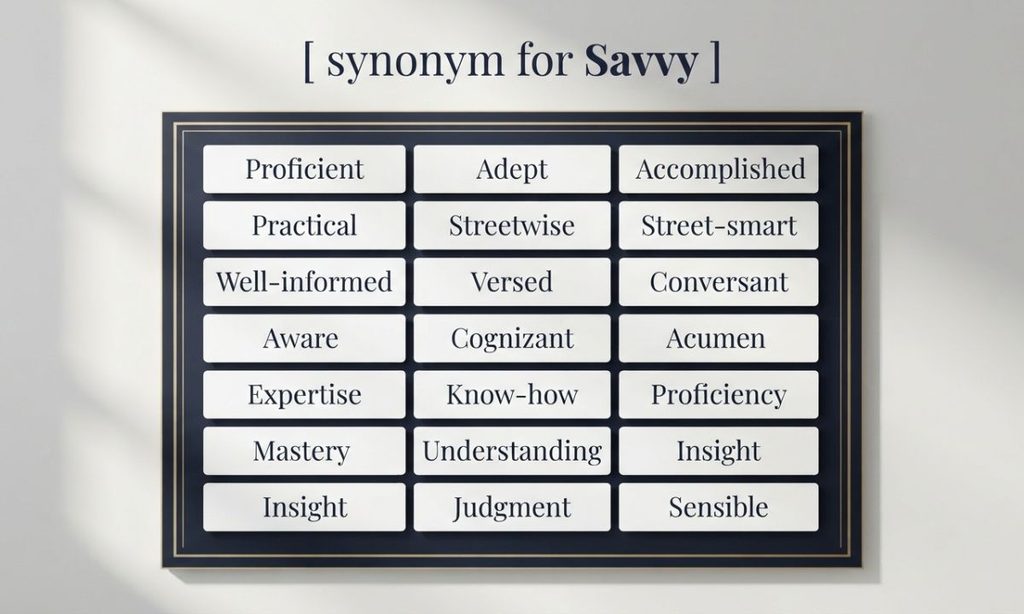
Knowledgeable
Meaning: Having a lot of information about a subject.
Knowledgeable earns trust fast. It tells the reader you respect the person’s depth without exaggerating. It sounds calm, fair, and professional.
- Our guide was knowledgeable about local history.
- She is a knowledgeable adviser on tax law.
When It Fits: Recommending a person who can answer questions, like a shop assistant or tutor.
Pronunciation: NOL-ij-uh-bul
Well-Informed
Meaning: Up to date and aware of current facts.
Well-informed signals responsibility. It shows that someone reads, checks, and stays current. That makes it a warm compliment for citizens, buyers, and leaders.
- A well-informed voter reads more than the headlines.
- He made a well-informed choice about his loan.
When It Fits: Praising someone who prepares before a big decision.
Pronunciation: wel-in-FORMD
Conversant
Meaning: Familiar with a subject and able to discuss it.
Conversant adds a polished, professional tone. It suggests comfort without claiming mastery. That honesty makes your praise more believable.
- She is conversant with modern accounting tools.
- He seemed conversant in three languages.
When It Fits: Describing a job candidate in a resume or reference.
Pronunciation: kun-VUR-sunt
Versed
Meaning: Skilled or well practiced in a subject, usually with “in.”
Versed feels literate and steady. It hints at study and long practice. Readers sense quiet authority.
- The lawyer is well versed in contract disputes.
- Our team is versed in cloud security.
When It Fits: Introducing a specialist at a meeting.
Pronunciation: VURST
Experienced
Meaning: Having learned through long practice.
Experienced offers comfort and confidence. It tells people the person has seen problems before. That calm assurance helps in hiring and teamwork.
- We hired an experienced manager to lead the launch.
- She is an experienced traveler who packs light.
When It Fits: Recommending someone for a role with real responsibility.
Pronunciation: ik-SPEER-ee-unst
Seasoned
Meaning: Made wise and capable by long experience.
Seasoned feels warm and respectful. It suggests someone who has weathered ups and downs. Readers picture calm hands and steady judgment.
- A seasoned pilot stayed calm during the storm.
- The seasoned editor spotted the error right away.
When It Fits: Praising a veteran coworker or mentor.
Pronunciation: SEE-zund
Streetwise
Meaning: Skilled at handling real-life situations, especially in tough places.
Streetwise adds a touch of grit and respect. It says the person reads people and risks well. That practical edge makes it a strong compliment for city life.
- She grew up streetwise and never got scammed.
- A streetwise traveler avoids obvious tourist traps.
When It Fits: Describing someone who navigates busy cities with ease.
Pronunciation: STREET-wyz
Synonyms for Savvy Meaning Skill and Know-How
These words fit the noun sense of savvy. They focus on what a person can do, not just what they know.
Know-How
Meaning: Practical knowledge of how to get something done.
Know-how feels friendly and grounded. It tells the reader the person delivers, not just talks. The casual tone keeps praise from sounding stiff.
- The mechanic has the know-how to fix almost anything.
- Her marketing know-how doubled our sign-ups.
When It Fits: Thanking a friend who solves a tech problem for you.
Pronunciation: NOH-how
Expertise
Meaning: Deep, specialized knowledge or skill.
Expertise shows serious respect. It tells readers the person reached a high level through study and practice. Use it only when the depth is real.
- We hired her for her expertise in supply chains.
- His legal expertise saved the deal.
When It Fits: Introducing a specialist in a formal setting.
Pronunciation: ek-spur-TEEZ
Proficiency
Meaning: A good, reliable level of skill.
Proficiency sounds measured and fair. It shows competence without overselling. Employers and teachers like it for that reason.
- The job requires proficiency in spreadsheets.
- Her proficiency in Spanish helped the team.
When It Fits: Listing skills on a resume.
Pronunciation: pruh-FISH-un-see
Mastery
Meaning: Complete control of a skill or subject.
Mastery carries admiration and awe. It tells the reader the person has reached the top of their craft. Use it when the praise is earned.
- The chef showed mastery of French technique.
- Her mastery of the violin moved the crowd.
When It Fits: Praising an artist, athlete, or craftsperson.
Pronunciation: MASS-tuh-ree
Adept
Meaning: Very skilled and quick at something.
Adept feels smooth and confident. It signals ease and quick learning. Readers picture someone who makes hard tasks look simple.
- He is adept at solving customer complaints.
- The kids became adept at using the new app.
When It Fits: Complimenting someone who learns new tools fast.
Pronunciation: uh-DEPT
Resourceful
Meaning: Good at finding clever ways to solve problems.
Resourceful builds admiration and trust. It tells people the person stays calm and finds a way. That quality helps in leadership and teamwork.
- A resourceful intern fixed the broken printer.
- She stayed resourceful when the funding dried up.
When It Fits: Praising someone who improvises well under pressure.
Pronunciation: rih-SORS-ful
Savoir-Faire
Meaning: Confident, graceful skill in social or practical situations.
Savoir-faire adds a touch of polish. It suggests someone who handles awkward moments with ease. The borrowed French flavor gives it a classy feel.
- He handled the tense meeting with savoir-faire.
- The host showed real savoir-faire at the dinner party.
When It Fits: Describing a person who stays smooth at events.
Pronunciation: sav-wahr-FAIR
Synonyms for Savvy Meaning Smart and Sharp Judgment
These words focus on intelligence and decision-making. They help when savvy describes a wise move or a quick mind.
Smart
Meaning: Showing good mental ability and sense.
Smart is friendly and direct. It praises without sounding formal. Everyone understands it right away.
- That was a smart way to save money.
- She is a smart negotiator.
When It Fits: Complimenting a quick choice in casual talk.
Pronunciation: SMART
Explore More Synonyms Guide
Synonyms for Love: 40 Words for Romance, Care, and Devotion
30 Perspective Synonyms to Add Depth to Your Writing
Synonym for Big: 30 Better Words With Meanings and Examples
Clever
Meaning: Quick to find creative or witty solutions.
Clever adds a spark of delight. It celebrates originality and quick thinking. Readers smile because the word feels playful.
- He came up with a clever fix for the leak.
- The ad used a clever pun.
When It Fits: Praising a creative shortcut or witty idea.
Pronunciation: KLEV-er
Sharp
Meaning: Quick, alert, and hard to fool.
Sharp shows admiration for focus. It signals that little escapes the person’s attention. It sounds energetic and modern.
- She is sharp with numbers and spots errors fast.
- A sharp editor caught the mistake.
When It Fits: Describing a coworker who notices small details.
Pronunciation: SHARP
Astute
Meaning: Good at noticing and understanding what matters.
Astute sounds thoughtful and formal. It rewards insight, not just speed. Readers feel that the person sees below the surface.
- He made an astute comment about the market.
- An astute manager sees trouble before it grows.
When It Fits: Praising a smart observation in a meeting.
Pronunciation: uh-STOOT
Shrewd
Meaning: Practical and sharp in judgment, often about money or people.
Shrewd shows respect for street-level smarts. It can also hint at hard bargaining. Use it when you want to praise skill without adding warmth.
- She made a shrewd move by buying early.
- He is a shrewd negotiator.
When It Fits: Describing a deal-maker or investor.
Pronunciation: SHROOD
Canny
Meaning: Careful, clever, and hard to trick.
Canny feels wise and a bit wry. It suggests careful thinking plus quiet confidence. It is a friendly word with a hint of humor.
- A canny shopper waits for the sale.
- She made a canny guess about the outcome.
When It Fits: Praising someone who avoids scams or bad deals.
Pronunciation: KAN-ee
Discerning
Meaning: Able to see quality and tell things apart.
Discerning signals taste and judgment. It flatters the person’s eye. Readers feel that the person chooses with care.
- A discerning buyer checks the stitching.
- The restaurant attracts discerning diners.
When It Fits: Describing a person with good taste or standards.
Pronunciation: dih-SUR-ning
Perceptive
Meaning: Quick to notice feelings, details, or hidden meaning.
Perceptive brings warmth and respect. It shows that someone listens and reads the room. That makes it a kind word for teachers, friends, and leaders.
- Her perceptive question changed the discussion.
- A perceptive teacher noticed the student struggling.
When It Fits: Thanking someone who understood your unspoken concern.
Pronunciation: per-SEP-tiv
Judicious
Meaning: Showing sound, careful judgment.
Judicious sounds calm and wise. It signals that someone thought before acting. Readers feel safe trusting the choice.
- The board made a judicious use of funds.
- He gave judicious advice during the crisis.
When It Fits: Praising careful spending or fair decisions.
Pronunciation: joo-DISH-us
Acumen
Meaning: Sharp skill in judging and making decisions.
Acumen carries authority. It suggests deep, proven judgment in a field. It works best in professional writing.
- Her business acumen helped the startup grow.
- He showed political acumen during the talks.
When It Fits: Praising a leader in a formal profile.
Pronunciation: AK-yuh-men
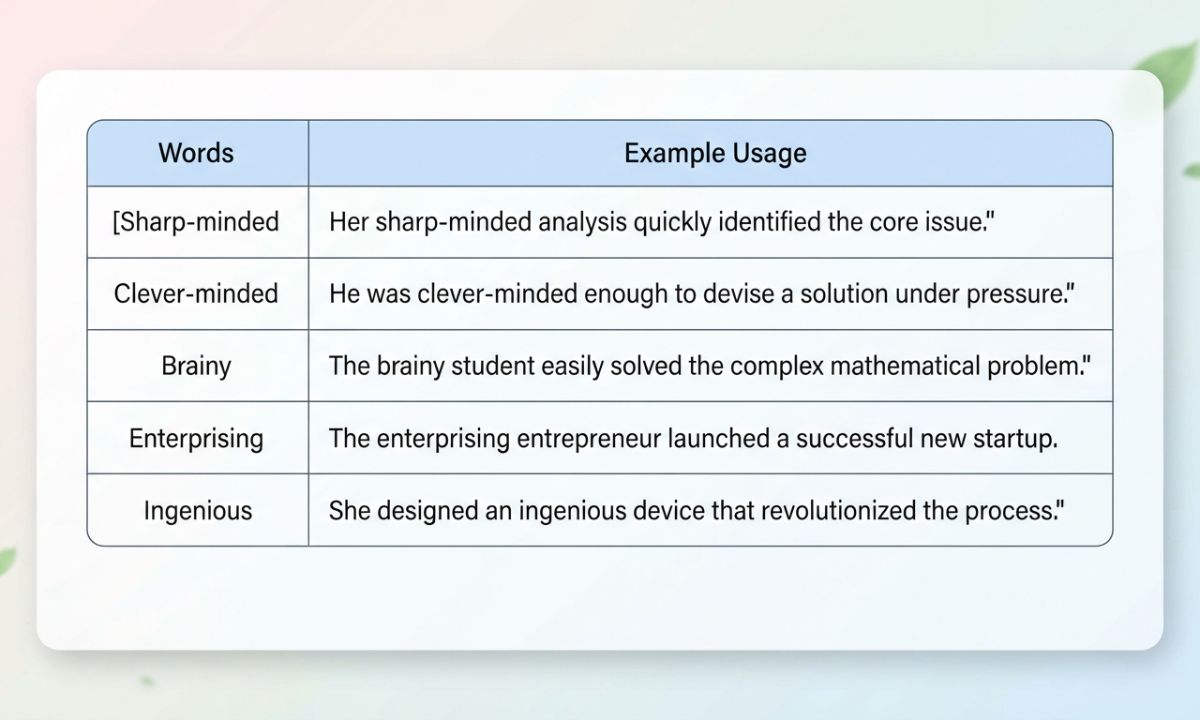
Synonyms for Savvy as a Verb: Understanding and Comprehension
The verb sense of savvy means “to understand.” These alternatives work in modern writing.
Understand
Meaning: To know what something means.
Understand is clear and kind. It builds trust because it is plain and honest. Everyone hears it the same way.
- I understand why you chose that plan.
- Do you understand the instructions?
When It Fits: Checking clarity in a friendly conversation.
Pronunciation: un-der-STAND
Grasp
Meaning: To understand an idea fully.
Grasp gives a sense of firm hold. It shows the idea sank in. It feels active and satisfying.
- She quickly grasped the new system.
- I still cannot grasp the rules of cricket.
When It Fits: Talking about learning a new concept.
Pronunciation: GRASP
Comprehend
Meaning: To fully take in the meaning of something.
Comprehend sounds thoughtful and a bit formal. It signals deep, careful understanding. It works well in teaching and writing.
- Young readers can comprehend the story’s message.
- I struggled to comprehend the contract.
When It Fits: Describing how well someone follows a complex text.
Pronunciation: kom-prih-HEND
Fathom
Meaning: To understand something deep or hard.
Fathom adds a note of wonder or struggle. It admits that the idea is hard to reach. That honesty makes your tone humble and human.
- I cannot fathom why he quit.
- She tried to fathom the size of the universe.
When It Fits: Reacting to something puzzling or surprising.
Pronunciation: FATH-um
Perceive
Meaning: To notice or understand through careful attention.
Perceive shows quiet insight. It suggests that someone sees below the surface. It carries a thoughtful, mature tone.
- Few people perceive the risks early.
- I perceived a change in her mood.
When It Fits: Describing subtle observations in a meeting or story.
Pronunciation: per-SEEV
Catch On
Meaning: To begin to understand, often quickly.
Catch on feels light and encouraging. It celebrates the moment learning clicks. Learners hear it as a warm boost.
- The kids caught on to the game in minutes.
- He caught on to the trick right away.
When It Fits: Cheering a beginner who learns fast.
Pronunciation: KACH ON
Realize
Meaning: To become aware of a fact or truth.
Realize marks a clear turning point. It tells the reader that understanding just arrived. That moment draws attention and emotion.
- She realized the deadline had moved.
- I realize now that I misread the email.
When It Fits: Sharing a sudden insight with a friend.
Pronunciation: REE-uh-lyz
Informal and Strategic Synonyms for Savvy
These words sound casual or carry a sharper edge. Some are compliments. Others hint at manipulation. Choose with care.
On the Ball
Meaning: Alert, prepared, and quick to act.
On the ball feels upbeat and friendly. It praises someone in a casual, teammate-like way. It sounds natural in offices and sports.
- Our new hire is really on the ball.
- She stayed on the ball during the busy week.
When It Fits: Praising a coworker during a rush.
Pronunciation: on thuh BAWL
In the Know
Meaning: Well informed, especially about inside or current details.
In the know gives a warm sense of belonging. It shows that someone shares the right information at the right time. It makes people feel included.
- Ask Maria; she is always in the know.
- Locals in the know avoid the highway at noon.
When It Fits: Chatting about neighborhood tips or office news.
Pronunciation: in THUH NOH
Crafty
Meaning: Clever, sometimes in a sneaky way.
Crafty adds a wink. It can sound playful or slightly suspicious. Use it carefully because tone matters.
- The crafty fox slipped past the guard.
- She found a crafty way around the rule.
When It Fits: Joking about a clever workaround.
Pronunciation: KRAF-tee
Cunning
Meaning: Clever in a way that often involves trickery.
Cunning carries a strong warning tone. It usually suggests self-interest or deceit. Do not use it as a compliment unless the context is clear.
- The villain devised a cunning plan.
- He was cunning enough to hide the truth.
When It Fits: Describing a sly character in a story or a tricky rival.
Pronunciation: KUN-ing
Synonyms for “Tech-Savvy,” “Business-Savvy,” and Other Compound Forms
Savvy pairs well with fields and topics. Here are better alternatives for common compounds.
| Compound | Meaning | Better Alternatives |
| Tech-savvy | Comfortable with technology | digitally literate, technically skilled, computer-literate |
| Business-savvy | Understands how companies work | commercially aware, business-minded, entrepreneurial |
| Financially savvy | Understands money and risk | financially literate, money-wise, financially knowledgeable |
| Politically savvy | Reads power and public opinion | politically astute, strategically aware, diplomatic |
| Street-savvy | Handles real-world risks | streetwise, street-smart, worldly |
| Media-savvy | Understands publicity and messaging | media-literate, media-aware, publicity-conscious |
| Socially savvy | Reads people and social cues | socially perceptive, emotionally intelligent, tactful |
Use the compound form when the field matters. Use a single stronger word when it does not.
Positive vs Negative Synonyms for Savvy
Savvy is a compliment. Some synonyms are not.
Clearly positive: knowledgeable, resourceful, perceptive, judicious, adept
Neutral or mixed: shrewd, canny, sharp, savvy
Risky or negative: cunning, crafty, calculating, scheming
If you want to praise someone, stay in the first two groups. Use the third group only when you want to signal trickery.
Formal vs Informal Synonyms for Savvy
Your setting decides the best word.
Formal or professional writing:
- Knowledgeable, proficient, astute, discerning, acumen, expertise
Neutral, everyday writing:
- Smart, experienced, resourceful, perceptive
Casual speech:
- On the ball, in the know, know-how, sharp
Savvy itself sits in the middle. It works in most business writing and media, but a formal report may prefer “knowledgeable” or “astute.”
Common Mistakes With Savvy
A few small errors weaken otherwise good writing.
Misspelling it as “savy.” Always use two v’s.
Treating savvy as general intelligence. It means practical smarts, not just IQ.
Using “expertise” for basic familiarity. Expertise implies deep skill.
Using “cunning” as praise. It hints at deceit.
Treating “know-how” as formal. It is friendly and casual.
Adding “a” before the noun. Say “business savvy,” not “a business savvy.”
Antonyms and Opposite Words for Savvy
Opposites of savvy fall into three groups. Match the group to what is missing.
Lack of knowledge:
- Uninformed, ignorant, unaware, clueless
Lack of experience:
- Naive, inexperienced, green, unseasoned
Poor judgment:
- Gullible, foolish, obtuse, unwise
Many of these words sound harsh. Soften them when you speak about a real person. “New to the field” is kinder than “clueless.”
How to Choose the Right Synonym for Savvy
Use this quick three-step check.
- Name the idea. Knowledge, skill, judgment, or understanding.
- Choose your tone. Formal, neutral, casual, or playful.
- Check the connotation. Positive, neutral, or slightly sly.
Then read the sentence aloud. If it sounds natural, keep it.
Frequently Asked Questions
What is another word for savvy?
Knowledgeable, astute, shrewd, and experienced are the most common alternatives.
What is a formal word for savvy?
Astute, proficient, and knowledgeable suit professional writing best.
What is the difference between savvy and smart?
Savvy stresses practical, experience-based judgment, while smart describes general mental ability.
Can savvy be used as a noun?
Yes, as in “business savvy,” which means practical know-how.
What is the opposite of savvy?
Naive is the closest opposite, along with clueless, uninformed, and gullible.
Conclusion
Savvy is a strong word, but it works best when you know exactly what you want it to say. Reach for “knowledgeable” when you mean informed, “expertise” when you mean deep skill, and “astute” when you mean sharp judgment.
Use verbs like “grasp” and “comprehend” when the point is understanding, and save words like “crafty” and “cunning” for moments when a hint of trickery fits. Match the meaning, check the tone, and read the sentence out loud. Do that each time, and your writing will sound both smarter and more precise.

[…] Synonym for Savvy: 35 Smart Words With Meanings and Examples […]