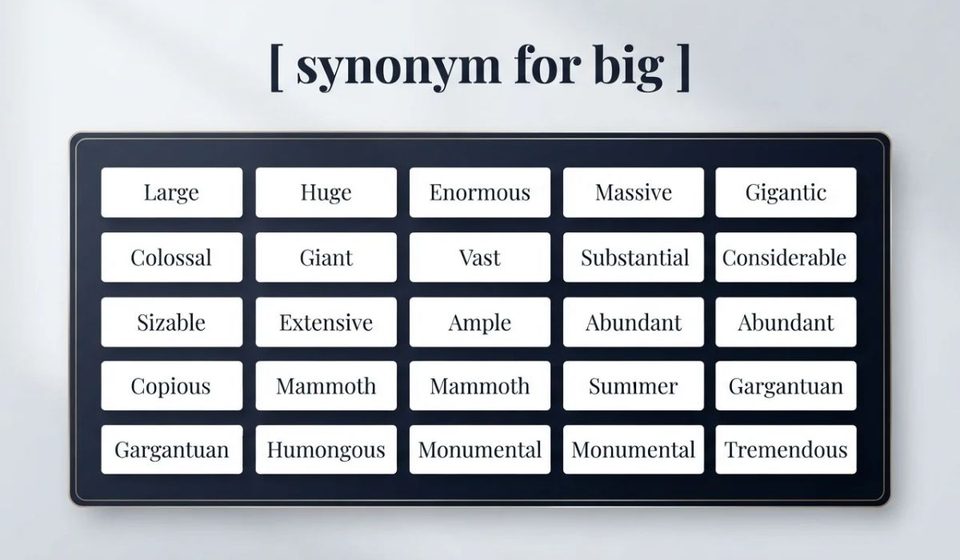

“Big” works in almost every sentence. That is also its weakness. It says something is large, but it never says how, why, or how much. A better word makes your point sharper and your writing stronger. This guide gives you 30 alternatives, each with a meaning, examples, and a pronunciation. You will also learn which word fits size, amount, area, importance, and impact.
What Is the Best Synonym for Big?
The best all-purpose synonym for big is large. It is neutral, clear, and works in both casual and formal writing. For a stronger effect, use “huge” or “enormous.” For importance, use major or significant. For amounts, use substantial or considerable.
No single word wins every time. “Big” has several meanings, so the right replacement depends on what you want to say:
- Size: a big house, a big tree, a big truck
- Amount: a big number, a big crowd, a big budget
- Importance: a big decision, a big name, a big story
- Intensity: a big mistake, a big surprise, a big change
- Age: a big sister, a big kid (this one is informal and has no true swap)
Match the word to the meaning. That single habit fixes most word-choice problems.
Big vs Large: What Is the Difference?
Both words describe size, and you can often swap them. The difference is tone.
- Big sounds casual and personal. It fits speech, stories, and emotion.
- Large sounds neutral and measured. It fits reports, essays, and business writing.
“A big decision” sounds natural. “A large decision” sounds odd. On the other hand, “a large sample” sounds better than “a big sample” in a research paper.
Use “large” when you measure something. Use “big” when you feel something.
How Strong Is Each Synonym for Big?
Some words say “a little bigger than average.” Others say “almost beyond belief.” This scale helps you pick the right level.
| Strength | Words | Tone |
| Mild | large, sizable, considerable, substantial | Neutral to formal |
| Strong | huge, massive, vast, immense, enormous | Neutral to emphatic |
| Extreme | gigantic, colossal, mammoth, gargantuan | Vivid or dramatic |
| Informal | humongous, whopping | Casual and playful |
Choose one step above what you need. If “large” feels flat, try “huge.” If “huge” feels flat, try “enormous.” Do not jump straight to “gargantuan” unless the moment calls for it.
Synonyms for Big Size: Words From Large to Colossal
These words describe physical size. They cover objects, buildings, animals, and anything you can see or measure.
Large
Meaning: Greater than average in size, amount, or scope.
Large is calm and steady. It signals that you are stating a fact, not chasing drama. Readers trust it because it never oversells the point.
- The company hired a large team for the launch.
- She carried a large bag to the airport.
When It Fits: Describing a product size, like a large coffee.
Pronunciation: LARJ
Huge
Meaning: Very big, well above the normal range.
Huge adds energy without sounding stiff. It shows real surprise or admiration. Your reader feels the scale right away.
- A huge wave rolled onto the beach.
- That was a huge win for our small team.
When It Fits: Reacting to something surprising, like a giant slice of pizza.
Pronunciation: HYOOJ
Enormous
Meaning: Extremely large, often beyond what you expected.
Enormous carries more weight than “huge.” It signals awe or seriousness. It also works well when the size feels a bit overwhelming.
- An enormous oak tree shaded the whole yard.
- The project required an enormous amount of data.
When It Fits: Describing something that stops you in your tracks, like a stadium.
Pronunciation: ih-NOR-mus
Massive
Meaning: Very large, heavy, and solid.
Massive gives a sense of weight and presence. It tells the reader the object is not just big but dense and powerful. That makes it strong for both things and events.
- A massive boulder blocked the trail.
- The storm caused massive damage across the coast.
When It Fits: Talking about something heavy or solid, like a truck or a building.
Pronunciation: MASS-iv
Gigantic
Meaning: Extremely large, almost unbelievable in size.
Gigantic creates a strong picture. It carries a touch of wonder or humor. Readers imagine something towering.
- A gigantic screen filled the front of the theater.
- The kids built a gigantic sandcastle.
When It Fits: Describing something that looks oversized, like a movie screen or a snowman.
Pronunciation: jy-GAN-tik
Immense
Meaning: Very large, often used for scale that is hard to measure.
Immense sounds thoughtful and a bit formal. It signals deep respect for the scale of something. It works for both physical size and abstract things like effort or pride.
- The team took immense pride in the result.
- An immense canyon stretched below the lookout.
When It Fits: Describing something moving or grand, like a mountain range.
Pronunciation: ih-MENSS
Colossal
Meaning: Overwhelmingly large, often impressive.
Colossal adds drama and a sense of achievement. It makes the reader stop and look. Use it when the scale truly earns attention.
- The city built a colossal statue by the harbor.
- The delay was a colossal waste of money.
When It Fits: Describing a landmark or a huge mistake.
Pronunciation: kuh-LOSS-ul
Gargantuan
Meaning: Enormous in a dramatic, almost comic way.
Gargantuan is playful and theatrical. It tells the reader you are having fun with the scale. Use it sparingly so it keeps its punch.
- He ordered a gargantuan burger and finished half.
- Moving the piano turned into a gargantuan task.
When It Fits: Joking about a giant meal or a tough chore.
Pronunciation: gar-GAN-choo-un
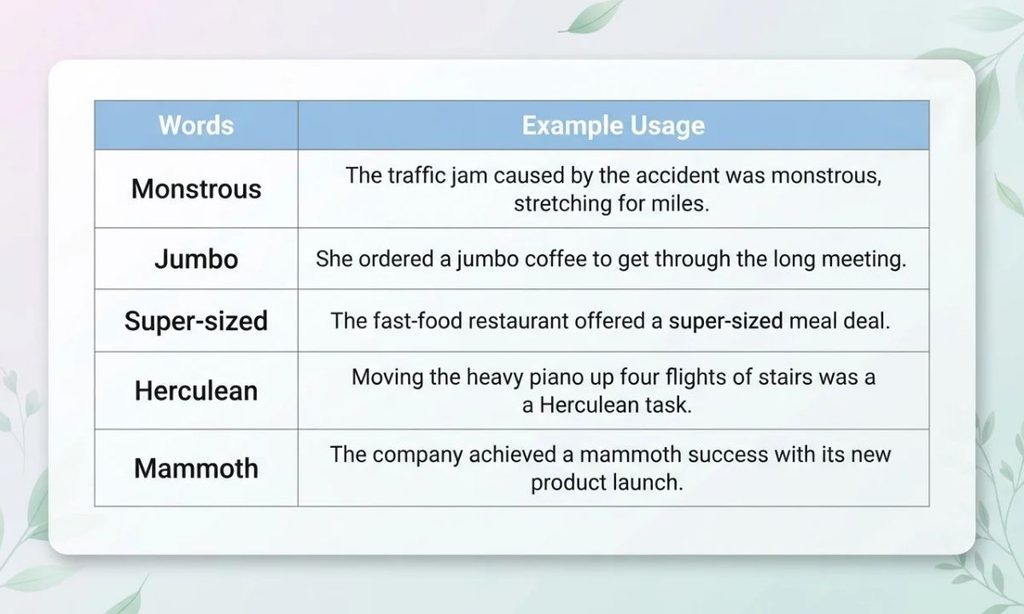
Mammoth
Meaning: Huge in size or scale, often used for big projects.
Mammoth suggests something heavy and hard to move. It signals effort and scale in one word. Readers sense both size and difficulty.
- The city launched a mammoth road project.
- She faced a mammoth pile of paperwork.
When It Fits: Describing a big task at work, like a huge cleanup.
Pronunciation: MAM-uth
Humongous
Meaning: Informal word for something extremely big.
Humongous feels warm and playful. It makes your tone friendly and lively. Kids and adults both enjoy it in casual talk.
- We found a humongous pumpkin at the farm.
- That is a humongous pile of laundry.
When It Fits: Chatting with friends about something oversized.
Pronunciation: hyoo-MUNG-gus
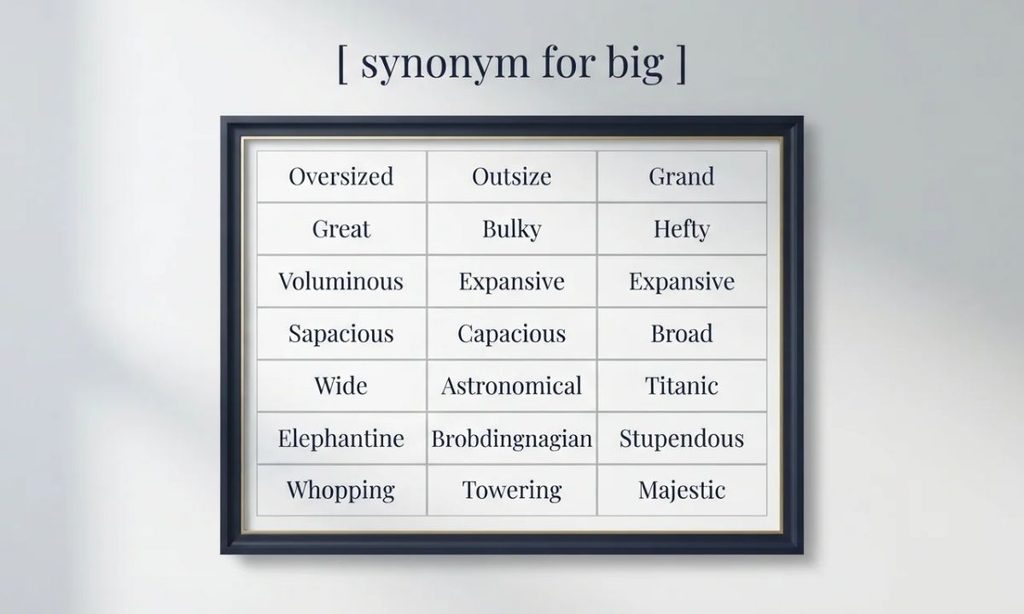
Synonyms for Big Areas and Spaces
Some words describe land, rooms, and reach. They give a sense of space more than weight.
Vast
Meaning: Very large in area, range, or amount.
Vast opens up the scene. It helps readers picture wide open land or endless knowledge. It carries a calm sense of wonder.
- A vast desert stretched to the horizon.
- The library holds a vast collection of maps.
When It Fits: Describing landscapes, oceans, or huge collections.
Pronunciation: VAST
Spacious
Meaning: Having plenty of room inside.
Spacious feels comfortable and welcoming. It tells the reader they will not feel cramped. It works well in descriptions meant to attract or reassure.
- The hotel room felt bright and spacious.
- They rented a spacious apartment near the park.
When It Fits: Describing a home, car, or office with room to move.
Pronunciation: SPAY-shus
Expansive
Meaning: Covering a wide area or scope.
Expansive suggests openness and reach. It makes your subject sound generous and free. It works for both places and ideas.
- The house has an expansive back lawn.
- She gave an expansive answer that covered every detail.
When It Fits: Describing wide views, wide plans, or wide-ranging talks.
Pronunciation: ik-SPAN-siv
Extensive
Meaning: Wide in coverage, range, or detail.
Extensive signals thoroughness. It tells the reader that nothing was skipped. That builds trust in research, damage reports, and experience.
- The report includes extensive research.
- Flooding caused extensive damage to the town.
When It Fits: Describing a resume, a study, or a repair job.
Pronunciation: ik-STEN-siv
Synonyms for a Big Amount or Number
These words describe how much or how many. Pick them for money, data, supplies, and crowds.
Substantial
Meaning: Large in amount, value, or impact.
Substantial sounds solid and serious. It tells the reader the amount matters. That makes it a top pick for business, finance, and evidence.
- The firm made a substantial investment.
- We found substantial evidence to support the claim.
When It Fits: Discussing money, profit, or real progress at work.
Pronunciation: sub-STAN-shul
Considerable
Meaning: Noticeably large in amount or degree.
Considerable is measured and fair. It shows you saw the scale and took it seriously. It sounds professional without sounding cold.
- She spent considerable time on the design.
- The event drew considerable attention.
When It Fits: Describing effort, time, or attention in an email.
Pronunciation: kun-SID-er-uh-bul
Explore More Synonyms Guide
Synonyms for Love: 40 Words for Romance, Care, and Devotion
30 Perspective Synonyms to Add Depth to Your Writing
25 Other Ways to Say “Nuance”: Examples and Usage
Sizable
Meaning: Fairly large in amount or size.
Sizable sits between “large” and “huge.” It keeps your tone calm while still showing scale. Readers see a real amount but not a shock.
- The bakery earned a sizable profit last month.
- A sizable crowd gathered outside.
When It Fits: Describing a crowd, a bill, or a bonus.
Pronunciation: SY-zuh-bul
Ample
Meaning: More than enough.
Ample carries a sense of comfort. It tells the reader they will not run short. That reassurance makes it a friendly word for planning.
- The trunk offers ample room for luggage.
- We left ample time to reach the airport.
When It Fits: Reassuring someone about time, space, or supplies.
Pronunciation: AM-pul
Abundant
Meaning: Existing in large quantities, often naturally.
Abundant sounds rich and generous. It paints a picture of plenty. Readers feel a sense of ease and health.
- The valley has abundant sunshine and fresh water.
- The market offered abundant fruit.
When It Fits: Describing crops, resources, or natural supplies.
Pronunciation: uh-BUN-dunt
Copious
Meaning: Large in supply, often used in formal or written contexts.
Copious adds a slightly polished tone. It suggests care and thoroughness. Use it for notes, records, and detailed writing.
- She took copious notes during the lecture.
- The recipe calls for copious amounts of garlic.
When It Fits: Describing notes, tears, or generous portions.
Pronunciation: KOH-pee-us
Numerous
Meaning: Many, used for items you can count.
Numerous is clear and objective. It tells the reader the count is high without hype. That works well for research and reports.
- Numerous studies support this finding.
- Numerous applicants sent resumes.
When It Fits: Referring to countable things like studies, emails, or examples.
Pronunciation: NOO-mer-us
Synonyms for Big Importance and Influence
Sometimes “big” means “matters a lot.” These words focus on weight and impact, not size.
Major
Meaning: Important, serious, or high in priority.
Major is direct and easy to trust. It signals a clear level of importance in a single word. That makes it perfect for plans, problems, and headlines.
- The board approved a major change to the plan.
- We found a major flaw in the design.
When It Fits: Flagging a key issue in a meeting.
Pronunciation: MAY-jer
Significant
Meaning: Important enough to matter, often in a measurable way.
Significant sounds thoughtful and precise. It tells the reader you looked carefully and found real impact. It fits research and professional writing.
- The new tool led to a significant improvement.
- The study found a significant increase in sales.
When It Fits: Reporting results in a work update.
Pronunciation: sig-NIF-ih-kunt
Monumental
Meaning: Of great and lasting importance.
Monumental raises the stakes. It signals that something will be remembered. Readers feel history, effort, or pride.
- Passing the exam was a monumental moment for her.
- The court made a monumental decision.
When It Fits: Marking a life milestone or a landmark event.
Pronunciation: mon-yuh-MEN-tul
Influential
Meaning: Having strong power to shape others.
Influential focuses on impact, not size. It gives credit to a person or idea that moves others. That respect makes it a strong word for praise.
- She is an influential voice in modern design.
- That book proved deeply influential.
When It Fits: Describing a leader, teacher, or mentor.
Pronunciation: in-floo-EN-shul
Prominent
Meaning: Well known or easy to notice.
Prominent signals status and visibility. It tells the reader someone or something stands out. That helps when you introduce experts or public figures.
- A prominent doctor spoke at the event.
- The logo sits in a prominent spot on the page.
When It Fits: Introducing a speaker or highlighting a design feature.
Pronunciation: PROM-ih-nunt
Synonyms for Big Impact and Intensity
These words describe strong effects, sharp results, and dramatic shifts. They work well for change, success, and emotion.
Whopping
Meaning: Informal word for surprisingly large.
Whopping brings a playful punch. It signals that the number surprised you. Readers lean in to see the number.
- The bill came to a whopping two thousand dollars.
- He won by a whopping margin.
When It Fits: Sharing a surprising number in casual talk.
Pronunciation: WOP-ing
Tremendous
Meaning: Very great in size, amount, or degree.
Tremendous sounds warm and generous. It adds real admiration to praise. Readers feel the enthusiasm behind it.
- The team made tremendous progress this quarter.
- Thank you for your tremendous support.
When It Fits: Thanking a friend or praising a coworker.
Pronunciation: trih-MEN-dus
Sweeping
Meaning: Wide in effect, covering many areas at once.
Sweeping tells readers a change reaches far. It suggests bold action. That makes it ideal for policy, reform, and big shifts.
- The city passed sweeping changes to its parking rules.
- The company announced sweeping cuts.
When It Fits: Describing broad reforms or large-scale updates.
Pronunciation: SWEE-ping
Staggering
Meaning: So large it is hard to believe.
Staggering hits with emotional force. It signals shock, awe, or concern. Readers feel the weight of the number.
- The staggering cost surprised everyone.
- She read a staggering number of books last year.
When It Fits: Reacting to a shocking figure in the news.
Pronunciation: STAG-er-ing
Best Synonyms for Big by Situation
Sometimes you already know the phrase. You just need a stronger version. This table maps common “big + noun” pairs to better options.
| Phrase | Better Options |
| Big success | major success, tremendous success, monumental achievement |
| Big problem | serious problem, major problem, significant challenge |
| Big change | sweeping change, significant change, substantial shift |
| Big amount | substantial amount, considerable amount, ample supply |
| Big number | large number, numerous items, staggering total |
| Big area | vast area, expansive region, extensive territory |
| Big business | major company, large-scale operation, influential firm |
| Big impact | significant effect, far-reaching impact, tremendous influence |
Formal vs Informal Synonyms for Big
Your audience decides the tone. Use this quick guide.
Formal or professional writing:
- Large, substantial, considerable, significant, extensive, major
Neutral, everyday writing:
- Huge, enormous, massive, vast, spacious
Casual speech:
- Humongous, whopping, tremendous
Dramatic or literary writing:
- Colossal, gargantuan, monumental, staggering
For an academic paper, “significant” and “substantial” work best. For a friendly email, “huge” and “tremendous” feel natural. For a story, “colossal” and “gargantuan” add color.
Common Mistakes When Replacing “Big”
Swapping words without care can change your meaning. Watch for these traps.
Using a size word for importance. “A massive decision” sounds odd. “A major decision” sounds right.
Using informal words in formal writing. “Humongous” does not belong in a business report.
Using “vast” for small objects. Reserve it for space, range, or quantity.
Mixing up countable and uncountable nouns. Use “numerous” with items you can count. Use “substantial” or “considerable” with amounts like money or time.
Changing fixed phrases. “Big sister” means an older sister. “Large sister” changes the meaning entirely.
Confusing “great.” It can mean large or excellent. Context must make the meaning clear.
Ignoring sensitivity. Words like “hefty” or “bulky” can sound rude when used for people. Choose kind, neutral language.
Antonyms of Big
Opposites work the same way. Match the meaning.
- Small size: small, little, tiny, compact, miniature
- Low importance: minor, insignificant, negligible, trivial
- Small amount: slight, modest, limited, meager
“A small problem” and “a minor problem” both work, but they mean slightly different things. One suggests size and the other suggests importance.
How to Choose the Right Synonym for Big
Use this quick three-step check.
- Ask what “big” describes. Size, amount, area, importance, or impact.
- Pick your tone. Formal, neutral, casual, or dramatic.
- Choose your strength. Mild, strong, or extreme.
Then read the sentence out loud. If it sounds natural, keep it. If it sounds forced, try a simpler word.
Frequently Asked Questions
What is another word for big?
Large is the most common neutral alternative, and huge, enormous, and massive add more force.
What is a formal word for big?
Substantial, significant, considerable, and extensive work is best in academic and professional writing.
What is a stronger word than big?
Enormous, colossal, and gigantic all express a larger scale than big.
Is “large” more formal than “big”?
Yes, large sounds are more neutral and formal, while big sounds are casual and conversational.
What is the opposite of big?
Small is the most direct opposite, with minor and insignificant covering low importance.
Conclusion
Big is a useful word, but it rarely carries the full weight of what you mean. When you swap it for a word that fits your size, amount, area, or importance, your writing sounds sharper and more confident. Start with the meaning, pick the right tone, then choose a strength that matches your message. Keep this list close, test each word in a sentence, and you will never settle for “big” out of habit again.