

You’re typing a quick reply. Someone just told you they missed their flight. Your fingers move fast, and you type “to bad.” Something feels off, but you’re not sure why. Is it “to bad” or “too bad”? This mix-up happens constantly, even to people who write well every day. Here’s the full answer, along with everything else you need to use this phrase correctly.
Quick Answer: “Too Bad” Is Correct
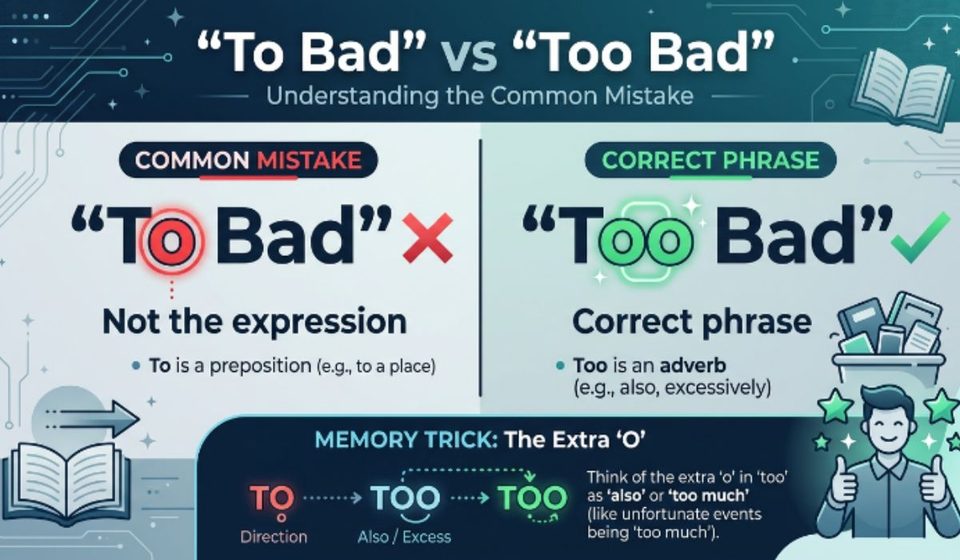
“Too bad” is the correct spelling when you’re expressing sympathy, disappointment, or an unfortunate situation. “To bad” is not a standard expression in English.
- ✅ “That’s too bad.”
- ❌ “That’s to bad.”
- ✅ “It’s too bad you couldn’t come.”
- ❌ “It’s to bad you couldn’t come.”
The confusion happens because “to” and “too” sound exactly the same when spoken. Your ear can’t tell them apart, so your fingers sometimes pick the wrong one without you noticing.
There’s one small exception worth knowing early. “To” can appear right before “bad” in a completely different kind of sentence, one about change or movement, like “the weather went from good to bad.” That’s not the same phrase, and we’ll break down that distinction later.
Why “To” and “Too” Get Confused
“To” and “too” are homophones. They’re pronounced identically, but they serve completely different grammatical jobs.
“To” is a preposition or part of an infinitive verb. It shows direction, connection, or a verb form.
“Too” is an adverb. It means “excessively” or “also.”
Because English relies on spelling to separate these meanings, and because typing happens fast, this mix-up ranks among the most common small errors in casual writing. It sits in the same category as:
- “Your” vs. “you’re”
- “Their,” “there,” and “they’re”
- “Affect” vs. “effect”
None of these errors change how a sentence sounds out loud. They only show up on the page.
What Does “Too Bad” Actually Mean?
“Too bad” is a flexible expression. It can carry several different emotional tones depending on the situation and how it’s delivered.
Here’s what it typically communicates:
Sympathy – “That’s too bad. I’m sorry to hear that.”
Disappointment – “It’s too bad the trip got canceled.”
Regret – “Too bad we didn’t get tickets in time.”
Indifference – “You didn’t finish? Too bad.”
Literal excess – “The milk was too bad to drink.”
That last example uses “too” in its most basic sense, meaning “excessively.” The others use the phrase idiomatically, as a fixed reaction to disappointing news.
Literal Meaning vs. Idiomatic Meaning
This distinction matters more than most guides admit, and it’s the easiest way to fully understand the phrase.
Literal Use
When “too” modifies “bad” literally, it means something crossed a threshold of acceptability.
- “The fish was too bad to eat.”
- “The road conditions were too bad to drive on.”
- “The signal was too bad to hear anything.”
In each case, something failed to meet a basic standard. “Too” here works the same way it does in “too hot,” “too small,” or “too far.”
Idiomatic Use
When “too bad” reacts to a piece of news or a situation, it’s not describing a literal degree of badness anymore. It’s functioning as a set phrase.
- “Too bad you missed the show.”
- “That’s too bad.”
- “Too bad about the weather.”
Nobody’s measuring exact badness here. The phrase has become shorthand for “that’s unfortunate” or “I’m sorry that happened.”
Knowing which use you’re dealing with helps you understand tone faster, especially in writing where you can’t hear a speaker’s voice.
Common Sentence Patterns
“Too bad” shows up in a handful of recurring structures. Recognizing these patterns makes the phrase easier to use correctly and naturally.
“It’s too bad that…” (used with added information)
“That’s too bad.” (a standalone reaction)
“Too bad!” (a short, casual exclamation)
“Too bad you couldn’t…” (regret about someone’s situation)
“Too bad about…” (a brief comment on a topic)
“Too bad, but…” (acknowledgment followed by a shift in tone)
A quick example set:
- “It’s too bad that the concert got rained out.”
- “You lost the game? That’s too bad.”
- “Too bad! Maybe next time.”
- “Too bad you couldn’t make it to the wedding.”
- “Too bad about your car. That’s rough.”
When “To Bad” Actually Works in a Sentence
This is the part most explanations skip entirely. “To” can sit right next to “bad,” but only inside a larger structure about transition or change, never as a standalone reaction.
Examples where “to bad” is grammatically fine:
- “The relationship went from good to bad very quickly.”
- “Her mood shifted from cheerful to bad within minutes.”
- “The product’s quality declined from acceptable to bad.”
In each case, “to” is doing its normal job: connecting two points along a path of change. It has nothing to do with the sympathetic or disappointed expression you’d use after hearing bad news.
The rule of thumb: if “bad” is one end of a transformation (“from X to bad”), “to” is correct. If you’re reacting to news or a situation on its own, you need “too.”
“Too Bad” vs. “Very Bad”
These two phrases often get treated as interchangeable, but they carry slightly different implications.
| Phrase | What it suggests |
| “Very bad” | A high degree of badness, stated plainly |
| “Too bad” | Badness beyond what’s acceptable, or a reaction of regret |
- “The weather is very bad today.” (a plain description)
- “The weather is too bad for a picnic.” (badness that ruins a specific plan)
“Too bad” often implies a consequence or a threshold being crossed. “Very bad” is more neutral and descriptive.
Explore More Grammar Guide
As Well or Aswell: The Correct Spelling, Explained
“Too Bad” vs. “So Bad”
“So bad” tends to carry more emotional intensity and often sets up a comparison or result.
- “The movie was so bad we left early.”
- “The movie was too bad to recommend.”
“So bad” frequently pairs with a result clause (“so bad that…”). “Too bad” more often stands alone or implies a limit was crossed. They overlap in meaning but aren’t always swappable without changing the tone slightly.
“Too Bad” vs. “Too Badly”
This comparison trips people up because both phrases look similar, but they follow different grammar.
“Too bad” = adverb (“too”) + adjective (“bad”). It describes a noun or reacts to a situation.
“Too badly” = adverb (“too”) + adverb (“badly”). It describes how an action was performed.
Examples:
“He was injured too badly to keep playing.” (describes how badly he was hurt, modifying the verb)
“She wanted the promotion too badly to give up.” (describes the intensity of her wanting)
“That’s too bad.” (a reaction, not describing an action)
“Too badly” isn’t automatically wrong, despite what some quick guides suggest. It’s simply a different construction used for different sentences.
How Tone Changes the Meaning
“Too bad” doesn’t always sound sympathetic. Depending on delivery, it can land anywhere from warm to dismissive.
Warm and sympathetic: “I’m really sorry. That’s too bad. Let me know if I can help.”
Neutral: “Too bad, I guess we’ll try again next week.”
Dismissive or sarcastic: “You forgot your homework? Too bad.”
A short, standalone “too bad” with no added context can come across as cold or uncaring, especially in text messages where tone is already hard to read. Adding a supportive sentence after it softens the phrase considerably.
If you want to sound more empathetic, try:
- “That’s too bad. I hope things get better soon.”
- “Too bad about the trip. Let’s plan something else.”
- “That’s really too bad. I’m sorry you’re dealing with that.”
Is “Too Bad” Formal or Informal?
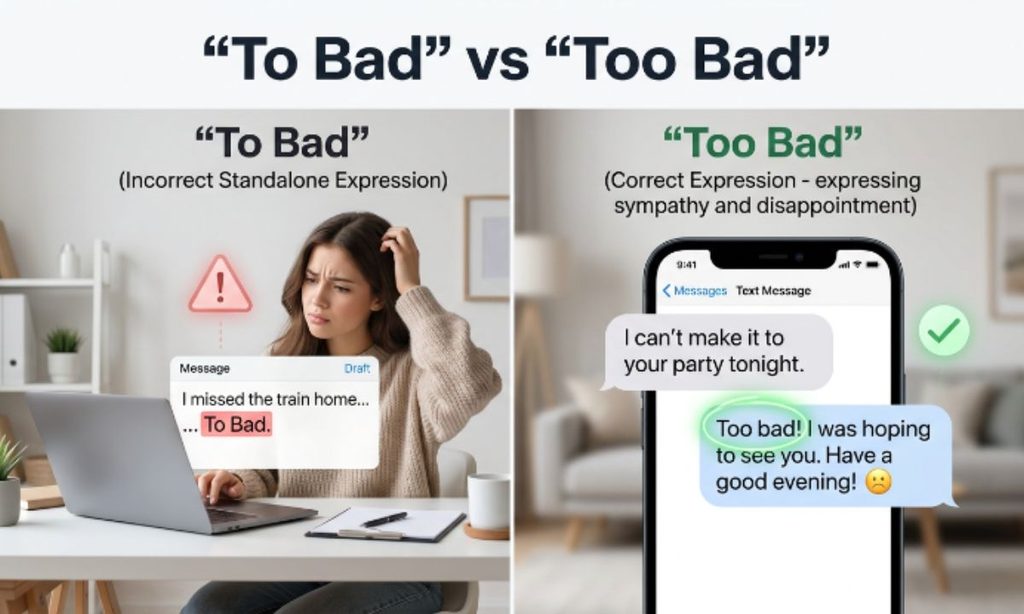
“Too bad” is generally informal. It fits naturally in:
- Text messages
- Casual emails
- Conversations
- Social media posts
In more formal writing, like academic papers, official reports, or professional correspondence with someone you don’t know well, it’s usually better to swap it out for something more neutral.
Formal alternatives include:
- “It is unfortunate that…”
- “It is regrettable that…”
- “Unfortunately, …”
- “Regrettably, …”
Example shift:
- Casual: “Too bad the deal fell through.”
- Formal: “It is unfortunate that the deal did not go through.”
American English vs. British English
There’s no spelling difference between American and British English here. Both use “too bad,” and both treat “to bad” as an error in this expression.
Some minor stylistic tendencies do exist:
- American English speakers may use “too bad” more casually and more often in daily conversation.
- British English speakers may lean toward slightly more reserved alternatives like “what a shame” or “that’s a pity” in similar situations.
These are soft tendencies, not grammar rules, so you won’t find a formal spelling distinction between the two varieties.
Common Mistakes to Avoid
Watch out for these frequent errors:
Writing “to bad” in texts and emails, where autocorrect often doesn’t catch it
Confusing “too” (excessive) with “very” (plain degree)
Assuming “too bad” always sounds sympathetic when tone can flip it dismissive
Swapping in “too badly” without checking if the sentence actually needs an adverb-adverb structure
Trusting pronunciation instead of checking the actual spelling before sending a message
How to Remember the Correct Spelling
A few quick tricks make this easier to get right every time:
The extra letter trick: “Too” has an extra “o,” and that extra letter matches its extra meaning, excess, addition, or emphasis.
The “very” swap test: Try replacing “too” with “very” or “excessively.” If the sentence still makes sense, “too” is correct. “That’s very bad” works, so “that’s too bad” is right.
The “also” test: If you could replace the word with “also” and the sentence still makes sense, you need “too.” (“I want to come, too” = “I want to come, also.”)
The three-second pause: Before sending a message, take one extra second to glance at “to” vs. “too.” That tiny pause catches most mistakes.
Synonyms and Alternatives for “Too Bad”
Repeating “too bad” constantly can feel repetitive, especially in writing. These alternatives carry similar meaning with slightly different tones:
- “That’s unfortunate.”
- “What a shame.”
- “That’s a pity.”
- “That’s disappointing.”
- “Unfortunately…”
- “Regrettably…”
- “Sadly…”
- “Tough luck.” (very casual, sometimes blunt)
Match the alternative to your context. “Unfortunately” and “regrettably” fit formal writing. “What a shame” and “that’s a pity” work well in warm, conversational settings. “Tough luck” leans blunt and should be used carefully, since it can sound uncaring depending on tone.
Practical Examples Across Different Contexts
Casual conversation:
- “It’s too bad we can’t meet today.”
- “Too bad! Maybe next time works better.”
Text messages:
- “Ugh, too bad your flight got delayed.”
Workplace writing:
- “It’s too bad the client declined the proposal this quarter.”
Social media:
- “Too bad it rained during the concert last night.”
News-style writing:
- “Too bad for fans, the show has officially been canceled.”
Academic or reflective writing (with a formal alternative):
Casual: “It’s too bad the opportunity was overlooked.”
Formal: “It is regrettable that the opportunity was overlooked.”
Frequently Asked Questions
Is “to bad” ever grammatically correct?
Only inside a larger phrase about change or transition, like “from good to bad,” never as a standalone reaction.
What does “too bad” mean?
It expresses sympathy, disappointment, regret, or sometimes mild indifference about an unfortunate situation.
Can “too bad” be used in formal writing?
It’s best kept informal; use “unfortunately” or “it is regrettable that” in formal contexts instead.
Is “too bad” always negative or rude?
No, its tone depends on delivery and context, ranging from warm sympathy to dismissive sarcasm.
What’s the easiest way to remember the correct spelling?
Try replacing the word with “very” or “excessively”; if the sentence still works, “too” is correct.
Conclusion
“Too bad” is the phrase you want almost every time you’re reacting to disappointing news, expressing sympathy, or describing something that’s crossed a line into being genuinely unacceptable.
“To bad” only earns its place in a sentence about change, like something shifting “from good to bad,” and even then it’s a completely different grammatical job than the reaction phrase people usually mean to type. Once you get comfortable with the quick tests, swapping in “very” or “also” to check your word choice, this mix-up stops being a guessing game and becomes second nature.


-
-
-
-
-
-
-
-
-
-
Show Comments[…] “To Bad” or “Too Bad”: Which Spelling Is Correct? […]
[…] “To Bad” or “Too Bad”: Which Spelling Is Correct? […]
[…] “To Bad” or “Too Bad”: Which Spelling Is Correct? […]
[…] “To Bad” or “Too Bad”: Which Spelling Is Correct? […]
[…] “To Bad” or “Too Bad”: Which Spelling Is Correct? […]
[…] “To Bad” or “Too Bad”: Which Spelling Is Correct? […]
[…] “To Bad” or “Too Bad”: Which Spelling Is Correct? […]
[…] “To Bad” or “Too Bad”: Which Spelling Is Correct? […]
[…] “To Bad” or “Too Bad”: Which Spelling Is Correct? […]
[…] “To Bad” or “Too Bad”: Which Spelling Is Correct? […]