

You typed “alot” in a text message. Then you paused. Something felt off. You’re not alone — this is one of the most common spelling mix-ups in English. The good news is the rule is simple once you see it clearly. This guide breaks down the correct spelling, the real meaning, and how to never mix it up again.
Quick Answer: Is It “A Lot” or “Alot”?
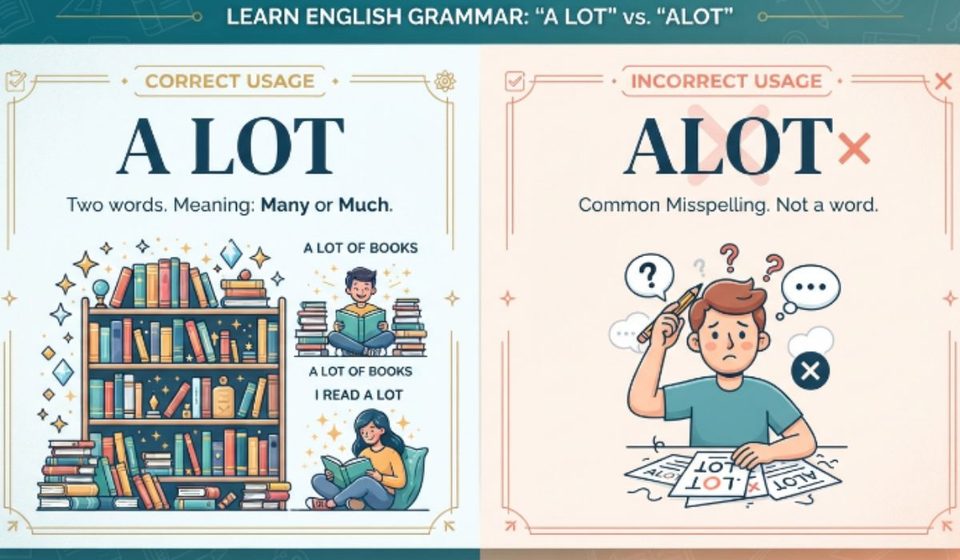
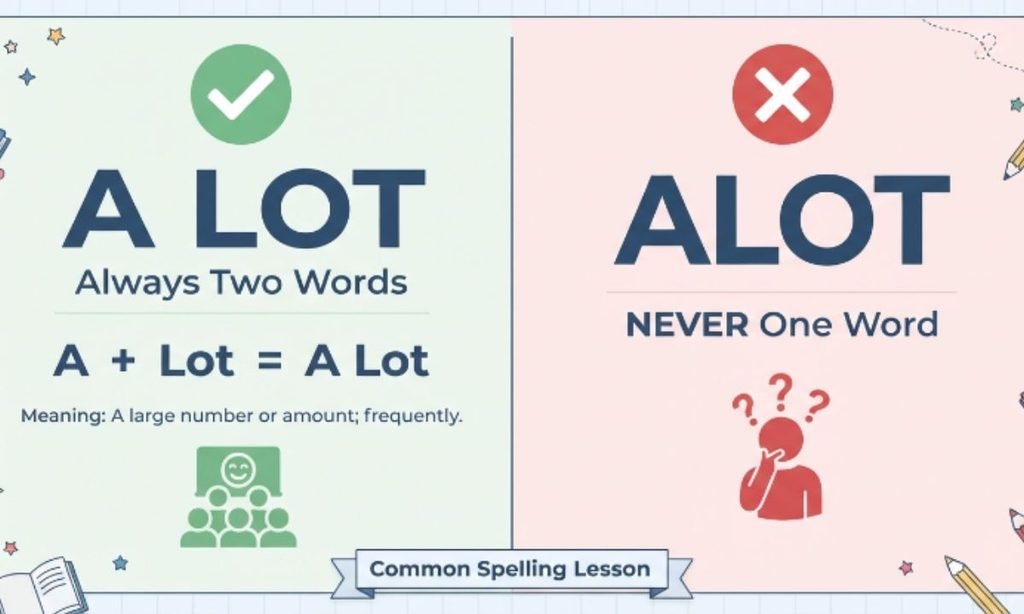
“A lot” is correct. “Alot” is not a real word.
- “A lot” is always written as two separate words.
- It means many, much, a large amount, or often.
- “Alot” is a common misspelling that should be avoided in any writing you want to look polished.
- “Allot” is a completely different word — a verb meaning to assign or distribute.
If you remember nothing else from this article, remember that one line.
Why “A Lot” Is Two Words, Not One
English combines words into one all the time — “cannot,” “another,” “itself.” So why not “alot”? Here’s the simple reason.
“A” is the indefinite article, the same one you use in “a dog” or “a house.”
“Lot” is a noun meaning a large quantity or a significant amount.
The two stay separate because “a” is doing its normal job — introducing a noun — not merging into it.
A simple test: try inserting “whole” in the middle.
“I have a whole lot of homework” — this works, which proves “a” and “lot” are two independent words.
You could never say “I have a whole car” and expect “acar” to make sense either.
This is the same logic behind phrases like “a dozen” or “a bunch.” Nobody writes “adozen.”
Is “Alot” Ever a Real Word?
No. “Alot” does not appear as a standard entry in any major dictionary. It shows up constantly in texts, social media, and casual emails, but frequency of use doesn’t equal correctness.
Spellcheckers usually flag “alot” as an error.
Teachers and editors mark it as a mistake in formal writing.
It likely spread because English speakers merge similar short phrases in casual typing — think “alright” (which is at least somewhat accepted) versus “alot” (which is not).
If you’ve been writing “alot” for years, you’re in good company. It’s one of the most frequently searched spelling questions in English. But now you know better.
What Does “A Lot” Mean?
“A lot” is flexible. It can describe quantity, frequency, or intensity depending on the sentence.
| Meaning | Example |
| A large amount | “There’s a lot of water in that tank.” |
| A large number | “A lot of students signed up.” |
| Very much | “I appreciate this a lot.” |
| Often | “She travels a lot for work.” |
| To a great degree | “This laptop is a lot faster.” |
What Part of Speech Is “A Lot”?
This trips people up because “a lot” doesn’t behave like a single, fixed part of speech. It shifts depending on how it’s used.
As a Noun Phrase
It refers to a quantity or amount.
- “He has a lot of patience.”
- “We ate a lot of food.”
As an Adverb
It modifies a verb or adjective, showing degree or frequency.
- “I laughed a lot.”
- “This version is a lot better.”
As a Pronoun
It stands in for a quantity without naming the noun directly.
- “Did you bring snacks?” — “Yes, a lot.”
Context tells you which role it’s playing. You don’t need to memorize the grammar — just notice what the sentence needs.
How to Use “A Lot” in a Sentence
Here’s where most guides stop short. Knowing the meaning is one thing — knowing exactly where to place it is another.
End of a sentence: “I miss home a lot.”
Before a comparative adjective: “This route is a lot shorter.”
With “of” before a noun: “A lot of people agree with you.”
In questions: “Do you get a lot of rain here?”
In negative sentences: “I don’t have a lot of time today.”
With uncountable nouns: “There isn’t a lot of evidence.”
With countable nouns: “A lot of books were damaged.”
A Lot Of vs. A Lot
The difference is simple: use “of” only when a noun follows directly.
- “I have a lot of money.” (noun follows, so “of” is needed)
- “I worked a lot this week.” (no noun follows, so no “of”)
“A Lot” vs. “Lots” vs. “Lots Of”
These three often get lumped together, but there’s a tone difference worth knowing.
- “Lots of” means almost exactly the same thing as “a lot of.”
- “Lots” tends to sound more casual and conversational.
- “A lot of” fits slightly more neutral or semi-formal contexts.
- Both work with countable nouns (“lots of friends”) and uncountable nouns (“lots of time”).
If you’re writing a cover letter, lean toward “a lot of” or a more formal synonym rather than “lots of.”
Explore More Grammar Guide
“To Bad” or “Too Bad”: Which Spelling Is Correct?
“A Lot” vs. “Many” vs. “Much”
Here’s a distinction most articles skip, and it’s genuinely useful.
- “Many” pairs with countable nouns: many books, many friends, many mistakes.
- “Much” pairs with uncountable nouns: much time, much effort, much water.
- “A lot of” works with both: a lot of books, a lot of time.
That flexibility is exactly why “a lot of” feels more natural in everyday speech. “Much” and “many” can sound stiff or overly formal in casual conversation, especially in affirmative sentences.
- Natural: “I have a lot of homework.”
- Stiff: “I have much homework.”
- “Much” sounds more natural in negatives and questions: “I don’t have much time.” “Do you have much experience?”
What Does “Allot” Mean?
“Allot” is a verb, and it means something entirely different from “a lot.”
To allot means to assign, distribute, reserve, or set aside a specific portion of something — usually time, money, space, or responsibility.
- “The manager allotted each employee two hours for training.”
- “The city allotted funds for road repairs.”
- “Each speaker was allotted five minutes.”
Verb Forms of “Allot”
| Form | Example |
| Allot | “They allot resources every quarter.” |
| Allots | “She allots time for review.” |
| Allotted | “Funds were allotted last year.” |
| Allotting | “We’re allotting space for the new office.” |
Notice the double “t” when adding “-ed” or “-ing.” That’s a small but common spelling trap on its own.
A Lot vs. Allot: The Core Difference
| Feature | A Lot | Allot |
| Spelling | Two words | One word |
| Part of speech | Noun phrase / adverb / pronoun | Verb |
| Meaning | Large amount, many, very much, often | To assign or distribute |
| Example | “I read a lot.” | “I allotted an hour to read.” |
| Memory trick | Expand to “a whole lot” | Links to “allocate” — both double up on letters |
Memory tip: “Allot” and “allocate” both start the same way and both involve giving something a defined share. If the sentence is about assigning or reserving something specific, you want “allot,” not “a lot.”
Can “A Lot” and “Allot” Appear in the Same Sentence?
Yes, and seeing them together makes the difference click.
- “Remember to allot a lot of time for the meeting.”
Here, “allot” is the action (reserving), and “a lot of” describes the quantity being reserved. Two different jobs, two different words.
The Many Meanings of “Lot” on Its Own
Since “a lot” contains the word “lot,” it helps to know that “lot” carries several unrelated meanings depending on context.
A parcel of land: “They bought a lot downtown.”
A parking area: “Park in the lot behind the building.”
A batch or group of items: “This lot of shoes just arrived.”
A share or portion decided by chance: “They drew lots to decide who goes first.”
A large quantity, as in “a lot”: “That’s a lot of cake.”
Context always makes the meaning clear, so this rarely causes real confusion — but it explains why “lot” shows up in so many everyday phrases.
Is “A Lot” Formal or Informal?
“A lot” is grammatically correct in any context, but it does carry a conversational tone. In more formal writing, consider swapping it out.
Better for formal or academic writing:
- Many
- Numerous
- A considerable amount
- A significant number
- Substantially
- To a great extent
Fine for everyday and business writing:
- A lot
- A lot of
- Plenty
Best avoided in formal writing:
- Lots
- Lots of
- Alot (always avoid this one, everywhere)
When to Use a Precise Number Instead
If you know the actual figure, use it. Vague quantities weaken persuasive or professional writing.
- Instead of “a lot of users,” write “62% of users.”
- Instead of “a lot of money,” write “$2.4 million.”
- Instead of “a lot of time,” write “three hours.”
This single habit instantly makes writing sound more credible and data-driven.
Common Mistakes to Avoid
Writing “alot” instead of “a lot.” This is the single most frequent error tied to this phrase.
Using “a lot” when you mean “allot.” “The teacher a lot time” is wrong — it should be “allotted.”
Using “allot” when you mean “a lot.” “There were allot of people” is incorrect — it should be “a lot of people.”
Misspelling “allotted” as “aloted.” Remember the double “t.”
Overusing “a lot” in professional documents. Swap in a precise number or formal synonym when possible.
Adding “of” when it isn’t needed. “I read a lot of” with nothing following is incomplete — drop the “of” if no noun follows.
Quick Practice: A Lot or Allot?
Try filling in the blanks before checking the answers below.
- The committee will ______ funding for the new park.
- I have ______ of respect for her work ethic.
- Each team member was ______ a specific task.
- We don’t get ______ of snow here in winter.
- The teacher ______ ten minutes to each presentation.
Answers: 1) allot 2) a lot 3) allotted 4) a lot 5) allotted
Frequently Asked Questions
Is “alot” a real word?
No, “alot” is not a standard English word — it’s a common misspelling of “a lot.”
Is “a lot” one word or two?
“A lot” is always two separate words, never one merged word.
What’s the difference between “a lot” and “allot”?
“A lot” means many or much, while “allot” is a verb meaning to assign or distribute.
Is “a lot” formal or informal?
“A lot” is grammatically correct everywhere but sounds conversational, so formal writing often favors alternatives like “many” or “numerous.”
What’s the past tense of “allot”?
The past tense is “allotted,” spelled with a double “t.”
Conclusion
Getting this right comes down to one simple habit: always write “a lot” as two words when you mean many, much, or often, and reach for “allot” only when you’re talking about assigning or distributing something specific — and never, under any circumstances, write “alot.” Keep that distinction in mind, and you’ll never second-guess this spelling again.


-
-
-
-
-
Show Comments[…] A Lot or Alot? Correct Spelling, Meaning, and Examples […]
[…] A Lot or Alot? Correct Spelling, Meaning, and Examples […]
[…] A Lot or Alot? Correct Spelling, Meaning, and Examples […]
[…] A Lot or Alot? Correct Spelling, Meaning, and Examples […]
[…] A Lot or Alot? Correct Spelling, Meaning, and Examples […]