

You’ve seen both spellings floating around. Maybe you’re texting a friend, writing a parenting post, or just settling a silly argument. Either way, you want a real answer, not guesswork. This guide breaks down which spelling is standard, which is a variant, and when each one actually fits. By the end, you’ll know exactly which word to reach for.
Quick Answer: Poopie or Poopy?
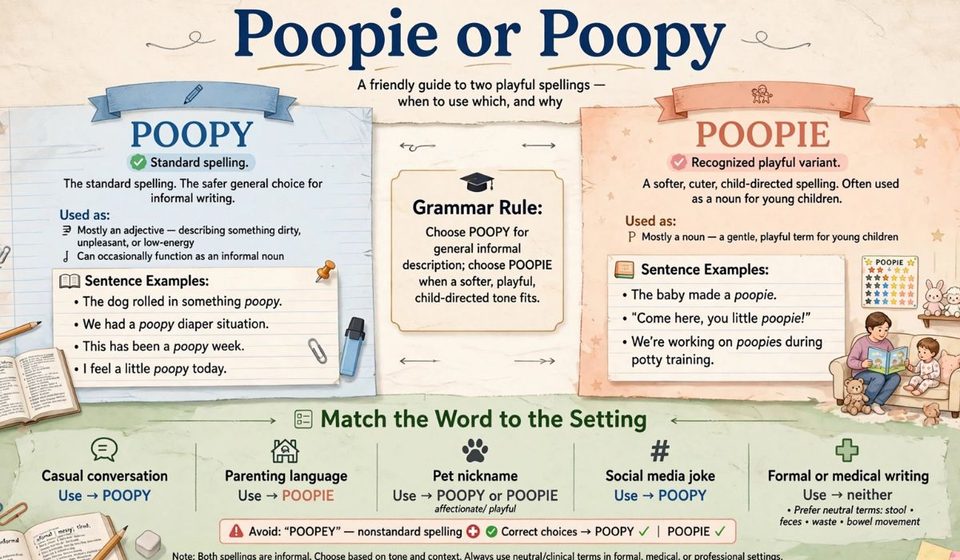
Poopy is the standard spelling. It’s the form you’ll find listed first in major dictionaries, and it’s the safer choice for general informal writing.
Poopie is a recognized variant. Dictionaries list it as an alternative form, and it tends to sound softer, cuter, or more child-directed.
Neither word is formal. Both are casual, and both are understood by most English speakers. The real question isn’t “Which one is correct?” It’s “Which one fits the tone I’m going for?”
Poopy vs. Poopie at a Glance
| Feature | Poopy | Poopie |
| Status | Standard spelling | Recognized variant |
| Dictionary listing | Primary entry | Alternative form |
| Common role | Adjective (also used as a noun) | Playful or child-directed noun |
| Tone | Casual, general-purpose | Cute, affectionate, childish |
| Best used for | Everyday informal writing | Baby talk, nicknames, humor |
| Comparative forms | poopier, poopiest | Not typically used |
Is “Poopy” the Standard Spelling?
Yes. Major dictionary sources list “poopy” as the main entry, complete with standard grammar behavior. It even follows regular comparative and superlative rules, the same way “happy” becomes “happier” and “happiest”:
- poopy
- poopier
- poopiest
That pattern alone tells you something: dictionaries treat “poopy” as a fully formed adjective with normal English grammar, not just internet slang.
If you’re unsure which spelling to use and you want the safer bet, go with poopy.
Is Poopie a Real Word?
Yes, it is. “Poopie” isn’t a typo or a made-up spelling. It shows up in dictionary entries as an alternative form of “poopy,” particularly when the word is used as a noun.
Where it shines is in tone. People reach for “poopie” when they want something to sound:
- Cute
- Playful
- Child-directed
- Affectionate
- Humorous
Think of how parents talk to toddlers, or how someone might use a silly nickname for a pet. That’s the natural home for “poopie.”
Is “poopy” an Adjective or a Noun?
Here’s where a lot of quick answers online get it wrong. Many pages claim poopy is only an adjective and poopie is only a noun. That’s a helpful shortcut, but it’s not the full picture.
Poopy as an adjective is by far its most common role:
- a poopy diaper
- poopy weather
- a poopy smell
Poopy as a noun also exists, especially in childish or slang use, referring to feces itself. It’s less common than the adjective form, but it’s documented.
“Poopie” as a noun is the most typical use, especially in phrases like “the baby made a poopie.” It can also work as a playful nickname or a stylized noun in humor writing.
So the cleaner rule is this: poopy usually describes something, and poopie usually names something, but neither rule is absolute. Context decides.
What Does “Poopy” Mean?
“Poopy” carries more meanings than most people realize. Here’s the full range:
Covered with feces: a poopy diaper
Contaminated with feces: poopy water
Smelling or looking like feces: a poopy odor
Bad or unpleasant: poopy weather, a poopy day
Worthless or low-quality: “That movie was pretty poopy.”
Weak, tired, or low-energy: “I’ve been feeling poopy all week.”
Needing to use the bathroom: less common, but documented, as in “I’m poopy, can we stop the car?”
That last meaning trips people up because it’s rare. Most of the time, “I feel poopy” means low energy or feeling under the weather, not a literal bathroom need. Context tells you which one applies.
What Does “Poopie” Mean?
“Poopie” carries a narrower, softer set of meanings:
A child-friendly word for feces, often used during potty training
A cute or affectionate nickname for a person or pet
A playful, exaggerated word used in jokes or casual social posts
An alternative spelling of the noun form of poopy
You’ll see it most in family conversations, parenting content, or lighthearted writing where a harsher or more clinical word would feel out of place.
How to Use Poopy in a Sentence
Poopy usually appears right before a noun, describing it:
- “The dog rolled in something poopy.”
- “We had a poopy diaper situation this morning.”
- “This has been a poopy week overall.”
- “I feel a little poopy today; I’m not sure why.”
Notice how the last two examples aren’t literally about feces at all. That figurative “unpleasant” or “low-energy” sense is doing the work there.
How to Use Poopie in a Sentence
Poopie tends to show up as a standalone noun or a nickname:
- “The baby made a poopie right before nap time.”
- “Come here, you little poopie!”
- “We’re working on poopies during potty training week.”
A quick caution: calling a pet “poopy” (as in “poopy dog”) can accidentally sound like you’re describing a dog that’s dirty, not giving it an affectionate nickname. If cuteness is the goal, “poopie” carries that tone more reliably.
Poopy or Poopie: Which One Should You Use?
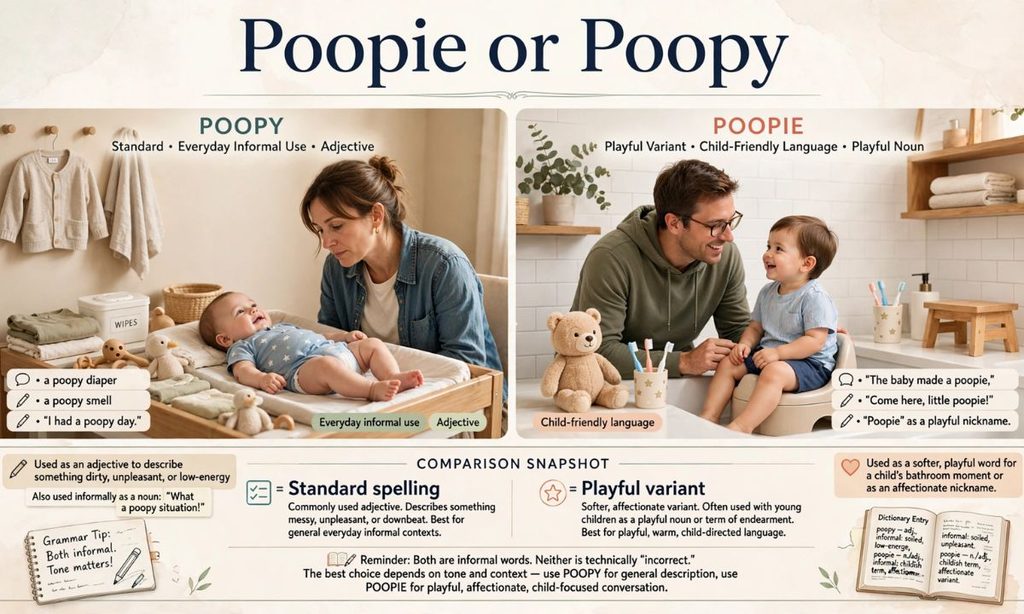
Your audience and setting matter more than any hard grammar rule. Here’s a practical breakdown:
| Situation | Better Choice |
| Talking to a toddler | poopie |
| Texting a friend casually | either works, poopy is safer |
| Writing a parenting blog post | either, depending on your voice |
| Naming a pet affectionately | poopie |
| Describing a diaper change | poopy |
| Social media caption or joke | either, poopie feels more playful |
| Veterinary or medical note | neither, use “stool” or “waste” |
| Professional email | neither, use a precise term |
Formal Alternatives to Poopy and Poopie
Neither word belongs in professional, medical, or official writing. If you need a more neutral or clinical term, reach for one of these instead:
- Stool
- Feces
- Bowel movement
- Fecal matter
- Waste
For non-literal uses like “poopy weather” or “I feel poopy,” swap in plain descriptive words instead:
- Unpleasant, rough, or bad (for weather or a bad day)
- Tired, drained, or run-down (for the low-energy meaning)
Poopy, Poopie, Poop, Poo, and Poopoo: What’s the Difference?
These related words often get lumped together, but each has its own flavor:
Poop: the plain, everyday informal noun for feces. Also works as a casual verb.
Poopy: the adjective form, describing something dirty, unpleasant, or low-energy. Occasionally used as a noun.
Poopie: the softer, more child-directed or playful variant, most often a noun.
Poo: a shorter informal noun, common in British English.
Poopoo (or poo-poo): an even more childish variant, typically spoken rather than written, common in toddler conversations.
If you’re writing for adults in a neutral tone, “poop” usually does the job without extra softening or added cuteness.
Poopy Head and Similar Childish Insults
“Poopy head” is a classic playground insult. It’s mild, unserious, and mostly used by or toward children. While it references something unflattering, it doesn’t carry the weight of a real curse word.
That said, tone and relationship still matter:
Said affectionately between siblings or friends, it’s harmless teasing.
Said with real irritation, it can still sting, especially to a child.
The same logic applies to “little poopie” as a nickname. It usually reads as fond and teasing, but the relationship and delivery shape how it lands.
Explore More Grammar Guide
Put or Puts: The Complete Grammar Guide With Rules and Examples
“To Bad” or “Too Bad”: Which Spelling Is Correct?
American English vs. British English
You’ll sometimes see claims that “poopy” dominates in the U.S. while “poopie” or “poo” show up more in the U.K. In practice, there isn’t solid public data to confirm precise regional splits for “poopy” versus “poopie” specifically. What’s safe to say:
“Poo” is more commonly used in British English as the general informal term.
“Poopy” and “poopie” both appear in American family and parenting language.
Regional habits can vary by family, community, and generation more than by country alone.
Treat strong regional claims about these two specific spellings with some skepticism unless you’re citing a real usage study.
Common Mistakes to Avoid
Watch out for these frequent slip-ups:
Writing “poopey.” This spelling isn’t standard. Stick with poopy or poopie.
Assuming “poopy” is only an adjective. It can function as a noun too, just less often.
Using either word in clinical or professional writing. Swap in stool, feces, or waste instead.
Assuming “I feel poopy” always means physical need. Most of the time, it means low energy or a bad mood.
Confusing poopy with “pooped.” “Pooped” means exhausted and has nothing to do with feces directly, even though it comes from the same root idea.
Frequently Asked Questions
Is it poopie or poopy?
Poopy is the standard spelling, while poopie is a recognized, more playful variant.
Is “poopie” a real word?
Yes, dictionaries list it as an alternative form of “poopy,” especially in its noun use.
Is poopy an adjective or a noun?
It’s most often an adjective, but it can also function as an informal noun for feces.
Can “poopy” mean tired or sad?
Yes, “I feel poopy” commonly means low-energy, run-down, or in a bad mood, not necessarily anything literal.
What should I use instead of “poopy” in formal writing?
Use a neutral term like “stool,” “feces,” “bowel movement,” or “waste” depending on the context.
Conclusion
When you’re stuck between poopy and poopie, let the setting guide you. Poopy is the standard, general-purpose spelling that works for most casual writing and covers everything from a dirty diaper to a rough day.
Poopie is the softer, more playful cousin, best saved for toddlers, nicknames, and lighthearted moments. Neither belongs in formal or clinical writing, where words like stool or feces do the job better. Once you match the word to the moment, you’ll never second-guess the spelling again.



[…] Poopie or Poopy: Which Spelling Is Actually Correct? […]
[…] Poopie or Poopy: Which Spelling Is Actually Correct? […]
[…] Poopie or Poopy: Which Spelling Is Actually Correct? […]