

You’ve typed one of these words and paused, wondering if it’s right. You’re not alone. These three words sound the same. That’s the whole problem. Once you know what each one actually means, the confusion disappears fast. This guide walks through simple rules, real examples, and tricks that make the choice automatic.
Quick Answer: The Simple Rule
Here’s the short version:
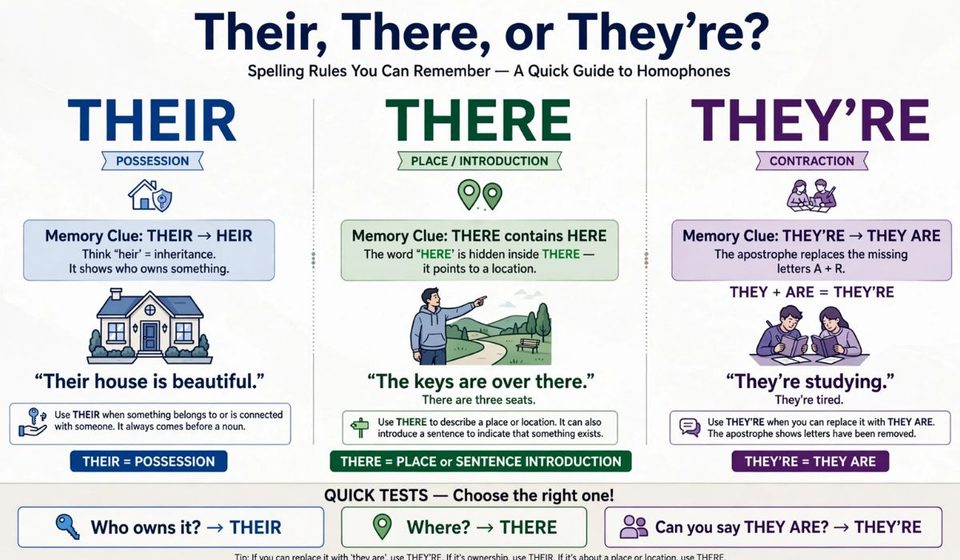
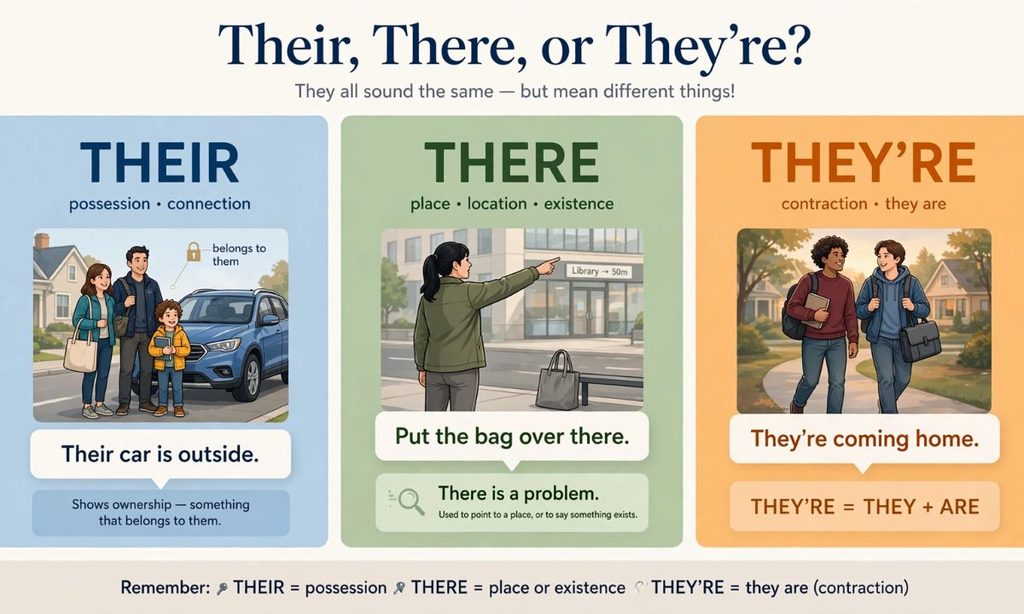
Their shows possession. Something belongs to them.
There points to a place or starts a sentence like “there is” or “there are.”
They’re is short for “they are.”
They sound identical, but they’re spelled differently because they do completely different jobs in a sentence. Once you know the job, the spelling follows.
Why These Three Words Trip People Up
There’s really only one reason: pronunciation gives you zero clues. All three words sound the same in normal speech, so your ear can’t help you here. You have to rely on meaning instead of sound.
The fix is simple. Before you type any of these words, ask yourself one question:
Am I talking about ownership? → their
Am I talking about a place, or starting a sentence with “is/are”? → there
Could I replace this word with “they are”? → they’re
That one habit solves almost every mistake.
Their: Showing Possession
Their tells you something belongs to, or is connected with, a group of people (or a single person referred to with “they”).
How to Use It
Their almost always comes right before a noun:
- “Their car is parked outside.”
- “The students finished their homework.”
- “The company updated their website.”
- “Someone left their umbrella at the door.”
What “Possession” Actually Covers
Their doesn’t just mean literal ownership. It can also show:
- A relationship — “their mother,” “their neighbor”
- Responsibility — “their job,” “their decision”
- Association — “their team,” “their opinion”
- A characteristic — “their style,” “their approach”
Their With Singular “They”
This one trips people up more than anything else. When you don’t know someone’s gender, or when a person uses “they” as their pronoun, “their” still works perfectly:
- “Someone left their phone on the table.”
- “If a student needs help, they should raise their hand.”
- “Alex brought their notebook to class.”
This isn’t a grammar shortcut or a mistake. It’s a standard, accepted use of English that’s been common for a long time, especially when the subject is unknown, general, or nonbinary.
There: Talking About Place (or Starting a Sentence)
There has two main jobs, and they’re worth separating clearly.
Job One: Pointing to a Location
This is the meaning most people already know:
- “Put the box over there.”
- “I left my keys there.”
- “We went there last summer.”
- “Stop right there.”
A simple trick: there contains the word here. Both relate to location, so if you can swap in “here” and the sentence still makes rough sense, you’re dealing with the location version.
Job Two: Introducing a Sentence
This use is less obvious but just as common. Here, “there” doesn’t point to a physical place at all. It introduces the existence of something:
- “There is a problem with the schedule.”
- “There are three seats left.”
- “There was a loud noise outside.”
- “There will be a meeting tomorrow.”
This is sometimes called an “existential there,” but you don’t need to remember that label. Just notice the pattern: there + is/are/was/were/will be, followed by a noun.
There Is vs. There Are
This is a small grammar detail that’s easy to get wrong:
- Use “there is” with a singular noun: “There is one answer.”
- Use “there are” with a plural noun: “There are several answers.”
In casual speech, people sometimes say “there’s” before a plural noun (“There’s a lot of people here”), but formal writing calls for “there are” when the noun is plural.
Other Everyday Uses of “There”
There also shows up in a few common expressions that aren’t strictly about location or existence:
- “There, there — it’ll be fine.” (comfort or reassurance)
- “There you go.” (approval or completion)
- “There’s no doubt about it.” (certainty)
These are worth recognizing, even if they don’t fit neatly into the two main categories above.
Explore More Grammar Guide
A Lot or Alot? Correct Spelling, Meaning, and Examples
“To Bad” or “Too Bad”: Which Spelling Is Correct?
They’re: Short for “They Are”
They’re is a contraction. The apostrophe stands in for the missing letters in “they are.” That’s genuinely the whole rule.
The Expansion Test
This is the single best trick for this word. Try replacing “they’re” with “they are.” If the sentence still makes sense, you’ve got the right word.
- “They’re coming over later.” → “They are coming over later.” ✔️
- “They’re tired.” → “They are tired.” ✔️
- “I think they’re at work.” → “I think they are at work.” ✔️
If the sentence sounds wrong after expanding it, you probably need “their” or “there” instead.
What Comes After “They’re”
They’re is usually followed by:
- An adjective: “They’re exhausted.”
- A verb ending in -ing: “They’re studying.”
- A location: “They’re at the airport.”
- A noun phrase: “They’re the new hires.”
One Common Mistake to Avoid
Don’t use “they’re” at the very end of a sentence when you actually mean “they are” standing alone:
- ❌ “I don’t know where they’re.”
- ✔️ “I don’t know where they are.”
The contraction needs something to attach to. Without a following word, it doesn’t work.
Their vs. There vs. They’re: Side-by-Side Comparison
| Word | Meaning | Typical Use | Quick Test |
| Their | Possession | Comes before a noun | Ask: “Who does it belong to?” |
| There | Place or introduction | Points to a location, or starts “there is/are” | Ask: “Where is it?” or swap in “here.” |
| They’re | They are | Followed by adjective, verb, or noun phrase | Expand it to “they are.” |
Quick Memory Tricks
If you only remember three things, make it these:
There contains here — both are about location.
Their contains heir — an heir inherits things, and “their” is about ownership.
They’re has an apostrophe because letters are missing — it’s always short for “they are.”
Another simple method, especially useful for quick checks:
- Does the word “answer” mean “where”? → there
- Does the word “answer” mean “who owns it?” → their
- Can the word be replaced with “they are”? → they’re
Run through those three questions, in order, and you’ll land on the right word almost every time.
Common Mistakes and How to Fix Them
Here are the errors people make most often, side by side with the correction.
❌ “Their going to the store.” → ✔️ “They’re going to the store.”
❌ “I put it over their.” → ✔️ “I put it over there.”
❌ “They’re car broke down.” → ✔️ “Their car broke down.”
❌ “There house is huge.” → ✔️ “Their house is huge.”
❌ “I don’t know where they’re.” → ✔️ “I don’t know where they are.”
❌ “Are you going their tomorrow?” → ✔️ “Are you going there tomorrow?”
Notice the pattern: every mistake happens because the writer picked based on sound instead of meaning. Slow down for one extra second, apply the test, and the error disappears.
Practice Examples
Try filling in the blank before checking the answer.
- “___ bringing snacks to the party.” (They’re)
- “The dog buried ___ bone in the yard.” (its — trick question, but for our three words: “their” if referring to a group of dogs)
- “Put your bag over ___.” (there)
- “___ is a reason for this delay.” (There)
- “The employees updated ___ schedules.” (their)
- “I heard ___ moving to a new city.” (they’re)
- “___ are two options left.” (There)
- “Is that ___ car in the driveway?” (their)
If you got most of these right without hesitating, the rule has already started to stick.
Their, There, and They’re in Formal Writing
All three words are grammatically correct in any context, but tone matters:
Their and there work fine in formal and informal writing alike.
They’re, being a contraction, leans casual. In academic papers, legal documents, or very formal reports, many writers spell out “they are” instead, simply for tone and consistency, not because the contraction is wrong.
If you’re writing something formal and want a more polished feel, swapping “they’re” for “they are” is a small, easy adjustment.
Related Word Pairs Worth Knowing
Once you’ve got this trio down, a few other homophone pairs follow the same logic:
- Your vs. you’re (possession vs. “you are”)
- Its vs. it’s (possession vs. “it is”)
- Who’s vs. whose (“who is” vs. possession)
The pattern repeats: one version shows ownership, and the other is a contraction. Once you understand this trio, the others get much easier.
Frequently Asked Questions
What is the easiest way to remember their, there, and they’re?
Their has “heir” for ownership, there has “here” for place, and they’re always expanded to “they are.”
Can “their” be used for one person?
Yes, when the person’s gender is unknown, or they use “they” as their pronoun, like “someone forgot their jacket.”
Is “there is” or “there are” correct?
Use “there is” with a singular noun and “there are” with a plural noun.
Can “they’re” go at the end of a sentence?
No, it needs a word after it, like an adjective or verb; use “they are” instead at the end.
What’s the difference between “their” and “theirs”?
“Their” comes before a noun (“their house”), while “theirs” stands alone (“the house is theirs”).
Final Thoughts
Their, there, and they’re will always sound the same, so the only real fix is training yourself to think about meaning instead of pronunciation. Their ownership points, there points to a place or opens a sentence, and they’re is just a shortcut for “they are.” Run through the three quick questions whenever you’re unsure, and the right spelling will come to you almost automatically, no matter how fast you’re typing.


[…] Their, There, or They’re? Spelling Rules and Examples […]