
You’ve typed “I’m laying down” a hundred times without thinking twice. Then someone corrects you, and suddenly you’re not sure which word is right. You’re not alone. This mix-up has confused English speakers for centuries, not just casual texters. The good news is there’s one simple test that clears up almost every case. Once you learn it, you’ll rarely second-guess yourself again.
Why Laying and Lying Get Mixed Up So Easily
The confusion between “laying” and “lying” is understandable. Two different verbs share several forms. One form even serves as the past tense of the other.
Here’s why the distinction causes trouble:
- “Lay” means to put or place something somewhere.
- “Lie” means to recline or rest.
- The past tense of “lie” is “lay.”
- That overlap causes most of the confusion.
There’s another complication. “Lie” also means to tell an untruth. The same four letters can refer to resting, placing something, or being dishonest.
Separate these three meanings, and the distinction becomes much easier.
The One Test That Settles Almost Every Case
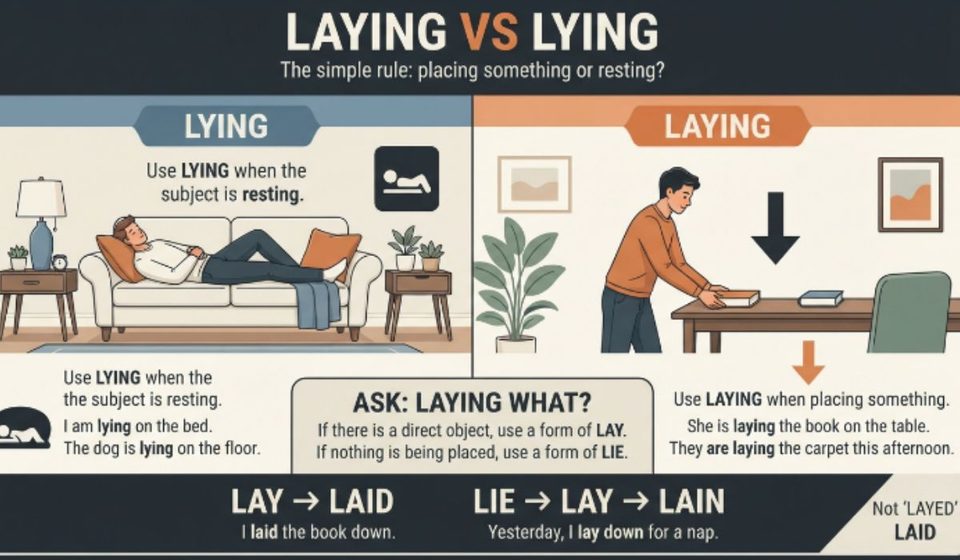
You can solve most cases with one question: Does the verb have a direct object?
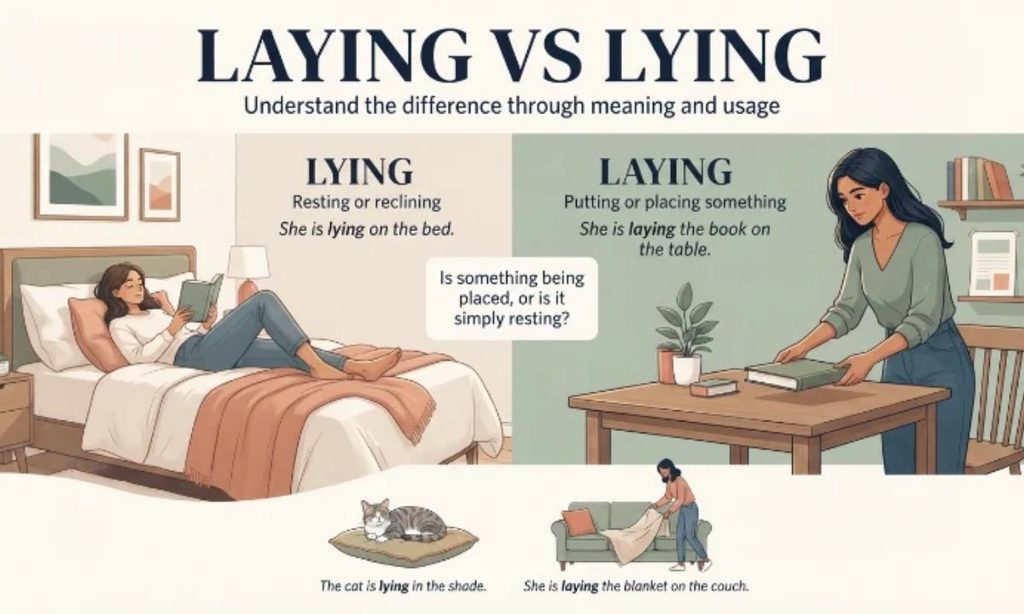
A direct object receives the action. Ask, “Laying what?” If you can name the thing being placed, use a form of lay. If nothing is being placed, use a form of lie.
“She is laying the book on the table.” → Laying what? The book. Use laying.
“She is lying on the couch.” → Lying what? Nothing. She is resting. Use lying.
That’s the key distinction. Once you learn to look for the direct object, choosing between laying and lying becomes much easier.
Lying: When the Subject Rests on Its Own
Use lying when the subject rests or stays in a position without acting on anything else.
Here are some clear examples:
- “I am lying on the bed.”
- “The dog is lying in the shade.”
- “The keys are lying on the counter.”
- “She was lying in the grass all afternoon.”
In each sentence, nothing is being placed. The subject is simply resting or staying in a particular position. The subject can be a person, an animal, or even an object such as a set of keys.
Lying Can Also Mean Telling an Untruth
Lying has another meaning: telling an untruth.
- “He’s lying about where he was last night.”
- “She’s been lying to her parents for weeks.”
The context usually makes the meaning clear. If someone is lying on a couch, they are resting. If someone is lying about a couch, they are not telling the truth about it.
The word looks the same, but the rest of the sentence shows which meaning applies.
Laying: When Something Is Put Down
Use “laying” when someone or something places an object, person, or idea somewhere.
The key question is simple: “Laying what?”
If you can answer that question, laying is the right choice.
Examples:
- “I am laying the book on the table.”
- “She is laying the baby in the crib.”
- “They are laying the carpet this afternoon.”
- “The hen is laying eggs.”
In each case, something receives the action. The book, the baby, the carpet, and the eggs are all direct objects.
Laying Isn’t Just for Physical Objects
A common gap in a lot of explanations is that “lay” only applies to physically setting something on a flat surface. That’s not quite right. “Lay” shows up in plenty of expressions that don’t involve furniture or floors at all:
- “Lay the blame on someone.”
- “Lay the groundwork for a project”
- “Lay out a plan”
- “Lay claim to something”
- “Lay down the law”
In every case, something is still being placed, even if it’s abstract rather than physical. The direct-object test still works perfectly here. Ask “laying what?” and you’ll always get an answer: the blame, the groundwork, the plan, and the claim.
Laying vs Lying: A Side-by-Side Look
| Form | Base Verb | Meaning | Needs an Object? | Example |
| Lying | Lie | Rest, recline, and remain in place. | No | “She is lying on the bed.” |
| Laying | Lay | Put or place something down. | Yes | “She is laying the book on the bed.” |
| Lying | Lie | Telling an untruth | No | “He is lying about the accident.” |
This table covers the three situations you’ll run into most often. Whenever you’re stuck, come back to the direct-object question first.
The Verb Forms: Lay, Lie, Laid, and Lain
This is where most of the real confusion lives, because the same spelling shows up in two different verb families.
| Meaning | Base Form | Past Tense | Past Participle | -ing Form |
| Place something down | Lay | Laid | Laid | Laying |
| Recline or rest. | Lie | Lay | Lain | Lying |
| Tell a falsehood | Lie | Lied | Lied | Lying |
Notice that “lay” appears twice in this chart. It’s the base form of the placing verb, and it’s also the past tense of the reclining verb. That overlap is the single biggest reason people mix these words up.
Explore More Grammar Guide
Position or Place: What’s the Real Difference?
Becuase vs. Because: Which Spelling Is Actually Correct?
“To Bad” or “Too Bad”: Which Spelling Is Correct?
Loose vs Lose: The Complete Guide to Using Each Word Correctly
Why “Yesterday, I Lay Down” Is Correct
Since “lay” is the past tense of “lie” (reclining), a sentence like this is grammatically correct:
- “Yesterday, I lay down for a nap.”
This trips people up constantly because it looks like it should be “laid,” but “laid” only applies when there’s a direct object.
- Correct: “Yesterday, I lay down.” (no object)
- Correct: “Yesterday, I laid the book down.” (object: the book)
Laid vs Lain
These two often get swapped by accident, but the direct-object test still applies.
- “I have laid the book on the table.” → Object: the book. Use “laid.”
- “I have lain in bed all morning.” → No object. Use “lain.”
- “The cat has lain in the sun for hours.” → No object. Use “lain.”
- “They have laid the carpets in every room.” → Object: the carpets. Use “laid.”
Is It “Laying Down” or “Lying Down”?
This is one of the most common questions about “lay” and “lie,” so let’s answer it directly.
In standard English, use “lying down” when you mean resting or reclining. There is no direct object. You are not placing anything. You are simply resting.
Correct: “I’m lying down.”
You will also hear “I’m laying down” in everyday speech. Many fluent speakers use it, and people usually understand what they mean.
However, “lying down” is the standard choice in formal writing. Use it in emails, essays, reports, and professional documents.
The rule is simple:
- Lying down = resting
- Laying something down = putting something in a place
So, if you mean that you are resting, say “I’m lying down.”
A practical way to think about it:
Casual speech: “Laying down” is widely used and understood.
Formal or edited writing: “lying down” is the standard choice
Is It “Laying in Bed” or “Lying in Bed”?
The same rule applies here. If you’re describing a person resting in bed with nothing being placed, “lying in bed” is the standard form.
- “She was lying in bed all morning.” (correct standard form)
- “She was laying the baby in bed.” (correct, because “the baby” is the object)
Swap in an object, and the word changes with it. Without one, stick with “lying.”
Is It “Laying on the Floor” or “Lying on the Floor”?
Same logic, different surface. If a person, animal, or object is simply positioned on the floor, use “lying”:
- “He was lying on the floor after the workout.”
- “The dog is lying on the floor by the door.”
- “My phone was lying on the floor all night.”
If someone is placing something onto the floor, “laying” takes over:
- “She is laying the yoga mat on the floor.”
- “He is laying tile on the floor.”
Is It “Laying Around” or “Lying Around”?
Use “lying around” when you mean that something is sitting or resting somewhere without anyone placing it there.
Examples:
- “Don’t leave your clothes lying around the house.”
- “Papers were lying around the office.”
Use “laying around” only when “laying” has a direct object. That use is uncommon in this phrase. In most everyday sentences, “lying around” is the correct choice.
Common Expressions Using “Lie” and “Lay”
A lot of everyday phrases use these verbs in ways that aren’t obviously about beds or furniture. Recognizing them helps you apply the same object test in less literal situations.
Phrases using “lie” (no object involved):
- “The problem lies in the details.”
- “The answer lies within the data.”
- “The city lies north of the river.”
- “Let sleeping dogs lie.”
Phrases using “lay” (object involved):
- “Lay the foundation for success.”
- “Lay out a plan before starting.”
- “Lay claim to the property.”
- “Lay down the rules early.”
In each “lay” example, you can answer “laying what?” with something concrete: the foundation, the plan, the claim, the rules.
Why “Layed” Isn’t Standard English
If you’ve ever typed “layed” and had it flagged, there’s a good reason. The correct past tense of “lay” (meaning to place) is “laid,” not “layed.” This holds in virtually all everyday, business, and academic writing.
There’s a narrow exception. In some specialized nautical or rope-related contexts, “layed” describes a particular way rope strands are twisted together. But for regular writing, stick with “laid” every time you need the past tense of “lay.”
How to Handle Passive Voice
Passive voice can help confirm whether you’re dealing with “lay” or “lie,” since only transitive verbs can be turned passive.
- Active: “She laid the blanket on the couch.”
- Passive: “The blanket was laid on the couch.”
This works because “lay” takes an object. Try the same thing with “lie,” and it falls apart:
- Active: “She lay on the couch.”
- Attempted passive: “The couch was lain by her.” (This doesn’t work in standard English.)
If a sentence can naturally shift into passive voice, that’s a strong sign you’re dealing with “lay,” not “lie.”
A Quick Practice Check
Try applying the direct-object test to these:
- “The papers are ___ on the desk.” (nothing is placing them — use lying)
- “She is ___ the papers on the desk.” (object: the papers — use laying)
- “He ___ down right after dinner yesterday.” (no object, past tense of lie — use lay)
- “He ___ the remote down right after dinner.” (object: the remote, past tense of lay — use laid)
- “The dog has ___ by the door all day.” (no object, past participle of lie — use lain)
Running through a few of these out loud is often enough to make the pattern click permanently.
Frequently Asked Questions
Is it “laying down” or “lying down”?
“Lying down” is the standard form for resting, since no object is involved; “laying down” is common in casual speech but not the traditional grammar rule.
What’s the difference between “laid” and “lain”?
“Laid” is the past tense of “lay” and needs a direct object, while “lain” is the past participle of “lie” and never takes one.
Is “layed” a real word?
No, the standard past tense of “lay” is “laid,” with “layed” limited to rare specialized rope or nautical usage.
Why Is the Past Tense of “Lie” the Word “Lay”?
English developed these verb forms over time, and they ended up overlapping. Lay serves two roles:
- It is the base form of the verb that means to put or place something.
- It is also the past tense of “lie,” which means to rest or recline.
That overlap makes these verbs harder to learn.
Is “I’m Going to Lay Down” Acceptable?
You will hear “I’m going to lay down” often in casual speech. Most people understand it to mean “I’m going to lie down.” However, “I’m going to lie down” remains the standard form in formal and edited writing.
Conclusion
The difference between “laying” and “lying” comes down to one simple question: Is something being placed, or is the subject resting?
Ask, “Laying what?” If you can name a direct object, use laying. If nothing is being placed and the subject is resting, use lying.
Once you make that question a habit, “lay” and “lie” become much easier to use correctly—in casual messages and formal writing alike.