
You’ve probably typed “place” when you meant “position,” or the other way around, without even noticing. These two words look like simple synonyms, but they carry different shades of meaning. One tends to describe a general area, while the other usually points to something more specific or relational.
Knowing which one fits keeps your writing precise and natural. This guide breaks down exactly when to reach for each word, with examples pulled from everyday life, work, sports, and more.
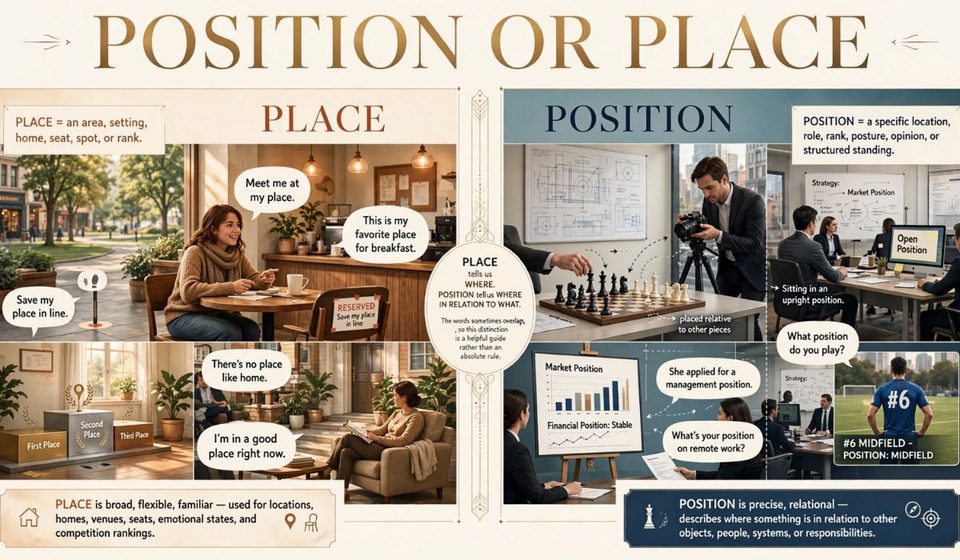
What “Place” Really Means
“Place” is the broader, more flexible word. It covers physical areas, but it also stretches into homes, seats, occasions, and even emotional states.
Here’s what “place” typically refers to:
A general area, town, building, or room
Someone’s home (“Meet me at my place.”)
A suitable setting for something (“This isn’t the place to argue.”)
A seat or spot (“Save my place in line.”)
A rank in a competition (“She finished in second place.”)
A role or social duty (“It’s not your place to decide that.”)
An emotional or mental state (“He’s in a good place right now.”)
Notice how flexible this word is. It can describe a country, a restaurant, a line at the grocery store, or someone’s feelings. That range is exactly what makes place the default, everyday choice for talking about locations and settings.
What “Position” Really Means
Position leans more toward being specific, relational, or structured. It’s the word you reach for when location matters in relation to something else, or when you’re talking about rank, role, posture, or stance.
Common uses of position:
Where something sits relative to other things (“Move the lamp to a different position.”)
Body posture (“Sitting position,” “upright position”)
A job or role (“She applied for a management position.”)
Rank or status (“He holds a senior position in the firm.”)
An opinion or stance (“What’s your position on remote work?”)
A financial or market condition (“The company’s financial position improved.”)
An investment holding (“She opened a long position in tech stocks.”)
A sports role (“What position do you play?”)
“Position” almost always implies a relationship, a system, or a defined structure behind it. That’s the thread connecting a chess position, a job position, and a negotiating position. Each one exists relative to something else: other pieces, other employees, the other side of a deal.
The Core Distinction in One Line
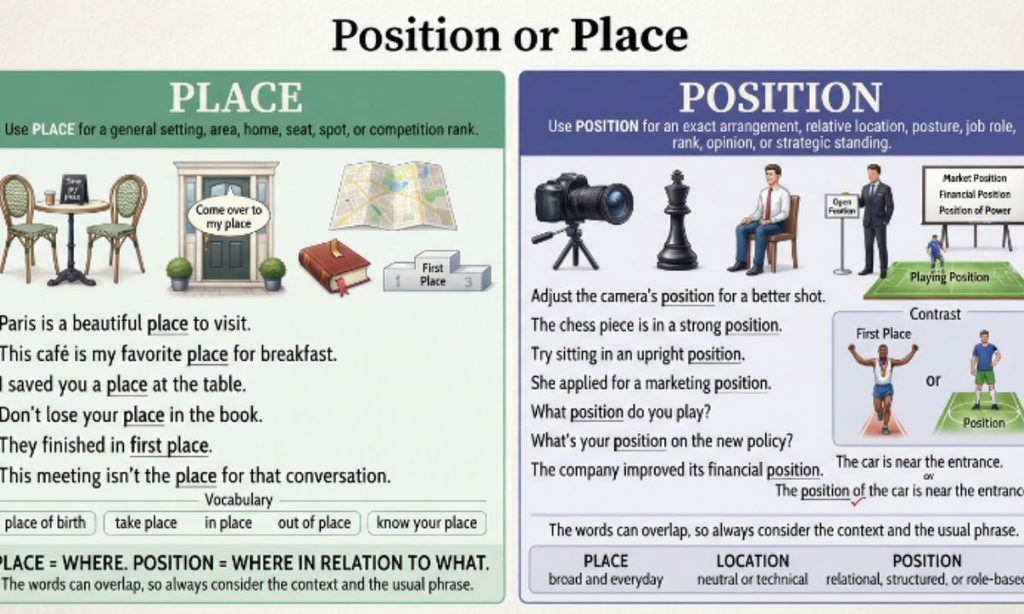
If you need the shortest possible rule: place is about where; position is about where in relation to what.
That’s not a perfect law, since English has plenty of exceptions and overlap. But it’s the fastest mental shortcut, and it holds up in most everyday sentences.
Where the Two Words Overlap
Here’s the part that trips people up: place and position aren’t always opposites. They genuinely overlap in several common expressions.
- “Keep my place in line” and “hold your position” can both describe staying where you are in a sequence.
- “Put the book back in its place” uses “place” to mean a specific, exact spot, not a vague general area.
- “I’m in no place to give orders” uses “place” to show the way you’d expect position to work, describing authority or standing.
So the “place equals general, position equals specific” rule is a helpful starting point, not an absolute law. Native English relies heavily on collocation, meaning certain words simply pair naturally with certain nouns through habit and convention, not strict logic. The best way to get this right consistently is to notice these common pairings rather than memorizing a rigid formula.
When to Choose “Place”
Reach for place when you’re talking about:
Geography and venues
- “Paris is a beautiful place to visit.”
- “This cafe is my favorite breakfast place.”
Home and comfort
- “Come over to my place this weekend.”
- “There’s no place like home.”
Seats and spots in a sequence
- “I saved you a place at the table.”
- “Don’t lose your place in the book.”
Competition rankings
- “They finished in first place.”
- “She came in third place at the race.”
Suitable settings or moments
- “This meeting isn’t the place for that conversation.”
- “University is a great place to make friends.”
Duty, role, or social standing
- “Know your place.”
- “It’s not my place to comment on that.”
When to Choose “Position”
Reach for position when you’re describing:
Exact arrangement or relative location
- “Adjust the camera’s position for a better shot.”
- “The chess piece is in a strong position.”
Body posture
- “Try sitting in an upright position.”
- “He stayed in a lying position for hours.”
Jobs and professional roles
- “She was offered a marketing position.”
- “The company has an open position on the team.”
Authority and rank
- “He holds a position of power.”
- “She earned a leadership position after five years.”
Opinions and stances
- “What’s your position on the new policy?”
- “The company took a firm position on sustainability.”
Financial and market standing
- “The business improved its financial position this quarter.”
- “Investors are watching the company’s market position closely.”
Sports roles
- “What position does he play, midfield or defense?”
Position or Place: Side-by-Side Comparison
| Feature | Place | Position |
| Core idea | An area, setting, seat, or spot | Location relative to other things, or a role/rank |
| Specificity | Often general, but can be exact | Usually exact, structured, or relational |
| Body meaning | Rare, mostly figurative | Common: sitting, standing, upright |
| Job meaning | Sometimes (“a place at school”) | Very common (“job position”) |
| Opinion meaning | Not typical | Common (“position on an issue”) |
| Finance meaning | Not typical | Common (“financial position,” “long position”) |
| Competition meaning | Common (“first place”) | Also used (“third position” in some contexts) |
| Verb meaning | Put or set something down | Arrange deliberately, often with orientation |
Place vs. Position vs. Location: Clearing Up a Three-Way Mix-Up
A related word often enters the conversation: location. Here’s how the three compare quickly.
Place is the broadest and most casual. It works for almost any setting, physical or figurative.
Location is more neutral and slightly more formal or technical. Real estate, business addresses, and GPS all favor “location.”
Position adds the relational or structural layer, whether that’s rank, posture, coordinates, or stance.
You’ll also occasionally hear “site,” which usually refers to where a building, event, or historical happening is or was (“the site of the battle”), and “situation,” an older or more formal word for a physical place that’s largely fallen out of everyday American English.
Position and Place as Verbs
Both words also work as verbs, and here the distinction becomes clearer.
“Place” (verb) means to put or set something somewhere:
- “Place the vase on the table.”
- “I placed my keys on the counter.”
- “Place an order before checkout.”
Position (verb) means to arrange something deliberately, often with attention to orientation, strategy, or purpose:
- “Position the camera above the doorway.”
- “The troops positioned themselves near the border.”
- “She positioned herself for a promotion.”
The overlap shows up here too. “The fence was placed to block the path” and “the fence was positioned to block the path” both work, but positioned carries a slightly stronger sense of intention and precision.
Position and Place at Work
This is one of the most common areas of confusion, so it deserves its own section.
A job opening is almost always called a position: “There’s an open position on the sales team.”
A place can refer to a spot at a school or university: “She got a place at Oxford.”
Rank or seniority uses position: “He was promoted to a senior position.”
“Job position” is technically a bit redundant since position already implies a job role, but it’s common enough in everyday speech that nobody will blink at it.
If you’re writing a resume, job posting, or professional email, position is almost always the safer, more standard choice for describing a role.
Position and Place in Sports and Competition
Sports terminology splits these words in a specific way:
“Place” usually refers to a competition ranking: first place, second place, or third place.
“Position” usually refers to a player’s role on the field: “What position do you play?”
Pole position is a fixed term in motor racing, referring to the front starting spot.
League standings sometimes use “position” too, especially outside the US: “The team is in third position in the league table.”
So a runner finishes in a place, but a soccer player plays a position. Both words show up in sports, just for different aspects of the game.
Explore More Grammar Guide
You Too or You To: The Correct Way to Reply Every Time
Separate or Seperate? The Correct Spelling Explained
“To Bad” or “Too Bad”: Which Spelling Is Correct?
Position in Business, Finance, and Marketing
Business writing leans heavily on position, and for good reason. Almost every business use of the word implies a relationship, comparison, or standing relative to competitors, markets, or risk.
Financial position: the overall health of a company’s finances
Market position: how a company compares to competitors
Bargaining position: leverage in a negotiation
Long position / short position: investment terms describing whether an investor is betting on a stock rising or falling
Product positioning: how a brand presents itself relative to competitors and target customers (“Positioning it as a luxury item.”)
Place rarely appears in these financial or strategic contexts. If you’re writing about business strategy, investing, or corporate structure, position is almost always the more natural fit.
Position and Place in Opinions and Politics
When someone states an opinion formally, “position” is the standard word:
- “The company’s position on climate policy is clear.”
- “What’s your position on remote work?”
- “The senator hasn’t taken a position on the bill yet.”
- “Negotiators reached a fallback position.”
Place doesn’t typically carry this meaning. You wouldn’t usually say “my place on the issue,” since that phrasing sounds off to native speakers. Position, stance, opinion, and viewpoint are the words that naturally fill this role.
Common Mistakes and How to Fix Them
A few patterns show up again and again:
Overcomplicating a simple location. “The position of the keys is on the counter” sounds stiff. Just say “The keys are on the counter.”
Using a place for a formal job title. “I have a place at the company” sounds vague. Say “I have a position at the company” instead.
Mixing up first place and playing position in sports writing. These describe two different things: a ranking versus a role.
Assuming position only means physical location. Remember it also covers opinions, jobs, posture, and finance.
Treating place, location, site, and position as interchangeable synonyms. Each one carries its own nuance and typical context.
A quick fix for wordy sentences: ask whether you actually need the noun at all. Often a simple preposition does the job better than either word.
| Wordier version | More natural version |
| “The position of the car is near the entrance.” | “The car is near the entrance.” |
| “The place of the meeting is the library.” | “The meeting is at the library.” |
| “He is in a place behind the door.” | “He is behind the door.” |
Prepositions That Pair With Place and Position
Since both words describe location in different ways, they naturally connect to a set of prepositions that show spatial relationships. Here’s a quick reference:
In: used for enclosed spaces or larger areas (“in the room,” “in London”)
On: used for surfaces (“on the table,” “on the wall”)
At: used for specific points, addresses, or activities (“at the door,” “at work,” “at 33 Hill Street”)
Above / below, over/under: vertical relationships
Beside / next to, near / close to: horizontal closeness
Between/among: relationships involving two or more things
Behind/in front of: front-to-back relationships
Opposite / across from: facing relationships
These prepositions do a lot of the heavy lifting in English location sentences, sometimes making the nouns “place” and “position” unnecessary altogether.
Useful Fixed Phrases to Know
With “place”:
- Place of birth
- Take place (meaning “happen”)
- In place (meaning “ready” or “in the correct spot”)
- Out of place
- In the first place
- Know your place
- Go places (meaning “to become successful”)
With “position”:
- In a position to do something (meaning “having the ability or authority”)
- Take a position (state an opinion or open an investment)
- Hold a position (keep a job, rank, or opinion)
- Position of power
- Open position (a job vacancy or an unresolved financial exposure)
Frequently Asked Questions
What is the main difference between place and position?
“Place” usually describes a general area or setting, while “position” describes an exact location relative to other things or a role, rank, or stance.
Can place and position be used interchangeably?
Sometimes, especially in phrases like “keep my place/position in line,” but they aren’t fully interchangeable across most contexts.
Is a job called a place or a position?
Job openings are almost always called positions, though “a place at a university” is a common exception in education.
Is it first place or first position?
In most competitions, “first place” is standard, while “position” is more common for describing a player’s role or a league ranking.
What does “take a position” mean?
It usually means stating an opinion on an issue or opening an investment in finance.
Final Thoughts
Choosing between place and position comes down to asking one simple question: are you describing a general setting or something defined by its relationship to other things? Place fits venues, homes, seats, and everyday settings. Position fits roles, rankings within a structure, posture, opinions, and financial standing.
Once you get comfortable with that distinction and recognize where the two naturally overlap, you’ll pick the right word instinctively, whether you’re writing a resume, discussing a market strategy, or just telling a friend where to meet you.