

You’ve probably typed “whether” a hundred times without thinking twice. Then you spot “wether” somewhere and wonder if you’ve been spelling it wrong all along. You haven’t. These are two completely different words with two completely different jobs. One deals with choices and uncertainty. The other deals with sheep. This guide clears up the confusion for good, along with the third word that usually gets dragged into the mix: weather.
Quick Answer: Whether or Wether?
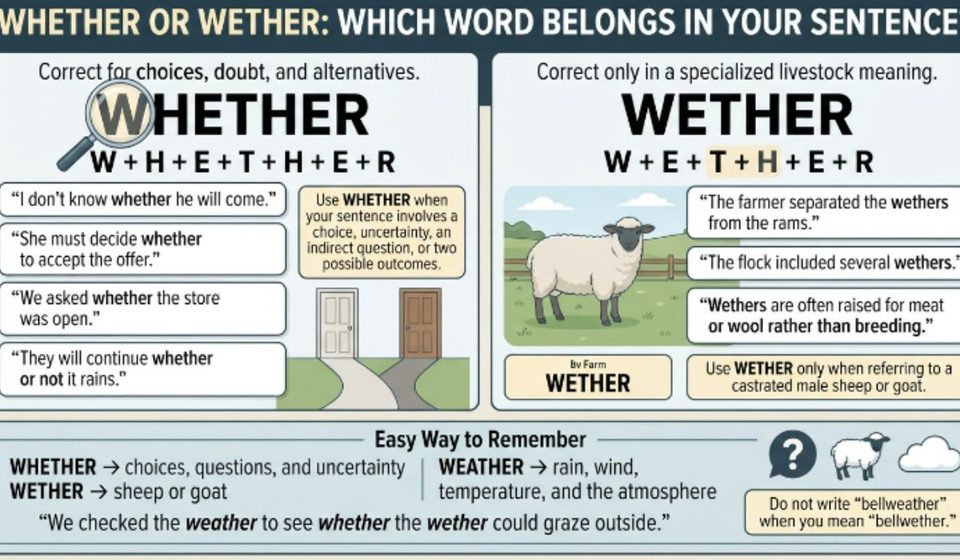
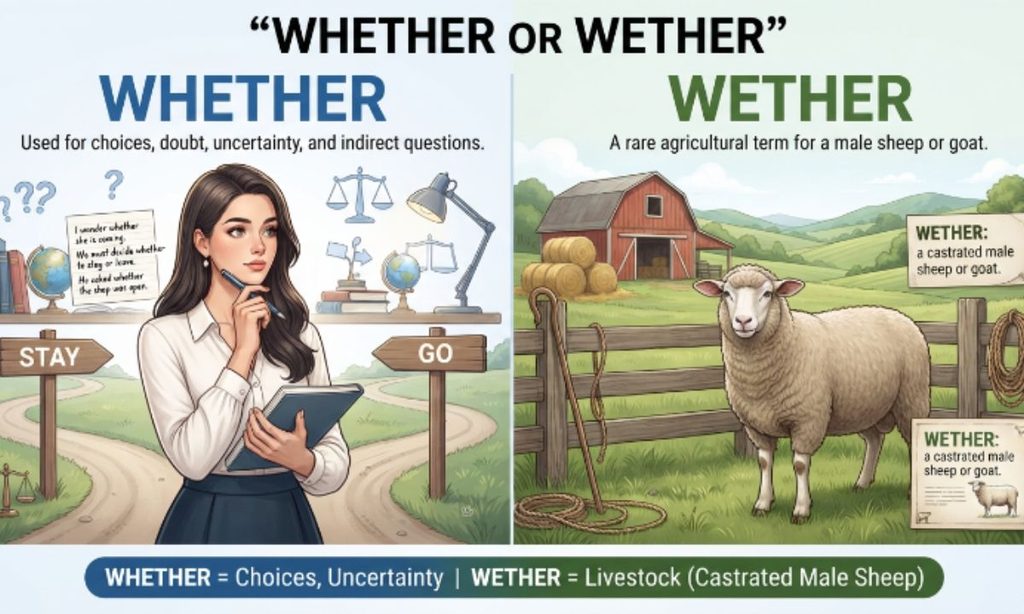
Whether is the word you almost always want. It’s a conjunction used for choices, doubt, and uncertainty.
Wether is a narrow, technical term. It refers to a castrated male sheep or goat. Unless you’re writing about livestock, you don’t need this word.
Here’s a fast way to check yourself: if your sentence isn’t about a farm animal, “wether” is almost certainly a typo for “whether.”
Whether vs. Wether at a Glance
| Feature | Whether | Wether |
| Part of speech | Conjunction | Noun |
| Meaning | Introduces alternatives, doubt, or an indirect question | A castrated male sheep or goat |
| Common use | Everyday writing and speech | Livestock and farming contexts |
| Frequency | Extremely common | Rare outside agriculture |
| Related word | Whether or not, whether…or | Bellwether |
What Does Whether Mean?
Whether is a subordinating conjunction. It connects a clause to the rest of a sentence and signals that more than one outcome is possible. You’ll typically see it doing one of these jobs:
Introducing alternatives: “We need to decide whether to drive or fly.”
Expressing doubt or uncertainty: “I’m not sure whether he got the message.”
Forming an indirect question: “She asked whether the store was open.”
Showing that something is true no matter the outcome: “Whether you agree or not, the plan is moving forward.”
In plain terms, whether shows up whenever a sentence is weighing options or expressing “I don’t know which of these is true.”
How to Use Whether in a Sentence
Whether can appear with or without an explicit second option. Both are correct.
With an explicit alternative:
- “I can’t tell whether she’s joking or serious.”
- “He hasn’t decided whether to accept the job or turn it down.”
Without a stated alternative (the second option is understood):
- “I don’t know whether he’ll come.” (This implies “…or not.”)
- “She wondered whether the package had arrived.”
A quick note here: many writers assume “or not” always needs to be spelled out. It doesn’t. In most cases, it’s already implied.
Whether or Not: When Do You Need It?
“Whether or not” isn’t just a longer version of “whether.” It changes the meaning slightly.
Plain whether: “I don’t know whether she’s coming.” This is a simple question with an implied yes/no answer.
Whether or not: “We’re going hiking whether or not it rains.” This means the outcome stays the same no matter what happens with the other condition.
Use “whether or not” when you want to stress that the result doesn’t change, regardless of which way things go. Skip it when you’re simply asking a straightforward either/or question, since “or not” is already baked in.
Whether vs. If: The Rule Most Guides Skip
This is where a lot of writers get stuck. Whether and if often overlap, but they’re not always swappable, especially in careful or formal writing.
| Situation | Better Choice | Example |
| A true conditional sentence | if | “If it rains, we’ll stay inside.” |
| An indirect yes/no question (casual) | either works | “I don’t know if/whether he’s coming.” |
| Explicit alternatives | whether | “I don’t know whether he’s coming or staying.” |
| Before an infinitive | whether | “She hasn’t decided whether to leave.” |
| After a preposition | whether | “It depends on whether the train is delayed.” |
| “Whether or not” constructions | whether | “We’ll go whether or not it rains.” |
Here’s the easiest way to remember it: if introduces a condition, whether introduces a choice. “If it rains, we’ll stay inside” sets up a cause and effect. “Whether it rains or not, we’re going” presents two possible situations without one causing the other.
Also, whether is the safer choice right before “to” plus a verb, and right after a preposition like “about,” “on,” or “depends on.” If sounds off in both of those spots to most fluent ears.
What Does Wether Mean?
A wether is a castrated male sheep or goat, usually neutered while still young. It’s a real word, just a specialized one. You’ll find it in farming, ranching, and veterinary contexts, not in everyday conversation.
A few related livestock terms help clarify the picture:
Ram: an adult male sheep that hasn’t been castrated
Ewe: an adult female sheep
Buck: an adult male goat that hasn’t been castrated
Doe (or nanny goat): an adult female goat
Wether: a castrated male sheep or goat
Farmers often castrate young male sheep or goats to make them easier to manage, since it reduces aggressive behavior and unwanted breeding within a flock or herd.
Explore More Grammar Guide
Poopie or Poopy: Which Spelling Is Actually Correct?
A Lot or Alot? Correct Spelling, Meaning, and Examples
“To Bad” or “Too Bad”: Which Spelling Is Correct?
How to Use Wether in a Sentence
- “The farmer separated the wethers from the breeding rams.”
- “Our flock includes ewes, lambs, and a few wethers.”
- “Wethers are often raised for meat or wool rather than breeding.”
If your sentence has nothing to do with sheep, goats, or farm management, you almost certainly meant “whether.”
What Is a Bellwether?
Here’s where “wether” sneaks into everyday language, even though most people don’t realize it. A bellwether was originally a lead sheep, a wether, that wore a bell around its neck. The rest of the flock followed the sound, which made it easy for shepherds to track and guide the group.
Over time, “bellwether” took on a figurative meaning: something or someone that signals a trend or predicts what’s coming next.
In politics: “This county is considered a bellwether in national elections.”
In economics: “Rising shipping costs are often seen as a bellwether for inflation.”
In business: “Analysts watch this company as a bellwether for the whole industry.”
One important spelling note: it’s bellwether, not “bellweather.” The word comes from “wether,” the sheep, not “weather,” the atmosphere. This mix-up is extremely common, so it’s worth double-checking anytime you write it.
Why Weather Also Gets Mixed Up in This Conversation
Even though this article is about whether and wether, weather shows up constantly in the same conversation because it sounds identical to both in most English accents.
Weather refers to atmospheric conditions: rain, wind, temperature, humidity, and similar factors. It works as both a noun and a verb.
- As a noun: “The weather turned cold overnight.”
- As a verb (meaning to endure): “The company managed to weather the economic downturn.”
- As a verb (meaning worn down by exposure): “The old fence has weathered badly over the years.”
Two common idioms use this verb sense:
- Weather the storm: get through a difficult situation without lasting damage.
- Under the weather: feeling mildly unwell.
Are “whether,” “wether,” and “weather” pronounced the Same?
In most modern English accents, yes, these three words sound identical. That’s exactly why they get confused so often in writing.
That said, some speakers, particularly in certain regional or older dialects, still pronounce “wh” with a slight puff of breath, which can make “whether” sound just a touch different from “weather.” This isn’t universal, and you shouldn’t rely on pronunciation to choose the right spelling. Context and meaning are always the safer guide.
Memory Tricks That Actually Help
If you need a quick mental shortcut, try these:
Whether relates to choices. Think of the “wh” as matching other choice-and-question words: who, what, when, where, why.
Weather relates to the atmosphere. Both words share the letters “ea,” and so does “Earth” and “sea.”
Wether is “missing” something, just like the animal it describes. Picture it as “whether” with the “h” left out.
None of these are hard rules, but they can help the correct spelling stick.
Common Mistakes to Avoid
- Writing “wether” when you mean “whether.” If the sentence has nothing to do with sheep or goats, this is almost always the error.
- Writing “bellweather” instead of “bellwether.” The correct root is the sheep term, not the atmospheric one.
- Using “if” after a preposition. “It depends on if you’re coming” is common in speech, but “it depends on whether you’re coming” is the safer, more polished choice.
- Using “if” before an infinitive. Say “decide whether to go,” not “decide if to go.”
- Overloading sentences with “whether or not” when a plain “whether” already covers the meaning.
Practical Examples Using All Three Words
- “We checked the weather to see whether the wether could safely graze outside.”
- “The rancher wasn’t sure whether the flock would weather the coming storm.”
- “This district has become a political bellwether, not a bellweather, in every recent election.”
Seeing all three together like this makes the distinction much easier to remember than studying them in isolation.
Frequently Asked Questions
Is it whether or wether?
Use “whether” for choices, doubt, or uncertainty; reserve “wether” only for a castrated male sheep or goat.
Is wether a real word?
Yes, it’s a legitimate agricultural term for a castrated male sheep or goat, though it’s rarely used outside farming contexts.
Is whether the same as if?
They often overlap, but whether is preferred before infinitives, after prepositions, and when presenting explicit alternatives.
Is “whether or not” redundant?
Sometimes; “or not” is already implied in many whether-questions, but it’s necessary when stressing that an outcome holds regardless of the result.
Is it bellwether or bellweather?
The correct spelling is “bellwether,” since the word comes from a bell-wearing lead sheep, not from atmospheric weather.
Conclusion
Whether and wether look almost identical, they couldn’t be more different in meaning. Whether handles choices, doubt, and uncertainty, and it shows up in nearly every kind of writing you’ll do.
Wether stays in its lane as a livestock term for a castrated male sheep or goat, useful mainly if you’re writing about farming or agriculture. Add weather into the mix, and you’ve got three words that sound alike but serve entirely separate purposes. Once you connect each spelling to its actual meaning, you’ll never have to second-guess which one belongs in your sentence.



[…] Whether or Wether: What’s the Real Difference? […]