
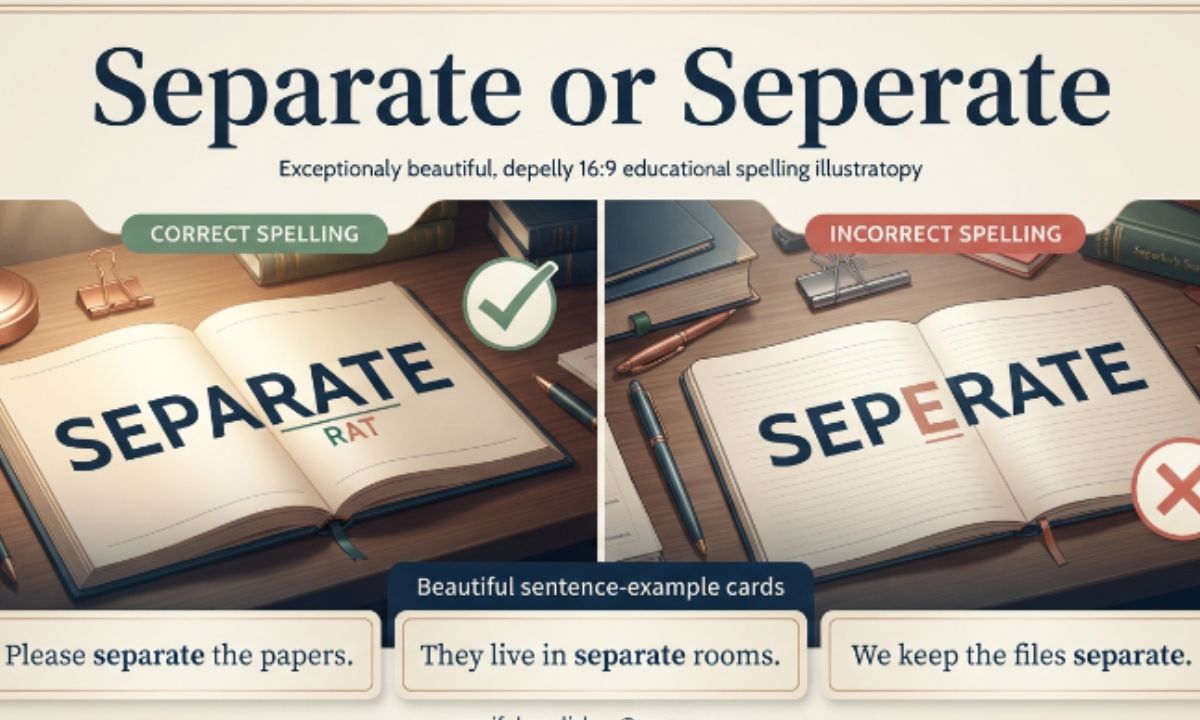

Separate is the correct spelling. Seperate is always wrong, no matter how you use it. This mix-up happens because of how the word sounds, not because the rules are unclear. Even strong writers slip on this one from time to time. This guide covers the correct spelling, meaning, pronunciation, and common mistakes. By the end, you’ll never second-guess thfis word again.
Separate vs Seperate: The Quick Answer
“Separate” is correct. Seperate is a misspelling and isn’t a real word in any dictionary.
The confusion comes down to one letter. Separate has two a’s, one right after the p and another later in the word. Seperate swaps that first a for an e, which breaks the spelling completely.
Every major dictionary, including Merriam-Webster, Oxford, and Cambridge, lists only one spelling: separate. There’s no alternate version, no informal variant, and no regional exception.
What Does “Separate” Mean?
Separate carries a few different meanings depending on how it’s used in a sentence.
As a verb, it means to divide, split apart, or keep two or more things from being together.
- “Please separate the whites from the colors before washing.”
- “The teacher separated the students into small groups.”
As an adjective, it means distinct, individual, or not connected to something else.
- “They live in separate apartments.”
- “These are two separate issues.”
As a noun, it’s rare, but it shows up in fashion when talking about individual clothing pieces meant to be mixed and matched.
- “The store sells stylish separates for spring.”
You’ll also see it used in more technical settings, like solving for separate variables in math, or describing a legal separation between a married couple.
Why Do People Misspell “Separate” as “Seperate”?
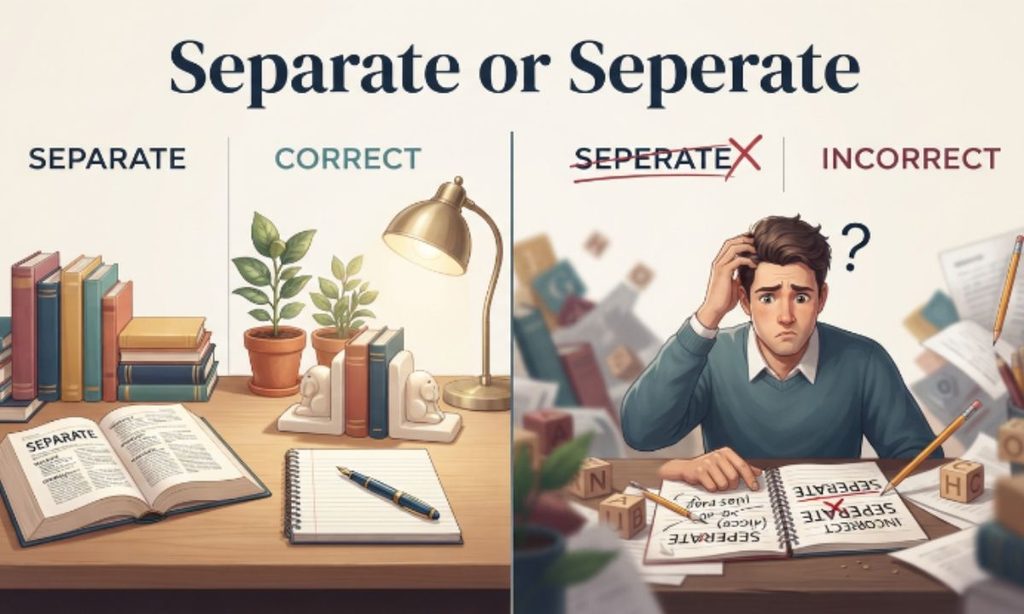
This one comes down to pronunciation, not carelessness.
When you say “separate” out loud, especially as an adjective, the middle syllable gets swallowed into a soft, unclear sound. Linguists call this a schwa. It doesn’t sound like a clear a or e, so your brain has to guess when spelling it.
Since e is a more common letter in unstressed syllables, people naturally reach for it instead of a. This isn’t a sign of poor spelling skills. It happens to native speakers and English learners alike, and it’s one of the most commonly misspelled words in the English language, right alongside words like “definitely” and “desperate.”
How to Pronounce “Separate” (Verb vs Adjective)
Here’s something most people don’t realize: separate is pronounced slightly differently depending on whether it’s a verb or an adjective.
| Form | Pronunciation | Sounds Like |
| Verb | /ˈsep-ər-eɪt/ | SEP-uh-rayt |
| Adjective | /ˈsep-ər-ət/ | SEP-rit |
As a verb, the last syllable is fully pronounced. As an adjective, it gets shortened and softened. That small shift is exactly why the spelling trips people up so often.
Where Does “Separate” Come From?
The word traces back to the Latin word separare, which combines se- (meaning “apart”) and parare (meaning “to prepare” or “arrange”). It made its way into English through French, keeping the double-a spelling intact even as pronunciation shifted over time.
That history explains why the spelling looks the way it does today, even though the sound doesn’t always match.
Memory Tricks to Never Misspell It Again
If you’ve struggled with this word before, a simple memory trick can lock it in for good. Here are the most effective ones people use.
Spot the rat: There’s a hidden “rat” inside sep-a-RAT-e. If you can find the rat, you’ve spelled it right.
Balanced vowels: The word follows an e-a-a-e pattern. Seperate breaks that balance with e-e-a-e, which should look wrong once you notice it.
Two A’s split by an R: The word literally separates its own two a’s with the letter r, which mirrors its meaning.
Simple rule: A comes after P, never E. If you remember that one detail, you’re set.
Pick whichever trick sticks best for you. Most people only need one to fix the habit permanently.
Separate as a Verb vs Adjective: Usage Examples
Separate works a little differently depending on its role in the sentence.
Verb examples (an action):
- “Separate the dough into four equal pieces.”
- “The fence separates our yard from theirs.”
- “It’s hard to separate fact from opinion these days.”
Adjective examples (a description):
- “We keep our finances in separate accounts.”
- “Each department has a separate budget.”
- “That’s a separate concern from what we’re discussing.”
Adverb form (“separately”):
- “Please file these documents separately.”
- “The two teams worked separately on the project.”
Knowing which role the word plays in your sentence makes it easier to pick the right form and avoid mixing up adjective and adverb usage.
Common Word Family Errors
Every form of “separate” follows the same spelling rule. If you fix the root, the rest falls into place.
| Correct | Incorrect |
| separate | seperate |
| separated | seperated |
| separating | seperating |
| separation | seperation |
| separately | seperately |
If you ever catch yourself typing an e in the middle of any of these words, stop and swap it for an a.
Common Collocations: “Separate From,” “Separate Into,” and More
Certain word pairings show up constantly with “separate,” and getting them right makes your writing sound more natural.
Separate from – the most common and correct pairing. (“Keep this pile separate from the rest.”)
Separate into – used when dividing something into parts or groups. (“Separate the class into three teams.”)
Separate out – used when pulling something specific away from a larger group. (“Separate out the recyclables.”)
One pairing to avoid: “separate than.” It shows up in casual speech sometimes, but it’s not standard English. Stick with “separate from” instead.
Common Grammar Mistakes Involving “Separate”
Beyond the spelling itself, a few grammar slip-ups tend to show up around this word.
Subject-verb agreement: “The manager separate the files” should be “The manager separates the files.”
Adjective vs adverb confusion: “Keep this separately” should be “Keep this separate,” since separate is the adjective here, not separately.
Double determiners: “A the separate issue” is incorrect; it should just be “a separate issue” or “the separate issue.”
Run-on sentences: Adding a separate clause without proper punctuation can create a run-on. Break it into two sentences or use a semicolon.
Watching for these small grammar issues alongside the spelling keeps your writing clean and professional.
Idioms and Fixed Expressions With “Separate”
“Separate” shows up in a handful of common phrases you’ve probably heard before.
Separate the wheat from the chaff – to distinguish valuable things from worthless ones.
Go your separate ways – to part company, often after a relationship or partnership ends.
A separate matter entirely – used to point out that two things shouldn’t be confused with each other.
Separation of powers – a governmental structure dividing authority across branches.
These expressions all rely on the same core meaning: keeping things apart or distinct.
American vs British English: Is There a Difference?
No. The spelling of “separate” is identical in American, British, Canadian, and Australian English. There’s no regional variant, unlike words such as “color” and “colour.”
Usage patterns and common phrases, like “separate from,” also stay consistent across English-speaking countries. If you’re writing for an international audience, you don’t need to worry about adjusting this particular word.
Separate vs Apart: What’s the Difference?
These two words overlap, but they’re not always interchangeable.
Separate is often used as a verb or adjective, describing the act of dividing or the state of being distinct. (“They have separate rooms.”)
Apart works as an adverb, usually describing distance or position. (“They live miles apart.”)
A simple test: if you need a verb or a noun modifier, reach for “separate.” If you’re describing distance or position, “apart” usually fits better.
Why This Spelling Matters in Professional Writing
A small spelling mistake like “seperate” can quietly hurt how your writing comes across, especially in emails, reports, or resumes. Readers may not consciously notice the error, but it can chip away at how polished and careful your work seems.
This matters most in:
- Client-facing emails
- Job applications and resumes
- Formal reports and proposals
- Marketing copy and public-facing content
Getting it right consistently is a small habit that pays off in how professional your writing feels.
How to Catch This Mistake Before You Hit Send
Spell-checkers don’t always catch “seperate,” especially in headlines, titles, or stylized text where automatic checking sometimes gets skipped.
A few practical habits help:
- Do a quick visual scan for the “rat” hidden inside the correct spelling.
- Read important documents once specifically looking for this word.
- Keep a mental list of words you personally tend to misspell, and give those a second look every time.
- Don’t rely on autocorrect alone, especially in professional documents.
A few extra seconds of attention is usually all it takes.
Frequently Asked Questions
Is it “separate” or “seperate”?
Separate is correct; seperate is a common misspelling with no dictionary standing.
Why do people misspell “separate”?
The unstressed middle vowel sounds like “uh,” which leads writers to guess an e instead of an a.
Is the spelling different in British English?
No, the spelling is identical across American, British, Canadian, and Australian English.
What part of speech is “separate”?
It works as a verb, an adjective, and occasionally as a noun.
What’s the easiest way to remember the spelling?
Look for the hidden word “rat” inside sep-a-RAT-e to lock in the correct spelling.
Conclusion
Separate is the only correct spelling, and seperate simply doesn’t hold up in any dictionary or style guide, no matter how natural it might sound when you say the word out loud. Once you understand that the mix-up comes from pronunciation rather than a tricky rule, and once you’ve got a memory trick that sticks, this word stops being a problem for good. A quick visual check before sending an email or finishing a document is usually all it takes to keep your writing clean, confident, and error-free.


[…] Separate or Seperate? The Correct Spelling Explained […]
[…] Separate or Seperate? The Correct Spelling Explained […]