

Confused about whether to write “put” or “puts”? You’re not alone. This mix-up trips up native speakers and learners alike. The good news is the rule is simple once you see it clearly. This guide walks through every case, from basic sentences to tricky exceptions. By the end, you’ll never second-guess this again.
Quick Answer: Put or Puts?
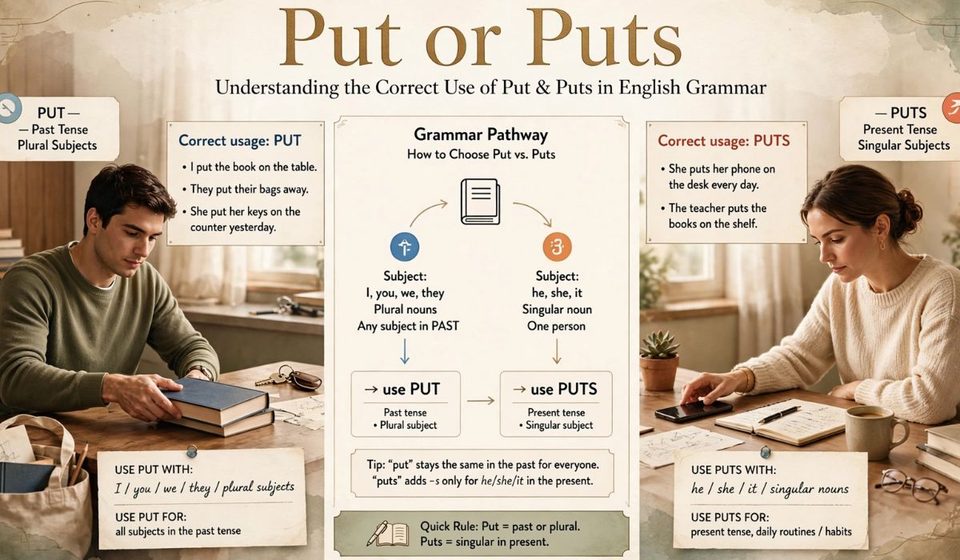
Use “puts” when your subject is he, she, it, or any singular noun, and you’re in the present tense.
Use “put” for every other subject, and for the past tense, no matter who’s speaking.
She puts her bag on the chair.
I put my bag on the chair.
They put their bags on the chair yesterday.
That’s the core rule. Everything else in this article builds on it.
Why Put and Puts Confuse People
The confusion comes from two things happening at once. First, English adds an “-s” to verbs in the present tense, but only for third-person singular subjects (he, she, it). Second, “put” is an irregular verb, meaning its past tense looks exactly like its base form. So the same word, “put,” shows up in the present (for most subjects) and in the past (for all subjects). That overlap is where people trip up.
Put vs. Puts: The Subject-Verb Agreement Rule
This is the heart of the issue. English present-tense verbs change form based on who or what is doing the action.
Use “Puts” With These Subjects
Puts is correct with:
He: He puts his keys in the same spot every day.
She: She puts extra effort into her work.
It: It puts pressure on the whole system.
A singular noun: The manager puts new hires through training.
A name: Sarah puts her phone on silent during meetings.
Singular indefinite pronouns: Everyone puts their notes in the folder. Someone puts the mail on the desk each morning.
Use “Put” With These Subjects
Put is correct with:
- I: I put my notes in order before the meeting.
- You: You put a lot of thought into that answer.
- We: We put safety first on every job site.
- They: They put the boxes in the storage room.
- Plural nouns: The kids put their shoes by the door.
Put or Puts Reference Table
| Subject | Correct Form | Example |
| I | put | I put my phone on the desk. |
| You | put | You put too much sugar in that tea. |
| He | puts | He puts his coat on the hook. |
| She | puts | She puts milk in her coffee. |
| It | puts | It puts stress on the engine. |
| We | put | We put our trust in the team. |
| They | put | They put up a new sign. |
| Singular noun | puts | The teacher puts grades online. |
| Plural noun | put | The students put their phones away. |
Put in the Past Tense
Here’s where things get interesting. In the past tense, every single subject uses “put.” There’s no change based on who’s doing the action.
- I put my keys on the counter yesterday.
- She put her keys on the counter yesterday.
- They put their keys on the counter yesterday.
Put is an irregular verb. Its base form, past tense, and past participle are all spelled the same way: put, put, put. This is different from regular verbs like “place,” which becomes “placed” in the past.
Put vs. Putting: Present Simple vs. Present Continuous
A common mistake is using “puts” to describe something happening right now. In standard English, the present simple usually describes habits and routines, not actions in progress.
Habit or routine: She puts her keys in the bowl every evening. (This happens regularly.)
Action happening right now: She is putting her keys in the bowl. (This is happening at this moment.)
If you want to describe something in progress, use “is putting,” “am putting,” or “are putting,” not “puts” or “put.” This distinction is often skipped in other grammar guides, but it matters if you want your writing to sound natural.
The Full Conjugation of “Put”
Here’s every form of the verb in one place.
| Verb Form | Correct Form |
| Base form / infinitive | put |
| Present simple (he/she/it) | puts |
| Present simple (I/you/we/they) | put |
| Present participle | putting |
| Simple past | put |
| Past participle | put |
Put vs. Putted: A Common Spelling Mistake
This is one of the most frequent errors people make. “Putted” is not the past tense of “put” when you mean “to place something.” That job belongs entirely to “put.”
- Correct: She put the vase on the table.
- Incorrect: She putted the vase on the table.
So where does “putted” come from? It’s the past tense of a completely different verb: putt, the golf stroke used to roll the ball into the hole.
- Correct: Tiger putted from twelve feet and sank it.
- Incorrect: Tiger put from twelve feet and sank it.
Two different verbs, two different meanings, two different past tenses. Keep them separate and you’ll avoid this mistake for good.
Puts or Put’s? The Apostrophe Trap
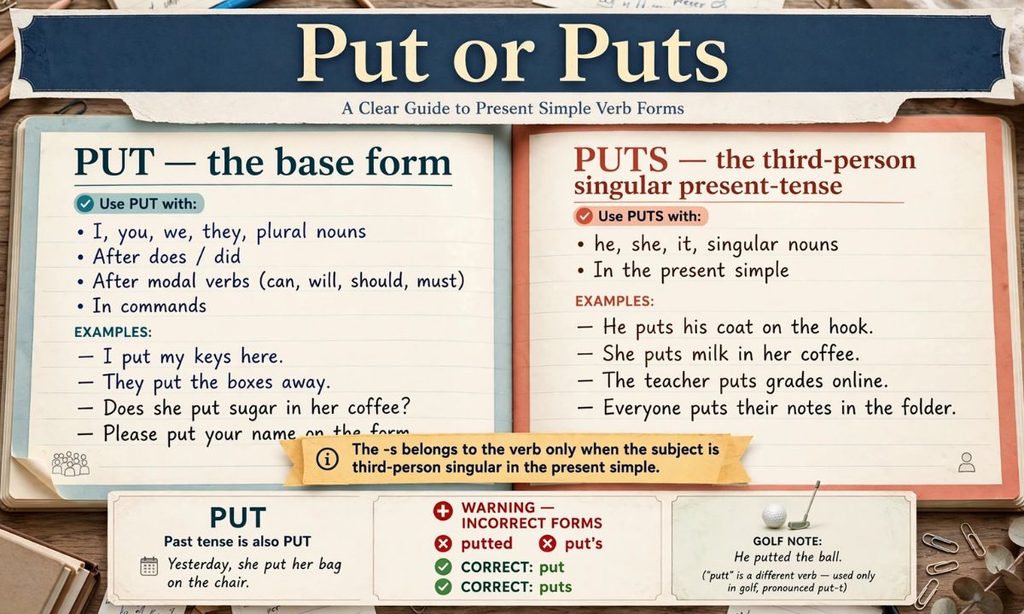
Another mix-up worth flagging: adding an apostrophe where it doesn’t belong.
- Correct: He puts his bag by the door.
- Incorrect: He put’s his bag by the door.
Regular verbs don’t take an apostrophe before the “s.” The apostrophe form “put’s” isn’t standard English. It could, in rare technical contexts, represent a contraction of “put is” or “put has,” but this is unusual and you’ll almost never need it. When in doubt, drop the apostrophe.
Put in Questions and Negatives
This is a gap many grammar pages miss. When you use “do,” “does,” or “did,” the main verb stays in its base form, even with he, she, or it.
Does she put sugar in her coffee? (Not “Does she puts…”)
He does not put his phone away. (Not “He does not puts…”)
Did they put the files back? (Not “Did they puts…”)
The “-s” only appears once in these sentences, and it attaches to “does,” not to “put.” This rule trips up a lot of learners because it feels like the “s” should go on the main verb.
Put After Modal Verbs
Modal verbs like can, could, will, would, should, may, might, and must are always followed by the base form of the verb.
- She can put the box on the shelf.
- He will put the report on your desk tomorrow.
- It might put the whole plan at risk.
Never add “-s” after a modal verb, regardless of the subject.
Put as a Command
Commands, or imperatives, always use the base form “put,” since the implied subject is “you.”
- Put your bag over there.
- Please put your name on the form.
- Don’t put your feet on the sofa.
Sentence Structure: Put + Object + Place
In its most common meaning, “put” needs an object and usually a location.
Pattern: Subject + put/puts + object + place
- Maya puts the vase on the table.
- They put the documents in a folder.
- I put my shoes by the front door.
Leaving out the object or location often makes the sentence sound incomplete, unless the context already makes it clear.
Common Meanings of Put
“Put” carries more than one meaning depending on the sentence. A few examples:
Place: Put the book on the shelf.
Express: To put it simply, the plan failed.
Cause a situation: This change puts the company at risk.
Write or record: Put your name on the list.
Assign a value: Analysts put the company’s worth at two billion dollars.
Phrasal Verbs With Put
“Put” forms many phrasal verbs, and each one shifts the meaning.
Put off – delay: He keeps putting off the appointment.
Put away – store something: She put away the groceries.
Put down – can mean set something down, insult someone, or, in a sensitive context, euthanize a sick animal. Context always makes the meaning clear.
Put up with – tolerate: I won’t put up with that behavior.
Put on – wear or apply: He put on his jacket.
Put together – assemble: They put together a great presentation.
Because “put down” carries such different meanings, always check the surrounding sentence before assuming which one applies.
Explore More Grammar Guide
A Lot or Alot? Correct Spelling, Meaning, and Examples
“To Bad” or “Too Bad”: Which Spelling Is Correct?
Advanced Agreement: Tricky Subjects
A few subjects cause more hesitation than others.
Everyone, someone, nobody, each: These are grammatically singular, so they take “puts.” Everyone puts their bag in the same spot.
Collective nouns (team, group, staff): In American English, these usually take the singular verb. The team puts safety first.
Relative clauses: The verb agrees with the noun the clause refers to. The person who puts in the most effort usually wins. The people who put in the most effort usually win.
Put Options vs. the Verb “Puts”
If you searched “put or puts” and landed here, you might actually be looking for something in finance. That’s worth a quick clarification since search results often mix the two topics.
In grammar, “puts” is a verb form: She puts the mail on the counter.
In finance, “puts” is the plural of “put option,” a contract that gives the buyer the right, but not the obligation, to sell an asset at a set price before a certain date. For example: He bought three puts on the stock before the earnings report.
These are two completely unrelated uses of the same spelling. If you’re researching options trading rather than grammar, you’ll want a finance-focused resource instead of a grammar guide.
Common Put or Puts Mistakes
Here are mistakes to watch for, along with the fix:
❌ She put her keys there every day. → ✅ She puts her keys there every day.
❌ He puts the keys there yesterday. → ✅ He put the keys there yesterday.
❌ They puts their bags down. → ✅ They put their bags down.
❌ Does she puts sugar in her coffee? → ✅ Does she put sugar in her coffee?
❌ He doesn’t puts it there. → ✅ He doesn’t put it there.
❌ She putted the book on the desk. → ✅ She put the book on the desk.
❌ Put’s the book on the table. → ✅ Puts the book on the table.
A Simple Decision Path
If you’re still unsure which form to use, run through these questions in order:
- Is the sentence in the past tense? Use put.
- Is it describing an action in progress right now? Use “putting” (with a form of “be”).
- Is there a modal verb, “do/does/did,” or a command? Use put.
- Is it present tense with he, she, it, or a singular noun? Use puts.
- Anything else in the present tense? Use put.
Following these five steps in order will settle almost every case you run into.
Frequently Asked Questions
Is it put or puts?
It depends on the subject and tense: use “puts” with he/she/it in the present tense, and “put” everywhere else.
What is the past tense of put?
The past tense is “put” for every subject; it does not change to “putted.”
Is “putted” ever correct?
Yes, but only for the golf verb “putt,” as in “he putted the ball into the hole.”
Is “put’s” correct grammar?
No, standard verb forms never take an apostrophe, so “puts” is correct and “put’s” is not.
Does “does” take “put” or “puts”?
“Does” carries the agreement, so the main verb stays as “put,” as in “Does she put sugar in her coffee?”
Conclusion
Choosing between “put” and “puts” comes down to two things: who’s doing the action, and when it’s happening. Use “puts” for he, she, it, or a singular noun in the present tense, and “put” for everyone else, plus every subject in the past tense.
Watch out for the “putted” mix-up with golf, skip the apostrophe in “put’s,” and remember that words like “does,” “did,” and modal verbs always pull the main verb back to its base form. Once these patterns click, you’ll write it correctly without having to think twice.


[…] Put or Puts: The Complete Grammar Guide With Rules and Examples […]