

You’ve probably typed both without thinking twice until one of them stopped a sentence in its tracks. One tiny apostrophe sits between “naming something” and “describing an action.” Get it wrong, and a simple sentence can read like a typo. Here’s exactly how to tell them apart, for good.
The Quick Answer
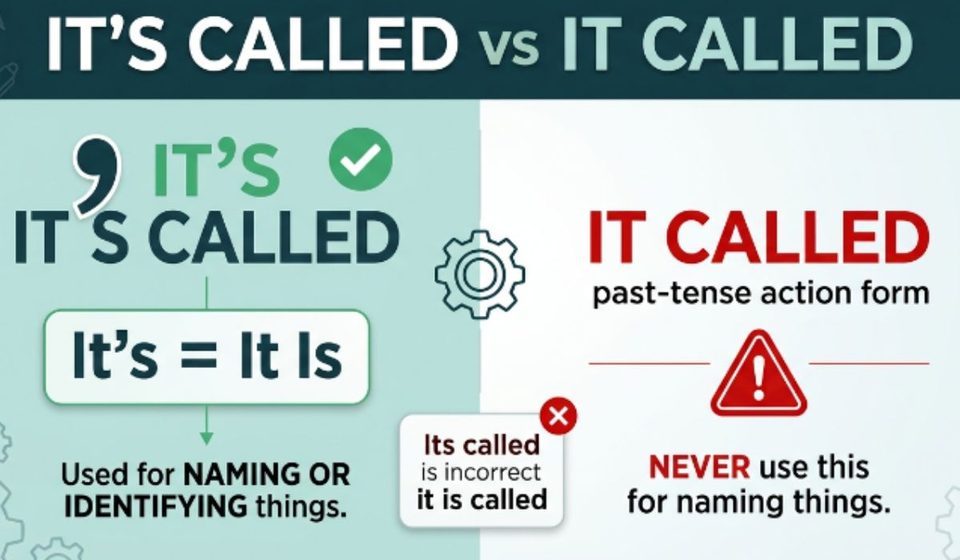
“It’s called” is the correct phrase when you’re naming or identifying something. “It called” is only correct when something acted out of calling, like making a phone call or triggering an alert.
It’s called = “it is called.” Use it to name a thing. It’s called a thermostat.
It called = past tense of “call.” Use it for an action. It called twice before anyone answered.
Its called = not a real phrase. It’s a spelling slip that mixes up “its” (possession) with “it’s” (contraction).
If you remember nothing else from this article, remember this: naming needs the apostrophe; action doesn’t.
Why These Three Phrases Get Mixed Up
The confusion isn’t really about grammar rules. It’s about sound. “Its,” “it’s,” and even the contracted flow of “it called” all blend when spoken out loud. Nobody hears an apostrophe.
That’s the whole problem. English relies on punctuation to carry meaning that speech doesn’t need. So when people write quickly, or type on a phone, or rely on how a sentence sounds rather than how it’s built, the wrong form slips through.
A few specific reasons this mix-up happens so often:
- Autocorrect sometimes lets “its called” pass because “its” is a real word.
- Fast typing leads to dropped apostrophes.
- Non-native speakers often translate word-for-word from languages that phrase naming differently.
- The words are homophones. Say them aloud, and there’s no audible difference.
None of that makes the error acceptable in writing. But it explains why even careful writers slip up.
It’s Called: What It Means and When to Use It
“It’s called” is a contraction of “it is called.” It’s a passive construction, meaning the subject of the sentence receives the name rather than acting.
Use it to:
- Introduce the name of an object, place, or concept.
- Answer the question “what is it called?”
- Define a term or explain terminology.
- Identify a title, brand, or label.
Examples:
- It’s called a barometer, and it measures air pressure.
- The process is complicated, but it’s called photosynthesis.
- That neighborhood is old, but it’s called the Historic District.
Notice the pattern. In every case, the thing being discussed isn’t doing anything. It’s simply receiving a name. That’s the core of passive voice: the subject sits still while the sentence tells you what it’s known as.
It’s Called vs. It Is Called

These two are functionally identical. “It’s called” is the contracted, conversational version. “It is called” is the expanded, more formal version. Neither is more “correct” than the other, but they carry a different tone.
Casual writing, conversation, blog posts: It’s called a spreadsheet.
Academic papers, technical documentation, formal reports: It is called a spreadsheet.
Style guides don’t typically ban contractions outright anymore, but many formal or academic contexts still favor the expanded form because it reads as more deliberate. If you’re writing a research paper, lean toward “it is called.” If you’re writing an email to a coworker, “it’s called” works fine.
It Called: What It Means and When to Use It
“It called” is simple past tense, active voice. Here, the subject actually does something. It doesn’t receive a name; it acts.
This phrase almost always means one of the following:
A device, system, or automated process made contact.
A person or entity telephoned someone.
An animal or object made a sound described as “calling.”
A program or function was triggered or invoked (common in technical writing).
Examples:
- It called three times before I picked up.
- The smoke alarm went off, and it called emergency services automatically.
- The function called an external server to fetch the data.
Here’s the key test: if you can replace “called” with “contacted,” “invoked,” “triggered,” or “phoned” and the sentence still makes sense, you’re in “it called” territory. If you’re trying to say what something is named, this isn’t the right phrase.
It Called vs. It Was Called
This is a distinction most explanations skip, and it trips people up constantly.
It called someone or something: an active action. It called the front desk.
It was called a name or description: a passive naming action in the past tense. It was called a mistake by the committee.
These look similar but mean completely different things. “It called the office” means the subject made contact. “It was called a failure” means someone gave that label to the subject. Mixing these up is one of the most common structural errors in this whole category, and almost none of the standard explanations address it clearly.
Its Called: Why This One Is Almost Always Wrong
“Its” is a possessive pronoun. It shows that something belongs to or is associated with the subject, similar to “his,” “hers,” or “theirs.” None of those words use an apostrophe, and neither does “its.”
- The company updated its policy. (possession)
- The dog wagged its tail. (possession)
- The phone lost its charge. (possession)
The problem starts when “its” gets used where “it’s” belongs. “Its called a policy update” doesn’t work, because “its” has no verb attached to it. The sentence is missing the word “is.” Without that verb, the phrase falls apart grammatically.
Quick rule: if you can expand the word to “it is” or “it has” and the sentence still makes sense, you need the apostrophe. If the word shows ownership, drop the apostrophe.
| Phrase | Type | Correct? | Example |
| It’s called | Contraction (it is called) | Yes | “It’s called a router.” |
| Its called | Missing verb / incorrect | No | “Its called a router.” ❌ |
| Its | Possessive pronoun | Yes (for possession) | “The router lost its signal.” |
| It called | Active past tense | Yes (for actions) | “The router called for an update.” |
The Apostrophe Test: A Fast Way to Check Yourself
Before publishing anything, run this quick test on any sentence with “its” or “it’s”:
- Replace the word with “it is” or “it has.”
- Read the sentence back.
- If it still makes sense, keep the apostrophe. If it doesn’t, remove it.
Example: “Its called a tablet.” → Expand it → “It is called a tablet.” → Makes sense → Apostrophe needed → It’s called a tablet.
Example: “The team updated it’s strategy.” → Expand it → “The team updated it is strategy.” → Doesn’t make sense → No apostrophe needed → The team updated its strategy.
This single test resolves almost every mix-up between the two words, regardless of context.
Explore More Grammar Guide
Persue or Pursue: Which Spelling Is Correct?
Suing or Sueing: Which Spelling Is Actually Correct?
Puting vs Putting: Which Spelling Is Actually Correct?
What Is It Called? vs. How Is It Called?
If you’re asking someone to identify a name, there’s a right way and a wrong way to phrase the question.
Correct: What is it called?
Correct: What do you call it?
Incorrect (in standard English): How is it called?
“What” asks about identity. “How” asks about method or manner. Since naming is about identity, not process, “what” is the word that fits. “How is it called?” shows up sometimes in non-native English usage, likely influenced by how other languages phrase the same question, but it isn’t standard in English.
If you’re ever unsure which question word to use, remember: names get a “what,” methods get a “how.”
Active Voice vs. Passive Voice: Why It Matters Here
Understanding the difference between active and passive voice clears up most of the confusion in this topic.
Active voice: the subject acts.
- People call it gravity.
- The system is called the server.
Passive voice: the subject receives the action.
- It is called gravity.
- The server was called by the system.
“It’s called” is passive because the named object doesn’t do anything; it just gets labeled. “It called” is active because the subject is the one taking action. Once you see the pattern, switching between them becomes automatic.
Real-World Examples Across Contexts
Seeing these phrases in different settings makes the distinction stick.
Everyday conversation:
- What’s that vegetable called? It’s called kohlrabi.
Technology:
- The app called the payment gateway twice before completing the order.
- This feature is called dark mode.
Business writing:
- The new onboarding process is called Fast Track.
- The client called our support line about the delay.
Academic or scientific writing:
- This phenomenon is called thermal expansion.
- The study called for a larger sample size. (Here, “called for” means “required,” a different but related usage worth noting.)
Common Mistakes to Avoid
Writing “its called” when you mean “it’s called.”
Using “it called” to name something instead of describing an action.
Asking “How is it called?” instead of “What is it called?”
Mixing formal and informal forms (“it’s called” and “it is called”) inconsistently within the same document.
Forgetting “was” in passive past constructions, like writing “it called a mistake” instead of “it was called a mistake.”
Assuming the words sound different when spoken. They don’t, so you can’t rely on your ear alone.
A Simple Decision Framework
When you’re stuck, walk through these three questions in order:
- Am I naming or identifying something?
Use “it’s called.”
- Am I describing possession, something belonging to the subject?
Use “its.”
- Did the subject act, like contacting someone or triggering a process?
Use “it called,” and check if you need “was called” for a passive past version.
This three-step check works for nearly every sentence you’ll come across.
Frequently Asked Questions
Is “it’s called” or “its called” correct?
“It’s called” is correct; “its called” is a common apostrophe error with no verb.
When should I use “it called” instead of “it’s called”?
Use “it called” only when the subject performed a past action, like making contact or triggering something.
Is “how is it called” grammatically correct?
No, standard English uses “What is it called?” to ask for a name.
What’s the difference between “its” and “it’s”?
“Its” shows possession, while “it’s” is short for “it is” or “it has.”
Is “it is called” more formal than “it’s called”?
Yes, “it is called” is the expanded, more formal version, while “it’s called” is common in everyday writing and speech.
Final Thoughts
The difference between these phrases comes down to one small mark that carries a lot of weight: an apostrophe separates naming something from describing an action, and mixing them up is one of the easiest slips to make since they all sound identical out loud.
Once you internalize that “it’s called” introduces a name, “it called” describes something happening, and “its” shows possession with no apostrophe at all, you’ll stop second-guessing yourself mid-sentence. Run the quick substitution test whenever you’re unsure, and you’ll get it right every time, in formal writing, casual messages, or anything in between.

[…] It’s Called vs It Called: Which One Should You Use? […]