

You’ve typed it a hundred times, but something about it still looks off. Is there an “e” before the “l” or after it? One version feels natural to say out loud, but looks wrong on the page. Here’s the short answer, and everything else you need to never second-guess it again.
The Correct Spelling Is Label
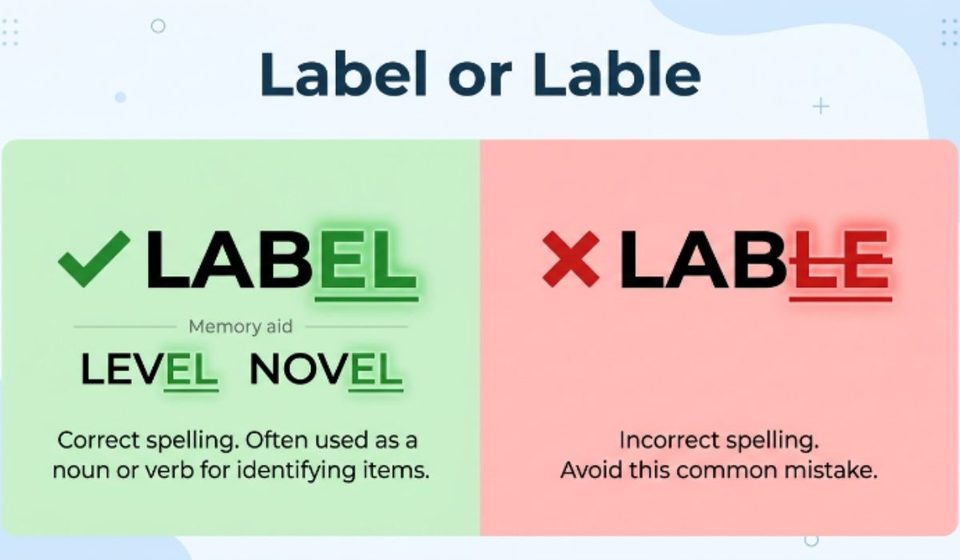
Label is correct. Lable is not a word in any form of English, standard or otherwise.
- Label ends in -el.
- Lable, with the letters flipped to -le, is a spelling error, not a regional variant or informal shortcut.
- You’ll find “label” spelled this way in American, British, Australian, and Canadian English. There’s no version of the language where “lable” is accepted.
If you’ve seen “lable” somewhere and assumed it might be a stylistic choice or a different dialect, it isn’t. It’s simply a typo that happens to look plausible, which is exactly why it sneaks past people.
Why the Mix-Up Happens
The confusion isn’t random. English has plenty of common words that end in “-le” instead of “-el”: table, cable, stable, capable. Say “label” out loud and it can sound like it belongs in that group.
But the ending isn’t the same. A quick trick: think of “label” the same way you think of “level” or “novel.” Same “-el” pattern, no ambiguity.
Other reasons the mistake shows up:
- Typing fast and swapping the last two letters without noticing.
- Autocorrect quietly letting it through because “lable” resembles a real word.
- Relying on how the word sounds instead of how it’s spelled.
- Simple carelessness during proofreading, especially in emails or quick notes.
None of these make “lable” acceptable. It’s worth catching, whether you’re writing a school paper, a product description, or a text to a friend.
What Does Label Mean?
Label works as both a noun and a verb, and the meaning shifts depending on which one you’re using.
Label as a Noun
As a noun, a label is something attached to an object, or a word used to describe something.
- A physical tag or piece of material attached to an item, like a size tag on a shirt.
- Printed or written information describing what something is, such as an ingredients list.
- A descriptive name or category applied to a person, idea, or group.
- A company that produces and sells recorded music (a record label).
- A brand name in the fashion industry (a fashion label).
Label as a Verb
As a verb, “to label” means to attach that identifying information, or, more broadly, to assign something to a category.
Physically attaching a tag: She labeled every jar in the pantry.
Adding descriptive information: The bottle is labeled with the expiration date.
Categorizing a person or idea: It’s easy to label someone without knowing their full story.
That last use deserves a closer look, because it’s where the word gets a little more complicated.
Labeling People: Useful or Reductive?
Calling something a “label” isn’t always neutral. When it’s applied to objects, there’s rarely any tension. A box labeled “fragile” is just informative. But when the word is applied to people, it can carry weight.
Labeling someone can be:
Neutral and practical: Job titles, medical diagnoses, and legal classifications are labels that help organize information clearly.
Reductive: Reducing a whole person to one trait or category, ignoring everything else about them.
Rooted in assumption: Judging someone quickly based on limited information, sometimes leaning on stereotypes.
There’s a real difference between calling someone “a teacher” (a factual, useful label) and calling someone “difficult” after one bad interaction (a label that flattens a person into a single impression). Context matters. A label can organize the world usefully, or it can oversimplify it. Good writers tend to know which one they’re doing.
Labeled or Labelled? The Spelling Splits Here
This is where things actually do change depending on which English you’re writing in. The base word “label” stays the same everywhere. It’s the forms with added endings that split.
| Form | American English | British / Australian English |
| Past tense | labeled | labelled |
| Present participle | labeling | labelling |
| Agent noun | labeler | labeller |
Why the difference? It comes down to a spelling convention around doubling the final consonant before adding “-ed” or “-ing.” British and Australian English tend to double the “l” regardless of where the stress falls in the word. American English generally doesn’t, unless the stress lands on the final syllable.
Examples:
American: The boxes have all been labeled and stacked.
British: The boxes have all been labelled and stacked.
American: We’re labeling each shelf by category.
British: We’re labelling each shelf by category.
The rule of thumb: pick one variety of English and stay consistent within a single document. Mixing “labeled” and “labelled” in the same piece of writing looks like an oversight, even though each spelling is correct in its own regional context.
Explore More Grammar Guide
Persue or Pursue: Which Spelling Is Correct?
Suing or Sueing: Which Spelling Is Actually Correct?
Puting vs Putting: Which Spelling Is Actually Correct?
Is Label Spelled Differently in British English?
No, not the base word. This trips people up because they assume the labeled/labelled split means the noun and verb themselves change too. They don’t.
- American English: label
- British English: label
- Australian English: label
The word “label” is identical across every major English-speaking region. The only variation shows up once you add a suffix like “-ed” or “-ing.” If you’re writing “label” as a plain noun or the base verb, spelling doesn’t change no matter your audience.
Shipping Label or Shipping Lable?
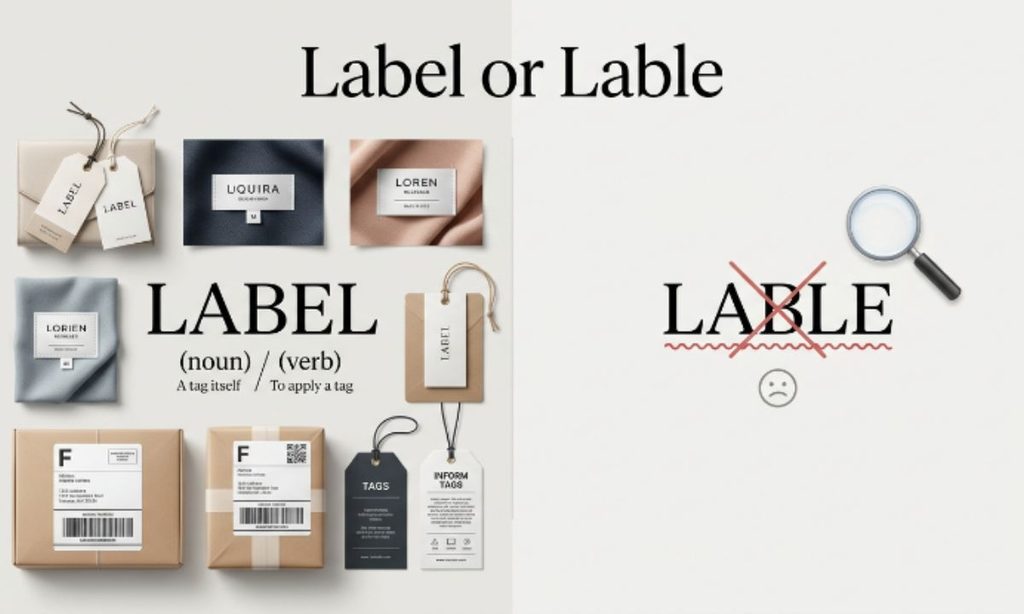
If you’ve searched this exact phrase, here’s your answer: it’s shipping label, always.
A shipping label is the printed sticker or document attached to a package that includes:
- The recipient’s address.
- The sender’s return address.
- A tracking number or barcode.
- Weight, size, or handling instructions.
“Shipping lable” is never correct, in any context, whether you’re printing labels for a small business or writing instructions for a warehouse team. The same rule applies to every compound phrase using this word: warning label, nutrition label, name label, address label. The base word never changes.
Common Phrases That Use Label
Seeing the word in familiar phrases can help the correct spelling stick. Here are some of the most common ones:
- Product label
- Warning label
- Nutrition label
- Clothing label
- Shipping label
- Name label
- Address label
- Private label
- Record label
- Fashion label
- Label maker
- Label something clearly
One worth explaining further: private label. This refers to products manufactured by one company but sold under another company’s brand name, common in grocery stores, cosmetics, and retail chains. A store’s own-brand cereal, made by a third-party manufacturer, is a private-label product.
Label in Everyday Industries
The word shows up far beyond clothing tags and shipping boxes. A few places where “label” carries specific meaning:
Retail and food: Nutrition labels, ingredient lists, and expiration dates.
Music: A record label signs artists and distributes their music. Major labels and independent labels operate differently, but both use the same term.
Fashion: A fashion label refers to a brand, not just a physical tag sewn into clothing.
Technology: In email apps, labels sort and organize messages instead of using folders. In data science, a “label” is the correct answer or category assigned to a piece of training data.
Design and data: Charts and graphs use labels to identify axes, categories, or data points.
Across all of these, the spelling never wavers. It’s always label.
Label vs. Similar Words
Label often gets used loosely alongside words like “tag,” “sticker,” or “marker,” but they’re not always interchangeable.
“Tag” usually implies something smaller or attached loosely, like a keychain tag or a price tag.
“Sticker” specifically means an adhesive label, often decorative or temporary.
“Marker” can mean a label but also refers to a physical pen or a signpost.
A caption describes an image or scene, rather than identifying an object.
“Brand” refers to a company’s identity, which a label might represent but isn’t identical to.
Stereotype is a specific, often unfair kind of label applied to people based on assumptions.
Choosing the right word depends on precision. “Label” tends to be the broadest and most flexible option of the group.
Synonyms for Label
Depending on how you’re using the word, a few alternatives work well:
As a noun (identifying information): tag, ticket, docket, marker
As a verb (attaching information): tag, mark, identify, categorize
As a verb (describing a person): classify, pigeonhole, stereotype, characterize
Swapping in the right synonym can help avoid repetition in writing, especially in longer pieces that reference the word often.
How to Remember the Correct Spelling
A few tricks that actually help:
- Picture the word “level.” Same “-el” ending, no exceptions.
- Say it slowly and picture the letters instead of relying on how it sounds.
- Remember that “-le” words like “table” and “cable” don’t apply here.
If you’re proofreading, search your document for “lable” specifically. It’s a fast way to catch the error before publishing anything.
Add “label” to your personal spell-check dictionary if autocorrect keeps letting the wrong version through.
Frequently Asked Questions
Is it lable or label?
The label is correct; lable is a common misspelling with no valid use in English.
Is lable a real word?
No, lable isn’t recognized in any English dictionary or style guide.
Is “label” spelled differently in the UK?
No, the base word is identical in American, British, and Australian English.
Is it labeled or labelled?
Both are correct: “labeled” is American English, and “labelled” is British and Australian English.
What is a synonym for label?
Common alternatives include “tag,” “ticket,” and “marker,” or “classify” and “pigeonhole” when describing people.
Final Thoughts
“Label” is one of those words that looks simple until you’re mid-sentence and suddenly unsure of yourself, but the rule is straightforward: it always ends in “-el,” never “-le,” and that holds whether you’re labeling a shipping box, a clothing tag, or a person’s reputation.
The only real variation shows up in extended forms like labeled and labelled, where American and British English part ways, so pick your regional spelling and stay consistent throughout whatever you’re writing. Get that much right, and you’ll never have to pause over this word again.

[…] Lable or Label: Which Spelling Is Actually Correct? […]
[…] Lable or Label: Which Spelling Is Actually Correct? […]
[…] Lable or Label: Which Spelling Is Actually Correct? […]