
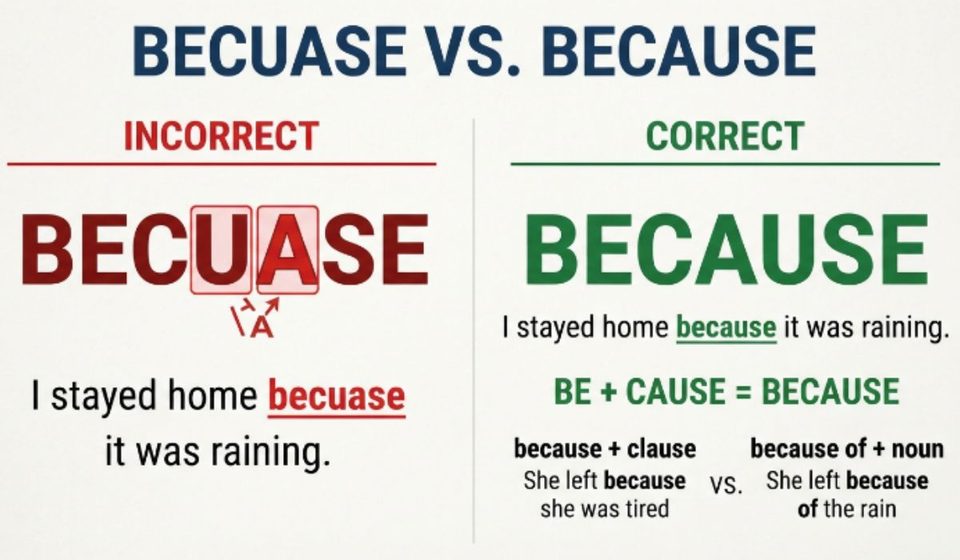

You’re typing fast, and your fingers swap two letters without you noticing. Suddenly “because” comes out as “becuase.” It happens to almost everyone at some point. The good news is that this one has a clear, simple answer with no exceptions. Once you understand why the mix-up happens, you’ll catch it every time before hitting send. This guide covers the correct spelling, the grammar behind the word, and the punctuation rules that trip people up even after they’ve nailed the spelling.
Why “Becuase” Isn’t a Real Word
“Because” is the only correct spelling in standard English.
“Becuase” doesn’t exist as a word.
It’s a typo, almost always caused by two letters swapping places: the “a” and the “u” get flipped, turning “because” into “becuase.”
This kind of error is called a letter transposition. It happens most often when you’re typing quickly, when your fingers move faster than you’re thinking, or when autocorrect doesn’t catch it because the two middle letters are just close enough in sound that your brain doesn’t flag the mistake.
Dictionaries, spell-checkers, and style guides all agree: there’s no version of standard, formal, or even casual English where “becuase” is acceptable. If you’re writing an email, an essay, a text to a friend, or anything in between, “because” is the spelling you want every time.
Common Misspellings of “Because”
“Becuase” isn’t the only variant floating around. Here are the most frequent typos people make with this word, and why each one happens:
| Misspelling | Likely cause |
| becuase | The a and u are swapped |
| becouse | The a is replaced with an o |
| becaus | The final e is dropped |
| becase | An internal vowel is missing |
| becuse | The a is dropped entirely |
| becasue | The letters are reordered near the end |
Most of these errors come down to one of three things: typing too fast, spelling the word the way it sounds rather than the way it’s written, or a keyboard slip that swaps adjacent letters. None of them are acceptable in edited, professional, or academic writing.
An Easy Way to Remember the Spelling
Here’s the trick that works for almost everyone: break the word into two smaller, familiar pieces.
Because = be + cause
You already know how to spell “cause.” Once you see “because” as “be” plus “cause,” the correct letter order becomes obvious. You’re literally naming the cause behind something, which also happens to match the word’s meaning: because introduces the reason or cause for something.
Another simple check: read it out loud slowly, syllable by syllable. Be-cause. That rhythm alone helps most people catch a transposition before they type it.
Where the Word Came From
“Because” has been around for a long time. It developed from the Middle English phrase “by cause,” where “by” meant “on account of” and “cause” traced back to the Old French word for reason or motive, which itself came from the Latin “causa.” Over time, English speakers merged the two words into the single conjunction we use today.
Knowing the history isn’t necessary to spell it correctly, but it does explain why “cause” sits right there inside the word, quietly reminding you what it means and how it’s built.
What “Because” Actually Means
“Because” introduces a reason. It connects two ideas: something that happens, and the reason it happens. In grammar terms, it answers the question “why?”
A few plain examples:
- The store closed early because a storm was coming.
- She stayed up late because she was studying for an exam.
- The team celebrated because they won the championship.
In every one of these, “because” links a result to its cause. That’s its entire job.
What Part of Speech Is “Because”?
“Because” is a subordinating conjunction. That’s a specific grammar term, but the idea behind it is simple.
A subordinating conjunction connects two parts of a sentence: one part that can stand alone (the independent clause) and one part that can’t stand alone (the dependent clause). The dependent clause needs the independent clause to make complete sense.
Take this sentence:
“We stayed inside because it was raining.”
- “We stayed inside” can stand alone as a complete sentence.
- “Because it was raining” cannot stand alone. It depends on the first part to make sense.
That’s the basic structure behind almost every sentence that uses “because.”
Can You Start a Sentence With “Because”?
Yes, absolutely. The old classroom rule that you should never begin a sentence with “because” isn’t accurate. You can open a sentence with it, as long as you follow it with a complete main clause.
Correct:
- “Because it was raining, we decided to stay inside.”
Incomplete (a fragment, not a full sentence):
- “Because it was raining.”
The issue was never really about starting with “because.” The real rule is that a sentence needs a complete main clause somewhere in it. If you start with a “because” clause, just make sure a full independent clause follows it, and you’re in the clear.
“Because” vs. “Because Of”: Know the Difference
This is one of the most common mix-ups, even among people who never misspell the word itself.
Because introduces a full clause, meaning it’s followed by a subject and a verb.
Because of is a two-word preposition, meaning it’s followed by a noun or noun phrase, not a full clause.
Compare these:
- “The game was postponed because it was raining.” (because + full clause: it was raining)
- “The game was postponed because of the rain.” (because of + noun phrase: the rain)
Both sentences are correct, but they’re built differently. Mixing them up, like saying “because of it was raining,” creates an awkward, ungrammatical sentence.
Do You Need a Comma Before “Because”?
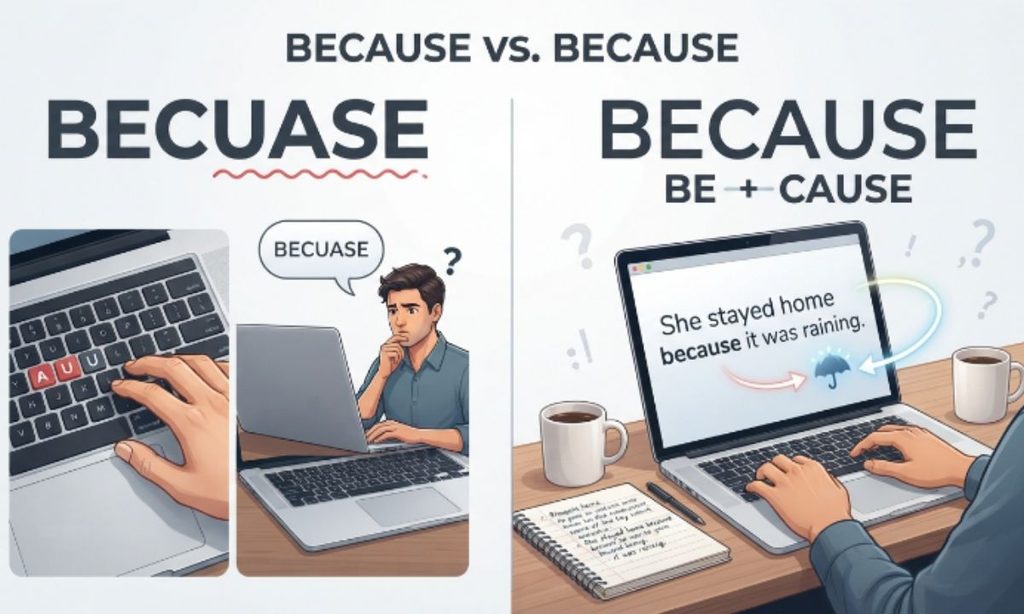
Most of the time, no. When a “because” clause comes after the main clause and gives the essential reason for it, you don’t need a comma.
- “She left early because she felt sick.” (no comma needed)
- “The bridge closed because of storm damage.” (no comma needed)
A few situations, though, use a comma to avoid confusion.
When the main clause is negative. A negative statement followed by “because” can sometimes be read two different ways.
“I didn’t go out because it was raining.” This could mean either “I stayed in due to the rain” or “I did go out, but the rain wasn’t my reason.”
Adding a comma clears it up: “I didn’t go out because it was raining.” This version makes clear that the rain kept you home.
When “because” could attach to more than one part of the sentence. If your sentence has more than one clause before “because,” it can be unclear which one the reason applies to. A comma, placed carefully, signals which clause the reason belongs to.
For a deliberate pause or slight emphasis. Some writers use a comma before “because” purely for rhythm or emphasis in more conversational writing. This is a style choice, not a strict rule, and it’s worth using sparingly.
What About a Comma After “Because”?
“Because” itself doesn’t normally need a comma right after it. The only time you’d add one is if a short interrupting phrase follows, and that phrase would need commas around it anyway.
- “We skipped the trip because, honestly, the weather looked terrible.”
Here, the comma isn’t really about “because.” It’s about setting off “honestly” as an inserted aside.
Comma Before a “Because” Clause at the Start of a Sentence
This one is more straightforward. When a “because” clause opens the sentence, put a comma right before the main clause begins.
- “Because the roads were icy, school was cancelled.”
- “Because she practiced every day, she improved quickly.”
This is one of the few comma rules with “because” that’s consistently applied, so it’s worth memorizing on its own.
“Because,” “Since,” and “As”: How Do They Compare?
All three words can express cause, but they carry slightly different shades of meaning.
Because is the clearest, most direct way to state a reason. When in doubt, this is the safest choice.
Since can express cause too, but it can also mean time, which can occasionally create ambiguity. “Since he moved to Chicago” could mean “because he moved” or “from the time he moved,” depending on context.
As can express cause as well, but it’s more formal and can sometimes be misread as meaning “while,” especially if it doesn’t sit at the start of the sentence.
If you want your meaning to be unmistakable, “because” is almost always the safer pick. Save “since” and “as” for situations where the surrounding context already makes the meaning obvious.
“Because” vs. “For”
“For” can occasionally mean “because,” but it reads as more old-fashioned or literary today.
- “He left early, for he had a long drive ahead.” (Correct, but sounds formal or dated.)
- “He left early because he had a long drive ahead.” (More natural in everyday writing.)
Unless you’re going for a deliberately formal or classic tone, “because” is the more natural modern choice.
Explore More Grammar Guide
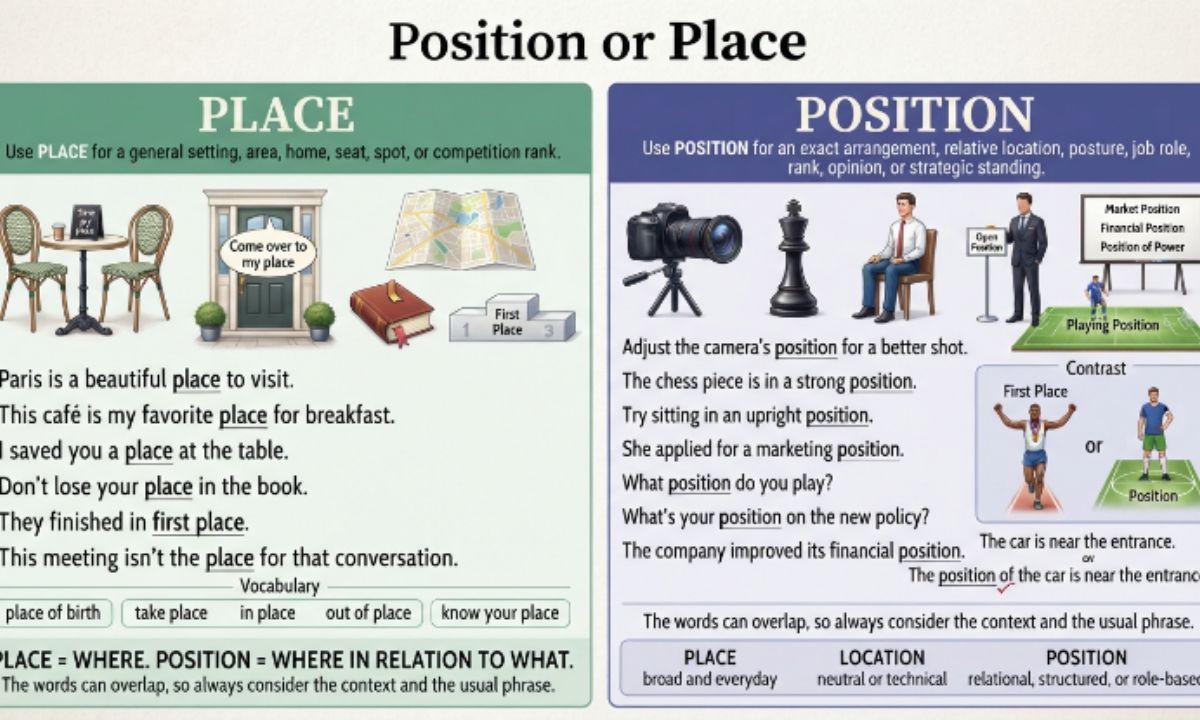
Position or Place: What’s the Real Difference?
Separate or Seperate? The Correct Spelling Explained
“To Bad” or “Too Bad”: Which Spelling Is Correct?
Alternatives to “Because Of”
If you’re looking to vary your writing or match a certain tone, several phrases work similarly to “because of.” Just remember they all pair with a noun phrase, not a full clause.
- Due to
- Owing to
- As a result of
- On account of
- Thanks to
Example: “The flight was delayed due to heavy fog.” All of these can replace “because of” directly, though some sound more formal than others. “Thanks to,” for instance, often implies something positive, while “owing to” and “due to” are more neutral and tend to show up in written or business contexts.
One phrase to avoid for concise writing: “because.” It means the same thing as “because,” just with extra words. Cutting it down to “because” almost always improves the sentence.
Is “The Reason Is Because” Correct?
Technically, no. This phrase is considered redundant, since “because” already means “for the reason that.” Saying “the reason is because” essentially repeats the same idea twice.
Instead, try one of these:
- “The reason is that we ran out of time.”
- “We ran out of time because the meeting ran long.”
Either version says the same thing more cleanly.
Informal Versions of “Because”
In casual speech, texting, and some creative writing, you’ll see shortened versions of “because”:
- Cos
- ‘Cause
- Cuz
- Coz
These are fine in relaxed, conversational contexts, like texting a friend or writing dialogue in a story. They’re not appropriate for formal writing, professional emails, academic papers, or anything meant to read as polished and standard.
“Because” in Everyday Sentences
Seeing the word used across different situations helps the rules stick.
Conversation
- I’m tired because I didn’t sleep well.
- She’s happy because her plan worked.
School and academic writing
- The experiment failed because the temperature was too high.
- Researchers changed their approach because earlier results were inconclusive.
Workplace and email
- The meeting was rescheduled because several team members were traveling.
- We’re updating the policy because customer feedback pointed to confusion.
Contrast structure
- She didn’t quit because she was afraid, but because she found something better.
That last example shows a useful pattern: “not because X, but because Y.” It’s a clean way to correct an assumption or clarify a real motive.
Common Mistakes to Avoid
Writing “becuase” instead of “because.” Always double-check the middle letters.
Mixing up because and because of. Remember: because + clause, because of + noun.
Adding a comma before because out of habit. Most of the time, you don’t need one.
Forgetting the comma after an opening because clause. If “because” starts the sentence, add a comma before the main clause.
Writing “the reason is because.” Pick one or the other, not both.
Using cos, cuz, or ’cause in formal writing. Save these for casual contexts only.
Writing a sentence fragment that starts with because and never finishes. Make sure a complete main clause follows.
A Quick Proofreading Checklist
Before you hit send or submit, run through this short list:
- Spelled it b-e-c-a-u-s-e? Good.
- Followed “because” with a full clause, not just a noun? Good.
- Used “because of” before a noun phrase, not a clause? Good.
- Added a comma if “because” opens the sentence? Good.
- Checked for ambiguity in a negative sentence? Good.
- Avoided “the reason is because”? Good.
Frequently Asked Questions
Is “becuase” ever correct?
No, “becuase” is a misspelling with no standard meaning in English.
Can a sentence start with “because”?
Yes, as long as a complete main clause follows the opening “because” clause.
Do I need a comma before “because”?
Usually not, except to clarify meaning in negative sentences or when the sentence could be read more than one way.
What’s the difference between “because” and “because of”?
“Because” introduces a full clause, while “because of” is followed by a noun or noun phrase.
Is “the reason is because” grammatically correct?
It’s considered redundant; use either “the reason is that” or simply “because” instead.
Final Thoughts
Getting “because” right comes down to one small habit: slow down just enough to check the middle letters before you hit send. Remembering it as “be + cause” makes the spelling almost automatic once it clicks.
Beyond spelling, understanding how “because” works as a subordinating conjunction, how it differs from “because of,” and when a comma actually helps will make your writing clearer and more confident, whether you’re texting a friend, finishing a school assignment, or sending a professional email.


[…] Becuase vs. Because: Which Spelling Is Actually Correct? […]
[…] Becuase vs. Because: Which Spelling Is Actually Correct? […]
[…] Becuase vs. Because: Which Spelling Is Actually Correct? […]
[…] Becuase vs. Because: Which Spelling Is Actually Correct? […]