

Someone wishes you a good day, and you type a quick reply. Then you pause. Is it “you too” or “you too”? This tiny mix-up happens to almost everyone, usually because you’re typing fast or your phone autocorrects at the wrong moment.
The good news is that the rule behind it is simple once you see it clearly. This guide walks through exactly when to use each form, with real examples you’ll recognize from texts, emails, and everyday conversation.
The Real Difference Between “You Too” and “You To”
These two phrases sound identical, but they do completely different jobs in a sentence.
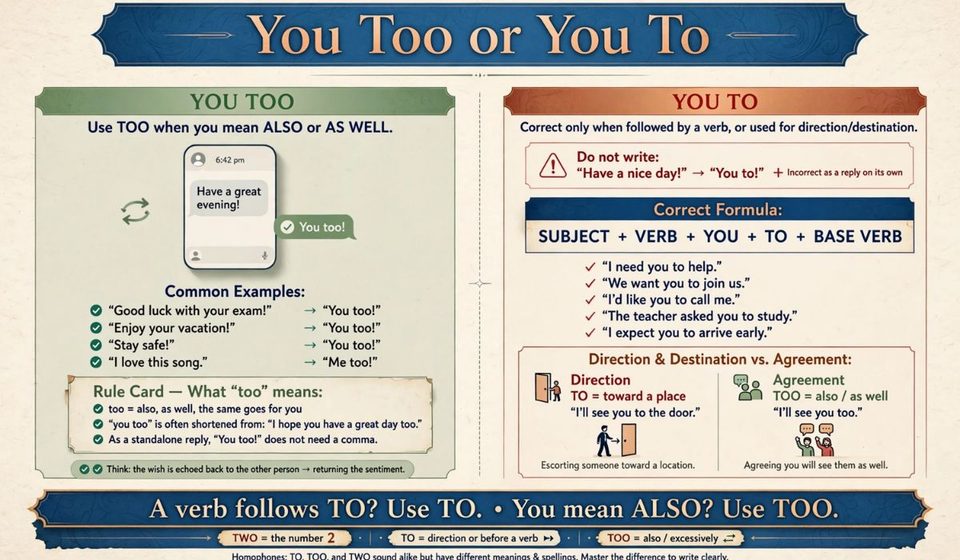
“Too” is an adverb. It means “also,” “as well,” or “the same goes for you.” When someone says something nice and you want to send that same feeling back, “too” is the word you need.
“To” is a different word entirely. It’s most often a preposition showing direction, or it introduces a verb, as in “to help” or “to go.” On its own, “you to” doesn’t carry a complete meaning. It only works as part of a bigger sentence, usually right before an action word.
So the short version:
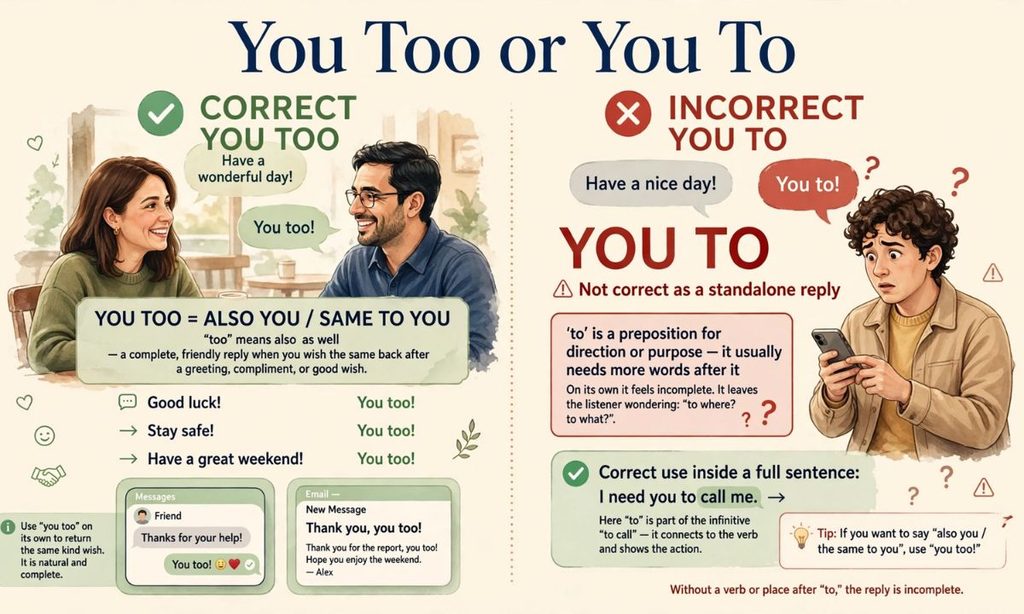
You too = “also you” or “same to you.” Works as a reply on its own.
You to = only correct inside a longer sentence, right before a verb, like “I need you to call me.”
Why People Mix These Up
“To,” “too,” and “two” are homophones. They sound the same out loud, but they’re spelled differently and mean completely different things. Your ear can’t tell them apart, which is exactly why fingers slip when typing fast.
Autocorrect doesn’t always catch the mistake either, because both “to” and “too” are real, correctly spelled words. Your phone won’t flag anything unless the surrounding grammar looks clearly wrong, and even then, it often misses it.
A quick way to picture it:
- Two = the number (2)
- To = direction or connects to a verb (go to the store, want to leave)
- Too = also, or “in excess” (I want to go too; it’s too hot)
When to Use “You Too”
Use “you too” any time you’re sending a wish, feeling, or compliment right back at someone. It’s the reciprocal option, meaning it works like an echo of what was just said to you.
Here’s the pattern in action:
| What they said | Your reply |
| “Have a great day!” | “You too!” |
| “Good luck with the interview.” | “You too!” |
| “Stay safe out there.” | “You too!” |
| “Enjoy your vacation.” | “You too!” |
| “Have a good weekend.” | “You too!” |
Notice something? In every case, “you too” is standing in for a longer sentence. When you reply “You too!” to “Have a great day,” you’re really saying, “I hope you have a great day too.” English speakers naturally drop the repeated words because the context already makes the full meaning obvious.
Grammar experts call this an elliptical response, but you don’t need the label to use it correctly. You just need to recognize that it’s a normal, accepted shortcut in spoken and written English.
This makes “you too” appear in:
- Texts and casual chats
- Social media replies
- Email sign-offs
- Everyday spoken conversation
- Workplace messages, including formal ones
Yes, “you too” is fine in professional email. If your client says “Have a productive week,” replying “Thank you, you too” is completely appropriate and won’t come across as unprofessional.
When “You To” Is Actually Correct
Here’s the part a lot of people miss: “you to” isn’t always wrong. It’s wrong as a standalone reply, but it’s perfectly correct when it’s doing a different job inside a sentence.
The pattern looks like this:
Subject + verb + you + to + [base verb]
Examples:
- “I need you to finish the report.”
- “We want you to join the team.”
- “The teacher asked you to submit your assignment.”
- “I’d like you to meet someone.”
- “They expect you to arrive early.”
In every one of these, “to” isn’t standing next to “you” by coincidence. It’s introducing an infinitive, meaning it’s connecting “you” to an action that comes right after. Take away the verb, and the sentence falls apart:
- “I need you to.” ❌ (incomplete, missing the verb)
- “I need you to help.” ✅ (complete)
That’s the real test. If a verb follows “to,” you’re in “you to” territory. If nothing follows and you’re just closing out a reply, you want “you too.”
The One Question That Settles It
Ask yourself: is a verb coming right after this word?
- If yes, use to. (“I need you to call.”)
- If no, and you mean “also,” use too. (“Thanks, you too!”)
That single question resolves almost every case you’ll run into. It’s faster than memorizing rules, and it works whether you’re texting a friend or writing a client email.
“You Too” vs. “Me Too”: Don’t Mix These Up Either
There’s a related mix-up worth clearing up while we’re here. “Me too” and “you too” both mean “also,” but they point in different directions.
“Me too” refers back to yourself. Someone shares an opinion or experience, and you’re saying you feel the same way.
- “I love this song.” → “Me too!”
You too point out the sentiment at the other person. It’s usually a reply to something they said about you or wished for you.
- “Have a great trip!” → “You too!”
Simple test: if you’re agreeing with something the other person said about themselves, say “me too.” If you’re sending a wish back at them, say “you too.”
“I Love You Too” or “I Love You To”?
This exact phrase comes up constantly, and the rule doesn’t change.
“I love you too” is correct when you’re returning the sentiment. Someone says “I love you,” and you’re saying the same thing back, plus “also.”
I love you to doesn’t work on its own, because nothing follows “to.” It would only make sense as part of a longer sentence, like “I’d love for you to visit,” which is a completely different meaning and a different sentence structure entirely.
You’ll also sometimes see this written with a comma: “I love you, too.” Both the comma and no-comma versions are acceptable. Style guides don’t require the comma here. It’s a matter of preference, and it can slightly change the emphasis or pacing of the sentence, but leaving it out is not a grammar mistake.
“I’ll See You Too” or “I’ll See You To”?
This one genuinely depends on what comes after.
“I’ll see you too.” Means “I will see you as well” (echoing something someone else said, like “I’ll see you at the party”).
“I’ll see you to the door.” Means you’re going to escort or accompany someone somewhere specific.
Both are correct, but they mean different things. The second version needs a destination after “to” (the door, your car, the exit) to make sense. Without that destination, you’d default back to “too” for the reciprocal meaning.
“If You Need Me To” or “If You Need Me Too”?
Both can be right, depending on what you’re saying:
“If you need me to, I can stay late.” Here, “to” sets up an implied verb (to stay late), even though the verb is only stated once, later in the sentence.
“I can help too, if you need me.” Here, “too” means “also,” as in you’re one of possibly several people available to help.
Read the full sentence before deciding. The words right next to “you” or “me” don’t tell the whole story on their own.
Common Everyday Phrases That Trip People Up
A few fixed expressions confuse people because they look similar to “you too” but actually always use “to”:
“What are you up to?” Always “to,” never “too.” This is a fixed idiom asking what someone is doing.
“What are you referring to?” Always “to.” You’re asking about the object or topic being referenced.
“I’m looking forward to it.” Always “to,” since it’s part of the phrase “looking forward to.”
These aren’t about the “also” meaning at all, so “too” never fits here, no matter how the sentence sounds out loud.
Explore More Grammar Guide
Poopie or Poopy: Which Spelling Is Actually Correct?
Separate or Seperate? The Correct Spelling Explained
“To Bad” or “Too Bad”: Which Spelling Is Correct?
Do You Need a Comma Before “Too”?
Short answer: usually not, but you can if you want the extra pause or emphasis.
“You too!” as a short standalone reply never needs a comma before “too.”
“I’m happy to see you too” and “I’m happy to see you, too” are both correct. The comma adds a slight beat and can highlight that “too” is doing extra work in the sentence.
Some style guides note this as writer’s choice rather than a fixed rule. There’s no universal law requiring the comma, so don’t feel like you’re making an error by leaving it out in casual or business writing. If you’re following a specific in-house style guide at work or school, check whether it has its own preference, since some publications do standardize this for consistency.
Common Mistakes and Quick Fixes
Here are the slip-ups that show up most often, and how to catch them:
Replying “You to!” to a nice wish. Fix: you mean “also,” so it’s “You too!”
Writing “I need you too call me.” Fix: a verb follows, so it’s “to”: “I need you to call me.”
Assuming “you to” is always incorrect. Not true. It’s wrong as a standalone reply but fine before a verb.
Treating “too” as only meaning “also.” It also means “excessively,” as in “That coffee is too hot.” Context tells you which meaning applies.
Trusting autocorrect blindly. Autocorrect won’t catch this error since both words are spelled correctly. Give your message a quick read before sending anything important.
Alternatives to “You Too” for More Variety
Saying “you too” every single time can feel repetitive, especially in longer conversations or professional emails. A few natural alternatives:
- Likewise
- Same to you
- The same goes for you
- I hope you do too
- Wishing you the same
- And you?
These work well when you want to sound a bit more polished or avoid repeating yourself in a longer email thread.
Quick Reference Table
| Phrase | Meaning | Example |
| You too | Also you / same to you | “Have a nice day!” → “You too!” |
| You to (+ verb) | Introduces an action for someone to do | “I need you to help.” |
| To you | Direction toward someone | “I gave the file to you.” |
| Me too | Also me | “I love pizza.” → “Me too!” |
Frequently Asked Questions
Is “you too” or “you to” correct after a greeting?
“You too” is correct after a greeting or good wish, since it means “also you.”
Is “you to” ever grammatically correct?
Yes, when it’s followed by a verb, like “I want you to succeed.”
Should there be a comma before “too” in “you too”?
No, a comma isn’t required; it’s optional and mainly affects emphasis in longer sentences.
Is “you too” appropriate for professional emails?
Yes, “you too” is fine in professional communication and reads as polite and natural.
What’s the difference between “you too” and “me too”?
“Me too” agrees with something the speaker said about themselves, while “you too” sends a wish or sentiment back to the other person.
Final Thoughts
Getting “you too” and “you to” right comes down to one habit: check whether a verb follows the word “to.” If it does, you’re using “to” correctly as part of a longer instruction or request. If nothing follows and you’re simply echoing a wish, compliment, or feeling back to someone, “you too” is what you want.
Once this distinction clicks, you’ll type the right one automatically, whether you’re replying to a friend’s text, wrapping up a work email, or telling someone you feel the same way they do.



[…] You Too or You To: The Correct Way to Reply Every Time […]