

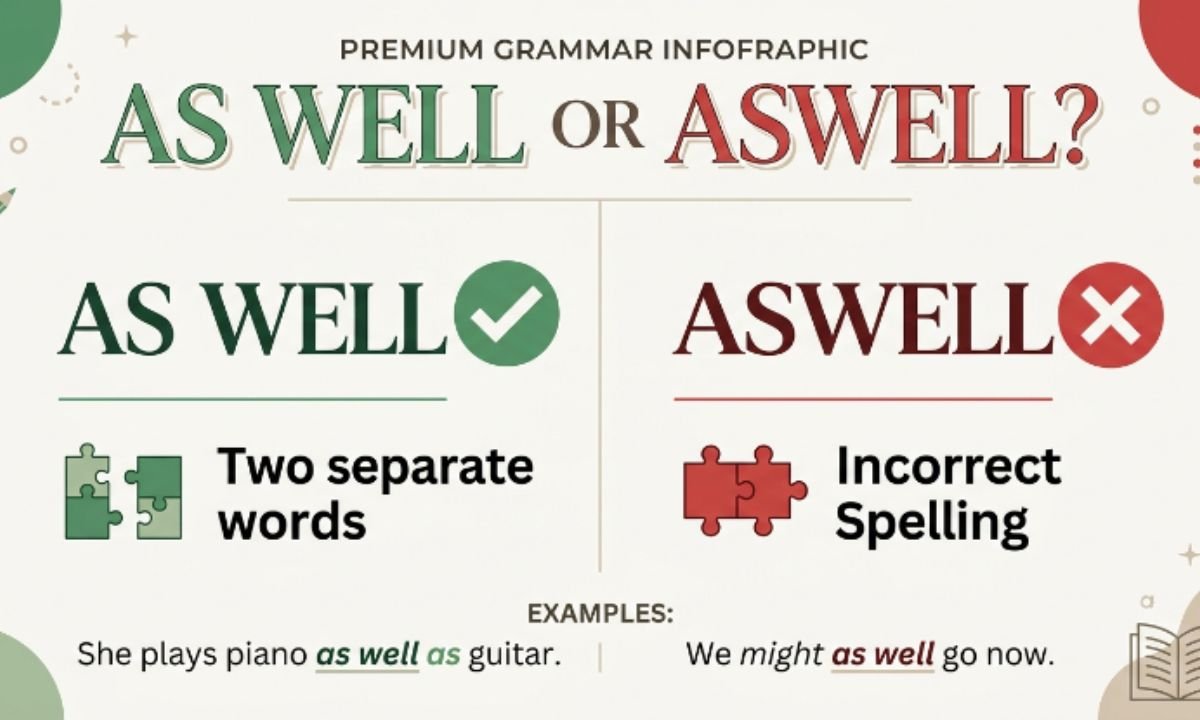
You’ve seen it written both ways, on menus, in emails, and even in published articles. One version looks perfectly normal. The other looks fine too, until you stop and question it. Only one of them actually exists in English, and here’s exactly why.
The Correct Spelling Is As Well
As well is always two words. Aswell doesn’t exist as a standard English term, no matter how naturally it might roll off the tongue when you’re typing fast.
As well = correct; means “also” or “too.”
Aswell = incorrect in every context, formal or casual.
The rule doesn’t bend for related phrases either: as well as, might as well, just as well, you as well, and me as well all keep the same two-word spacing for “as well.”
If you remember one thing from this article, remember that “as” and “well” never merge into a single word, no matter which phrase you’re building around them.
Why People Write “Aswell” by Mistake
This isn’t really a knowledge gap. Most people know “as well” means “also.” The mistake happens at the keyboard, not in understanding.
A few reasons this typo is so persistent:
Speech doesn’t pause between “as” and “well,” so writers sometimes type them the way they sound.
English has plenty of legitimate closed compounds, like “already” and “although,” which can make “aswell” feel plausible by association.
Fast typing and texting habits favor shorter, merged forms.
Autocorrect occasionally fails to flag it, since “well” is a valid word on its own.
None of this makes “aswell” acceptable. But it explains why the mistake shows up even in writing that’s otherwise careful.
What Does “As Well” Actually Mean?
“As well” is an adverb, and it generally means:
- Also
- Too
- In addition
- Together with, depending on how the sentence is built
It adds something- a person, an object, an action, or an idea- to whatever’s already been mentioned.
Examples:
- She sings beautifully, and she dances as well.
- He speaks three languages, and he plays piano as well.
- The bakery sells bread, and it makes cakes as well.
Notice where “as well” sits in each sentence. It usually shows up near the end, tacked on after the main point, reinforcing that something else applies too.
Etymology and Origin of “As Well”
The expression as well is made up of two separate words: as and well. It developed gradually in English rather than being created as a single word. The phrase has been used for several centuries, with the meaning changing naturally from ideas such as “in the same way” or “to the same extent” toward its modern meaning of “also” or “in addition.”
Origin of “Well”
The word well comes from Middle English wel and Old English wel. In Old English, it could mean:
- In a good or satisfactory manner.
- Properly.
- Abundantly.
- Very much.
- Indeed.
- With good reason.
The word is related to the Proto-Germanic form reconstructed as wel- and has connections with words in other Germanic languages, including Old Norse vel, Dutch wel, German wohl, and Gothic waila. Its deeper Indo-European connection is associated with ideas such as wishing, choosing, or being favorable.etymonline
How “Well” Developed Its Meaning
At first, well mainly described the manner in which something happened. For example, if someone performed an action “well,” they performed it successfully or properly.
Over time, the word developed additional meanings, including:
- In good health.
- In a satisfactory condition.
- To a considerable degree.
- Certainly or emphatically.
- In a favorable or desirable way.
These meanings helped “well” become part of several expressions, including:
- as well
- as well as
- might as well
- just as well
The word “well” in these expressions does not refer to a water source. It comes from the older adverbial meaning connected with being satisfactory, equal, or favorable.etymonline
Early Meaning of “As Well”
Historically, as well was associated with the idea of being equally, to the same extent, or in the same manner.
For example, an older sense could suggest that one person or thing was just as good, suitable, or satisfactory as another. From this idea of equality, the expression gradually developed the additional meaning of:
- Also.
- Too.
- In addition.
- Along with something else.
This explains why modern English can use as well to add information:
- “She speaks Spanish as well.”
- “He plays the guitar as well.”
- “I would like to come as well.”
In each example, the phrase adds another fact to information already mentioned.
Origin of the Meaning “Also” or “Too”
The modern additive meaning of as well probably developed from the idea of adding something that is equal or comparable to something already mentioned.
The semantic development can be understood like this:
- Well could mean satisfactorily or to a certain extent.
- As well could suggest “to the same extent” or “equally.”
- The phrase began to be used for another person, object, or action that belonged in the same group.
- It eventually acquired the modern meaning “also” or “too.”
The phrase is recorded in English as early as the late fourteenth century with the meaning “in addition to.” Some historical discussions also identify later examples from the fifteenth century. The exact stages of development are not completely certain, but the expression appears to have originated as two separate words.etymonline
Origin of “As Well As”
The phrase as well as developed from the same basic idea of equality or addition. It came to mean:
- In addition to.
- Along with.
- Together with.
- Besides.
For example:
- “She studies biology as well as chemistry.”
- “The hotel provides breakfast as well as dinner.”
In these sentences, as well as connects one item with another. The expression does not mean that the two items are always equal in importance; in modern English, it mainly introduces additional information.
Why “Aswell” Is Not the Standard Spelling
Although the phrase may sound like one continuous unit in speech, standard English writes it as two words:
- Correct: as well
- Incorrect: aswell
English contains many expressions that sound connected when spoken but remain separate in writing. The fact that “as well” functions as a familiar phrase does not make it a single compound word.
Historical spellings sometimes joined the words, but the standard modern form is as well, with a space. Therefore, “aswell” should be treated as a spelling mistake in contemporary formal and standard English.
Origin of “Might As Well”
The expression might as well is also old. It developed from the idea that one action is just as reasonable, suitable, or acceptable as another.
Today, might as well can mean:
- There is no strong reason not to do something.
- One option is as good as another.
- The action will make little difference.
- The circumstances make the action a reasonable choice.
Examples:
- “We might as well take the earlier train.”
- “You might as well call her now.”
- “It is raining, so we might as well stay inside.”
Here, as well does not simply mean “also.” It contributes the meaning “equally reasonably” or “just as acceptably.”etymonline
Origin of “Just As Well”
The expression just as well developed from the meaning of being equally satisfactory or favorable.
In modern English, it commonly means that something is fortunate or beneficial:
- “It is just as well that we arrived early.”
- “It was just as well that she brought an umbrella.”
In these examples, the phrase suggests that the situation turned out favorably. This meaning is different from the additive meaning of ordinary as well.
Compare:
- “She speaks French as well.”
Meaning: She speaks French too. - “It is just as well that she brought her notes.”
Meaning: It was fortunate or useful that she brought them.
Why “As Well” Remains Two Words
The expression remains two words because it developed from the ordinary words as and well, rather than becoming a fully established single-word compound in standard English.
The phrase functions as a unit in meaning, but its spelling preserves its historical structure:
- as introduces a comparison, degree, or relationship.
- well contributes the idea of suitability, equality, or satisfactory manner.
Together, they developed several related meanings, including “equally,” “also,” “in addition,” and “with equal reason.”
Where Does “As Well” Go in a Sentence?
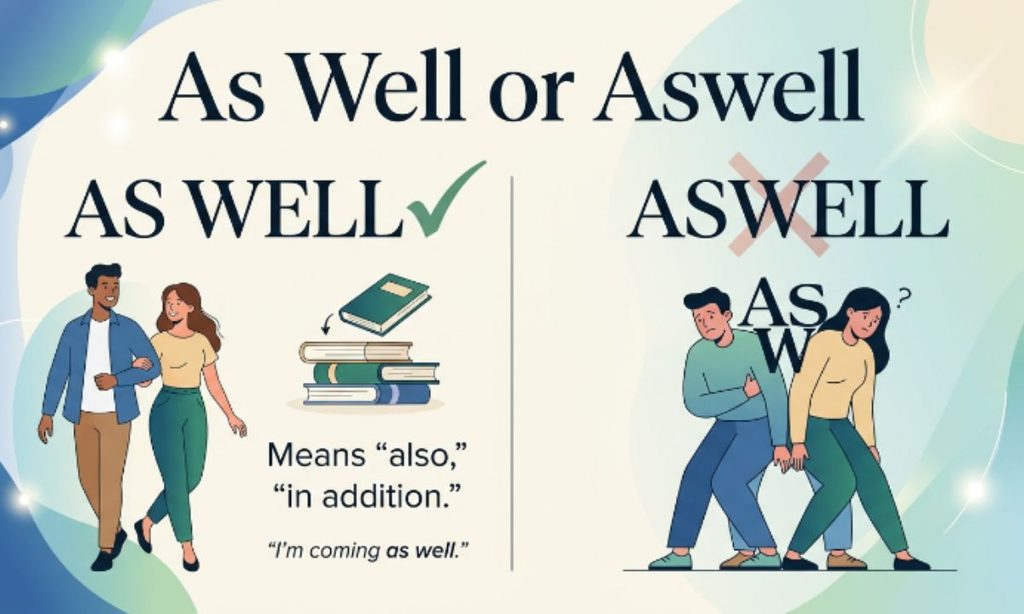
Most explanations stop at “it usually goes at the end,” which is true but incomplete. Here’s a fuller picture of how it actually behaves.
End of a sentence (most common): I’m coming to the party as well.
After the subject, before the verb, in some constructions: less common, but grammatically possible in certain formal or literary contexts.
Rarely at the start of a sentence: starting a sentence with “as well” on its own sounds awkward in modern English and isn’t typical usage.
Within longer phrases: as well as connecting two elements mid-sentence rather than tagging something onto the end.
If you’re unsure where to place it, default to the end of the sentence. That’s where it fits naturally in almost every case.
As Well vs. As Well As
These look nearly identical, but they work differently.
| Phrase | Function | Position | Example |
| As well | Adverb meaning “also” or “too” | Usually at the end of a sentence | “She plays tennis as well.” |
| As well as | Preposition or conjunction connecting two elements | Mid-sentence, linking clauses or items | “She plays tennis as well as golf.” |
The key difference: “as well” adds information after the fact, almost like an afterthought. “As well as” links two things directly within the same sentence, similar to how “and” works, though with a slightly different emphasis.
- He is a doctor as well. (adds information)
- He is a doctor as well as a musician. (connects two roles directly)
One practical note the standard explanations often skip: when “as well as” joins a compound subject, the verb usually agrees with the first, main subject, not whatever follows “as well as.”
The manager, as well as her team, was pleased with the results. (singular verb, agreeing with “the manager”)
This is a subtle point, but it’s one that trips up a lot of careful writers.
Might As Well: A Different Kind of Meaning
Here’s where things get more interesting. “Might as well” isn’t just “also” dressed up with a modal verb. It carries its own distinct meaning.
“Might as well” suggests:
There’s no strong reason not to do something.
One option isn’t any better than another, so you might as well pick one.
The outcome won’t change much either way, so acting is just as reasonable as not acting.
Examples:
It’s raining anyway, so we might as well stay in.
You might as well ask her directly instead of guessing.
We’re already late, so we might as well finish our coffee first.
This meaning is about resignation or practical acceptance, not simple addition. It’s a completely different function from plain “as well,” even though the words overlap.
Explore More Grammar Guide
Persue or Pursue: Which Spelling Is Correct?
Suing or Sueing: Which Spelling Is Actually Correct?
Lable or Label: Which Spelling Is Actually Correct?
Might As Well vs. Mine As Well
This one catches a lot of writers off guard. “Mine as well” is often just a misheard, misspelled version of “might as well. “If you’re trying to say there’s no reason not to do something, you want “might,” not “mine.”
But “mine as well” isn’t always wrong. It can be grammatically correct when “mine” is a possessive pronoun, referring to something that belongs to the speaker.
- Person A: My flight got delayed.
- Person B: Mine as well. (meaning: my flight got delayed too)
So the phrase isn’t automatically an error. It depends entirely on what you’re trying to say. If you mean “might,” write “might as well. If you’re talking about something of your own, “mine as well” can work.
Just As Well vs. As Well
Another pair that looks related but means something different.
“Just as well” describes a fortunate or beneficial outcome, not addition.
It’s just as well you brought a jacket. The temperature dropped fast.
It was just as well we left early, since traffic got terrible later.
Compare that to plain “as well,” which simply adds information:
- She brought a jacket as well. (She brought something else too)
The word “just” completely shifts the meaning here. Without it, you’re adding a fact. With it, you’re commenting on how lucky or sensible something turned out to be.
You As Well and Me As Well: Conversational Shortcuts
These two show up constantly in casual conversation, especially as quick replies.
You as well:
- Means “you too.”
- Common when returning a greeting or well-wish.
Example:
- “Have a great trip!”
- “You as well!”
Me as well:
- Means “me too.”
- Used to express agreement or shared experience.
Example:
- “I’m exhausted today.”
- “Me as well.”
Both are perfectly fine in spoken English and casual writing, like texts or informal emails. But they’re incomplete sentence fragments, so they’re generally not suited to formal writing. If you’re drafting a report or a professional letter, spell out the full thought instead: “I feel the same way” or “I hope you have one too.”
As Well vs. Also vs. Too: What’s the Difference?
These three words all point in the same general direction, addition, but they don’t always sit the same way in a sentence.
Also often appears before the main verb or at the start of a clause: She also plays piano.
Too typically lands at the end of a sentence, similar to “as well”: She plays piano too.
As well functions almost identically to “too,” sitting at the end: She plays piano as well.
In casual speech, these three are close to interchangeable. The differences come down to rhythm, formality, and personal style rather than strict grammar rules.
I’m going to the meeting. I’ll bring the report too.
I’m going to the meeting. I’ll bring the report as well.
I’m going to the meeting, and I’ll also bring the report.
All three sentences say the same thing. Pick whichever fits the sentence’s rhythm best.
As Well vs. In Addition To
“In addition to” tends to show up in more formal writing, while “as well” feels more natural in everyday speech and writing.
Formal: In addition to the report, please prepare a summary slide.
Everyday: Prepare a summary slide as well.
If you’re writing a business proposal, an academic paper, or a formal letter, “in addition to” often reads as more polished. If you’re writing an email to a colleague or chatting casually, “as well” fits better and sounds less stiff.
Common Mistakes to Avoid
Writing “aswell” instead of “as well,” in any context.
Writing “aswell as” instead of “as well as.”
Confusing “might as well” with “mine as well” when you mean the modal expression, not the possessive one.
Using “just as well” when you only mean simple addition, not a fortunate outcome.
Stacking “not only… but also… as well” together, which is usually redundant. Pick one additive phrase, not two.
Using “you as well” or “me as well” as standalone answers in formal writing, where a complete sentence works better.
A Quick Proofreading Checklist
Before you hit publish or send, run through this:
- Search your document for “aswell.” If it appears anywhere, add the space.
- Check every “as well as” for the same spacing issue.
- If you used “might as well,” confirm you didn’t mean “mine as well,” or vice versa.
- Look at “just as well.” Make sure you’re describing a fortunate outcome, not just adding a fact.
- Scan for “you as well” or “me as well” in formal writing, and consider spelling out the full sentence instead.
This five-step pass catches almost every mistake connected to this phrase.
Synonyms for As Well
Depending on tone and sentence structure, a few alternatives work well:
- Also
- Too
- Additionally
- Along with
- Together with
- Besides
- Furthermore
- Likewise
Formal writing tends to favor “additionally” or “furthermore.” Everyday writing and speech lean toward “too” or “also.” Pick based on the register you’re writing in, not just personal preference.
Frequently Asked Questions
Is it “as well” or “aswell”?
“As well” is correct; “aswell” is a misspelling with no accepted use in English.
What does “as well” mean?
It means “also” or “too,” adding extra information to what’s already been said.
Is “might as well” the same as “mine as well”?
No, “might as well” means there’s no reason not to act, while “mine as well” is usually a misspelling of that phrase, though it can correctly mean “mine too” in possessive contexts.
Can “as well” be used in formal writing?
Yes, though “in addition to” or “additionally” often sound more polished in formal contexts.
What’s the difference between “as well” and “as well as”?
“As well” adds information at the end of a sentence, while “as well as” connects two elements directly, similar to “and.”
Final Thoughts
“As well” is one of those phrases that seems simple until you start noticing how many related expressions branch off it, from “might as well” to “just as well” to quick conversational replies like “you as well.”
The core rule never changes, though: it’s always two words, never one, no matter which version of the phrase you’re using or how casual the sentence feels. Once you separate the additive meaning of plain “as well” from the very different meanings behind “might as well” and “just as well,” the whole family of phrases stops being confusing and starts being second nature.

1 Comment
Pingback: "To Bad" or "Too Bad": Which Spelling Is Correct?