

You’ve typed it a hundred times without thinking twice. Then one day you pause and wonder if you’ve been getting it wrong all along. It happens with more common phrases than people admit. Here’s the answer and the reasoning behind it, so you never have to second-guess it again.
Is It “Time Flies” or “Time Flys”?
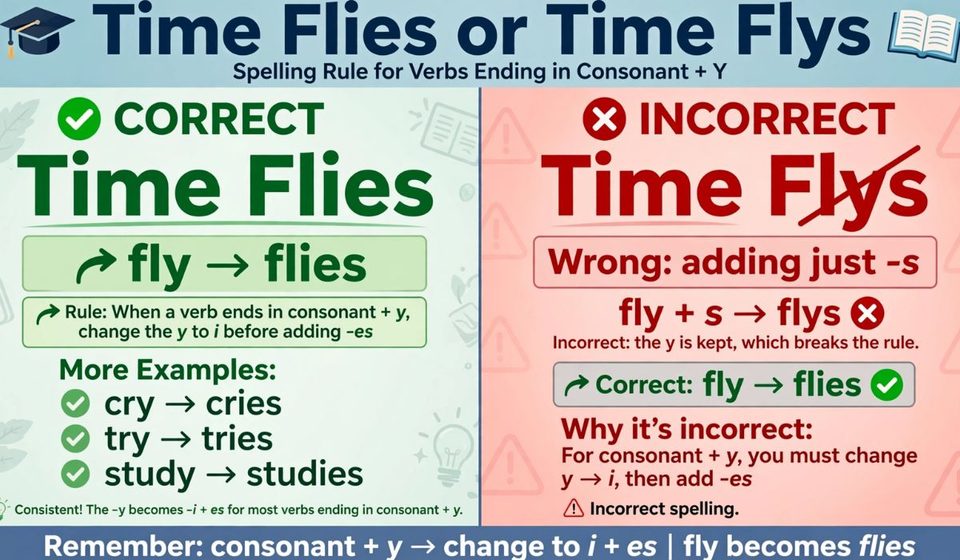
The correct spelling is “time flies.” Not “time flys,” not “time fly’s,” and not “times flies.”
If you remember nothing else from this article, remember this:
| Form | Status |
| Time flies | Correct |
| Time flys | Incorrect (common misspelling) |
| Time fly’s | Incorrect (unnecessary apostrophe) |
| Times flies | Incorrect (wrong subject) |
“Flys” isn’t a recognized word in standard English, whether you’re talking about time, insects, or anything else. It shows up a lot online because people are guessing at the spelling based on sound, not on the actual grammar rule. We’ll get into that rule shortly, and once you see it, the mistake becomes obvious.
What Does “Time Flies” Mean?
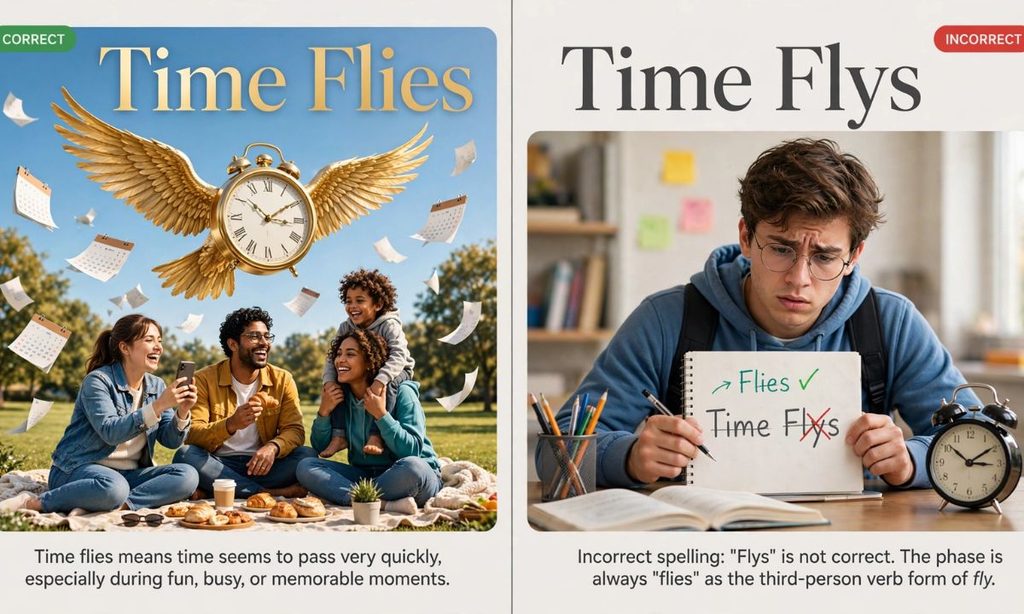
“Time flies” is an idiom. It means time seems to move faster than expected, especially when you’re not paying close attention to it.
You’ll typically hear or use it in a few situations:
- When you’re enjoying yourself and don’t notice the hours passing
- When you look back and realize how much time has gone by since an event
- When you’re busy with work or a project and lose track of the clock
- When a milestone (a birthday, an anniversary, a graduation) makes you reflect on how quickly the years added up
The most common version of the phrase is “time flies when you’re having fun,” but the idiom works in plenty of other contexts too. It can be used with excitement, nostalgia, or even a little regret.
A few natural examples:
- “It’s already been ten years since we graduated? Time flies.”
- “I can’t believe the kids are starting school already. Time really flies.”
- “We got so absorbed in the project that time flew by without us noticing.” (More on this tense shift below.)
Worth noting: “Time flies” isn’t always a happy statement. You can say it with a sigh just as easily as with a smile. Context decides the tone, not the words themselves.
Why Is “Flies” Correct and Not “Flys”?
This comes down to a basic English spelling rule that applies to more than just this phrase.
The Consonant + Y Rule
When a verb ends in a consonant followed by the letter “y,” and you need to add an “s” for the third-person singular form, the “y” changes to “i” before adding “es.”
So “fly” becomes “flies,” not “flys.”
This isn’t a random exception. It’s a pattern you’ll see across dozens of common verbs:
| Base Verb | Third-Person Singular |
| Fly | Flies |
| Cry | Cries |
| Try | Tries |
| Fry | Fries |
| Dry | Dries |
| Study | Studies |
| Carry | Carries |
| Worry | Worries |
| Reply | Replies |
Notice something in each case: the letter right before the “y” is a consonant (l, r, d, p). That’s the trigger for the spelling change.
The Exception: Vowel + Y
If the letter before the “y” is a vowel instead of a consonant, the rule flips. You just add an “s” and leave the “y” alone.
Examples:
- Play → plays
- Stay → stays
- Enjoy → enjoys
- Buy → buys
This is why “plays” doesn’t become “plaies,” but “flies” does need the change. The letter right before matters more than people realize.
Subject-Verb Agreement
There’s a second layer to this. “Time” is a singular noun, and it acts as a third-person subject in this sentence. In English, singular third-person subjects generally pair with a verb ending in “s” or “es” in the present tense (he runs, she sings, it flies).
So the full logic looks like this:
- “Time” is singular and third-person.
- The base verb is “fly.”
- Singular third-person subjects need an “s” ending on the verb.
- Because “fly” ends in a consonant + “y,” that ending becomes “ies,” not just “s.”
- Result: “Time flies.”
Skip any one of those steps, and you land on “flys” by mistake.
Verb vs. Noun: Two Different “Flies”
Here’s something most explanations skip over, and it’s worth clearing up because it causes real confusion.
“Flies” does double duty in English:
- As a verb, it’s the third-person singular present tense of “fly” (time flies, a bird flies, she flies to Chicago every month).
- As a noun, it’s the plural of “fly,” the insect (there are flies buzzing around the kitchen).
Both spellings are identical, and both are correct in their own context. Neither one is ever spelled “flys.” If you’re ever unsure, picture the insect. Nobody writes “there are flys in the kitchen,” and that same spelling instinct should carry over to the idiom.
Related Verb Forms of “Fly”
“Time flies” isn’t the only correct way to talk about time passing quickly. Depending on the tense you need, the verb changes shape. Here’s the full picture:
| Tense | Form | Example |
| Base form | Fly | Time can fly if you let it. |
| Present tense (singular) | Flies | Time flies when you’re busy. |
| Present continuous | Is flying | It feels like time is flying this month. |
| Simple past | Flew | The weekend flew by. |
| Past participle | Flown | Time has flown since the wedding. |
A quick breakdown of when to use each:
“Time flies” describes a general truth or a habitual observation. It’s the most common form and works in almost any casual sentence.
“Time is flying” emphasizes that it’s happening right now, in the moment you’re speaking.
“Time flew by” talks about a specific period that has already ended and felt short in hindsight.
“Time has flown by” connects a past period to the present moment, often used when reflecting on a longer stretch (years, not just a weekend).
None of these change the core spelling issue. “Flew” and “flown” are irregular forms, so they don’t follow the consonant + “y” rule at all. Only “flies” (present tense) is where people trip up.
Explore More Grammar Guide
Vender or Vendor: Which Spelling Should You Actually Use?
Shiney vs Shiny: Which Spelling Is Actually Correct?
Take Effect or Take Affect? The Correct Phrase, Explained
Common Mistakes People Make
Beyond the basic “flys” typo, a few other versions sneak into writing more often than you’d expect.
“Time fly’s” — Apostrophes are for possession or contractions, not for making a verb plural or changing tense. There’s no reason for one here.
“Times flies” — This adds an “s” to “time,” which is unnecessary and grammatically wrong. “Time” stays singular in this idiom.
“Time flys by” — Adding “by” doesn’t change anything about the spelling of “flies.” The mistake is identical to the standalone version.
“Time files” — This one isn’t a spelling mistake so much as a mishearing. “Files” and “flies” can sound similar when spoken quickly, but “time files” doesn’t mean anything.
Most spell-checking tools will catch “flys” automatically and suggest “flies,” so if you’re writing anywhere with spell-check enabled, you’ll likely get flagged before you hit publish or send. That said, it’s worth knowing the rule so you’re not relying on software to catch it every time, especially in texts, captions, or quick notes where spell-check might not run.
Easy Ways to Remember the Spelling
If the grammar rule doesn’t stick right away, a few mental shortcuts can help:
Compare it to other “y” verbs you already know. If you can spell “cries” and “tries” correctly, you already know how to spell “flies.” It’s the same pattern.
Think of the insect. The plural of the bug is “flies,” never “flys.” Use that spelling as your anchor.
Say it out loud. “Flies” rhymes with “skies,” “pies,” and “ties.” “Flys” doesn’t rhyme naturally with anything in that group, which is a small clue that it looks off.
Picture French fries. The plural is “fries,” not “frys.” Same rule, same pattern, different word.
Any one of these tricks should be enough to keep the spelling straight going forward.
Other Correct Variations to Know
Once you’re comfortable with the core phrase, you’ll notice it shows up in several natural variations, all of which are correct:
- “Time flies.”
- “Time flies by.”
- “Time flies when you’re having fun.”
- “How time flies.”
- “Time flies so fast.”
- “Time is flying.”
- “Time has flown.”
- “Time flew by.”
The spelling of “flies” doesn’t change no matter which version you use. Only the verb tense shifts depending on what you’re describing.
Is “Time Flies” Formal or Informal?
“Time flies” works in both casual and formal writing. You’ll see it in everyday conversation, birthday cards, and social media captions, but it also appears comfortably in speeches, articles, and even literature. It’s not slang, and it’s not considered too casual for professional writing. The only version to avoid entirely, in any setting, is “time flys.”
Frequently Asked Questions
Is “time flies when you’re having fun” correct?
Yes, this is one of the most common and grammatically correct versions of the phrase.
Is “time flies by” correct?
Yes, adding “by” doesn’t change the spelling or grammar of “flies” in any way.
What is the plural of “fly”?
The plural noun is “flies,” the same spelling used in the idiom “time flies.”
What is the past tense of “fly”?
The simple past tense is “flew,” as in “the afternoon flew by.”
Can “time flys” ever be considered acceptable?
No, “flys” is not a standard English word in any context, formal or informal.
Conclusion
“Time flies” is the only correct spelling, and it comes down to a simple rule: verbs ending in a consonant plus “y” swap the “y” for “i” before adding “es,” which is exactly why “fly” becomes “flies” and never “flys.”
Once you connect that rule to the idiom’s meaning- that time seems to pass quickly when you’re busy, having fun, or looking back on the past- the spelling stops being something you have to guess at. Keep the consonant + “y” pattern in mind, compare it to words like “cries” and “tries” when you’re unsure, and you’ll never write “time flys” again.



[…] Time Flies or Time Flys: Which Spelling Is Correct? […]