
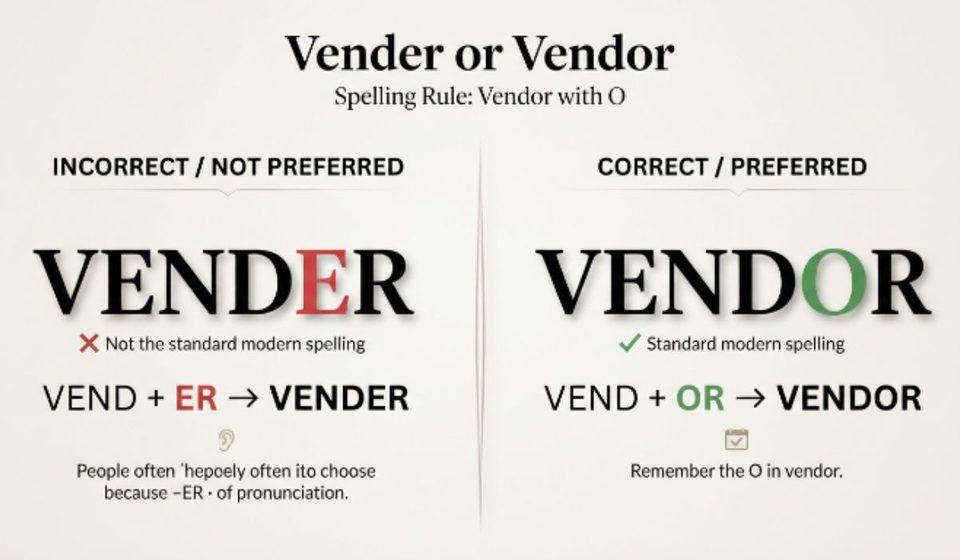

You’ve probably typed both versions without thinking twice. One shows up in contracts and business emails everywhere. The other quietly survives inside one famous magazine. Only one of them is the spelling you should actually rely on.
Quick Answer: Vendor Is Correct
Vendor, spelled with an “o,” is the standard modern spelling in both American and British English. Vender, spelled with an “e,” is a rare historical variant that shows up almost exclusively in one specific context: The New Yorker’s house style.
| Spelling | Status | Where You’ll See It |
| Vendor | Standard, modern | Business, legal, academic, everyday writing |
| Vender | Rare, restricted variant | Historical texts, The New Yorker’s house style |
If you’re writing a contract, a resume, a website, or basically anything meant for a general audience, use vendor. That’s the safe, correct choice almost every time.
What Does “Vendor” Actually Mean?
A vendor is a person, business, or organization that sells goods or services. The word applies just as easily to a single person selling something on a sidewalk as it does to a multinational company supplying software to a Fortune 500 client.
The word traces back to the Latin vendere, meaning "to sell." That root is also where "vend" and "vending" come from, which is a useful thing to keep in mind when you're trying to remember the correct spelling.
Common Types of Vendors
Vendors show up across nearly every industry:
- Street vendors selling food or goods
- Software vendors providing business tools
- Wedding vendors like photographers, caterers, and florists
- Marketplace vendors on platforms like Etsy or Amazon
- Government and procurement vendors supplying public contracts
- Vending-machine operators
- Market vendors at farmers markets or craft fairs
Vendor in Business and Technology
In a business setting, “vendor” almost always refers to a supplier relationship. Companies sign vendor agreements, manage vendor contracts, and evaluate vendors before onboarding them. It’s the standard term across procurement, IT, and operations, and swapping in “vender” in any of these documents is likely to read as a typo rather than a stylistic choice.
Is “Vender” a Real Word?
This is where the answer gets a little more nuanced than a flat yes or no.
"Vender" isn't a nonsense word invented by autocorrect. It has appeared in English writing historically, and it isn't strictly a made-up error. But that doesn't make it a good choice for everyday writing.
Why “Vender” Is Usually Not Recommended
Here’s the practical reality:
- Most modern dictionaries treat vendor as the standard entry.
- Vender is generally labeled as rare, dated, or a minor variant.
- Readers in business and professional settings expect vendor.
- Using vender in a resume, contract, or formal email risks looking like a spelling mistake, even if you meant it deliberately.
Put simply: vender existing somewhere in the historical record doesn’t mean it’s a safe bet today.
The New Yorker Exception
If you’ve seen “vender” in print and wondered where it came from, there’s a good chance it was in The New Yorker. The magazine is known for unusual, old-fashioned style choices, and “vender” is one of them.
This isn’t evidence that vender is common or gaining ground. It’s a deliberate editorial decision tied to one publication’s specific house style, not a reflection of how English speakers spell the word generally. Unless you’re writing specifically for that publication or matching its style guide, there’s no reason to copy it.
Why Do People Mix Up Vendor and Vender?
The confusion isn’t random. A few specific things drive it.
Pronunciation Plays a Big Role
Spoken aloud, the ending of “vendor” can sound close to a generic “-er” sound, which nudges some writers toward spelling it the way it sounds rather than the way it’s actually written. This kind of ending-sound confusion is common in English and isn’t unique to this word.
The Two Spellings Look Nearly Identical
Vendor and vender differ by exactly one letter, sitting in the same position, surrounded by identical letters on both sides. That kind of near-identical visual pattern is easy to miss during a quick read or a fast proofread, especially in longer documents.
The “-er” vs “-or” Myth
A theory sometimes floated is that “-er” and “-or” split meaning somehow, maybe with “-er” referring to an individual seller and “-or” referring to a company or institution. It’s a tidy idea, but it doesn’t hold up.
English is full of “-er”/”-or” pairs that don’t follow any consistent person-versus-institution rule. A few examples:
- Adviser and advisor
- Jailer and jailor
- Conveyer and conveyor
None of these pairs cleanly separates people from organizations. The lesson here is simple: don’t rely on the ending to guess at meaning. Spelling variation in English often comes down to historical accident, not a logical system.
Vendor vs Vendee: Two Completely Different Words
This mix-up trips people up in a different way. Vendee isn’t a spelling variant of vendor. It’s a separate word with the opposite meaning.
| Term | Meaning |
| Vendor | The seller |
| Vendee | The buyer |
| Vend | To sell (the base verb) |
| Vending | The act or process of selling, often through a machine |
If a contract mentions both a vendor and a vendee, it’s describing two different parties on opposite sides of a transaction, not two spellings of the same role.
Is Vender British English? (No, Not Really)
A common assumption is that vender might just be the British version of vendor, similar to how “colour” and “color” split between British and American spelling. That assumption doesn’t hold up here.
Based on the available evidence, vendor is the standard spelling in both American and British English. No solid regional pattern makes vender the “correct” choice on one side of the Atlantic. The confusion is more about pronunciation and rare historical usage than any real geographic divide.
How Common Is Vendor Compared to Vender?
A widely cited corpus-based discussion, using data from the Corpus of Contemporary American English (COCA), gives a clear picture of just how lopsided this actually is.
| Spelling | Approximate Usage Count |
| Vendor | Over 2,000 examples |
| Vender | 45 examples |
That works out to a ratio of more than 100 to 1 in favor of vendor. And the 45 examples of vender aren’t even a clean count of ordinary usage. Roughly:
- 17 were regular English usage outside The New Yorker
- 11 came specifically from The New Yorker
- 2 were proper names
- 15 appeared in foreign-language contexts
Once you strip out the proper names, foreign-language hits, and New Yorker-specific style choices, vender’s presence in everyday English gets even smaller than the raw number suggests.
Correct and Incorrect Examples
Seeing the two side by side makes the right choice easier to spot.
| Usually Not Recommended | Correct |
| The street vender sells tacos. | The street vendor sells tacos. |
| We need to approve a new vender. | We need to approve a new vendor. |
| Our software vender provides support. | Our software vendor provides support. |
| The wedding venders include a florist. | The wedding vendors include a florist. |
Vendor vs Supplier vs Seller: Quick Distinctions
“Vendor” often gets used loosely alongside similar business terms. Here’s a fast breakdown of how they typically differ in practice:
Vendor: A general term for anyone who sells goods or services, from an individual to a company.
Supplier: Usually refers to a business providing raw materials or products, often within a supply chain.
Seller: A broad, informal term for anyone selling something, without the business connotation vendor often carries.
Merchant: Typically implies a retail context, someone selling goods directly to consumers.
These terms overlap heavily, and in casual writing, swapping between them rarely confuses. In contracts and formal business documents, though, sticking with the term the document already uses helps avoid ambiguity about roles.
How to Remember the Correct Spelling
If the rule doesn’t stick on its own, try one of these shortcuts:
- Vending machine connection: Both “vendor” and “vending” share the letter o. If you can spell vending machine correctly, you already know how to spell vendor.
- “O” for official: Vendor, with its o, is the official, standard spelling for professional writing.
- When in doubt, avoid the e: Unless you’re quoting historical text or specifically writing for a publication that uses vender, leave the e out.
When Vendor Is the Right Choice (Almost Always)
Use vendor in:
- Resumes and cover letters
- Business contracts and vendor agreements
- Academic and formal writing
- Everyday communication, emails, and casual writing
- Websites, marketing copy, and product descriptions
- Legal and procurement documents
Reserve vender only for direct quotations from historical sources or writing that specifically follows a style guide requiring it, such as The New Yorker’s own house style.
Frequently Asked Questions
Is it vender or vendor?
Vendor is the standard, correct spelling in modern English; vender is a rare historical variant.
Is vender a real word?
Yes, technically, but it’s uncommon and mostly limited to historical texts and specific house styles like The New Yorker’s.
Is vender the British spelling of vendor?
No, vendor is standard in both American and British English; vender isn’t a regional variant.
What’s the difference between a vendor and a vendee?
A vendor is the seller and a vendee is the buyer; they’re separate words, not spelling variants of each other.
Why does The New Yorker use “vender”?
It reflects the magazine’s distinctive editorial house style rather than common English usage.
Conclusion
When you’re deciding between vender and vendor, the choice really isn’t close. Vendor is the spelling dictionaries recognize, businesses use, and readers expect, while vender survives mainly as a historical curiosity and a deliberate quirk of one magazine’s editorial style.
Stick with vendor in your contracts, resumes, and everyday writing, save vender for the rare case where you’re quoting an older text or matching a specific publication’s style, and you’ll never have to second-guess this one again.



[…] Vender or Vendor: Which Spelling Should You Actually Use? […]
[…] Vender or Vendor: Which Spelling Should You Actually Use? […]