

You’ve typed it a dozen times and still paused before hitting send. One version looks right. The other sounds right. Only one of them actually is right, and the mix-up shows up in contracts, emails, and news headlines more often than you’d think.
Quick Answer: It’s “Take Effect,” Not “Take Affect”
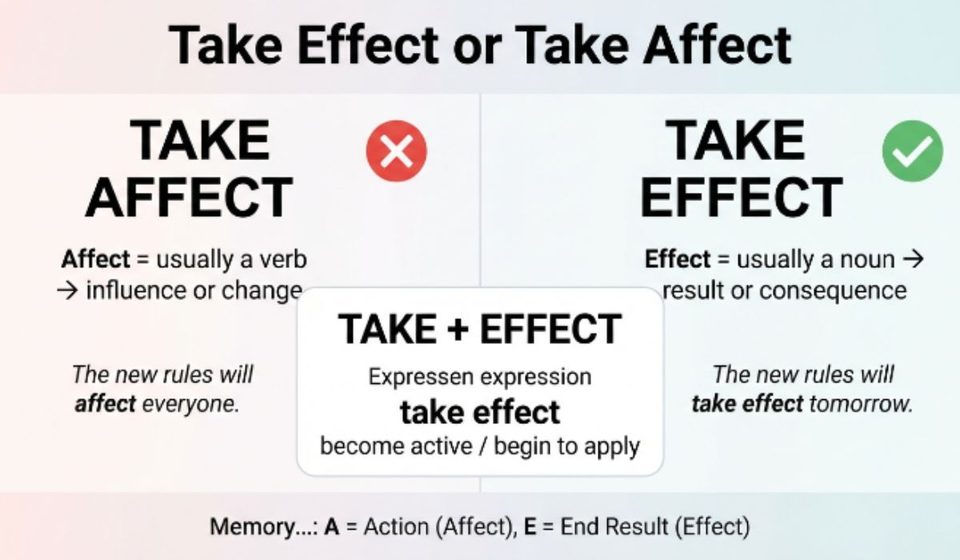
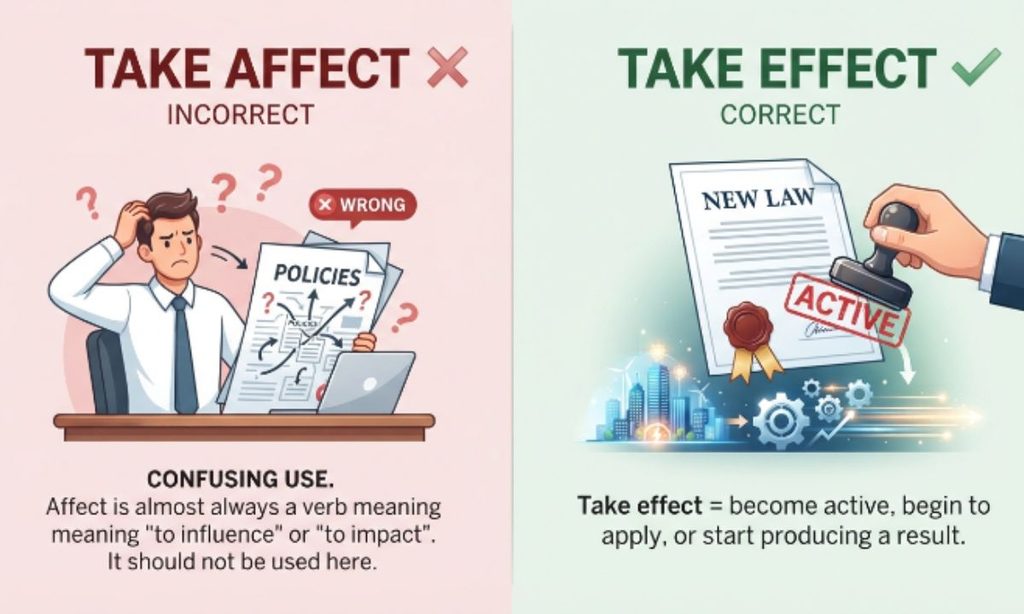
Take effect is the correct phrase. It means something starts working, becomes active, or begins to apply.
Take affect is not standard English. It shows up because affect and effect sound almost identical when spoken, so the ear mishears one for the other.
Here’s the short version:
| Phrase | Status | Meaning |
| Take effect | Correct | To become active or start producing a result |
| Take affect | Incorrect | Not a recognized phrase in English |
If you remember nothing else from this article, remember this: effect is the noun that pairs with take. Affect is almost always a verb, and verbs don’t usually follow “take” this way.
What Does “Take Effect” Actually Mean?
“Take effect” describes the moment something shifts from inactive to active. It’s used constantly in law, medicine, business, and everyday life whenever a change needs a starting point.
When a Law, Rule, or Policy Becomes Active
Legislation, workplace policies, and government regulations almost always come with a specific date they take effect.
- The new tax law takes effect on January 1.
- The updated dress code takes effect next Monday.
- The ceasefire is set to take effect at midnight.
When Medicine or Treatment Starts Working
Doctors, pharmacists, and patients use this phrase to describe how long a drug takes to start doing its job.
- The painkiller should take effect within 30 minutes.
- Anesthesia takes effect almost immediately once administered.
- It can take a few days for the antibiotic to take full effect.
When a Change Begins Producing Results
Beyond law and medicine, “take effect” fits any situation where a decision moves from paper to practice.
- The price increase takes effect this weekend.
- Our new return policy takes effect for all orders placed after today.
- The software update takes effect once the system restarts.
Why “Take Affect” Is Incorrect
To understand why “take affect” doesn’t work, you need the actual grammar difference between the two words, not just a rule to memorize blindly.
The Core Grammar Difference: Affect vs. Effect
Most of the time, the two words split cleanly by part of speech.
- Affect is usually a verb. It means to influence or produce a change in something.
- Effect is usually a noun. It means the result or outcome of a change.
Since “take” needs an object, and objects are nouns, “take” naturally pairs with effect, not affect.
- Correct: The medicine will affect your appetite. (verb)
- Correct: The medicine’s effect on your appetite was mild. (noun)
- Correct: The medicine will take effect soon. (fixed phrase, noun)
- Incorrect: The medicine will take affect soon.
Why “Affect” Doesn’t Fit After “Take”
“Take effect” isn’t just any verb-plus-noun pairing. It’s a fixed expression, meaning the two words function as a set unit with one specific meaning: to become operative. You wouldn’t swap “effect” for a different noun and expect the same result, and you can’t swap it for a verb like “affect” either. The phrase only works as written.
Affect vs. Effect: The Rule You Actually Need
Here’s a table that separates the two words by their most common roles.
| Word | Most Common Role | Meaning | Example |
| Affect | Verb | To influence or impact | The weather will affect the game. |
| Effect | Noun | A result or consequence | The weather had no effect on the game. |
Affect as a Verb: To Influence
Use affect when you’re describing an action that changes or influences something.
- Sleep deprivation can affect your concentration.
- The new manager’s decisions affect the whole team.
- Loud noise affects a baby’s ability to nap.
Effect as a Noun: A Result or Consequence
Use effect when you’re naming the outcome of that action.
- Sleep deprivation has a noticeable effect on concentration.
- The manager’s decisions had a positive effect on morale.
- Loud noise has a real effect on a baby’s sleep.
The Important Exceptions: When “Effect” Is a Verb and “Affect” Is a Noun
Grammar rules love exceptions, and this pair has two worth knowing.
Effect can be a verb, meaning to bring about or cause something directly. Example: "The new CEO plans to effect real change in the company." This is formal usage and appears mostly in business or political writing.
Affect can be a noun, used mainly in psychology to describe someone's visible emotional expression. Example: "The patient displayed a flat affect during the interview." Outside clinical settings, you'll rarely see this usage.
These exceptions are why a blanket “affect is always a verb” rule eventually trips people up. Knowing they exist helps you recognize correct usage when you see it in professional or academic writing.
How to Remember the Correct Spelling
If the grammar explanation didn’t stick, a memory trick usually does the job faster.
RAVEN: Affect = Verb, Effect = Noun. Picture a raven croaking out the rule.
A for Action, E for End result: Affect starts the action, effect is what’s left afterward.
The substitution test: Try swapping in “influence” for affect, or “result” for effect. If “influence” fits, use affect. If “result” fits, use effect. This test works in almost every sentence you’ll write.
Try it here: “The delay will ___ our schedule.” Swap in “influence.” It fits. So the answer is affect.
Now try: “The delay had a serious ___ on our schedule.” Swap in “result.” It fits. So the answer is effect.
“Take Effect” in Real Sentences
Seeing the phrase across different fields makes it easier to use confidently in your own writing.
Legal and policy examples
- The court’s ruling takes effect immediately.
- New immigration rules take effect at the start of the fiscal year.
- The merger agreement takes effect once both parties sign.
Workplace and school examples
- The revised attendance policy takes effect this semester.
- Salary adjustments take effect at the beginning of the next pay period.
- The new grading system takes effect for incoming students only.
Medicine and technology examples
- The vaccine typically takes effect two weeks after the second dose.
- The security patch takes effect after you restart your device.
- The app’s dark mode setting takes effect instantly.
Common incorrect sentences and their corrections
| Incorrect | Corrected |
| The new law will take affect in March. | The new law will take effect in March. |
| Does this policy take affect today? | Does this policy take effect today? |
| The medication hasn’t taken affect yet. | The medication hasn’t taken effect yet. |
“Take Effect,” “Go Into Effect,” and “Come Into Force”: What’s the Difference?
This is where most explanations stop short, and it’s usually the part people actually need.
Which Phrases Mean the Same Thing?
Take effect and go into effect are essentially interchangeable. Both describe the moment a rule, law, or change becomes active. “Go into effect” leans slightly more formal and shows up often in news reporting and legal writing.
Come into effect is another close synonym, common in British English and international contexts, especially with treaties and formal agreements.
Become effective works the same way and is common in business and contract language: “The agreement becomes effective on the signing date.”
When “Come Into Force” May Be Better
Come into force is the preferred phrasing in legal and legislative contexts, particularly outside the US, when referring to laws, treaties, and international agreements. It carries a slightly more formal, official tone than “take effect.”
Come into operation appears in similarly formal legal drafting, often for regulations or administrative rules.
In everyday writing, “take effect” is safe almost everywhere. In formal legal drafting, especially international or UK-style documents, “come into force” is often the more conventional choice. Business contracts frequently favor “becomes effective.” Choosing between them is less about correctness and more about matching the register of the document you’re writing.
Explore More Grammar Guide
https://synonymsvibe.com/puting-vs-putting/
https://synonymsvibe.com/vender-or-vendor/
Verb Forms and Common Editing Errors
One gap that trips up even careful writers is tense. “Take effect” changes form depending on when the action happens, and getting the tense wrong is an easy, avoidable mistake.
| Tense | Form | Example |
| Present | takes effect | The policy takes effect every January. |
| Past | took effect | The rule took effect last year. |
| Present perfect | has taken effect | The change has taken effect already. |
| Future | will take effect | The new law will take effect next month. |
A quick editing checklist for contracts, announcements, and policy emails:
Check that “effect,” not “affect,” follows “take” anywhere in the document.
Confirm the tense matches the timeline: has the change already happened, or is it upcoming?
Look for a specific date or trigger event tied to the phrase. Vague timing (“will take effect soon”) often needs a concrete date in formal documents.
Search for “affect” used as a noun outside psychology or clinical writing; it’s almost always a sign the writer meant “effect.”
Read the sentence aloud and substitute “result” or “influence” to double-check which word belongs.
Frequently Asked Questions
Is it “take effect” or “take affect”?
It’s “take effect.” “Take affect” is not standard English and should be avoided in any formal or informal writing.
What does “take effect” mean?
It means something starts working, becomes active, or begins to apply, such as a law, policy, or medication.
Can “effect” be used as a verb?
Yes, though rarely. As a verb, “effect” means to bring about or cause something, as in “effect change.”
Can “affect” be a noun?
Yes, mainly in psychology, where it refers to a person’s observable emotional expression, such as a “flat affect.”
Is “go into effect” the same as “take effect”?
Yes, the two phrases are interchangeable, and both describe the moment a rule or change becomes active.
Conclusion
The confusion between “take effect” and “take affect” almost always comes down to how similar the two words sound out loud, but the grammar behind them is straightforward once you separate the roles: affect acts, effect results, and only effect pairs with take.
Whether you’re drafting a policy, writing a work email, or explaining when your medication kicks in, sticking with “take effect” keeps your writing accurate and professional, and knowing the related phrases like “go into effect” or “come into force” gives you the flexibility to match the tone of any document you’re working on.



[…] Take Effect or Take Affect? The Correct Phrase, Explained […]