
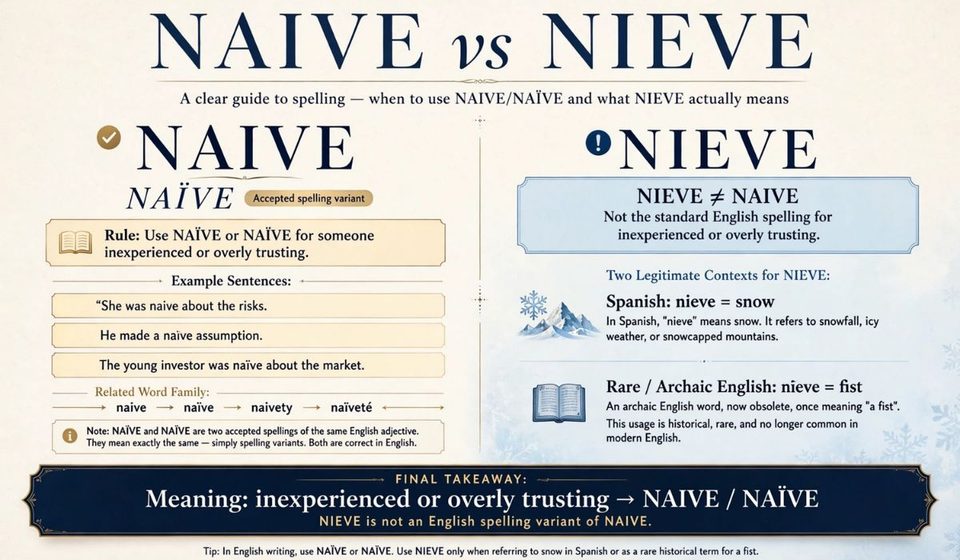

If you mean inexperienced, innocent, or overly trusting, use naive. You can also write the word as naïve with two dots over the i.
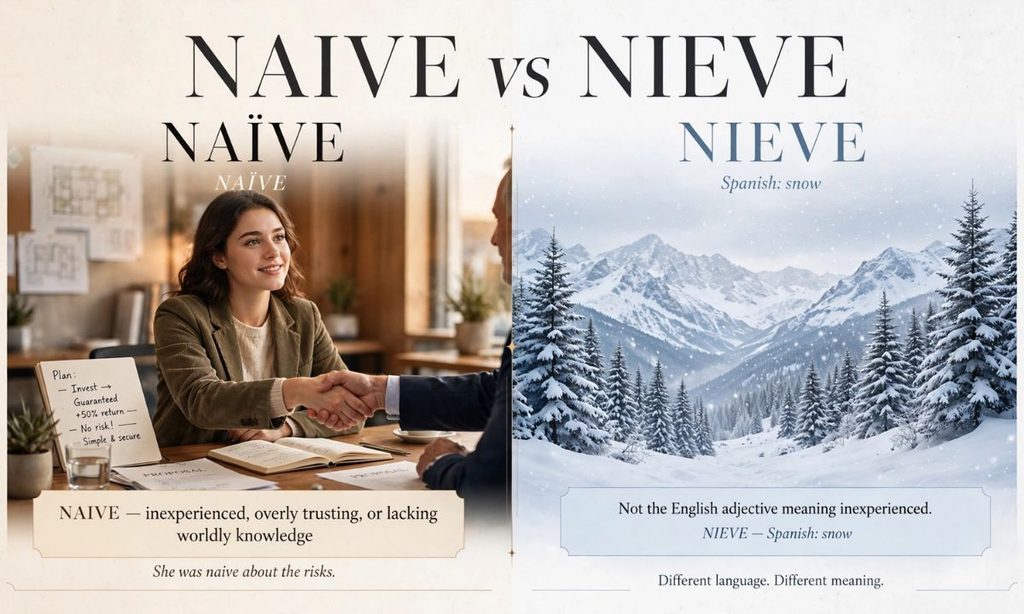
Nieve is not an alternative English spelling of naive. In Spanish, however, nieve means “snow.”
Older or dialectal English also records nieve as a noun meaning “fist.” These meanings have nothing to do with the modern English adjective naive.
Naive vs Nieve: The Correct Spelling
The correct English spelling is naive or naïve when you want to describe someone or something as inexperienced, overly trusting, or lacking worldly knowledge.
For example:
- She was naive about the risks.
- He made a naive assumption.
- The young investor was naïve about the market.
- That was a naive approach to the problem.
You should not write nieve when you mean “naive.”
This distinction matters in school assignments, professional communication, websites, reports, and everyday English. The research reviewed for this article consistently identifies naive/naïve as the standard English form.
A simple spelling rule
If the meaning is inexperienced or too trusting, choose:
naive / naïve
Do not choose:
nieve
That one rule solves the main confusion.
What Does Naive Mean?
Naive is an adjective. It describes someone who lacks experience, worldly knowledge, or sound judgment.
The word can also describe a belief, assumption, approach, or idea that seems too simple because it ignores important realities.
A naive person may trust others too easily. They may assume that people have good intentions. They may expect situations to work out more simply than they actually do.
For example:
She was naive to believe that everyone would keep their promises.
Here, naive does not simply mean “nice.” It suggests that the person lacks experience or judgment about how people behave.
The word can also describe an idea:
The plan was based on a naive assumption that costs would never increase.
The assumption sounds unrealistic because it overlooks an obvious possibility.
Dictionary-based research describes several related meanings, including innocence, simplicity, lack of experience, and excessive willingness to trust.
Naive Does Not Always Mean Foolish
People sometimes use naive as if it means “stupid.” That interpretation goes too far.
A naive person may simply lack experience.
Imagine a teenager who has never negotiated a contract. They might accept the first offer they receive. Calling that decision naive highlights their lack of experience. It does not necessarily mean they lack intelligence.
The context also affects the tone.
Disapproving use:
It was naive to assume the company would accept the proposal without negotiation.
More positive use:
Her naive enthusiasm gave the project a fresh sense of possibility.
The second example treats simplicity and lack of cynicism more positively.
Research on dictionary usage also identifies approving senses connected with being innocent, simple, artless, or ingenuous.
What Does Nieve Mean?
The word nieve creates confusion because it looks and sounds similar to naive. However, nieve does not mean “inexperienced” or “overly trusting” in standard English. You may encounter it in other contexts.
Nieve in Spanish
In Spanish, nieve means snow.
For example, a Spanish sentence may contain nieve when discussing snowfall or snow-covered landscapes.
That does not make nieve an English spelling of naive. The two words belong to different linguistic contexts.
Nieve as an older English word
Some dictionaries and language sources also record nieve as a rare, archaic, or dialectal English noun meaning fist, particularly in Scottish usage.
That meaning remains separate from naive.
So it would be inaccurate to say that nieve can never appear anywhere. The more precise rule is this:
Nieve is not the standard English adjective meaning inexperienced, innocent, or overly trusting.
Naive vs Nieve at a Glance
| Feature | Naive / Naïve | Nieve |
|---|---|---|
| Standard English adjective | Yes | No |
| Meaning “inexperienced” | Yes | No |
| Meaning “overly trusting” | Yes | No |
| Spanish meaning | Not applicable | “Snow” |
| Rare older English meaning | Not applicable | “Fist” |
| Suitable for formal English | Yes | Not for the meaning of naive |
| Common spelling mistake | No | Yes, when used for naive |
The key difference is simple. Naive belongs to standard English as an adjective. Nieve does not serve as its alternative spelling.
Why Do People Confuse Naive and Nieve?
Several factors can create the confusion.
Similar spelling
The two words contain similar letters.
naive
nieve
Only a few letters change, so a fast typist can easily produce the wrong version.
Similar pronunciation
English pronunciation can make the words seem related. The similarity becomes stronger when someone hears the word rather than sees it written.
The “i before e” habit
English learners often remember the familiar spelling pattern involving i and e. However, English spelling contains many exceptions and irregular patterns. That makes a word like naive easy to misspell.
Spanish exposure
Someone who knows Spanish may already recognize nieve as the Spanish word for snow. Seeing the word in Spanish can reinforce the spelling and create interference when writing English.
Fast typing and autocorrect
Digital writing adds another source of mistakes. People often type quickly and rely on spellcheck. An unfamiliar word can produce an incorrect suggestion or survive without correction.
The research notes similar causes, including pronunciation, spelling habits, fast typing, autocorrect, and exposure to Spanish.
Naive or Naïve: Which One Should You Use?
Both naive and naïve are accepted spellings of the same English adjective.
The version with two dots uses a diaeresis:
naïve
The diaeresis signals that the vowels should be pronounced separately. It also reflects the word’s French origin.
The simplified spelling removes the two dots:
naive
Modern English frequently uses the version without the diaeresis.
Is naïve more correct than naive?
No.
Both forms are accepted. Your choice can depend on the publication, style guide, keyboard, or personal preference.
For general online content, naive offers a simple, widely recognized form. If a publication consistently uses naïve, follow that style.
The important point is that naive and naïve are variants of the same word, while nieve is not.
How to Use Naive in a Sentence
You can use naive to describe a person, belief, assumption, approach, opinion, or action.
Describing a person
The naive buyer trusted the seller immediately.
Describing a belief
She had a naive belief that every business always puts customers first.
Describing an assumption
Their naive assumption caused problems later.
Describing an approach
The team abandoned its naive approach after reviewing the evidence.
Describing a lack of experience
He was naive about how difficult the negotiation would become.
The word often appears with about when you want to identify the subject of someone’s lack of experience.
For example:
She was naive about investing.
You can also use naive to in structures such as:
It was naive to expect immediate results.
These patterns appear frequently in standard English usage.
Common Collocations With Naive
Learning common word combinations can help you remember the correct spelling.
Common phrases include:
- naive person
- naive belief
- naive assumption
- naive approach
- naive view
- naive investor
- naive buyer
- naive voter
- politically naive
- hopelessly naive
- refreshingly naive
- naive about something
For example:
The naive investor ignored the risks.
That view seems naive after considering the available evidence.
She was refreshingly naive about the industry’s complicated traditions.
The surrounding noun often makes the meaning clear.
Naive vs Innocent
Naive and innocent overlap, but they do not mean exactly the same thing.
Innocent can describe someone who has done nothing wrong. It can also describe someone who lacks guilt, corruption, or harmful intent.
Naive focuses more strongly on inexperience and judgment.
Compare these sentences:
The child was innocent.
This could refer to the child’s lack of wrongdoing.
The child was naive.
This suggests that the child lacks experience and may misunderstand how the world works.
So, innocent does not automatically mean naive.
Naive vs Gullible
Gullible carries a stronger idea of being easily deceived. A gullible person readily believes things that others might question.
Naive can imply gullibility, but it can also simply mean inexperienced or unsophisticated.
Consider:
He was naive about online scams.
This emphasizes his lack of experience.
He was gullible and believed every message he received.
This emphasizes his tendency to believe things too easily.
The words overlap, but gullible usually gives the reader a stronger impression that deception has occurred or could occur.
Naive vs Credulous
Credulous also describes someone who readily believes what others tell them.
It often focuses specifically on a willingness to accept claims without enough skepticism.
Naive has a broader meaning.
A person can show a naive approach without believing a specific false statement.
For example:
Her naive approach to negotiations underestimated the other side.
The sentence concerns experience and judgment rather than simple belief.
Naive vs Unsophisticated
Unsophisticated can describe someone who lacks experience, refinement, or familiarity with a particular environment.
It does not always suggest gullibility.
For example:
The software has a simple interface designed for unsophisticated users.
Here, unsophisticated can simply mean unfamiliar with advanced technology.
By contrast:
The buyer was naive about the seller’s tactics.
This suggests insufficient knowledge or judgment.
That difference makes naive more closely connected to trust, assumptions, and worldly experience.
Naive, Ingenuous, and Artless
Some words related to naive have a more positive tone.
Ingenuous often describes someone who appears sincere, open, and free from deception.
Artless can describe someone who lacks artificiality or calculation.
Naive can carry either positive or negative meaning depending on context.
A writer should therefore consider the emotional tone before replacing one word with another.
For example:
- naive: inexperienced or overly trusting
- gullible: too easy to deceive
- credulous: too ready to believe
- innocent: free from wrongdoing or corruption
- ingenuous: sincere and straightforward
- unsophisticated: lacking experience or refinement
The distinctions matter when you want precise writing.
Related Forms of Naive
The spelling question becomes easier when you understand the word family.
Naivety
Naivety is a noun meaning a lack of experience, sophistication, or worldly judgment.
Example:
His naivety became obvious during the negotiation.
Naïveté
Naïveté is another noun form.
It carries the same basic idea and retains the French-style spelling.
Example:
Her naïveté made her vulnerable to misleading claims.
Both naivety and naïveté occur in English. The preferred form can vary by region, publication, and style.
Naïf
Naïf can function as a noun for a naive person. It also appears in discussions of art and art criticism.
Example:
The critic described the painter as a naïf.
The related term naive art can refer to art created outside conventional academic traditions, often with a simple or unschooled visual style.
These related forms receive less attention in basic spelling articles, but they help explain the wider vocabulary surrounding naive.
Naive in Science and Medicine
The word naive has specialized meanings in technical writing.
In these contexts, it does not necessarily mean gullible.
Naive T cells
In immunology, a naive T cell is a T cell that has not yet encountered its specific antigen in the relevant way that activates it.
The technical meaning therefore differs from the everyday meaning.
Drug-naive
Researchers may describe a patient as drug-naive when the person has not previously received a particular drug or class of treatment.
For example:
The study enrolled drug-naive patients.
Here, naive means previously unexposed, not inexperienced in a general social sense.
Naive subjects or animals
Scientific research may also describe experimental subjects as naive when they have not previously encountered the relevant procedure, task, stimulus, or experimental condition. These technical uses show why context matters.
Naive in Art
The word also appears in art terminology.
Naive art generally describes art associated with a simple, direct, or relatively unschooled style. A naive painter may be self-taught and work outside established academic traditions.
In this context, the word does not simply mean that the artist lacks intelligence. It describes characteristics of the artistic style or background.
The word can therefore shift meaning depending on the field:
- everyday English: inexperienced or overly trusting
- science: previously unexposed
- medicine: not previously exposed to a drug or antigen
- art: unschooled, self-taught, or stylistically simple
Is Naive Formal or Informal?
Naive works in both everyday and formal English.
You can use it in:
- academic writing
- professional reports
- business communication
- journalism
- essays
- websites
- everyday conversation
For formal writing, the main concern is not whether naive is too informal. The concern is whether it communicates your intended meaning accurately.
For example:
The model relies on a naive assumption about consumer behavior.
That sentence can work perfectly well in an academic or professional context.
The research specifically identifies naive as appropriate for academic writing, professional emails, reports, journalism, and ordinary standard English.
Is Naive American or British English?
Naive is used in both American and British English.
It is not a US-versus-UK spelling difference.
The main spelling variation concerns naive versus naïve, not naive versus nieve.
So you can safely use naive in English regardless of whether your audience follows American or British English conventions.
Common Mistakes to Avoid
Writers often make a few predictable mistakes with these words.
Mistake 1: Writing nieve for naive
Incorrect:
She was nieve about the situation.
Correct:
She was naive about the situation.
Mistake 2: Assuming nieve is an English variant
It is not an alternative spelling of naive.
Mistake 3: Thinking naive always means stupid
The word usually points to inexperience, simplicity, or excessive trust. Context determines the strength and tone.
Mistake 4: Treating innocent and naive as exact synonyms
They overlap, but innocent can refer to morality or lack of wrongdoing, while naive emphasizes experience and judgment.
Mistake 5: Forgetting the technical meaning
In scientific writing, naive can mean previously unexposed to a particular stimulus, drug, antigen, or experimental condition.
Mistake 6: Assuming naïve is a different word
It is simply a spelling variant of naive.
How to Remember the Correct Spelling
A simple memory trick can prevent the most common mistake.
Think:
naive = naive person
Then remember that nieve belongs to a different context.
You can also connect the forms:
naive → naïve → naivety → naïveté
The naiv- spelling stays visible across the word family.
If you see nieve in an English sentence and the writer means “inexperienced,” stop and check it. In most cases, the writer intended naive.
When Nieve Is Actually Appropriate
Although nieve is normally wrong when you mean naive, the word can legitimately appear in English text.
Use nieve when:
- You are quoting or discussing Spanish.
- You are translating Spanish.
- You are referring to a Spanish name.
- You are discussing the rare or archaic English noun meaning “fist.”
- A proper noun or title specifically uses the spelling.
For example, an English article about Spanish vocabulary may write:
The Spanish word nieve means “snow.”
That use is correct because the writer is discussing Spanish.
The mistake occurs when someone writes nieve as an English adjective meaning inexperienced.
Naive vs Nieve: Examples Side by Side
| Intended meaning | Correct sentence |
|---|---|
| Inexperienced person | She was naive about the industry. |
| Overly trusting | His naive trust caused problems. |
| Simple assumption | That is a naive assumption. |
| Lack of experience | Her naivety showed during the negotiation. |
| Spanish “snow” | The Spanish word nieve means “snow.” |
| Rare historical English | The old dialect used nieve for “fist.” |
This distinction prevents the most common error while preserving the legitimate uses of nieve.
Frequently Asked Questions
Is it naive or nieve?
Use naive or naïve when you mean inexperienced, innocent, or overly trusting.
Is nieve a real word in English?
Nieve appears in rare or archaic English as a noun meaning “fist,” but it is not the standard adjective meaning naive.
What does nieve mean in Spanish?
In Spanish, nieve means “snow.”
Is naïve the same as naive?
Yes, naïve and naive are accepted spellings of the same English adjective.
Is naive suitable for formal writing?
Yes, naive is standard English and works in academic, professional, journalistic, and everyday writing.
Final Words
The difference between naive and nieve becomes straightforward once you separate spelling from language context. Use naive or naïve when you describe someone or something as inexperienced, overly trusting, or lacking worldly judgment. Reserve nieve for its legitimate uses, especially the Spanish word for “snow” or its rare historical English sense of “fist.” Knowing that distinction helps you write accurately without treating two similar-looking words as interchangeable.


[…] Naive vs Nieve: Which Spelling Is Correct? […]
[…] Naive vs Nieve: Which Spelling Is Correct? […]