
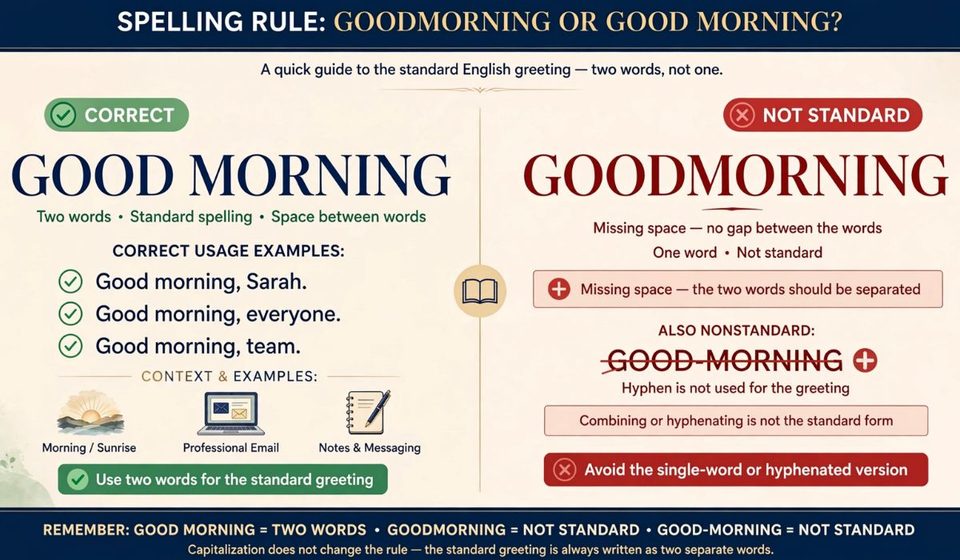

Good morning is the standard spelling in English. You should write it as two separate words. Goodmorning is not standard English spelling. The phrase works as a polite greeting during the morning. Its capitalization and punctuation depend on how you use it. This guide explains the correct form, meaning, grammar, and everyday usage.
Good Morning Is the Correct Spelling
The correct form is good morning.
English treats the expression as two words when you use it as a greeting. The first word, good, describes the second word, morning. Together, they create a familiar expression that people use to greet someone at the start of the day.
The one-word form goodmorning does not belong to standard English spelling. You may see it in usernames, hashtags, casual posts, or fast typing, but those digital uses do not make it the standard written form.
The same rule applies across common communication settings. You should write good morning in:
- Emails
- Letters
- Workplace messages
- School assignments
- Text messages
- Social media posts
- Business communication
- Everyday sentences
You may also encounter good-morning, with a hyphen. That form is not the normal spelling of the greeting either.
Good Morning, Goodmorning, or Good-Morning?
| Form | Standard greeting? | Typical use |
|---|---|---|
| good morning | Yes | Standard English greeting |
| goodmorning | No | Nonstandard one-word spelling |
| good-morning | No | Not the standard spelling of the greeting |
If you want to know how to spell good morning correctly, remember one simple rule: keep the space.
What Does Good Morning Mean?
Good morning is a polite expression used to greet someone during the morning.
It usually works in the same general way as hello, but it adds a time-of-day meaning. When you say good morning, you acknowledge someone and greet them at the beginning of the day.
For example:
- “Good morning, Alex.”
- “Good morning, everyone.”
- “Good morning. How are you?”
- “I said good morning to my neighbor.”
Dictionaries classify the expression as a greeting or interjection. Cambridge also presents it as a basic English expression for greeting someone politely in the morning.
The phrase can also appear in a sentence without functioning as a direct greeting.
For example:
“I hope you had a good morning.”
Here, good morning does not greet anyone. It describes the quality of a period of time.
That difference matters because capitalization and punctuation can change with the grammatical context.
Why Is Good Morning Written as Two Words?
The practical answer is simple: standard English writes this greeting as two separate words.
The expression combines two ordinary words:
- Good is an adjective.
- Morning is a noun.
You can think of the phrase as a compact wish for a pleasant morning. English has many expressions that combine words without joining them into a single spelling.
Some grammar resources describe good morning as a fixed phrase or an open compound. The terminology can vary, but the writing rule stays consistent: use two words when you mean the greeting.
Pronunciation can create confusion. In natural speech, speakers connect words closely. The expression may sound almost like one continuous unit. That does not mean you should combine the words in writing.
Fast typing can create the same problem. When people type quickly, they may remove spaces accidentally. Digital habits can also encourage informal spellings. Neither situation changes the standard spelling.
So if you are asking, “Is good morning one word or two?”, the answer is two words.
How to Capitalize Good Morning Correctly
Spelling and capitalization are separate questions.
The words remain good morning regardless of whether you capitalize one or both words. Capitalization depends on where the expression appears and which writing style you follow.
Good Morning at the Start of a Sentence
When good morning starts a normal sentence, capitalize the first word because English capitalizes the first word of a sentence.
Example:
“Good morning, everyone. Today we will discuss the schedule.”
The second word, morning, does not need capitalization simply because it follows Good.
Good Morning in the Middle of a Sentence
When the expression appears in ordinary running text, lowercase it unless another capitalization rule applies.
Example:
“I wished my colleague good morning before the meeting.”
Another example:
“She always says good morning when she arrives.”
This distinction often gets overlooked. Some articles treat every email greeting as a reason to capitalize both words, but capitalization can depend on whether you are writing a standalone salutation or using the phrase as part of a sentence.
Good Morning as an Email Salutation
Email greetings create a small style question.
You may see:
Good Morning,
You may also see:
Good morning,
Both styles appear in professional communication. The important point is to follow the capitalization style your organization, publication, or personal writing convention uses consistently.
When the greeting includes a person’s name, sentence-style capitalization is especially natural:
Good morning, Jordan,
Good morning, Ms. Patel,
Good morning, team,
The Editor’s Manual research highlighted an important distinction between a standalone salutation and a greeting followed by a person’s name.
In practical writing, Good morning, Jordan, is a clear and conventional format.
Do You Put a Comma After Good Morning?
Usually, yes, when you directly address a person or group.
The comma separates the greeting from the person or group being addressed.
Correct examples include:
“Good morning, Sarah.”
“Good morning, everyone.”
“Good morning, team.”
“Good morning, Dr. Lee.”
This is a direct-address comma. The comma does not belong there because “good morning” always requires one. It appears because you are speaking directly to the person or group named after it.
Compare these examples:
“Good morning, David.”
“I said good morning to David.”
The first example directly addresses David. The second describes an action and does not require the same punctuation.
You can also use an exclamation mark when the tone calls for more energy:
“Good morning, everyone!”
In professional writing, however, a period or comma may create a calmer tone.
Examples of Good Morning Used Correctly
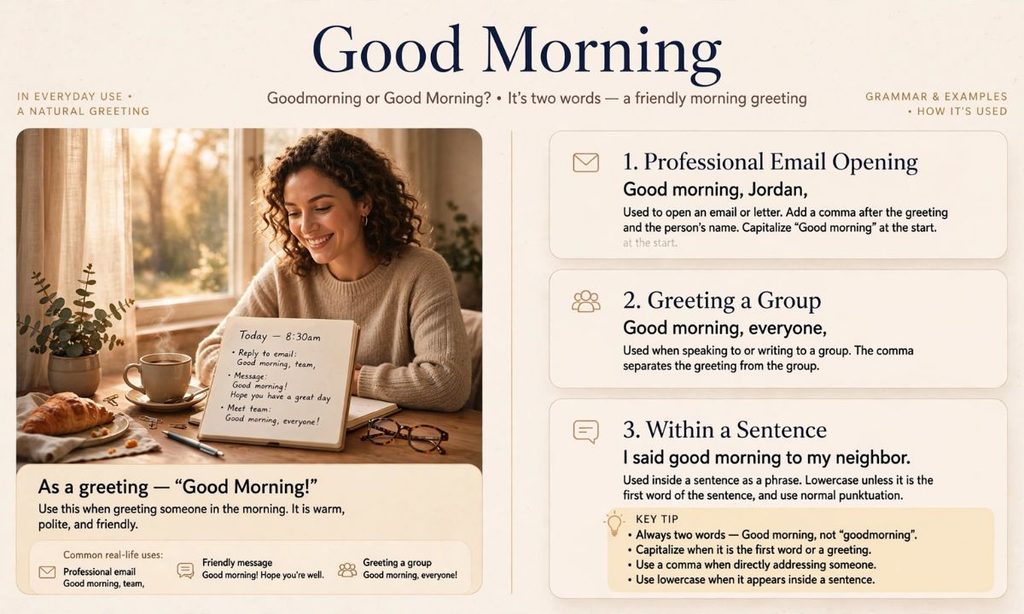
Seeing the expression in different situations makes the rules easier to remember.
Professional Email
Good morning, Jordan,
I’m writing to confirm our meeting time for today.
Workplace Message
Good morning, team. The updated schedule is now available.
Friendly Text
Good morning! Hope you have a great day.
Classroom Greeting
Good morning, everyone. Please take your seats.
Ordinary Sentence
I had a good morning before work.
Direct Address
Good morning, Maria.
Group Address
Good morning, everyone.
Casual Greeting
Morning! How are you doing?
Notice that the spelling good morning stays the same across these examples. The context changes the capitalization, punctuation, or tone, but it does not turn the phrase into goodmorning.
When Should You Say Good Morning?
People conventionally use good morning during the morning hours, generally before noon.
There is no universal social rule that makes noon a magical cutoff in every situation. Context matters. A person may still say good morning shortly before noon, while another person may switch to good afternoon around midday.
Written communication creates another complication.
Suppose you send an email at 11:45 a.m., but the recipient will not read it until 2:00 p.m. A time-neutral greeting such as Hello may make more sense.
Time zones can create the same issue when you communicate internationally.
For example, your morning may occur during another person’s afternoon or evening. In that situation, consider the recipient’s likely local time rather than relying only on the time shown on your device.
A useful practical rule is:
- Use good morning during the morning.
- Use good afternoon after morning has ended.
- Use good evening later in the day.
- Use hello when the time of day is uncertain or irrelevant.
Treat these as conventions rather than rigid laws.
Good Morning in Formal and Casual Communication
Good morning works in both formal and informal settings.
Its tone depends heavily on what follows it and how you deliver it.
In a workplace email, you might write:
“Good morning, Mr. Williams.”
In a message to a friend, you might write:
“Good morning! ☀️”
The phrase itself does not automatically make communication formal.
Professional Uses
Use the full expression when you want a polite, clear opening.
Examples include:
- Good morning, Professor.
- Good morning, everyone.
- Good morning, Mr. Chen.
- Good morning. I’m following up on yesterday’s meeting.
Casual Alternatives
In informal conversation, people often shorten the greeting.
Common alternatives include:
- Morning!
- G’morning!
- Hey, good morning!
- Morning, everyone!
Morning! works well in casual speech and messages. It sounds shorter and more relaxed than the full expression.
For formal documents, professional emails, academic writing, and business correspondence, the standard good morning remains the safer choice.
Good Morning vs. Similar Greetings
Several English greetings follow the same general time-of-day pattern.
Good Morning vs. Good Afternoon
Good morning refers to the morning. Good afternoon refers to the afternoon.
Both expressions use two words.
Examples:
Good morning, everyone.
Good afternoon, everyone.
You should not write goodafternoon in standard English.
Good Morning vs. Good Evening
Good evening works as an evening greeting.
It also uses two words:
Good evening, Dr. Brown.
Again, the words remain separate.
Good Morning vs. Hello
Hello does not specify a time of day.
That makes it useful when:
- You do not know when the recipient will read a message.
- You communicate across time zones.
- You want a neutral greeting.
- You are unsure whether morning or afternoon is more appropriate.
Good Morning vs. Morning
Morning! is a shorter, more casual version of Good morning!
The shortened form works naturally in conversation and informal messages. It may sound too casual for some formal situations.
Why Is Goodnight One Word but Good Morning Two?
This question causes a lot of confusion.
People often notice that goodnight can appear as one word and assume that goodmorning should work the same way.
English does not work that neatly.
When you use good night as a greeting or farewell, the normal phrase remains two words:
Good night, everyone.
Good night. See you tomorrow.
The one-word form goodnight can occur in other grammatical uses, particularly as part of a compound expression.
For example:
“She gave him a goodnight kiss.”
The word goodnight in that expression behaves differently from the ordinary farewell good night.
This distinction explains why the existence of goodnight does not make goodmorning correct. The two expressions developed different uses and spelling patterns.
The same principle applies to related greetings. You should not create one-word forms such as goodafternoon or goodevening simply because some other English expressions have developed closed forms.
How to Pronounce Good Morning
English learners may recognize good morning easily, but pronouncing it naturally can be harder.
Cambridge lists different UK and US pronunciations. This reflects normal regional differences in English.
The main stress falls on the first syllable of morning. In natural speech, the two words flow together smoothly.
Do not worry if native speakers say the phrase faster than its written form suggests. In connected speech, speakers often blend words and reduce the pauses between them.
The key point is simple: the pronunciation may flow together, but the spelling stays separate.
Common Mistakes With Good Morning
Several mistakes appear repeatedly in informal writing.
Writing Goodmorning as One Word
Incorrect:
Goodmorning, everyone.
Standard:
Good morning, everyone.
Adding a Hyphen
Incorrect as the standard greeting:
Good-morning, everyone.
Standard:
Good morning, everyone.
Explore More Grammar Guide
Naive vs Nieve: Which Spelling Is Correct?
Nosey vs Nosy: Which Spelling Is Correct?
“To Bad” or “Too Bad”: Which Spelling Is Correct?
Loose vs Lose: The Complete Guide to Using Each Word Correctly
Capitalizing Both Words Everywhere
Incorrect style in ordinary running text:
I hope you had a Good Morning.
Standard:
I hope you had a good morning.
The phrase needs capitalization when sentence position or a chosen salutation style calls for it. It does not require title-style capitalization every time it appears.
Forgetting the Direct-Address Comma
Less precise:
Good morning Sarah.
Standard punctuation:
Good morning, Sarah.
The comma signals that Sarah is the person being addressed.
Treating Noon as an Absolute Rule
The morning usually ends around noon, but communication does not always follow an exact clock boundary. Email delivery times, time zones, workplace customs, and when the recipient reads the message can all affect the most natural greeting.
A Simple Rule for Emails
If you need to write good morning in an email, focus on three things: spelling, capitalization, and punctuation.
A practical format looks like this:
Good morning, Jordan,
Then start the message.
For a group:
Good morning, everyone,
For a more casual workplace message:
Good morning, team!
The exact capitalization of a standalone salutation can vary by style. What matters most is that you use the standard spelling and maintain a consistent format.
If your workplace follows a house style, use that style rather than switching formats from one email to another.
Good Morning in American and British English
The expression good morning appears in both American and British English. The spelling stays the same in both varieties.
The pronunciation differs slightly. Cambridge provides separate UK and US pronunciations, reflecting normal regional differences.
The meaning also stays the same: good morning is a polite greeting used in the morning.
You can use good morning with English speakers in either variety without changing the spelling.
When “Good Morning” Can Mean More Than a Greeting
The most common use of good morning is as a greeting. Dictionaries also record a less common use for parting during the morning.
In everyday English, people use good morning far more often as a greeting.
If you are leaving someone in the morning, another expression may sound more natural. Depending on the situation, you could say goodbye, have a good morning, or another suitable farewell.
This shows an important point about dictionary definitions: a recorded meaning does not always reflect the most common choice in everyday conversation.
Quick Rules to Remember
If you want a fast reference, keep these rules in mind:
- Write good morning, not goodmorning.
- Do not use a hyphen in the standard greeting.
- Capitalize the first word when the greeting starts a sentence.
- Follow your chosen style for standalone email salutations.
- Use a comma before a person’s name in direct address.
- Use a comma when directly addressing a group.
- Use good morning during the morning.
- Consider time zones when writing emails.
- Use Morning! mainly in casual communication.
- Do not assume that goodnight makes goodmorning acceptable.
The core rule remains simple: good morning is two words.
Frequently Asked Questions
Is goodmorning one word?
No. Good morning is the standard two-word spelling of the greeting.
Is “Good Morning” capitalized in an email?
It can be capitalized as a standalone salutation depending on the style used, while sentence-style greetings normally capitalize only the first word.
Is it “Good morning, everyone” or “Good morning everyone”?
“Good morning, everyone” is the standard punctuation when everyone receives direct address.
Is “good morning” a greeting or a salutation?
It can function as a greeting, while its use at the beginning of an email or letter also makes it a salutation.
Can I write “Morning” instead of “Good morning”?
Yes. Morning! is a common casual alternative, but good morning works across a wider range of formal and informal situations.
Final Words
Good morning is the standard English spelling for the familiar morning greeting. Write the phrase as two separate words. Capitalize it based on its position in the sentence and your writing style.
When you address a person or group directly, a comma usually follows the greeting. The rules are simple. Keep good morning as two words. Use it during the morning. Adjust the tone to match the situation.

[…] Goodmorning or Good Morning: Which Spelling Is Correct? […]
[…] Goodmorning or Good Morning: Which Spelling Is Correct? […]