
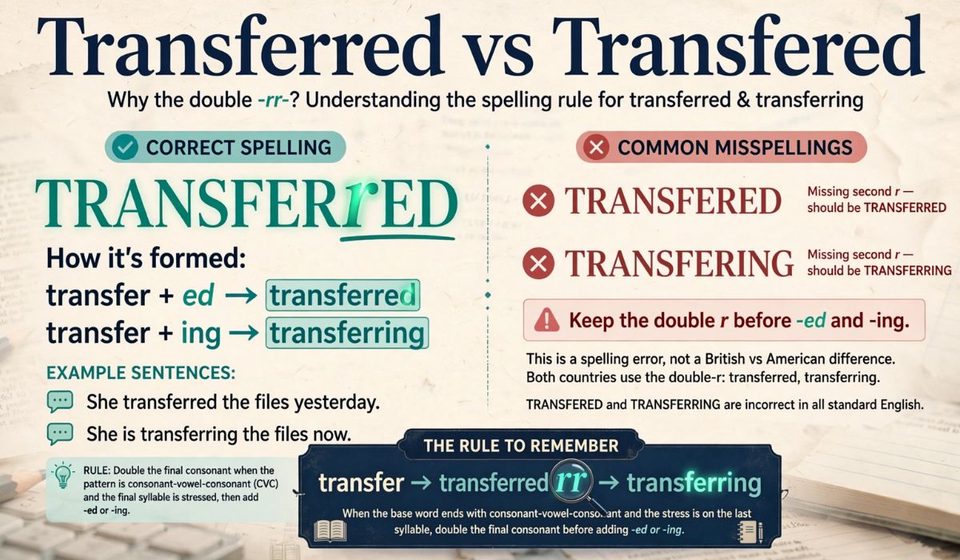

The correct spelling is transferred with two r’s. Transfered is a common spelling mistake in standard English. The word transferred works as both the simple past and past participle of transfer.
English doubles the final r because the stress falls on the last syllable. The same spelling pattern gives us transferring, not transfering. American and British English use transferred in the same way.
Transferred or Transfered: Which One Is Correct?
Transferred is the correct spelling. Transfered is not the standard spelling.
The base verb is transfer. When you form its past tense or past participle, you add -ed and double the final r:
transfer → transferred
That extra r matters. If you write transfered, most standard dictionaries and grammar references will treat it as a spelling error. The same principle applies to the present participle:
transfer → transferring
So, if you are writing an email, report, school assignment, business document, application, or formal message, use transferred.
| Form | Correct spelling | Example |
|---|---|---|
| Base verb | transfer | We need to transfer the files. |
| Third-person singular | transfers | The system transfers the data automatically. |
| Present participle | transferring | She is transferring the files. |
| Simple past | transferred | He transferred the money yesterday. |
| Past participle | transferred | The money has been transferred. |
The research landscape consistently confirms this distinction. Dictionary and grammar sources identify transferred as the accepted form, while transfered appears as a common misspelling.
Why Does Transferred Have Two R’s?
The spelling comes from an English consonant-doubling pattern.
The verb transfer has stress on its final syllable. You can hear that stress when you say the word aloud. The ending carries the strongest emphasis.
When English adds a vowel-initial suffix such as -ed or -ing to certain words, the spelling can double the final consonant. In transfer, that produces:
- transfer → transferred
- transfer → transferring
The important point is that this rule does not mean that every English word ending in a consonant automatically doubles that consonant.
Stress and word structure matter.
For example:
- transfer → transferred
- refer → referred
- infer → inferred
- defer → deferred
- occur → occurred
But:
- target → targeted
- visit → visited
- open → opened
This distinction helps explain why writers sometimes remember the general rule but apply it too broadly. The spelling pattern depends on the structure and stress of the word.
A simple way to remember it
Think of the word as:
transfer + ed = transferred
Do not remove the final r before adding -ed.
A useful memory cue is to remember that the word already ends in r, and its past form keeps that letter while adding another one:
transfe + rr + ed
The same idea works with -ing:
transfe + rr + ing
That gives you transferring.
Is Transfer a Regular or Irregular Verb?
Transfer is a regular verb.
A regular verb forms its past tense and past participle with the -ed ending. Transfer follows that pattern:
transfer → transferred
However, being a regular verb does not mean that the spelling stays completely unchanged.
English spelling rules sometimes require a letter to double when a suffix is added. That is what happens with transfer.
Compare these verbs:
- work → worked
- play → played
- transfer → transferred
- refer → referred
All four verbs form their past tense with -ed. The spelling changes slightly in some cases because English spelling conventions control how the suffix attaches.
This distinction helps learners avoid a common misconception: regular describes the way the verb forms its tense, not the idea that every letter remains unchanged.
Complete Verb Forms of Transfer
Understanding the full word family makes the spelling easier to remember.
| Grammatical form | Correct form | Example |
|---|---|---|
| Base form | transfer | I will transfer the account. |
| Third-person singular | transfers | The bank transfers funds electronically. |
| Present participle | transferring | They are transferring the files. |
| Simple past | transferred | She transferred to another department. |
| Past participle | transferred | The account has been transferred. |
The two forms that cause the most confusion are transferred and transferring.
Both contain two consecutive r’s.
That means these spellings are incorrect:
- transfered
- transfering
And these are correct:
- transferred
- transferring
If you are unsure, check the base word first. Start with transfer, then add the suffix while keeping the correct spelling pattern.
What Does Transferred Mean?
Transferred generally means that someone or something moved from one person, place, position, system, or situation to another.
The exact meaning depends on the context.
For example, a company might transfer an employee to another office. A bank might transfer money between accounts. A computer system might transfer data between servers.
The word can describe movement, reassignment, transmission, or a change in ownership or control.
Common meanings include:
- moving money between accounts
- moving data between devices
- moving an employee to another location
- changing schools or universities
- changing from one transportation route to another
- transferring ownership or legal rights
- moving a patient between medical facilities
- forwarding a telephone call
- moving a sports player from one club to another
This broad range of meanings explains why transferred appears in many different types of writing.
How to Use Transferred in a Sentence
The best way to understand transferred is to see it in realistic sentences.
Work and employment
She was transferred to the company’s London office.
Here, transferred means that the employee moved from one work location or assignment to another.
The manager transferred him to the sales department.
In this sentence, the manager performs the action.
Money and banking
The bank transferred the funds to the new account.
Here, transferred describes the movement of money.
The payment was transferred successfully.
This sentence uses the past participle in a passive construction.
Data and technology
The administrator transferred the files to a secure server.
The administrator performs the action.
The files were transferred securely.
The files receive the action.
Education
She transferred to another university after her first year.
The sentence describes a student’s move from one institution to another.
Property and legal rights
The owner transferred the property to his daughter.
Here, transferred refers to a change in ownership.
Transportation
We transferred to another train at the central station.
The word describes a change from one transportation service to another.
Sports
The player was transferred to another club.
In sports writing, transferred can describe a player’s move between teams or clubs.
Transferred as a Verb, Past Participle, and Modifier
The word transferred can perform different grammatical roles.
Consider these three sentences:
I transferred the files yesterday.
Here, transferred is the simple past form of the verb. The subject, I, performs the action.
The files were transferred yesterday.
Here, transferred is a past participle used in a passive construction. The files receive the action.
The transferred files are stored on the new server.
Here, transferred modifies the noun files. It works in a participial, adjective-like role.
This distinction matters because learners sometimes assume that transferred only functions as a past-tense verb. Its grammatical role depends on the sentence.
The basic pattern looks like this:
Active: The technician transferred the data.
Passive: The data were transferred by the technician.
Modifier: The transferred data remained available.
All three sentences use the same spelling.
Transferred vs Transferring
Transferred and transferring both come from the verb transfer, but they usually focus on different points in time.
Transferred normally describes a completed action, a completed move, or a resulting state.
Transferring usually describes an action that is happening or continuing.
Compare:
The company transferred Maria to its Chicago office.
The transfer happened.
The company is transferring Maria to its Chicago office.
The transfer is in progress or planned as an ongoing process.
Another example:
The files were transferred to the new server.
The movement is presented as completed.
The technician is transferring the files now.
The movement is currently happening.
This difference becomes especially useful in business, technical, and workplace writing.
Is Transfered American or British Spelling?
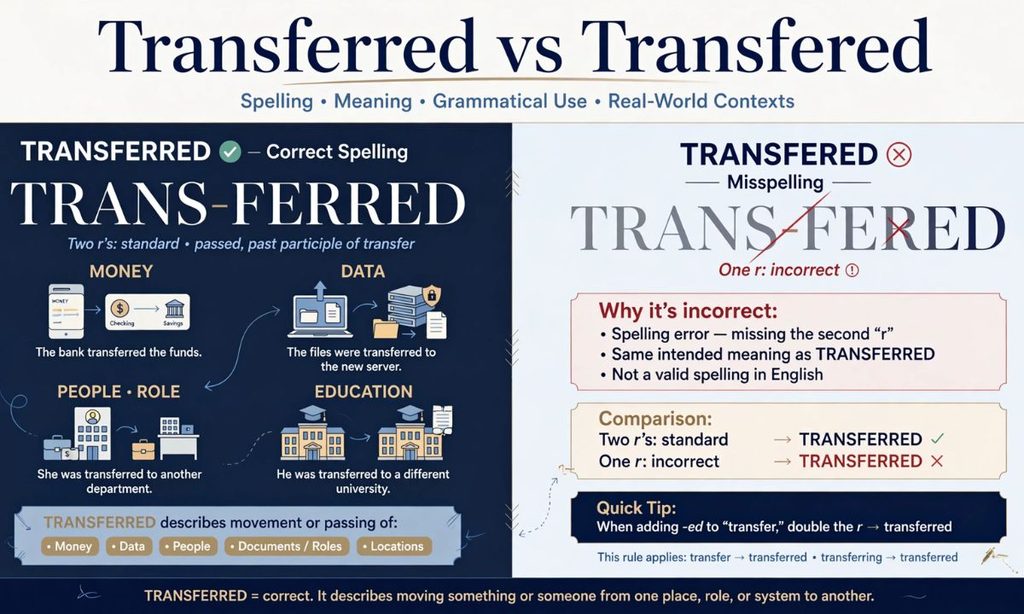
No. Transfered is not a standard American spelling or a standard British spelling.
Both major varieties of English use:
transferred
The same spelling applies in American English and British English.
Some English words do have different American and British spellings. For example, American English often uses color, while British English uses colour.
That does not happen with transferred.
So these are both correct:
- American English: transferred
- British English: transferred
And this is not a regional alternative:
- transfered
If you see transfered in a text, treat it as a spelling error rather than a US-versus-UK variation.
Transferred Pronunciation
The pronunciation of transferred reflects the stress pattern that helps explain its spelling.
The main stress remains on the final part of the original verb. That stress is one reason the final r doubles when the suffix is added.
English accents can produce small pronunciation differences. Rhotic accents, such as many American accents, pronounce the r sound more clearly. Non-rhotic accents, found in many varieties of British English, may treat the final r differently depending on the following sound.
The spelling does not change because of these accent differences.
Whether you use American English or British English, write:
transferred
Common Mistakes With Transferred
Several incorrect forms appear because writers remember the sound but not the spelling pattern.
1. Transfered
This is the most common mistake.
Incorrect: The money was transfered yesterday.
Correct: The money was transferred yesterday.
2. Transfering
This mistake drops the second r before -ing.
Incorrect: She is transfering the files.
Correct: She is transferring the files.
3. Transferrred
Some writers overcorrect and add three r’s.
Incorrect: The account was transferrred.
Correct: The account was transferred.
The word needs two r’s, not three.
4. Transferreded
This error adds the past-tense ending twice.
Incorrect: The data was transferreded.
Correct: The data was transferred.
Once transferred has the correct -ed ending, do not add another one.
5. Confusing transferred with transferee
These words have different meanings.
A transferee is the person or entity that receives something in a transfer.
A transferor is the person or entity that makes or gives the transfer in certain legal contexts.
Transferred, by contrast, describes the action, result, or state.
Explore More Grammar Guide
Naive vs Nieve: Which Spelling Is Correct?
Nosey vs Nosy: Which Spelling Is Correct?
Goodmorning or Good Morning: Which Spelling Is Correct?
Loose vs Lose: The Complete Guide to Using Each Word Correctly
Transferred in Active and Passive Sentences
Writers often use transferred in both active and passive voice.
Active voice puts the actor first:
The administrator transferred the files.
The administrator performs the action.
Passive voice puts the receiver first:
The files were transferred by the administrator.
The files receive the action.
For clear business and technical writing, active voice often makes the responsible actor easier to identify.
Compare:
The files were transferred to the new server.
with:
The IT team transferred the files to the new server.
The second sentence tells readers who performed the action.
Use the passive form when the action or result matters more than the actor, or when the actor is unknown or obvious.
Transferred Data or Transfered Data?
The correct phrase is transferred data.
For example:
The system encrypted the transferred data.
Here, transferred modifies data.
You can also write:
The data were transferred securely.
Here, transferred functions as part of the passive verb structure.
Do not write:
transfered data
The spelling remains transferred whether the word functions as a verb or as a modifier.
Transferred Money or Transfered Money?
The correct phrase is transferred money.
Examples include:
The bank confirmed that the transferred money had arrived.
The transferred money appeared in the recipient’s account.
You can also use the word as the main verb:
The bank transferred the money yesterday.
The meaning stays connected to movement from one account or person to another, but the grammatical function changes.
Transferred Schools or Transfered Schools?
The correct spelling is transferred.
For example:
She transferred schools during her sophomore year.
You could also write:
She transferred to another school during her sophomore year.
The choice depends on the sentence structure, but the spelling does not change.
Use transferred, never transfered, in either construction.
Transferred to, From, or Between?
The preposition depends on the direction or relationship you want to express.
Use transferred to when you identify the destination:
She was transferred to the New York office.
Use transferred from when you identify the starting point:
He was transferred from the finance department.
Use transferred between when you describe movement involving two or more places, systems, or groups:
The funds were transferred between the two accounts.
These patterns help make business and workplace sentences more precise.
Related Words From the Transfer Family
Learning related words can reinforce the spelling of transferred.
Transfer means to move, shift, pass, or convey something from one place, person, or situation to another.
Transferring describes the ongoing process.
Transferred describes a completed action or resulting state.
Transferable means capable of being transferred or applied in another context.
Transferee generally refers to the recipient of a transfer.
Transferor can refer to the person or entity making a transfer, especially in legal contexts.
Transference refers to the act or process of transferring.
Transferral is another noun related to the act of transferring, although it is less common in everyday writing.
Knowing the word family makes it easier to recognize the correct spelling when you encounter a new sentence.
A Simple Memory Trick for Transferred
Use this three-step method when you need to spell the word quickly.
Step 1: Start with the base verb.
Transfer.
Step 2: Notice the stressed ending.
The final syllable carries the main stress.
Step 3: Add the suffix and double the final r.
Transfer + ed → transferred
Transfer + ing → transferring
You can also remember this compact rule:
Transfer has two r’s when you add -ed or -ing.
That gives you:
- transferred
- transferring
Not:
- transfered
- transfering
This memory trick works well for emails, reports, schoolwork, and quick proofreading.
When Should You Use Transferred?
Use transferred whenever you need the past form or past participle of transfer.
Common situations include:
- Work: The employee was transferred to another department.
- Banking: The bank transferred the funds.
- Technology: The files were transferred to the cloud.
- Education: He transferred to another university.
- Property: Ownership was transferred to the buyer.
- Healthcare: The patient was transferred to another facility.
- Telecommunications: The caller was transferred to customer support.
- Transportation: We transferred to a different train.
- Sports: The player was transferred to another club.
The context can change the meaning of transfer, but it does not change the spelling of transferred.
How to Proofread Transferred Quickly
When proofreading, look for the most common error first.
If you see transfered, change it to transferred.
Then check related forms:
- transfer → correct
- transfers → correct
- transferring → correct
- transferred → correct
- transfering → incorrect
- transfered → incorrect
You can also ask a simple question:
Am I using the past tense or past participle of transfer?
If the answer is yes, write transferred.
This quick check prevents one of the most common spelling errors associated with the verb.
Frequently Asked Questions
Is it transferred or transfered?
Transferred is the correct standard spelling, while transfered is a common misspelling.
Is transfered a word?
Transfered can appear as an error, but standard English uses transferred for the past tense and past participle of transfer.
Why is transferred spelled with two r’s?
The final r doubles because transfer has a stressed final syllable and follows a consonant-doubling spelling pattern before -ed.
What is the past tense of transfer?
The simple past tense is transferred, as in “She transferred the files yesterday.”
Is it transferring or transfering?
The correct form is transferring, with two r’s before -ing.
Conclusion
Transferred is the correct spelling in standard English. Transfered is a common spelling mistake. Transferred serves as both the simple past and past participle of transfer. The double r follows the spelling rule for verbs with a stressed final syllable. The same rule gives us transferring, not transfering. American and British English use the same spelling. Use transferred when you write about money, data, employees, schools, property, transportation, or any other type of movement.



[…] Transferred vs Transfered: Which Spelling Is Correct? […]