
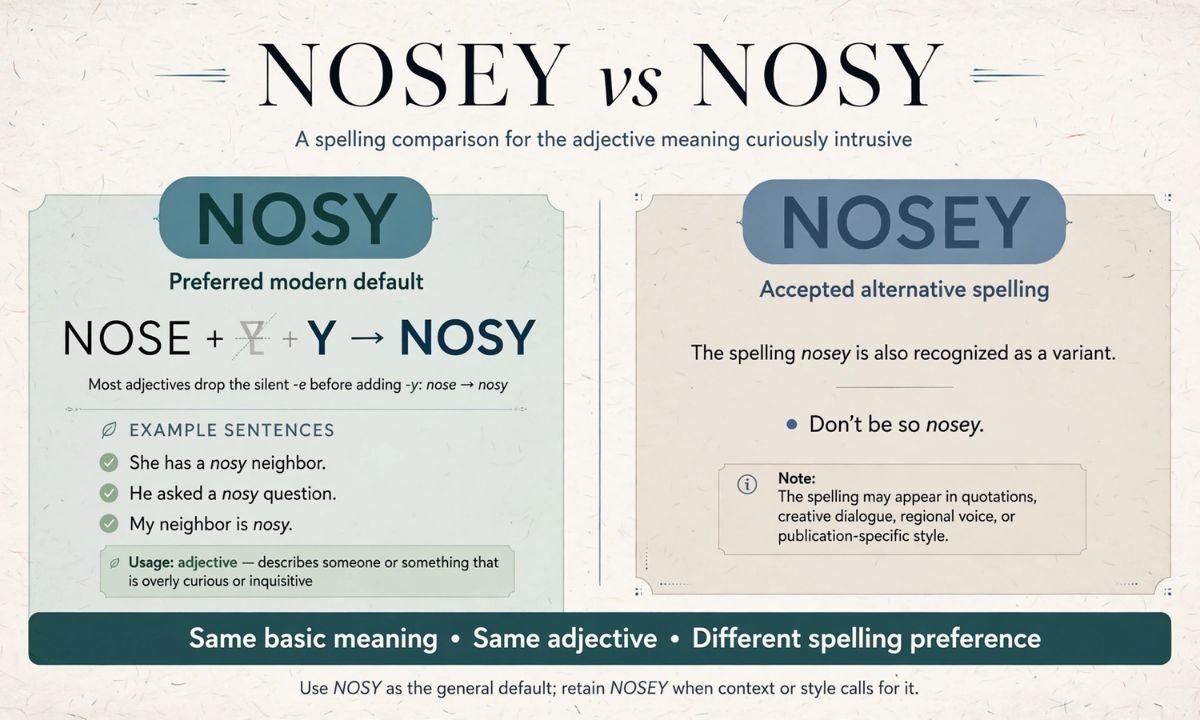
People often wonder whether nosy or nosey is the correct spelling. Both spellings refer to the same kind of intrusive curiosity.
Nosy appears more often in modern standard writing. Nosey remains an accepted alternative spelling.
The difference is mainly about spelling and usage, not meaning. For most formal and general writing, nosy is the safest choice.
Nosy vs Nosey: The Main Difference
The short answer is simple: use “nosy” as your default spelling.
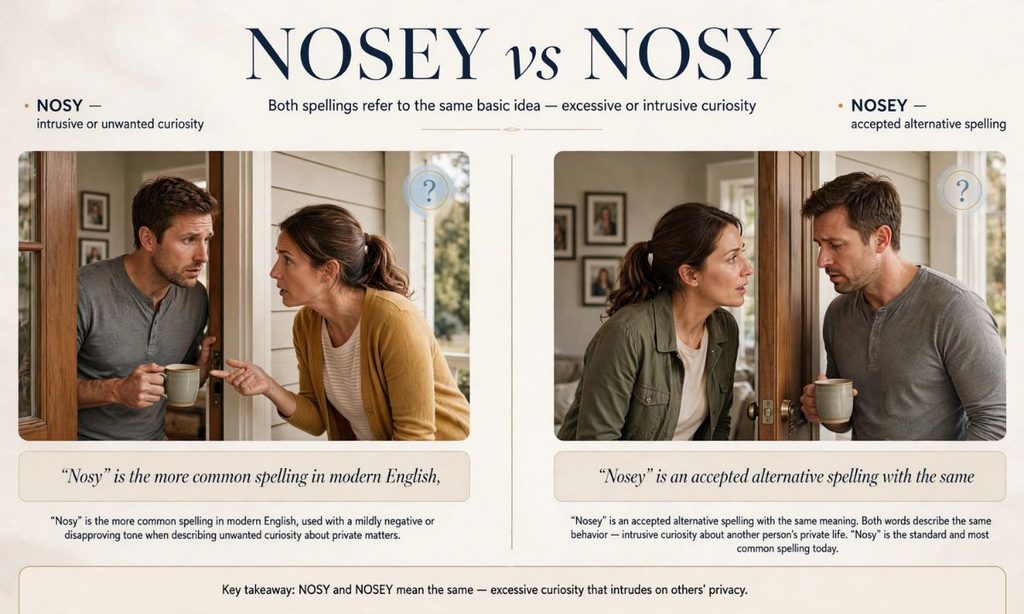
Nosy and nosey have the same basic meaning. Both describe someone who shows too much interest in other people’s private affairs. The person may ask personal questions, snoop, pry, meddle, or try to discover information that does not concern them.
The main difference lies in spelling and frequency.
Major dictionary treatments recognize nosey as a variant or alternative form rather than treating it as a completely separate word. The supplied research notes that Merriam-Webster lists nosey as a variant, while Cambridge and Oxford also recognize the spelling.
That distinction matters because some grammar websites describe nosey as wrong or nonstandard. The research shows that this claim goes too far. A better description is:
- Nosy is the preferred modern spelling.
- Nosey is an established alternative spelling.
- Both forms have the same adjective meaning.
- Nosy works best as the general default.
- Nosey can still appear in British-influenced writing, quotations, fiction, and informal contexts.
So, if you are writing an essay, email, article, report, or professional message, choose nosy unless a specific style guide says otherwise.
What Does Nosy Mean?
Nosy means overly interested in other people’s private affairs.
A nosy person does more than show ordinary curiosity. Their questions or actions cross a social boundary. They may want information that another person has not offered.
For example:
My nosy neighbor kept asking why my relatives were visiting.
The neighbor’s interest becomes nosy because the questions concern another person’s private business.
The word usually carries a negative or disapproving connotation. Cambridge describes the term as disapproving, while Oxford treats it as informal and disapproving. The supplied research also notes dictionary definitions centered on prying, intrusive, or excessive curiosity.
Nosy does not mean simply curious
This distinction helps explain the word clearly.
Someone can feel curious without being nosy.
For example:
- She is curious about astronomy.
- He is curious about how computers work.
- The student asked a curious question about the experiment.
These examples do not necessarily involve an invasion of privacy.
By contrast:
- She asked about her coworker’s salary.
- He read a private letter without permission.
- The neighbor repeatedly questioned the family about their finances.
These examples can describe nosy behavior because the interest focuses on another person’s private matters.
In simple terms:
Curiosity can be neutral. Nosiness usually involves unwanted or inappropriate interest.
Is Nosey a Correct Spelling?
Yes. Nosey is an accepted spelling variant of nosy.
However, acceptance does not mean that both spellings occur with equal frequency or serve as equally useful defaults in every situation.
The research found that major dictionaries recognize nosey, while many competitor grammar pages incorrectly present it as simply wrong or nonstandard.
That makes “preferred” a more accurate term than “correct versus incorrect.”
Think of the distinction this way:
Nosy: preferred, common, and suitable as the default spelling.
Nosey: recognized variant that remains valid in particular contexts.
This difference also explains why you may see nosey in British-oriented material, older writing, informal communication, or deliberately regional dialogue.
If you encounter nosey in a published text, you do not automatically need to treat it as a spelling error.
Nosey vs Nosy at a Glance
| Feature | Nosy | Nosey |
|---|---|---|
| Meaning | Excessively interested in other people’s affairs | Same meaning |
| Part of speech | Adjective | Adjective |
| Pronunciation | Generally the same | Generally the same |
| Dictionary status | Main or preferred form | Accepted variant |
| Modern frequency | More common | Less common |
| American English | Widely used | Less common |
| British English | Widely used | Also recognized |
| Formal writing | Strong default choice | Usually less suitable as the default |
| Creative writing | Natural | Useful for deliberate voice or style |
The important point is that nosy vs nosey does not represent a difference in definition. The spelling changes, but the basic adjective meaning remains the same.
Is Nosy American or British English?
Nosy is used in both American and British English.
Some usage websites simplify the issue by saying that nosy belongs to American English while nosey belongs to British English. That explanation does not fully capture modern dictionary usage.
The research specifically warns against treating this as a strict US-versus-UK rule. Both spellings can occur in British contexts, and nosy remains widely recognized there.
You may encounter nosey more often in some British-facing material, but that does not make it the required British spelling.
For a mixed or international audience, nosy offers the clearest default.
Why Is Nosy Spelled Without the E?
The spelling nosy connects naturally with the noun nose.
The word suggests the familiar expression “stick your nose into someone else’s business.” That metaphor describes someone who interferes in matters that do not concern them.
A common spelling explanation also involves the silent e in nose. When English adds certain suffixes, the final silent e can disappear.
So:
nose + y → nosy
This pattern provides a useful memory aid, but it does not prove that nosey cannot exist. English contains many established spelling variants, and dictionaries recognize nosey as one of them.
An easy memory trick
Think:
Nose + Y = Nosy
If you need to choose one spelling quickly, remember the version without the e.
When Should You Use Nosy?
Use nosy when you want the safest general spelling.
It works especially well in:
- School assignments
- Academic writing
- Professional emails
- Business communication
- Reports
- Websites and blogs
- Newsletters
- General-audience articles
- International communication
For example:
The manager warned employees not to ask nosy questions about private matters.
She complained about a nosy coworker who repeatedly asked about her personal life.
The article explains why some people consider the question too nosy.
The research consistently identifies nosy as the practical default for formal, professional, educational, and broad-audience writing.
When Can You Use Nosey?
You can use nosey when the context gives you a reason to preserve that spelling.
For example, you may keep nosey when:
- You reproduce a direct quotation.
- A publication’s style guide uses it.
- A fictional character deliberately uses the spelling.
- You want a particular regional voice.
- You are discussing the spelling difference itself.
- An existing title, name, or piece of text uses nosey.
Suppose a source says:
“Don’t be so nosey.”
If you quote the source directly, changing nosey to nosy would alter the original wording.
The same principle applies to fiction. An author may intentionally use a particular spelling to create a regional or conversational voice. The supplied research identifies direct quotations, creative dialogue, and publication style guides as legitimate reasons to retain nosey.
Is Nosey Wrong?
Calling nosey simply “wrong” does not accurately reflect the dictionary evidence.
A more precise distinction separates three ideas:
- Preferred: the form editors generally choose as the default.
- Accepted variant: a recognized alternative that has the same meaning.
- Incorrect: a spelling that standard dictionaries do not recognize for the intended meaning.
The research places nosey in the second category, not the third. Major dictionaries recognize it as a variant or alternative form.
That does not mean you should use both forms randomly.
Choose nosy as your standard spelling. Use nosey when context, quotation, style, or voice gives you a reason.
How to Use Nosy in a Sentence
Nosy functions as an adjective.
It can appear before a noun:
She has a nosy neighbor.
He asked a nosy question.
The reporter faced criticism for asking nosy questions.
It can also appear after a linking verb:
My neighbor is nosy.
The children became nosy about the surprise.
His questions seemed nosy.
The word can describe a person, a question, behavior, or another situation involving intrusive curiosity. The research specifically notes common uses involving people, questions, and behavior.
Common phrases with nosy
You will often see these combinations:
- nosy neighbor
- nosy neighbour
- nosy person
- nosy questions
- nosy reporter
- nosy coworker
- nosy relative
- nosy in-laws
- nosy behavior
These phrases all describe unwanted interest in another person’s private matters.
Explore More Grammar Guide
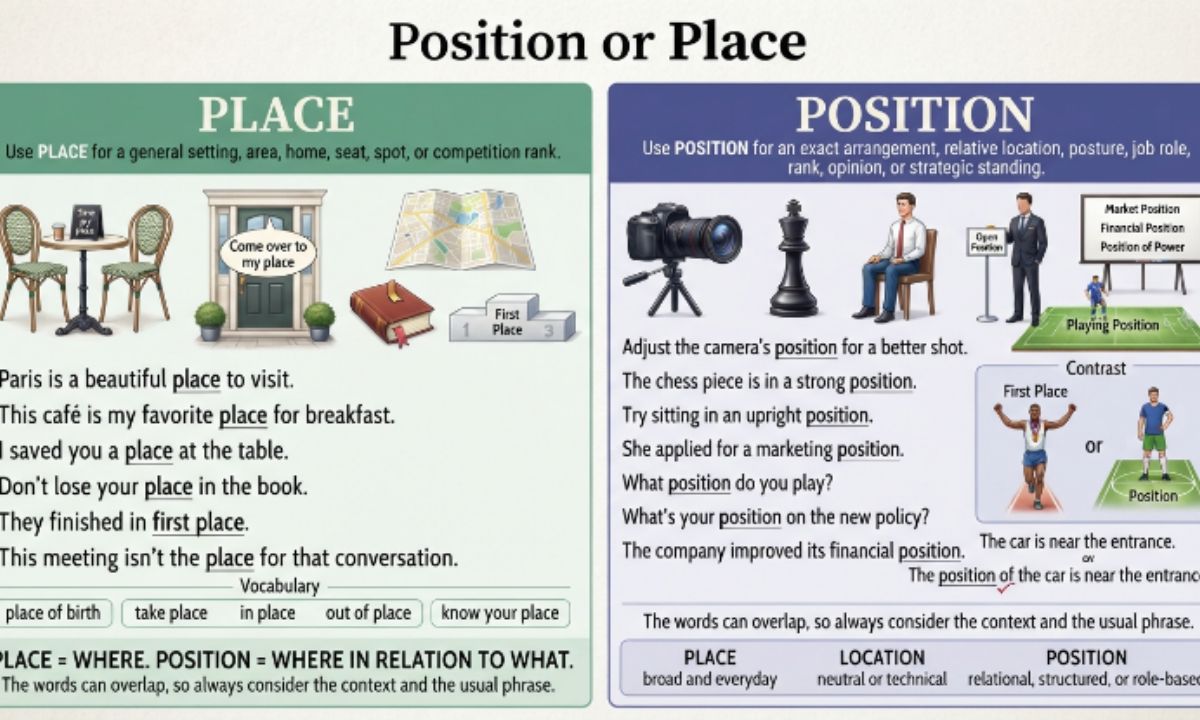
Position or Place: What’s the Real Difference?
Becuase vs. Because: Which Spelling Is Actually Correct?
Laying vs. Lying: The Grammar Rule Explained Simply
Loose vs Lose: The Complete Guide to Using Each Word Correctly
Nosier, Nosiest, Nosily, and Nosiness
The word nosy has several related grammatical forms.
| Form | Example |
|---|---|
| Positive adjective | She is nosy. |
| Comparative | He is nosier than his brother. |
| Superlative | She is the nosiest person in the office. |
| Adverb | He nosily asked about their plans. |
| Noun | Her nosiness annoyed everyone. |
The forms nosier, nosiest, nosily, and nosiness extend the same word family. The research identifies these forms as part of the standard grammatical treatment of nosy.
For spelling, keep the i in these forms:
- nosy
- nosier
- nosiest
- nosily
- nosiness
Nosy vs Curious: What Is the Difference?
Curious and nosy overlap, but they do not always carry the same tone.
Curious often describes a natural desire to learn.
Nosy usually describes unwanted interest in another person’s private affairs.
Compare these examples:
Maya was curious about the history of the building.
This sentence sounds neutral.
Maya was nosy about her coworker’s divorce.
This sentence suggests that Maya asked questions about something private.
The difference often depends on what someone wants to know and whether they have a legitimate reason to ask.
A child who asks how a machine works may sound inquisitive. A stranger who asks how much you earn may sound nosy.
Nosy vs Prying vs Intrusive
Several words can describe similar behavior, but their strength and nuance differ.
- Curious: interested in learning something; often neutral.
- Inquisitive: interested in asking questions; can sound neutral or positive.
- Nosy: excessively interested in other people’s private matters.
- Prying: actively trying to discover private information.
- Intrusive: interfering with someone’s privacy or personal space.
- Meddlesome: repeatedly interfering in other people’s affairs.
- Snoopy: informal and often somewhat playful.
- Busybody: someone who repeatedly involves themselves in other people’s affairs.
The research identifies these words as part of the broader synonym field for nosy. It also notes that prying and intrusive can express a stronger negative judgment than nosy.
What Does “Have a Nosy” Mean?
“Have a nosy” has a different use from the adjective “nosy.”
In informal British English, have a nosy can mean take a look around because you are interested.
For example:
Let’s have a nosy around the new shop.
Here, a nosy functions as an informal noun phrase meaning a look or inspection.
That does not mean the person necessarily behaves intrusively.
This distinction matters because someone can have a nosy without being described as nosy.
The research identifies this British informal noun use in Cambridge and Longman material and recommends separating it from the ordinary adjective.
What Does “Nosy Parker” Mean?
Nosy Parker is a chiefly British informal expression for a person who interferes in other people’s affairs or shows excessive curiosity.
It functions as a noun rather than simply as another spelling of the adjective.
For example:
Don’t be such a nosy Parker.
The expression has a distinctly informal tone. It fits casual conversation better than formal business or academic writing.
The supplied research identifies nosy parker as a relevant British regional expression and connects it with the ideas of meddling and prying.
Common Mistakes With Nosy and Nosey
Writers often make a few predictable mistakes.
Mistake 1: Treating nosey as a completely different word
The two spellings generally carry the same adjective meaning.
Mistake 2: Calling nosey automatically incorrect
Major dictionaries recognize nosey as a variant, so an absolute “wrong” label oversimplifies the evidence.
Mistake 3: Assuming nosey is required in British English
British English recognizes both forms. Do not treat nosey as a mandatory British spelling.
Mistake 4: Using nosey as the default in formal writing
Choose nosy when you need a broadly accepted default for school, work, professional, or general-audience writing.
Mistake 5: Confusing curiosity with nosiness
A person’s interest becomes nosy when it crosses into unwanted attention, prying, or interference with private matters.
Mistake 6: Switching spellings without a reason
Pick one form and stay consistent. If you use nosy throughout an article, do not randomly change it to nosey.
Preserve the original spelling only when a quotation, style guide, or deliberate voice requires it. The research specifically recommends this consistent editorial approach.
A Simple Decision Rule for Nosy or Nosey
You can resolve the spelling question in a few seconds.
Are you writing for school, work, a website, or a general audience?
Use nosy.
Are you quoting someone who wrote “nosey”?
Keep nosey.
Does a publication or house style require one form?
Follow that style guide.
Are you writing dialogue with an intentional regional voice?
You can use nosey when it supports the character or setting.
Is none of the above true?
Use nosy.
This approach avoids the common mistake of treating the spelling issue as a strict right-or-wrong rule. It also gives writers a practical way to choose the form without overthinking the distinction.
Frequently Asked Questions
Is it nosy or nosey?
Both are accepted spellings, but nosy is the preferred default for most modern writing.
Is nosey a real word?
Yes, nosey is an established variant spelling of nosy.
Is nosey correct in British English?
Yes, but British English also widely recognizes nosy, so nosey is not a required British spelling.
Is nosy correct in American English?
Yes, nosy is the common default spelling in American English.
Is nosy a negative word?
Usually yes; nosy normally describes unwanted or excessive interest in another person’s private affairs.
Final Words
The clearest way to remember nosey vs nosy is to choose nosy when you need the standard default spelling and recognize nosey as a valid alternative. The two forms share the same core meaning, pronunciation, and grammatical role. The real distinction involves spelling preference, frequency, context, and style. For schoolwork, professional communication, websites, and general writing, nosy provides the simplest choice. Keep nosey when a quotation, publication style, regional voice, or creative purpose calls for it.

5 Comments
Pingback: Naive vs Nieve: Which Spelling Is Correct?
Pingback: Transferred vs Transfered: Which Spelling Is Correct?
Pingback: International Phonetic Alphabet: Chart, Symbols, and How to Read It
Pingback: Flue vs. Flu: What’s the Difference and Which Do You Need?
Pingback: Lily or Lilly: Which Spelling Is Correct?