
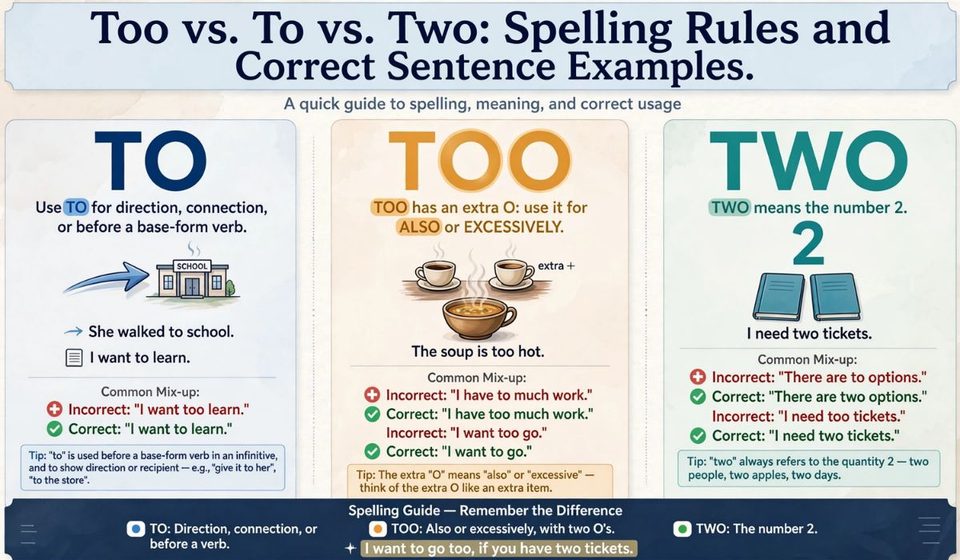

“To,” “too,” and “two” sound exactly the same when spoken out loud. That’s what makes them so easy to mix up in writing. Each word plays a completely different grammatical role, though. One shows direction or connects to a verb. One means “also” or “excessively.” One is simply the number 2. This guide walks through each word in plain terms, with enough examples that the difference sticks for good.
What Does “To” Mean?
“To” is one of the most flexible words in English. Most of the time, it works as a preposition, but it also has a second job: introducing an infinitive verb.
“To” as a Preposition
As a preposition, “to” connects a noun or pronoun to the rest of the sentence. It covers several related ideas.
Direction or movement
- “Walk to the store.”
- “Drive to the airport.”
Destination or arrival
- “Return to work on Monday.”
- “Come to the meeting early.”
A recipient
- “Give the report to Maya.”
- “Send the invoice to the client.”
Attachment or connection
- “Pin the note to the board.”
- “Connect the cable to the monitor.”
A range
- “Open Monday to Friday.”
- “Pages 10 to 20.”
A limit or endpoint
- “Turn the volume up to 10.”
- “Count to 100.”
Comparison
- “I prefer tea to coffee.”
- “This version is superior to the last one.”
Time
- “It’s ten minutes to noon.”
You’ll also see “to” inside fixed expressions like according to, due to, next to, and up to. These don’t follow a single rule; they’re just worth recognizing as set phrases.
“To” Before a Verb: The Infinitive
The second major role of “to” is introducing an infinitive, the base form of a verb.
- “I want to travel.”
- “She plans to apply next year.”
- “We need to finish this today.”
A simple way to spot this use: if “to” is immediately followed by a plain verb (not an -ing form or a noun), it’s almost certainly forming an infinitive.
Common verbs followed by an infinitive
- Want to
- Need to
- Plan to
- Try to
- Decide to
- Hope to
- Agree to
One quick note for careful writers: putting a word between “to” and the verb (a split infinitive, like “to quickly finish”) is grammatically fine in modern English. It’s a style choice, not an error.
What Does “Too” Mean?
“Too” is an adverb, and it carries two distinct meanings that are easy to confuse with each other.
“Too” Meaning “Also”
- “I want to come too.”
- “She likes coffee too.”
- “Me too.”
This sense usually shows up at the end of a sentence or clause, often right after a comma in formal writing.
“Too” Meaning “Excessively”
- “The coffee is too hot.”
- “That bag is too heavy to carry.”
- “You’re speaking too quickly.”
This sense typically sits right before an adjective or adverb, and it signals that something has crossed a limit, whether that’s comfort, ability, or appropriateness.
“Too” also pairs with quantity words:
- Too much
- Too many
- Too few
- Too little
“Too” vs. “Very”: A Distinction Worth Making
This is a nuance most quick explainers skip, but it matters for clear writing.
Very simply adds intensity, without implying a problem. “The soup is very hot” just means the temperature is high.
Too implies a consequence or limit being exceeded. “The soup is too hot” means you can’t eat it yet.
Compare:
- “She was very tired.” (a description, no issue implied)
- “She was too tired to drive.” (a description that leads to a result)
If you can add “and that’s a problem” to the sentence and it still makes sense, “too” is probably the right word.
“Too Late” vs. “To Late”
“Too late” is the standard phrase, and it means time has run out.
- “I’m afraid you’re too late.”
- “Too little, too late.”
“To late” isn’t wrong in every case, but it only works when “to” and “late” happen to sit next to each other for unrelated grammatical reasons, such as “go to late showings,” where “to” is a preposition and “late” simply describes “showings.” In nearly every other context, “too late” is what you want.
“Too” in Negative Sentences
Here’s a detail most grammar pages skip entirely. In negative sentences, “too” usually gets replaced by “either.”
- Positive: “I want to go too.”
- Negative: “I don’t want to go either.”
Saying “I don’t want to go too” sounds off to most fluent ears, even though it’s technically understandable. Stick with “either” for negative agreement in formal writing.
What Does “Two” Mean?
“Two” is the simplest of the three. It’s the cardinal number that comes after one and before three, and it rarely causes confusion once you separate it from the other two words by sound and function.
As a quantity word
- “Two apples.”
- “Two tickets.”
- “Two hours.”
As a standalone noun, when the counted item is understood from context
- “I only need two.”
- “Two should be enough.”
In a sequence
- “Chapter two.”
- “The second of two options.”
In compound adjectives, where it’s hyphenated before a noun
- “A two-day trip.”
- “A two-person team.”
- “Two-factor authentication.”
Related to pairs and duality
- “Two sides of the argument.”
- “Both options.”
Too vs To vs Two: Why These Three Words Get Confused
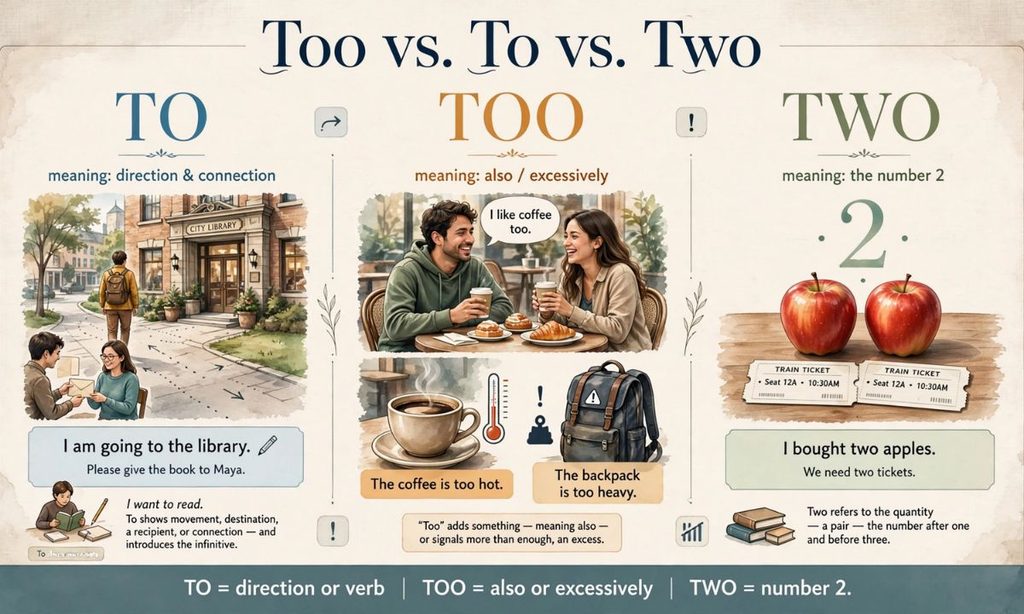
To, too, and two are homophones. That means they sound identical, even though they’re spelled differently and mean different things. All three are typically pronounced /tuː/, though in fast, natural speech, an unstressed “to” often reduces to a quick “tuh” sound (as in “I want to go”), while “too” and “two” tend to keep their fuller vowel sound.
Since your ear can’t tell them apart, your eye and your grammar knowledge have to do the work instead. A few other reasons these words trip people up:
Autocorrect sometimes swaps one for another without you noticing.
Fast typing skips the extra letter in “too.”
Writers focus on sound while reading their own sentence back, instead of checking word function.
“To” is confused with “too” far more often than either is confused with “two,” simply because “to” and “too” share more contexts.
How to Choose the Right Word: A Quick Test
Run through these questions in order when you’re unsure:
- Are you talking about the number 2? Use two.
- Can you swap the word for “also” or “as well” and keep the meaning? Use too.
- Does it mean “more than acceptable,” “excessively,” or “very,” with a sense of a limit being crossed? Use too.
- Does the word show direction, a recipient, a connection, a range, or a comparison? Use to.
- Does it come right before a base-form verb? Use to.
Where Each Word Usually Sits in a Sentence
| Word | Common position |
| To | Before a noun/pronoun, or before a base-form verb |
| Too | At the end of a sentence (for “also”), or right before an adjective/adverb (for excess) |
| Two | Before a plural noun, or standing alone when the noun is implied |
This positional pattern is one of the fastest ways to self-edit. Read the word in context, not in isolation, and check what comes right before or after it.
Common Mistakes to Watch For
These errors show up constantly in emails, texts, and social posts:
❌ “I have to much work.” → ✅ too much work
❌ “I want too go.” → ✅ want to go
❌ “I need to tickets.” → ✅ need two tickets
❌ “Me to.” → ✅ Me too
❌ “I am going too school.” → ✅ going to school
❌ “There are to options.” → ✅ two options
❌ “It is to late.” → ✅ too late
❌ “The task is to difficult.” → ✅ too difficult
❌ “I will send it too her.” → ✅ send it to her
A fast way to catch these while proofreading: read the sentence aloud and ask what job the word is doing. If it’s naming a quantity, it should be two. If it means “also” or “excessively,” it should be too. Everything else defaults to to.
Explore More Grammar Guide
Position or Place: What’s the Real Difference?
Becuase vs. Because: Which Spelling Is Actually Correct?
“To Bad” or “Too Bad”: Which Spelling Is Correct?
Loose vs Lose: The Complete Guide to Using Each Word Correctly
Punctuation With “Too”
Should you put a comma before “too” at the end of a sentence? Both styles are common today.
- Traditional style: “I would like to join, too.”
- Modern style: “I would like to join too.”
Neither is incorrect. The comma adds a small pause and slightly more emphasis. Many style guides now treat it as optional, so consistency within your own document matters more than picking one “correct” rule. Short responses like “Me too” and “You too” don’t take a comma at all.
Examples Across Real Contexts
Work and email
- “Please send the draft to the client by Friday.”
- “The proposal is too long for a one-page summary.”
- “Two reviewers signed off on the changes.”
Technology
- “Connect the printer to your laptop.”
- “The file is too large to upload.”
- “Enable two-factor authentication for extra security.”
Travel
- “We’re flying to Lisbon next month.”
- “The layover was too short to explore the city.”
- “Our flight included two free checked bags.”
Academic writing
- “The study aims to measure long-term outcomes.”
- “The sample size was too small for reliable results.”
- “Two variables were controlled throughout the experiment.”
Everyday conversation
- “I’m heading to the gym.”
- “It’s too cold for a walk today.”
- “We ordered two coffees to go.”
Easy Ways to Remember the Difference
Too has an extra O, and that extra letter stands for something extra, an additional idea, or an excessive amount.
Two starts like “twin” and “twice,” both words tied to the number 2.
The substitution trick: if you can swap the word for “also,” it’s too. If you’re counting something, it’s two. Anything left over is usually to.
A one-line anchor sentence: “I want to go too, if you’re bringing two tickets.” That single sentence uses all three words correctly and can serve as a quick mental check.
Frequently Asked Questions
Is it “too much” or “to much”?
It’s “too much.” “To” never pairs with “much” to mean an excessive amount.
Is it “too late” or “to late”?
“Too late” is correct in almost every case, meaning time has run out.
Is “to” always a preposition?
No. It’s often a preposition, but it also introduces infinitive verbs, like “to run” or “to decide.”
Is “too” the same as “very”?
Not quite. “Very” just adds emphasis, while “too” implies a limit has been crossed, often with a negative result.
Should I use “too” or “either” in a negative sentence?
Use “either.” For example, “I don’t want to go either,” not “I don’t want to go too.”
Final Thoughts
To, too, and two sound identical but serve three completely different purposes in a sentence. To points toward a direction, a recipient, or a verb. “Too” means “also” or signals that something has gone beyond a reasonable limit. Two is simply the number 2, nothing more. Once you tie each word to its job rather than its sound, choosing the right spelling becomes automatic, and your writing reads more polished as a result.

[…] Too vs To vs Two: How to Use Each Word Correctly […]
[…] Too vs To vs Two: How to Use Each Word Correctly […]