
You’ve probably typed “long term” and then stared at it, wondering if it needs a hyphen. Maybe autocorrect changed it on you. Maybe a coworker wrote “longterm” in a report and it looked wrong, but you weren’t sure why. This mix-up trips up even experienced writers, because the rule depends on grammar, not just spelling. The good news is that once you see the pattern, you’ll never second-guess it again.
Quick Answer: Which Form Is Correct?
Here’s the short version, so you can get back to writing:
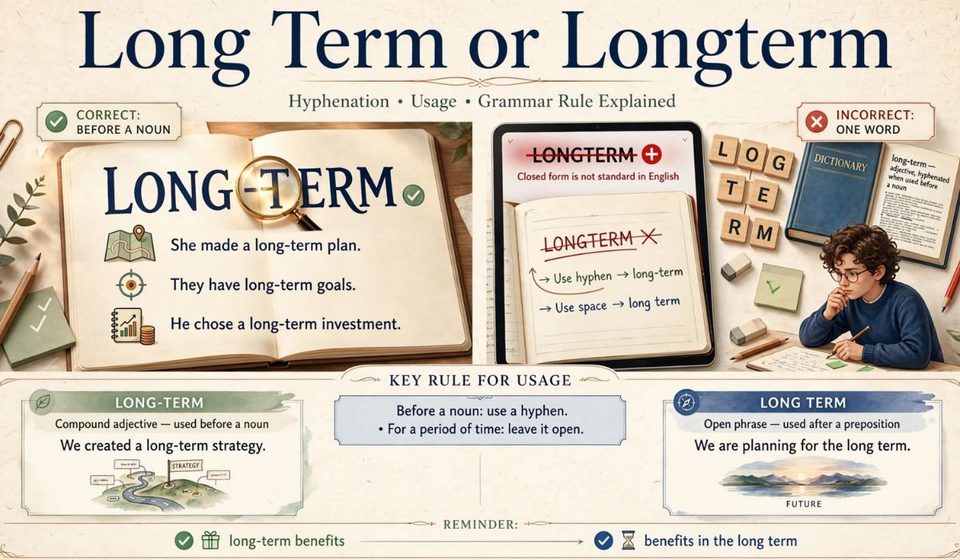
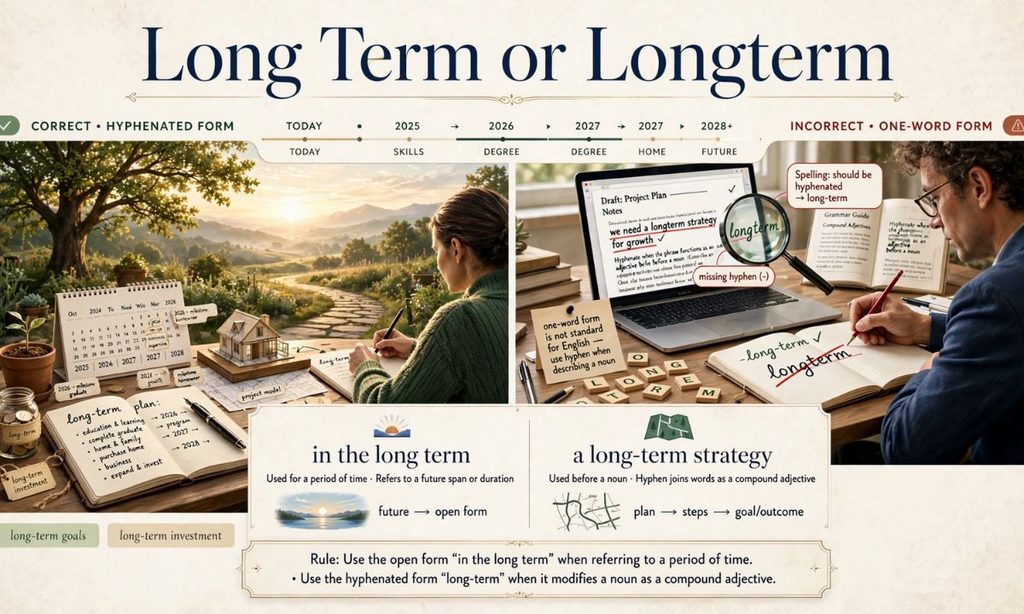
Long-term (hyphenated) is a compound adjective. Use it right before a noun, like “long-term plan” or “long-term investment.”
“Long term” (two words, no hyphen) is a noun phrase. Use it to talk about a stretch of time, like in the long term or plan for the long term.
“Longterm” (one word) isn’t standard English. Style guides and dictionaries don’t recognize it, so avoid it in formal or professional writing.
If you remember nothing else, remember this: hyphenate it when it sits before a noun. Leave it open everywhere else.
Long Term vs. Long-Term: The Core Grammar Difference
This isn’t really a spelling issue. It’s a grammar issue that happens to show up as a spelling difference.
“Term” is a noun that means a period of time. On its own, “long term” is just an adjective (long) describing a noun (term), the same way you’d say “short walk” or “quiet afternoon.” Nobody hyphenates those, so nobody needs to hyphenate “long term” either, as long as it’s standing on its own as a time expression.
The moment you use “long” and “term” together to describe a different noun, though, they team up. Grammarians call this a compound modifier, or more specifically, a premodifying compound adjective. When two words join forces to modify a third word, English convention links them with a hyphen so the reader instantly sees they’re a single unit.
Compare these two sentences:
“We’re investing for the long term.” (Long term is the noun phrase, the thing you’re investing for.)
“We made a long-term investment.” (Long-term is modifying investment. It’s doing the job of one adjective, not two separate words.)
Same two words. Different job. Different spelling.
When to Use “Long-Term”
Use the hyphenated form whenever “long-term” sits directly in front of a noun and describes it. This is the pattern you’ll see constantly in business, health, and everyday writing:
- Long-term plan
- Long-term goals
- Long-term strategy
- Long-term investment
- Long-term effects
- Long-term growth
- Long-term relationship
- Long-term care
- Long-term debt
- Long-term agreement or contract
A simple test: if you can swap in a single-word adjective and the sentence still makes sense structurally (“a long-term plan” works the same way as “a solid plan”), you need the hyphen.
When to Use “Long Term”
Drop the hyphen when “long term” functions as a noun phrase, usually describing a stretch of time rather than modifying something else. It shows up most often after a preposition:
- In the long term
- For the long term
- Over the long term
- Planning for the long term
- Thinking about the long term
In this form, “long term” behaves a lot like “long run.” In fact, in business writing, “the long term” and “the long run” are often interchangeable. If you’re talking about a general future period rather than describing a specific noun, leave it open.
Longterm: Is the One-Word Spelling Ever Correct?
Short answer: not in standard English.
“Longterm” as a single closed-up word doesn’t appear in major dictionaries, and no mainstream style guide recognizes it as correct. It shows up online mostly because people type fast, skip the hyphen key, or see other closed compounds in English (like “longtime” or “weekend”) and assume “long term” has gone through the same evolution. It hasn’t, at least not yet.
That “longtime” comparison is actually a useful thing to understand, because it explains where the confusion comes from. English compounds tend to move through three stages over time:
- Two separate words (long time)
- A hyphenated compound (long-time)
- Eventually, one closed word (longtime)
“Longtime” made it all the way to stage three and is now accepted as a single word by most dictionaries. “Long-term” hasn’t made that jump. It’s still living at stages one and two, depending on how it’s used in the sentence. Maybe someday “longterm” will be standard too, but that day hasn’t come, so avoid it in anything formal: essays, resumes, reports, articles, or professional correspondence.
The only place you might reasonably see “longterm” as one word is inside a brand name, a username, or some kind of stylized title where a company or app deliberately dropped the hyphen for a logo or domain name. That’s a design choice, not a grammar rule, and it shouldn’t influence how you write in regular prose.
A Side-by-Side Comparison Table
| Form | Part of speech | Typical position | Example |
| Long-term | Compound adjective | Before a noun | “She made a long-term investment.” |
| Long term | Noun phrase | After a preposition or verb | “Think about the long term before deciding.” |
| Longterm | Nonstandard | Avoid in formal writing | Not used in edited English |
Keep this table in your back pocket. If you’re ever stuck mid-sentence, ask yourself: is there a noun right after this phrase? If yes, hyphenate. If not, leave it open.
Examples in Real Writing
Seeing the rule applied across different fields makes it stick better than any abstract explanation.
Business and workplace
- The company set a long-term strategy for expansion.
- We need to think long term if we want this partnership to last.
Finance and investing
- Long-term investments are typically held for more than a year.
- Long-term debt appears differently on a balance sheet than short-term liabilities.
Healthcare
- Long-term care facilities support patients who need extended assistance.
- The long-term effects of the treatment are still being studied.
Education and academics
- Researchers examined the long-term consequences of the policy.
- Over the long term, reading habits shape vocabulary development.
Career and personal goals
- She’s building a long-term career in engineering.
- What are your goals for the long term?
Everyday communication
- We’re in this for the long term.
- Long-term friendships take work.
Common Mistakes and How to Fix Them
Even careful writers slip up here. Watch for these patterns:
Writing “longterm” as one word. Fix: split it into two words, then decide if it needs a hyphen based on position.
Writing “in the long-term” with a hyphen. This is wrong because “long term” here is a noun phrase after a preposition, not a modifier. Fix: drop the hyphen, write “in the long term.”
Writing “long term plan” without a hyphen. Since “long term” is modifying “plan” here, it needs the hyphen: “long-term plan.”
Hyphenating every instance out of habit. Not every use needs a hyphen. Check whether a noun immediately follows.
Switching spellings mid-document. Pick the correct form for each sentence and stay consistent throughout.
A quick proofreading trick: search your document for “long term” and “long-term.” For every result, check whether a noun comes right after. If yes, add the hyphen. If the phrase is just sitting there describing time, remove it.
Long-Term in Business, Finance, and Accounting
Finance and accounting give “long-term” some extra technical weight beyond basic grammar.
In accounting, something is generally classified as long-term when it extends beyond one year. Long-term debt, long-term assets, and long-term liabilities all follow this convention on financial statements. This is different from the everyday sense of “long-term,” which just means “far into the future” without a specific cutoff.
Investment terminology adds another layer. A long-term capital gain, for tax purposes, typically applies to assets held for a longer holding period rather than sold quickly.
The exact thresholds can vary depending on the country, the tax year, and the type of asset, so if you’re writing about taxes or investments professionally, verify the current numbers rather than assuming they’re fixed forever. Rules like these get updated by regulators from time to time.
Common financial phrases you’ll run into:
- Long-term bonds
- Long-term borrowing
- Long-term savings
- Long-term capital gains
- Long-term contracts
All of these follow the same hyphenation rule as everyday usage: hyphenate before the noun.
Long-Term vs. Short-Term
Once you’ve got “long-term” down, “short-term” is free. It follows the exact same pattern.
- Short-term solution (adjective, before a noun)
- Solution for the short term (noun phrase, after a preposition)
- Short-term goals vs. goals for the short term
- Long-term growth vs. short-term losses
Businesses and writers often pair these two terms together when comparing timelines, like weighing short-term costs against long-term benefits. The hyphenation logic doesn’t change just because you’re contrasting two time frames in the same sentence.
Explore More Grammar Guide
Poopie or Poopy: Which Spelling Is Actually Correct?
Separate or Seperate? The Correct Spelling Explained
“To Bad” or “Too Bad”: Which Spelling Is Correct?
Related Forms Worth Knowing
A few cousins of “long-term” follow similar or related rules, and it helps to know how they behave too.
Medium term / medium-term. Same rule applies. “The medium term” is a noun phrase; “a medium-term goal” is a compound adjective.
Medium-to-long-term. When you stack multiple time frames into one modifier, hyphenate the whole chain: “a medium-to-long-term forecast.”
Near-term. Usually hyphenated when used as an adjective, similar to long-term.
Long-run. Common in economics, functions similarly to “long term” as a noun phrase, though “long run” is almost always open, never hyphenated.
Longtime. Already closed into one word and accepted by dictionaries, unlike “longterm.” Don’t let this one talk you into merging “long term.”
Long-standing, long-lived, long-range. These are established hyphenated compounds in their own right, worth knowing if you’re editing similar phrases.
Style and Editorial Considerations
Dictionaries and general grammar rules will get you most of the way there, but if you’re writing for a specific publication, company, or academic program, check their house style guide too. Some publications have their own preferences for hyphenation in headlines, bullet points, or technical labels, and those house rules can occasionally override the general grammar convention for consistency’s sake.
A few practical tips:
In headlines and titles, some style guides drop hyphens for visual cleanliness. Check your specific style guide before assuming.
In tables, labels, and bullet lists, keep the same form throughout instead of mixing “long-term” and “long term” for the same meaning.
When editing someone else’s writing, don’t just search-and-replace. Read each instance in context, since the correct form depends on the sentence structure.
A Simple Decision Tree
Next time you’re unsure, walk through these questions in order:
- Does a noun come immediately after the phrase? If yes, hyphenate.
- Are you describing a general time horizon or period, especially after a preposition like “in,” “for,” or “over”? If yes, leave it open.
- Is it part of a fixed expression like “in the long term” or “long run”? If yes, no hyphen.
- Are you using a specific financial or accounting term with an established convention? Check the relevant standard, since some fields have their own formatting habits.
- Does your employer, publisher, or professor have a house style guide? If so, follow that guide for edge cases.
Frequently Asked Questions
Is “longterm” one word?
No. Standard English treats it as two words, either “long term” or “long-term” depending on grammar, never merged into one.
Is “long-term” always hyphenated?
No, only when it comes directly before a noun and acts as a compound adjective, like “long-term plan.”
Is “in the long term” correct?
Yes. This is a fixed noun phrase, so it stays open with no hyphen.
What’s the difference between long-term and long run?
They mean almost the same thing in context, but “long run” is always written as two open words, while “long-term” can be hyphenated depending on its role in the sentence.
Does the same rule apply to short-term?
Yes. “Short-term” and “short term” follow identical hyphenation logic to “long-term” and “long term.”
Final Thoughts
The difference between long term, long-term, and longterm comes down to one simple check: look at what comes right after the phrase. If a noun follows and the phrase is describing it, add the hyphen. If you’re talking about a stretch of time on its own, leave the words open.
And no matter what, skip the one-word “longterm” entirely in anything you want to look polished and professional. Once this rule clicks, you’ll spot it instantly every time you write, and you’ll never have to pause mid-sentence wondering which version to use again.