

These two words trip up even experienced writers. They sound nearly identical when spoken. Their meanings overlap just enough to cause hesitation. Most of the time, one simple rule solves the problem. But a few exceptions exist, and knowing them makes you a sharper writer. This guide walks through every rule, exception, and example you need.
Quick Answer: Affect or Effect?
In almost every sentence, the rule is simple:
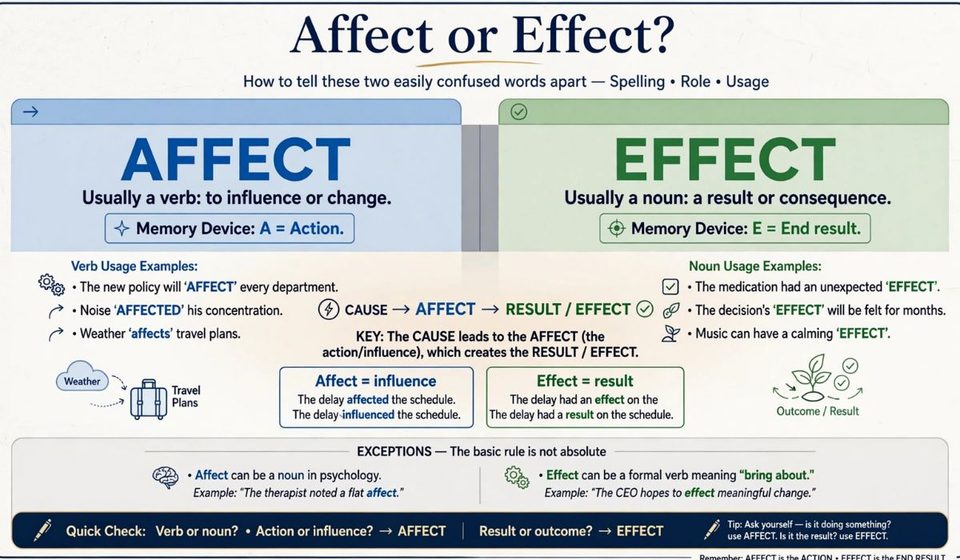
Affect is usually a verb, meaning to influence or change something.
Effect is usually a noun, meaning the result of that change.
Example:
The storm affected the harbor. (verb — the action)
The storm’s effect on the harbor was severe. (noun — the result)
That covers roughly 95% of real-world usage. But both words have secondary meanings — effect can act as a verb, and affect can act as a noun — and we’ll cover those too, so you’re never caught off guard.
The Basic Difference Between Affect and Effect
Think of it as a chain reaction:
- Something happens (a cause).
- That cause affects something else (the action).
- The change it leaves behind is the effect (the result).
Simple framework: If A affects B, then B experiences the effect of A.
| Info | Affect | Effect |
| Common role | Verb | Noun |
| Meaning | To influence, change, or impact | A result, outcome, or consequence |
| Example | The heat affected the crops. | The heat had a damaging effect on the crops. |
Once this core distinction is locked in, the exceptions become much easier to understand.
Affect: Meaning and Usage
Affect as a Verb (the common use)
As a verb, affect means to influence, change, or have an impact on something. It’s almost always transitive, meaning it needs a direct object — someone or something that receives the action.
Ask yourself: what or who is being affected? If you can answer that, “affect” is likely correct.
Examples:
- Poor sleep affects concentration.
- The new policy will affect every department.
- Her tone of voice affected how the message was received.
- Gravity affects the trajectory of a thrown ball.
- The scandal affected the company’s reputation.
Affect as a Noun (specialized use)
In psychology and clinical settings, affect is a noun. It refers to a person’s outward, observable emotional expression — not their private internal feelings, but how those feelings show up in tone, face, and body language.
Examples of clinical phrases:
- Flat affect (little to no emotional expression)
- Blunted affect (reduced emotional expression)
- Labile affect (rapidly shifting emotional expression)
- Appropriate affect (emotional expression that matches the situation)
Example sentence:
- The therapist noted a flat affect during the session, despite the patient describing intense grief.
This noun is pronounced differently than the verb. The verb is stressed on the second syllable (uh-FECT), while the noun is stressed on the first (AFF-ect).
Affect Meaning “To Pretend”
There’s a third, less common meaning. As a verb, affect can mean to put on a false appearance, adopt an artificial manner, or pretend.
Examples:
- He affected a British accent at the interview.
- She affected an air of calm, though she was nervous inside.
- The actor affected a limp for the role.
The adjective form, affected, describes behavior that feels artificial or pretentious.
- His affected politeness felt insincere.
Effect: Meaning and Usage
Effect as a Noun (the common use)
As a noun, effect means a result, consequence, or change brought about by a cause. It often pairs with descriptive adjectives.
Common combinations:
- Positive effect
- Negative effect
- Significant effect
- Long-term effect
- Calming effect
- Ripple effect
- Side effect
Examples:
The medication had an unexpected effect.
Tourism has a strong effect on the local economy.
The lighting created a dramatic effect on stage.
Effect as a Verb (formal, less common)
As a verb, effect means to bring something about, cause it to happen, or accomplish it directly. This use is formal and shows up most often in business, government, and organizational writing — frequently paired with the word “change.”
Examples:
The new CEO hopes to effect meaningful change.
Activists worked to effect reform in the justice system.
The committee aims to effect lasting improvements.
Important distinction:
Affect change = to influence or alter change that’s already happening.
Effect change = to actively cause change to happen in the first place.
These two phrases look similar but mean different things, and mixing them up can confuse a reader in formal writing.
“Effects” as Personal Possessions
There’s one more noun meaning worth knowing: effects, in plural form, can mean personal belongings.
Example:
- Please collect your personal effects before leaving the hospital.
This meaning appears in legal, medical, and travel contexts, and it’s easy to overlook.
Affect vs. Effect: Grammar Rules and Memory Tricks
A few memory aids make this distinction stick:
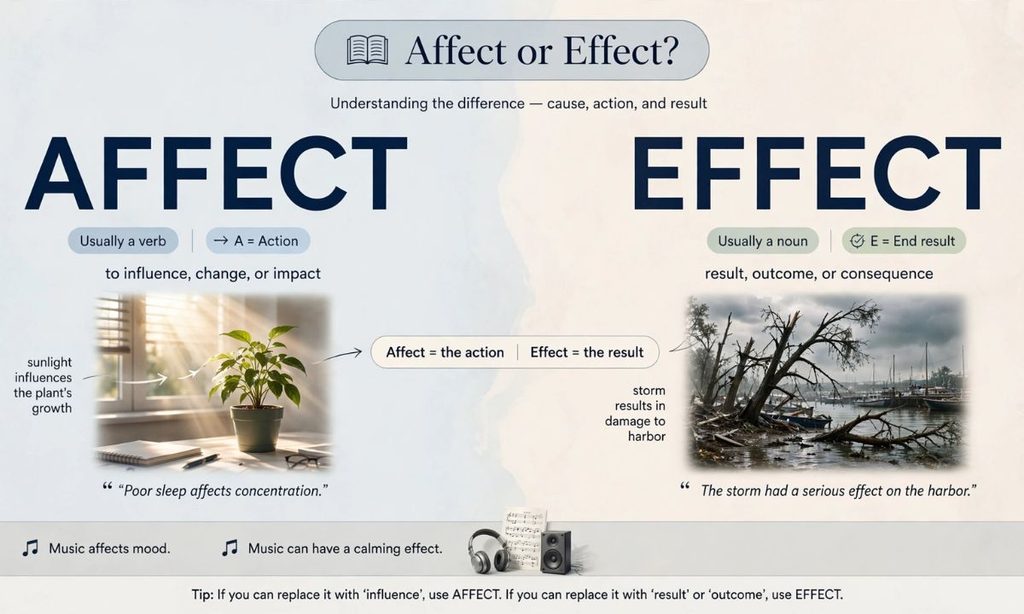
A is for Action: Affect starts with A, and action starts with A. Action words are usually verbs.
E is for End result: Effect starts with E, and so does “end result.” Results are usually nouns.
Cause and effect: This classic phrase pairs the word “effect” with results, reinforcing its noun role.
Substitution test: Try replacing the word with “influence” (for affect) or “result” (for effect). If the substitution makes sense, you’ve likely chosen correctly.
Substitution examples:
- The delay affected [influenced] the schedule. ✓
- The delay had an effect [result] on the schedule. ✓
This test won’t catch the rarer verb/noun exceptions, but it works for the vast majority of everyday sentences.
Affect or Effect: A Simple Decision Process
When you’re unsure, run through these questions in order: Is the word acting as a verb or a noun in this sentence?
Does it describe an action or influence? → Likely “affect” (verb)
Does it describe a result or outcome? → Likely “effect” (noun)
Is this about psychology or emotional expression? → Likely “affect” (noun)
Does it mean “pretend” or “put on”? → “Affect” (verb)
Does it mean “bring about” or “accomplish”? → “Effect” (verb)
Is it part of a fixed phrase like “take effect” or “side effect”? → “Effect”
Working through this list takes seconds once it becomes habit.
Affect vs. Effect: Side-by-Side Examples
| Sentence with Affect | Sentence with Effect |
| The medicine affects blood pressure. | The medicine’s effect on blood pressure is well documented. |
| Noise affected his concentration. | The noise had a distracting effect. |
| The decision will affect the whole team. | The decision’s effect will be felt for months. |
| Weather affects travel plans. | Bad weather had a major effect on travel plans. |
| Music affects mood. | Music can have a calming effect. |
Notice the pattern: affect describes the action happening to something, while effect describes what’s left after it happens.
Common Fixed Expressions
Certain phrases always use one specific word. Memorizing these prevents a lot of common mistakes.
Always “effect”:
Take effect
Go into effect
Come into effect
Put into effect
In effect
Side effect
Cause and effect
Ripple effect
Domino effect
Personal effects
Sound effects
Special effects
For effect
Always “affect”:
Affect someone’s mood
Affect a decision
Affect performance
Affect judgment
Affect behavior
If you’re ever unsure about a phrase, check whether it fits into the “always effect” list first — most fixed expressions default to effect.
Affect vs. Effect vs. Impact vs. Influence
These four words overlap, but small differences matter.
Affect (verb): to influence or change something directly.
Effect (noun): the result of that change.
Impact: can work as either a verb or noun, and generally implies a stronger, more forceful change than “affect” or “effect.”
Influence: often implies a gradual or shaping effect over time, rather than a single direct action.
Example comparison:
- The lecture affected her thinking. (a direct change)
- The lecture had a lasting influence on her thinking. (a gradual, shaping change)
- The lecture had a major impact on her thinking. (a strong, forceful change)
None of these words are strictly interchangeable, so choose based on the tone and strength you want to convey.
Explore More Grammar Guide
A Lot or Alot? Correct Spelling, Meaning, and Examples
“To Bad” or “Too Bad”: Which Spelling Is Correct?
Your or You’re? Difference, Meaning, and Correct Usage
Definitely or Definately? Correct Spelling and Common Mistakes
Affected vs. Effected
These past-tense forms confuse writers just as often as the base words.
- Affected = influenced, changed, or emotionally moved.
- Effected = brought about, caused, or accomplished.
Examples:
- The community was deeply affected by the flood.
- The new leadership effected real change within a year.
- She was visibly affected by the news.
- The reforms were successfully effected by the committee.
If you can substitute “caused” or “brought about,” use “effected.” If you can substitute “influenced” or “changed,” use “affected.”
Using Affect and Effect in the Same Sentence
Once you understand both words, combining them in one sentence becomes a strong writing technique — it shows both the cause and the consequence clearly.
Examples:
The new policy will affect attendance, which will have a direct effect on final grades.
Rising temperatures affect crop yields, and the effect is already visible in food prices.
Her leadership style affected team morale, producing a noticeable effect on productivity.
This pattern works well in academic and professional writing, where showing cause-and-result relationships adds clarity.
Affect and Effect in Academic and Professional Writing
Precision matters more in formal writing than in casual speech. A few guidelines:
In research papers, use affect when describing how one variable influences another (e.g., “Sleep deprivation affects reaction time”).
Use effect when reporting the measured outcome (e.g., “The effect was statistically significant”).
In business writing, favor effect as a verb sparingly — it sounds formal and works best in phrases like “effect change” or “effect a solution.”
Avoid vague sentences like “this had an effect” without specifying what changed, how much, and in what direction.
Stronger version:
- Vague: “The training had an effect on performance.”
- Precise: “The training improved performance scores by 15%.”
Specificity always beats a vague reference to “an effect.”
Common Mistakes to Avoid
- Writing “have an affect on” instead of “have an effect on”
- Writing “take affect” instead of “take effect”
- Writing “side affect” instead of “side effect”
- Using “affect” when the sentence actually needs a noun
- Using “effect” when the sentence actually needs a verb
- Confusing the psychological noun “affect” with ordinary emotion or mood
- Assuming “affect” and “effect” are always interchangeable with “impact”
A quick proofreading pass — reading the sentence aloud and asking “verb or noun?” — catches most of these errors before they reach a reader.
Frequently Asked Questions
Is affect always a verb?
No — affect is usually a verb, but it can also be a noun in psychology, referring to observable emotional expression.
Is effect always a noun?
No — effect is usually a noun, but it can also be a formal verb meaning “to bring about” or “to cause.”
What’s the difference between affected and effected?
Affected means influenced or emotionally moved, while effected means caused or brought about.
Is it “take effect” or “take affect”?
It’s always “take effect” — this is a fixed expression that never uses “affect.”
What does “effect change” mean?
It means to actively cause or bring about change, rather than simply influencing something that’s already changing.
Conclusion
Most of the confusion between affect and effect disappears once you remember one core idea: affect is the action, and effect is the result. Use the “A for action, E for end result” trick for quick decisions, but keep the exceptions in your back pocket — effect as a formal verb, affect as a psychological noun, and affect meaning “to pretend.” With those distinctions in place, you’ll choose the right word every time, whether you’re writing a casual email or a formal report.



[…] Affect or Effect? Meaning, Grammar Rules, and Examples […]
[…] Affect or Effect? Meaning, Grammar Rules, and Examples […]
[…] Affect or Effect? Meaning, Grammar Rules, and Examples […]