

You typed a text. You paused before hitting send. Was it “your welcome” or “you’re welcome”? This tiny mix-up happens to almost everyone, even confident writers. The confusion makes sense because both words sound identical when spoken. Once you see the pattern, though, you’ll never guess again. This guide breaks the rule down completely, with tests you can use on any sentence.
Quick Answer: When to Use “Your” and When to Use “You’re”
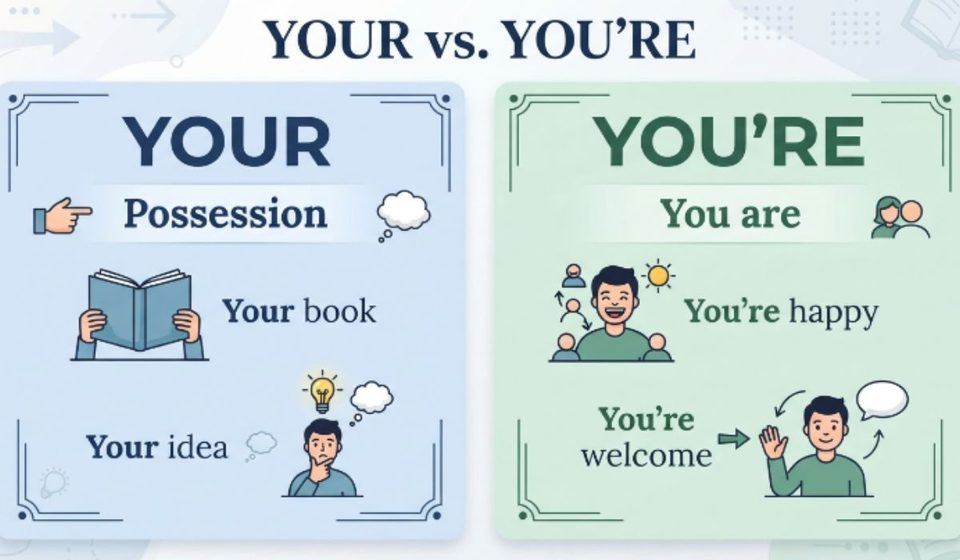
“Your” shows possession. “You’re” means “you are.”
“Your” is a possessive adjective — it tells you something belongs to, relates to, or was done by the person you’re addressing.
“You’re” is a contraction of “you” and “are,” with the apostrophe standing in for the missing letter.
They’re homophones — same sound, different spelling, different job in the sentence.
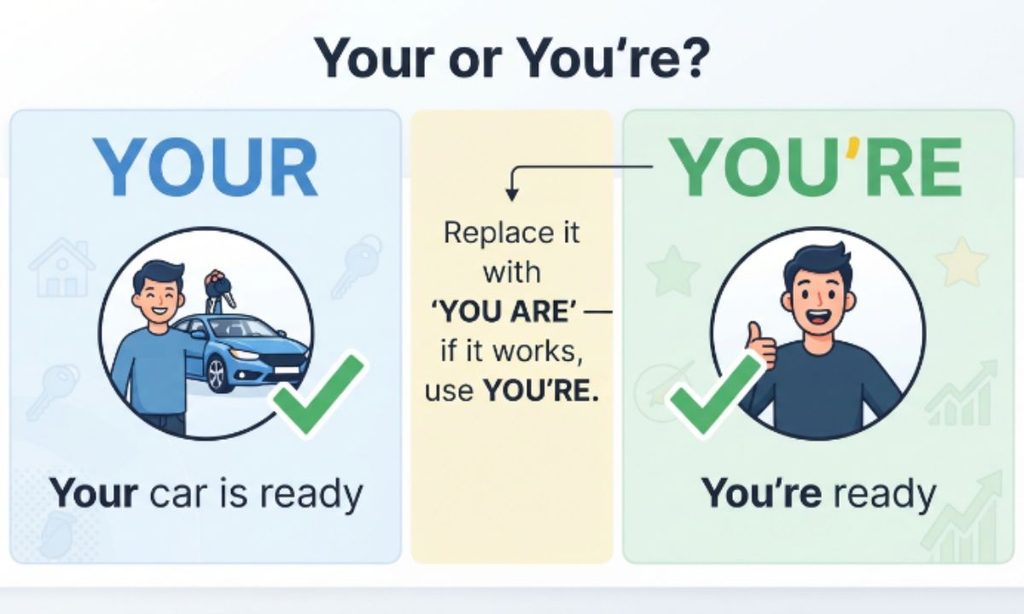
If you remember one rule, remember this: try replacing the word with “you are.” If the sentence still makes sense, use “you’re.” If it doesn’t, use “your.”
What Is the Difference Between “Your” and “You’re”?
Both words come from the same root pronoun, “you,” but they branch off in different directions.
| Feature | Your | You’re |
| Type | Possessive adjective | Contraction |
| Stands for | Belonging to you | You are |
| Followed by | A noun or gerund | An adjective, verb, or noun phrase |
| Apostrophe | None | Yes, replacing the missing “a” |
| Example | “Your bag is here.” | “You’re going to love this.” |
Because they’re pronounced exactly the same, the only way to tell them apart in writing is by checking what each one is doing in the sentence.
What Does “Your” Mean?
“Your” is a possessive adjective. It always points to something connected to the person you’re speaking to.
It can show:
- Ownership — “Is this your umbrella?”
- Relationship — “I met your brother last week.”
- Association — “Your team did a great job.”
- Something done or made by you — “Your explanation was clear.”
- A characteristic — “Your patience is impressive.”
What Part of Speech Is “Your”?
“Your” functions as a possessive adjective, also called a possessive determiner. That means it never stands alone — it always sits in front of a noun or a gerund (a verb form ending in “-ing” that acts like a noun).
- Noun example: “Your car needs gas.”
- Gerund example: “Your singing was beautiful.”
A useful check: if nothing follows “your,” something is probably missing or you’ve used the wrong word.
What Does “You’re” Mean?
“You’re” is a contraction. It squeezes “you” and “are” into one word, with an apostrophe replacing the missing “a.”
It expresses:
A state of being — “You’re tired.”
An action in progress — “You’re working hard today.”
A description of character — “You’re always so generous.”
A simple fact about the listener — “You’re the last person to arrive.”
What Part of Speech Is “You’re”?
“You’re” isn’t really its own part of speech — it’s a compressed sentence. “You” is the subject pronoun, and “are” is the verb. Put together, “you’re” carries the same grammatical weight as “you are.”
That’s why “you’re” is almost always followed by:
An adjective — “You’re brilliant.”
A present participle (-ing verb) — “You’re improving.”
A noun phrase — “You’re a good listener.”
A prepositional phrase — “You’re in trouble.”
The “You Are” Substitution Test
This is the single most reliable trick for choosing correctly, and it works every time.
Step 1: Find the word you’re unsure about. Step 2: Mentally replace it with “you are.” Step 3: Read the sentence back.
- If it still makes sense → use you’re.
- If it sounds wrong or nonsensical → use your.
Examples:
“You are welcome.” → makes sense → “You’re welcome.”
“You are car is parked outside.” → doesn’t make sense → “Your car is parked outside.”
“I hope you are enjoying the trip.” → makes sense → “I hope you’re enjoying the trip.”
“Can I borrow you are pen?” → doesn’t make sense → “Can I borrow your pen?”
This test takes two seconds once it becomes a habit, and it removes almost all guesswork.
The Noun-or-Gerund Test for “Your”
Here’s a second check that works especially well when the substitution test feels tricky.
Ask yourself: does a noun or a gerund immediately follow the word?
- “Your idea” — noun follows → correct use of “your.”
- “Your running every morning is impressive” — gerund follows → correct use of “your.”
- “Your late” — nothing meaningful follows → this should be “you’re late.”
If there’s no noun or gerund directly after the word, you likely need “you’re” instead.
How to Use “Your” in a Sentence
“Your” shows up in a wide range of sentence types. Here’s how it typically behaves:
- Before a noun: “Your phone is ringing.”
- Before a gerund: “I appreciate your helping me move.”
- In questions: “Is this your seat?”
- In negative sentences: “This isn’t your responsibility.”
- With abstract nouns: “Your confidence is growing.”
- With relationships: “How is your sister doing?”
- With opinions or feelings: “Your concerns are valid.”
How to Use “You’re” in a Sentence
“You’re” fits naturally into statements, questions, and everyday conversation.
Followed by an adjective: “You’re right.”
Followed by a verb-ing form: “You’re learning fast.”
Followed by a noun phrase: “You’re a natural leader.”
Followed by a preposition: “You’re on the right track.”
In questions: “Are you sure you’re ready?”
In negatives: “You’re not going to believe this.”
In indirect speech: “She asked if you’re coming to the party.”
“Your” vs. “You’re” in the Same Sentence
Seeing both words together often makes the rule click faster than any explanation.
“I think your idea is great, but you’re going to need more time to finish it.”
“Your effort shows, and you’re clearly improving.”
In both examples, “your” sits directly before a noun (idea, effort), while “you’re” functions as “you are,” followed by a verb or description.
Why People Confuse “Your” and “You’re”
This mix-up is one of the most common writing errors in English, and there are real reasons behind it.
They sound completely identical in speech.
The apostrophe in “you’re” gets mentally linked to possession, since apostrophes often mark ownership elsewhere (like “Sarah’s book”).
Fast typing and autocorrect don’t always catch the error.
Seeing “your” used incorrectly online normalizes the mistake over time.
The Real Role of the Apostrophe
Apostrophes do two very different jobs in English, and that dual role is the root of the confusion.
In contractions (like “you’re,” “don’t,” “can’t”), the apostrophe replaces missing letters.
In possessives (like “Sarah’s car,” “the dog’s leash”), the apostrophe shows ownership.
“Your” is the odd one out here — it shows possession without using an apostrophe at all. That’s exactly why writers mistakenly assume “you’re” must be the possessive form, when really it’s a contraction disguised by that same punctuation mark.
Explore More Grammar Guide
A Lot or Alot? Correct Spelling, Meaning, and Examples
“To Bad” or “Too Bad”: Which Spelling Is Correct?
“Your” vs. “Yours”: What’s the Difference?
This is a gap many guides skip, but it’s genuinely useful to understand.
“Your” always needs a noun right after it: “your book,” “your idea.”
“Yours” stands completely alone and replaces the noun: “This book is yours.”
Compare:
“Is that your coat?” (needs a noun — “coat”)
“Is that coat yours?” (no noun needed — “yours” replaces it)
Both show possession, but they’re structured differently. Mixing them up — writing “this is your” without a noun, or “this is yours coat” — is a smaller but related error worth watching for.
“You,” “Your,” and “You’re”: Seeing All Three Together
Since these three words share a root, it helps to line them up side by side.
You — the subject or object pronoun: “You are kind.” / “I saw you.”
Your — the possessive adjective: “Your kindness matters.”
You’re — the contraction of “you are”: “You’re kind.”
One sentence using all three: “You know your strengths, and you’re using them well.”
“Your” and “You’re” in Formal vs. Informal Writing
Both words are grammatically correct in any setting, but tone matters depending on where you’re writing.
Fine in most contexts:
- Business emails
- Blog posts
- Everyday professional writing
Worth softening in very formal writing:
- Highly formal academic papers may prefer spelling out “you are” instead of “you’re,” since contractions can read as slightly conversational.
- Legal or technical documents often avoid direct address (“you”) altogether, which sidesteps the issue entirely.
Naturally casual:
- Text messages, social captions, and chat conversations use “you’re” constantly, and that’s completely appropriate there.
Common Mistakes to Avoid
Writing “your” when you mean “you are.” “Your welcome” should be “You’re welcome.”
Writing “you’re” when showing possession. “You’re book is great” should be “Your book is great.”
Forgetting the apostrophe entirely. “Youre” is not a word — the apostrophe is required.
Adding an apostrophe to “your” by mistake. “Your’s” is incorrect; the possessive form never takes an apostrophe.
Confusing “your” with “yours.” “This is your” is incomplete without a noun, or should be “this is yours.”
Assuming autocorrect will catch it. Spellcheckers often miss this error because both words are spelled correctly — just used in the wrong place.
Quick Practice: Your or You’re?
Try these before checking the answers.
- ______ going to do great on the exam.
- I really like ______ new haircut.
- Let me know when ______ ready.
- Is this ______ jacket on the chair?
- ______ always welcome here.
Answers: 1) You’re 2) your 3) you’re 4) your 5) You’re
Frequently Asked Questions
What is the difference between “your” and “you’re”?
“Your” shows possession, while “you’re” is a contraction meaning “you are.”
Is “you’re welcome” or “your welcome” correct?
“You’re welcome” is correct, since it means “you are welcome.”
Why does “you’re” have an apostrophe?
The apostrophe replaces the missing letter “a” from “are” in the contraction “you are.”
How can I remember the difference between “your” and “you’re”?
Replace the word with “you are” — if the sentence still makes sense, use “you’re”; if not, use “your.”
Is “your” or “you’re” more formal?
Neither is inherently informal, but very formal writing sometimes spells out “you are” instead of using the contraction “you’re.”
Conclusion
The difference between “your” and “you’re” comes down to one clear rule: use “your” when you’re showing possession or connection, and use “you’re” only when it can be replaced with “you are” without changing the meaning of your sentence — run that quick substitution test whenever you’re unsure, and this common mix-up will stop tripping you up for good.



[…] Your or You’re? Difference, Meaning, and Correct Usage […]
[…] Your or You’re? Difference, Meaning, and Correct Usage […]