
You’ve typed “good morning” a hundred times, and your phone never blinked. So is it actually wrong? Here’s the thing: autocorrect isn’t a grammar teacher. The real answer is simpler than you’d think, and it comes down to two small words doing two separate jobs. Let’s clear it up for good.
Is “Good Morning” One Word or Two?
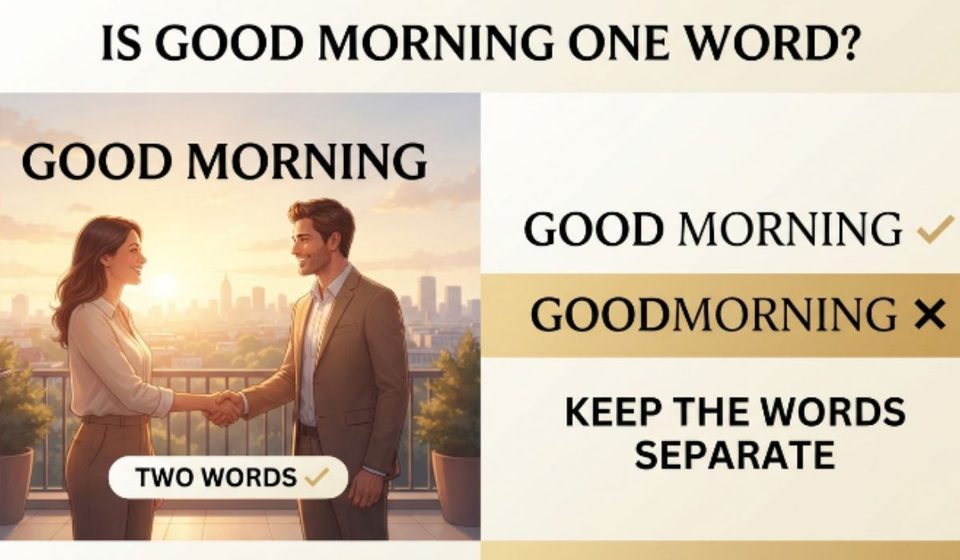
Short answer: two words. Always.
“Good morning” is never written as a single word in standard English. “Good morning” is a common typo, not an accepted spelling, no matter how often you see it in a rushed text or a comment section.
A few quick facts to settle this right away:
“Good morning” is correct in every context: formal, casual, spoken, or written
“Goodmorning” is not recognized by any major dictionary
The two-word spelling holds whether you’re writing an email or texting a friend
Casual tone changes your punctuation and capitalization, not the spelling itself
What Does “Good Morning” Actually Mean?
At its core, “good morning” is a greeting. It’s a short, friendly way of wishing someone well as the day starts.
Merriam-Webster classifies it as an interjection, meaning it’s a standalone expression used to greet someone rather than a full grammatical sentence. Think of it as part of the same family as “hello” or “hi.”
But the phrase doesn’t always work as a greeting. Its job actually shifts depending on how you use it:
As a greeting (interjection): “Good morning, Alex.” You’re saying hello.
As a noun phrase: “I had a good morning.” Here it’s describing an experience, not a greeting.
As part of a larger sentence: “She wished me a good morning.” The phrase becomes the object of the sentence.
This distinction matters because it explains why the words never merge. “Good” is doing adjective work, and “morning” is doing noun work, in every single one of these cases. Merging them would erase that structure.
Why Does “Good Morning” Stay Two Words?
English doesn’t automatically combine an adjective and a noun just because they’re used together often. It usually takes decades, sometimes centuries, of consistent use before that kind of merge happens, and even then it’s not guaranteed.
Here’s the grammar in plain terms:
- “Good” is an adjective. It describes the noun that follows.
- “Morning” is a noun. It refers to the first part of the day.
- Together, they form a phrase, not a compound word.
A simple way to test this: mentally expand the greeting to “I wish you a good morning.” That sentence only makes sense if the words stay separate. Try doing the same thing with “goodmorning,” and it falls apart immediately.
The same logic applies to its siblings:
- Good afternoon
- Good evening
- Good day
All three follow the identical pattern, and none of them get squished into one word either.
“Good Morning” vs. “Goodmorning”: Side-by-Side Comparison
Here’s a quick reference table so you never second-guess it again.
| Form | Correct? | Where you’ll see it | Why |
| Good morning | Yes | Formal and casual writing | Standard, dictionary-recognized spelling |
| good morning | Yes | Texts, casual chats | Lowercase is fine informally; spelling stays the same |
| Goodmorning | No | Typos, fast texting | Not a recognized English word |
| Good-morning | Usually no | Occasional hyphenation attempts | Ordinary greetings don’t need a hyphen |
If you’ve been typing “goodmorning” out of habit, it’s worth retraining. Most phone keyboards will keep suggesting the merged version simply because you’ve typed it that way before, not because it’s correct. Correcting it a few times in a row usually fixes the autocorrect suggestion.
How to Capitalize “Good Morning” Properly
Capitalization trips people up more than the spelling does. Here’s how it actually breaks down:
Start of a sentence: Capitalize only the first word. “Good morning, everyone.”
Email salutation: The same rule applies. “Good morning, Ms. Johnson.”
Mid-sentence: Neither word needs a capital. “She always says good morning before coffee.”
Titles or headlines: Both words may be capitalized for stylistic reasons. “Good Morning, Sunshine” on a greeting card or headline is a design choice, not a grammar rule.
A common mistake is capitalizing both words in ordinary sentence case, like writing “Good Morning, John!” in a regular text. It’s not technically incorrect in casual writing, but it’s not standard either. Save the double capitalization for titles, headlines, or stylized designs.
Punctuation: Do You Need a Comma?
Yes, almost always, when you’re greeting a specific person.
- “Good morning, Sarah.” — comma before the name
- “Good morning, everyone.” — comma before the group
- “Good morning!” — exclamation point works fine without a name attached
Skipping the comma before a name is one of the more common small errors people make. “Good morning Sarah” without the comma technically merges the greeting and the name in a way that reads slightly off, even if most readers won’t consciously notice.
Punctuation also shifts the tone:
- A period keeps it neutral and calm
- An exclamation point adds warmth or energy
- No punctuation at all (just trailing off) feels more casual, like a quick text
Explore More Grammar Guide
Vender or Vendor: Which Spelling Should You Actually Use?
Is “Goodnight” Different From “Good Morning”?
Yes, and this is where a lot of confusion starts.
“Goodnight” frequently appears as one word, especially as a farewell. “Good morning,” on the other hand, never merges this way. Here’s the comparison:
| Expression | Typical spelling | Usage |
| Good morning | Two words | Morning greeting |
| Good night | Two words (formal) | Farewell, more traditional spelling |
| Goodnight | One word (common) | Informal farewell, texts, song titles |
| Goodbye | One word | Historically merged completely |

Why the difference? “Goodnight” has drifted toward single-word status through heavy informal use over a long period, similar to how “goodbye” fully merged long ago. “Good morning” simply hasn’t followed that same path.
Dictionaries and style guides don’t treat these two greetings identically, so it’s not accurate to assume the same merging rule applies across the board. If you’re writing something formal, “good night” as two words is the safer, more traditional choice.
How to Use “Good Morning” in Different Situations
In a Professional Email
Keep it simple and properly punctuated:
- “Good morning, Ms. Johnson.”
- “Good morning, team.”
This works as a clean, professional opener before you get into the body of your message.
In a Casual Text
- “Good morning! Did you sleep okay?”
- “Good morning, running late lol”
Lowercase is completely fine here. Just don’t merge the words, even in a rushed text.
In Speech
“Morning” on its own works as a shortened, casual version. It’s common between coworkers passing in a hallway or friends who see each other daily. It’s not rude, just quicker.
In Cards and Notes
- “Wishing you a good morning and a wonderful day ahead.”
- Decorative capitalization (“Good Morning, Sunshine!”) is acceptable here since it’s a stylistic, title-like use.
“Morning” vs. “Good Morning”: Does Tone Change?
Both are grammatically fine. The real difference is warmth and context, not correctness.
“Morning” feels quick, casual, and low-effort. Common among coworkers, roommates, or people who greet each other often throughout the week.
“Good morning” feels a little warmer and more deliberate. It works well in professional settings, as the first message of the day, or when you want the greeting to feel more complete.
In dating or early-relationship texting, “good morning” often reads as more intentional or affectionate, especially with an added name or compliment, like “Good morning, gorgeous.” “Morning” alone in that same context can feel more neutral or even distant, depending on how well two people know each other.
Neither version is wrong. Choose based on the tone you’re going for, not because one is “more correct” than the other.
Common Mistakes to Avoid
- Writing “goodmorning” as one word
- Adding an unnecessary hyphen: “good-morning”
- Capitalizing both words in regular sentence case
- Forgetting the comma before a name: “Good morning John” instead of “Good morning, John”
- Assuming autocorrect suggestions confirm correct spelling
- Treating “good morning” as a standalone noun, like “my goodmorning was great” (should be “my morning was good,” or “I had a good morning”)
A Simple Way to Remember the Rule
If you ever pause mid-text wondering whether to merge the words, run through this quick mental checklist:
Expand it: “I wish you a good morning.” Still makes sense as two words? Then it stays two words.
Compare it: “Good afternoon” and “good evening” follow the same pattern, and nobody merges those.
Ignore autocorrect: it reflects your typing habits, not dictionary accuracy.
This takes about two seconds once it becomes second nature, and it’ll stop the second-guessing for good.
Frequently Asked Questions
Is “good morning” one word or two?
It’s always two words in standard English.
Is “good morning” ever considered correct?
No, it’s a common typo and isn’t recognized by major dictionaries.
Should I use a comma after “good morning” when greeting someone?
Yes, use a comma before the name, as in “Good morning, Sarah.”
Is “good night” or “goodnight” the correct spelling?
Both appear in use, but “good night” is the more traditional two-word form, while “goodnight” is common informally.
Can I say “morning” instead of “good morning”?
Yes, it’s a widely accepted, more casual shortened greeting.
Conclusion
“Good morning” is, and always has been, two separate words, an adjective paired with a noun to form a simple, friendly greeting. “Good morning” might show up constantly in fast texting and autocorrect suggestions, but it’s never the correct spelling in standard English.
Once you understand why the words stay separate, remembering the rule becomes automatic, whether you’re writing a professional email, sending a quick text, or signing a greeting card.