

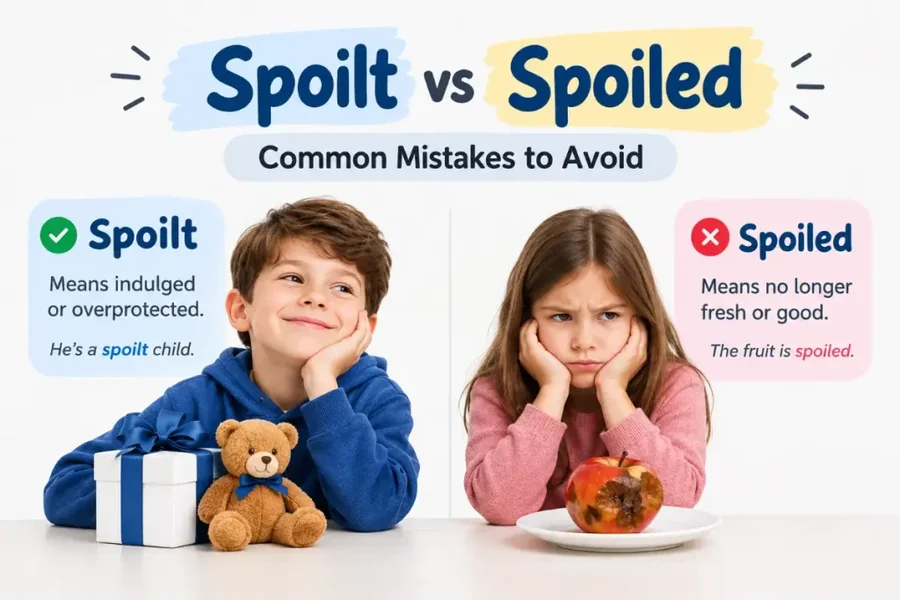
English can sometimes be confusing because two different spellings may have the same meaning. One common example is spoilt vs spoiled. Both words are used to describe something that has been damaged, ruined or affected in a negative way. They can also describe someone who receives too much attention or gets everything they want.
Although these words look different, their meanings are usually the same. The main difference is how they are used in different varieties of English. Spoiled is more common in American English while spoilt is frequently used in British English.
Understanding this difference can help you write more naturally and avoid spelling mistakes. Whether you are preparing an email, writing an article or improving your everyday communication, knowing when to use each form can make your English clearer.
This guide explains the meanings of spoilt and spoiled. It also covers their grammatical uses, pronunciation, regional differences and practical examples so you can understand both words with confidence.
1. What Does Spoilt Mean?
The word spoilt is the past tense and past participle of the verb spoil. It is commonly used in British English and several other varieties of English.
The word can have different meanings depending on the context. One common meaning is something that has become damaged or unsuitable for use. For example, food can become spoilt when it is left outside for too long or stored incorrectly.
Another meaning describes a person who receives too much attention or too many privileges. A child who always gets expensive gifts and rarely hears the word no may be described as a spoilt child.
The word can also describe an experience that has been negatively affected by something unexpected.
Consider these examples:
-
The milk has spoilt because it was not refrigerated.
-
He is a spoilt child who always expects special treatment.
-
Heavy rain spoilt our outdoor celebration.
-
The unexpected noise spoilt the peaceful atmosphere.
-
She did not want anyone to tell her the ending because it might have spoilt the film.
In each example the word communicates that something has been damaged or negatively affected.
Spoilt is particularly familiar to readers in the United Kingdom. It is also used in countries where British English has traditionally influenced education and formal writing.
Understanding this spelling is useful when communicating with British English speakers or preparing content for audiences who prefer British spelling conventions.
2. What Does Spoiled Mean?
The word spoiled is another past tense and past participle form of the verb spoil. It has the same basic meanings as spoilt but is more widely preferred in American English.
Like spoilt, spoiled can describe food that is no longer fresh or safe to consume. It can also refer to a person who has become overly demanding because of excessive attention or rewards.
The word is also used when an event or situation does not go as expected because something has negatively affected it.
Here are some examples:
-
The vegetables spoiled after several days in the refrigerator.
-
The spoiled child refused to share his toys.
-
The sudden storm spoiled our picnic.
-
A careless comment spoiled the entire conversation.
-
The broken television spoiled our movie night.
These sentences show that spoiled can be used in several everyday situations.
In American English, spoiled is the standard choice in most writing. It is common in newspapers, books, educational materials and professional communication.
However, people who use British English may also recognise and understand the word. The difference is mainly related to regional spelling preferences rather than meaning.
Spoiled is also useful when writing for an international audience because American English spelling is widely recognised across digital platforms.
3. Spoilt vs Spoiled: What Is the Main Difference?
The main difference between spoilt and spoiled is spelling. Both words come from the verb spoil and usually communicate the same idea.
The choice depends largely on the type of English you are using.
In British English, spoilt is a common alternative form. In American English, spoiled is generally preferred.
For example:
-
British English: The food has spoilt.
-
American English: The food has spoiled.
Both sentences are grammatically understandable and express the same meaning.
There is no major difference in pronunciation or meaning between the two forms. The spelling simply reflects different language conventions.
Another important point is that the word spoiled can sometimes be used as an adjective to describe a person or something that has gone bad. Spoilt can serve the same purpose.
The following table makes the difference easier to understand.
| Feature | Spoilt | Spoiled |
|---|---|---|
| Main use | British English | American English |
| Word origin | Spoil | Spoil |
| Grammar | Past tense and participle | Past tense and participle |
| Meaning | Damaged or ruined | Damaged or ruined |
| Describes behaviour | Yes | Yes |
| Describes food | Yes | Yes |
| General acceptance | Widely understood | Widely understood |
The easiest way to remember the difference is to connect spoilt with British English and spoiled with American English.
Both are correct. Your choice should depend on your target audience and writing style.
4. Different Meanings of Spoilt and Spoiled
Both words have several meanings. Understanding the context is important because the same word can describe different situations.
1. Something damaged or ruined
The first meaning relates to something that has lost its original quality or usefulness. This meaning is commonly used when discussing food or personal belongings.
Examples:
-
The hot weather spoiled the fresh vegetables.
-
The old photographs were spoilt by water.
-
The accident spoiled his new car.
2. A person who receives too much attention
Another meaning describes someone who receives excessive gifts, attention or special treatment. This usage is often associated with children.
Examples:
-
The little boy is spoiled because his parents give him everything.
-
Her grandparents have spoilt her with expensive presents.
-
Nobody enjoys spending time with a spoiled person who never appreciates anything.
3. An enjoyable experience that becomes unpleasant
Both spellings can describe something that reduces the enjoyment of an event or activity.
Examples:
-
The heavy traffic spoiled our holiday.
-
An argument spoilt the birthday celebration.
-
His negative attitude spoiled the family dinner.
4. Someone who receives special treatment
The words do not always have a negative meaning. Sometimes they describe someone who receives extra kindness or attention.
Examples:
-
I felt spoiled when my family prepared breakfast for me.
-
She was spoilt with beautiful gifts on her birthday.
-
We were spoiled by the excellent hotel service.
The meaning depends on the situation. Receiving special treatment can be positive while being excessively indulged may suggest negative behaviour.
5. Grammar Rules for Using Spoilt and Spoiled
Understanding grammar makes it easier to use both words correctly. Since they are forms of the verb spoil, they can appear in different sentence structures.
The base form is spoil. Its common grammatical forms are:
| Verb form | Word | Example |
|---|---|---|
| Base form | Spoil | Do not spoil the surprise. |
| Third-person singular | Spoils | Too much sugar spoils the taste. |
| Present participle | Spoiling | You are spoiling the experience. |
| Past tense | Spoiled / Spoilt | The rain spoiled the event. |
| Past participle | Spoiled / Spoilt | The food has spoilt. |
Using the words in the past tense
When describing something that happened in the past, either form can be used.
Examples:
-
The rain spoiled our plans.
-
The rain spoilt our plans.
Both sentences are correct.
Using the words with has or have
When describing an action that has already happened, the past participle is used.
Examples:
-
The food has spoiled.
-
The food has spoilt.
-
They have spoiled the surprise.
-
They have spoilt the surprise.
Using the words as adjectives
Spoiled and spoilt can also describe a person or an object.
Examples:
-
He is a spoiled child.
-
He is a spoilt child.
-
The spoiled milk was thrown away.
-
The spoilt food was no longer suitable for use.
One useful grammar tip is to maintain consistency throughout your writing. If you are following British English, spoilt may be a natural choice. If you are following American English, spoiled is generally preferred.
6. British English vs American English
Regional spelling is one of the most important reasons people become confused about these words.
British and American English have several spelling differences. Words such as colour and color or favourite and favorite are familiar examples.
The same general pattern applies to spoilt and spoiled.
British English
In British English, both forms are accepted. However, spoilt is particularly familiar and is commonly used as an adjective.
For example:
-
The child is spoilt.
-
The food has spoiled.
-
Our holiday was spoilt by the weather.
American English
American English generally prefers spoiled in both verb and adjective forms.
For example:
-
The child is spoiled.
-
The food has spoiled.
-
The weather spoiled our holiday.
Other English-speaking countries
Countries such as Australia, New Zealand and Canada have their own spelling conventions. British English has influenced some of these conventions while American English has also influenced modern writing.
Therefore, it is important not to assume that every country follows exactly the same spelling rules.
The best approach is to consider your audience and follow the style guide used by your school, workplace or publication.
If you are writing for a British audience, spoilt is a natural option. For an American audience, spoiled is usually the better choice.
Oxford and Cambridge dictionaries recognise both forms while identifying their regional preferences.
7. Common Mistakes When Using Spoilt and Spoiled
Even people with good English skills sometimes confuse these words. Most mistakes happen because writers do not understand the difference between regional spelling and grammatical usage.
Here are some common mistakes to avoid.
Mistake 1: Thinking spoilt is always incorrect
Some writers believe spoiled is the only correct spelling. This is not true. Spoilt is an accepted English form and is especially common in British usage.
Incorrect understanding: Spoilt is a spelling mistake.
Correct understanding: Both spellings are correct depending on the regional convention.
Mistake 2: Using different spellings without a reason
Changing between British and American spelling throughout an article can make the writing look inconsistent.
For example:
-
The food has spoilt.
-
The weather spoiled the event.
-
The child is spoilt.
These sentences are individually understandable. However, a consistent spelling style is usually better for professional writing.
Mistake 3: Confusing spoiled with spoiling
Spoiled and spoilt generally describe a completed action or a resulting condition. Spoiling describes an ongoing action.
Examples:
-
Correct: The food is spoiling.
-
Correct: The food has spoiled.
-
Correct: The food has spoilt.
Mistake 4: Assuming the words always have negative meanings
The words can describe positive experiences too.
For example:
-
I was spoiled by my friends on my birthday.
-
We were spoilt by the wonderful hospitality.
These sentences express appreciation rather than criticism.
Mistake 5: Forgetting the context
The word spoiled can describe food that has gone bad or a person who receives excessive attention. These meanings are different even though the spelling remains the same.
Reading the complete sentence helps identify the intended meaning.
8. Practical Examples and the Expression Spoilt for Choice
Examples are one of the easiest ways to understand how these words work in everyday English.
Here are some additional sentences that demonstrate their use.
Examples with spoiled:
-
The spoiled fruit was removed from the kitchen.
-
His careless behaviour spoiled the meeting.
-
My parents spoiled me with birthday gifts.
-
The unexpected rain spoiled our weekend plans.
-
She has spoiled the surprise by revealing the secret.
Examples with spoilt:
-
The spoilt child refused to listen to his teacher.
-
The beautiful garden was spoilt by rubbish.
-
We were spoilt by the restaurant’s excellent service.
-
The milk had spoilt before breakfast.
-
His rude comments spoilt the atmosphere.
There is also a popular British English expression called spoilt for choice.
This expression means having so many good options that choosing one becomes difficult.
For example:
-
Customers are spoilt for choice at this shopping centre.
-
We were spoilt for choice when selecting a holiday destination.
-
Students are spoilt for choice because the university offers many courses.
The expression is also written as spoiled for choice. Both forms can be understood, although spoilt for choice is especially associated with British English.
This expression does not suggest that someone has bad behaviour. Instead, it describes having plenty of attractive options.
Learning common expressions like this can improve your vocabulary and help you understand natural English conversations.
9. Frequently Asked Questions (FAQs)
1. Which is correct: spoilt or spoiled?
Both are correct. Spoiled is generally preferred in American English while spoilt is particularly common in British English. The choice depends on your preferred English spelling style.
2. Is spoilt British or American English?
Spoilt is mainly associated with British English. It is also understood in other English-speaking countries. American English generally prefers spoiled.
3. Is spoiled more commonly used than spoilt?
Spoiled is widely used in American English and is also accepted in British English. Spoilt is especially familiar in British writing. The more suitable option depends on your audience.
4. Do spoilt and spoiled have different meanings?
No. They generally have the same meanings. Both can describe damaged food, ruined experiences or someone who receives excessive attention and special treatment.
5. Is spoilt grammatically correct?
Yes. Spoilt is a recognised past tense and past participle form of the verb spoil. It is also used as an adjective.
6. Can I use spoiled in British English?
Yes. Spoiled is perfectly acceptable in British English. However, spoilt is also common and may be preferred in certain contexts.
7. What is the difference between a spoiled child and a spoilt child?
There is no difference in meaning. Both expressions describe a child who receives excessive attention or gets too many things without enough discipline.
8. What does spoilt for choice mean?
Spoilt for choice means having so many good options that it becomes difficult to select one. For example, someone visiting a large shopping centre may be spoilt for choice.
9. Is spoiled the past tense of spoil?
Yes. Spoiled is a standard past tense form of spoil. Spoilt is another accepted past tense form.
10. Which spelling should I use in professional writing?
Use the spelling that matches your target audience or publication’s style guide. Choose spoiled for American English and consider spoilt for British English. Most importantly, remain consistent.
10. Final Thought
Understanding spoilt vs spoiled is easier once you recognise that both words are correct forms of the verb spoil. Their main difference comes from regional spelling preferences rather than meaning.
Spoiled is the standard choice in American English. Spoilt is especially common in British English and is widely accepted in other varieties of English.
Both words can describe food that has gone bad, an experience that has been ruined or a person who receives too much attention. They can also describe someone who is treated exceptionally well.
For everyday communication, either form may be understood by English speakers. However, choosing the right spelling for your audience makes your writing more consistent and professional.
The most useful lesson is to understand the context and follow one spelling convention throughout your work. Once you learn these simple rules, you can use both words confidently in conversations, emails, articles and academic writing.
Ultimately, spoilt and spoiled are not competing words with different meanings. They are two accepted ways of writing the same word in different English traditions.
