
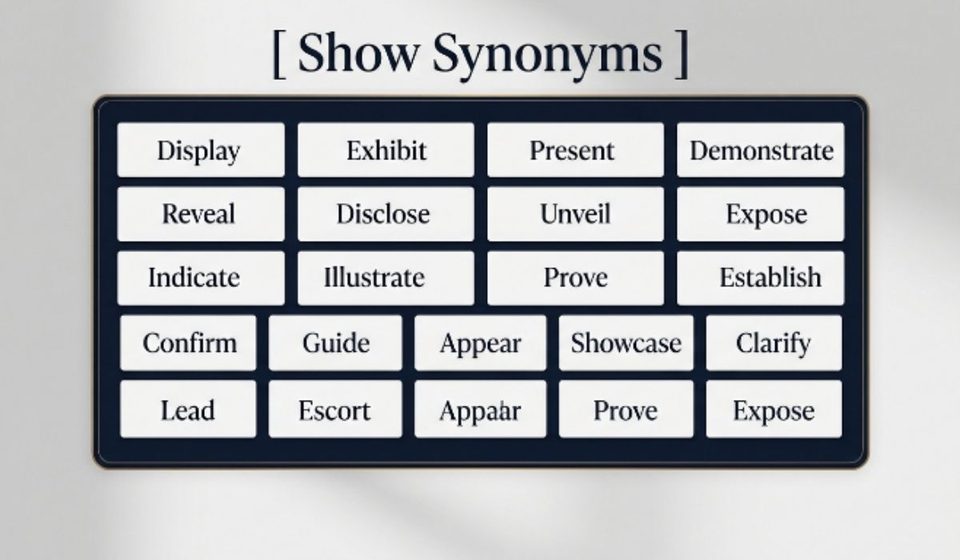

Ever caught yourself using “show” in three sentences in a row? It happens to almost every writer, because “show” is one of those words that quietly does five or six different jobs. The problem is, each job needs a different word to sound sharp. Here’s a full breakdown so you never have to reach for “show” out of habit again.
What Does “Show” Actually Mean?
“Show” isn’t one simple word. It works as both a verb and a noun, and each form carries several distinct meanings.
As a verb, it can mean:
- To display something so it can be seen
- To reveal or disclose information
- To prove or demonstrate a claim
- To explain or teach a process
- To guide or lead someone somewhere
- To appear or come into view
As a noun, it can mean an exhibition, a television program, or even a false front someone puts up to hide the truth.
That’s a lot of ground for one word to cover. Picking a more specific synonym helps your reader understand exactly which sense you mean, instead of making them guess from context.
Why “Show” Needs So Many Different Synonyms
Repetition is only part of the problem. The bigger issue is vagueness. If a report says “the data shows a trend,” a reader has to figure out whether that means “suggests,” “proves,” or “illustrates,” and those aren’t the same claim.
Swapping in the right word does two things. It removes the guesswork, and it usually makes your writing sound more confident and specific. The list below is organized by meaning, so you can jump straight to the sense you need.
Show Synonyms for Display or Make Visible
These replace “show” when something is put where people can see it.
1. Display
Meaning: Display means to put something out in the open, often intentionally, so people can view it.
It’s a neutral, widely used word that fits both casual and professional writing without sounding forced.
- The store decided to display the new arrivals near the entrance.
- She likes to display family photos on the mantel.
When It Fits: Retail, home decor, or general visibility contexts.
2. Exhibit
Meaning: Exhibit means to formally present something for public viewing, often in an artistic, academic, or evidentiary setting.
It carries more weight than “display,” suggesting the item deserves attention or scrutiny.
- The museum will exhibit rare manuscripts next spring.
- Lawyers exhibit physical evidence during the trial.
When It Fits: Art, legal, or academic contexts.
3. Present
Meaning: Present means to formally bring something forward for an audience or a specific person to see or consider.
It suggests intention and structure, which makes it useful when the moment matters.
- She will present her findings at the conference next week.
- He presented the proposal to the entire leadership team.
When It Fits: Business meetings, presentations, or formal introductions.
4. Showcase
Meaning: Showcase means to feature something in a way designed to highlight its best qualities.
It adds a promotional tone, useful when the goal is to impress rather than simply inform.
- The gallery will showcase local artists this weekend.
- Her portfolio showcases years of design experience.
When It Fits: Marketing, portfolios, or promotional writing.
5. Unveil
Meaning: Unveil means to reveal something new or previously hidden, often with a sense of occasion.
It works well when the reveal itself is the newsworthy part of the sentence.
- The company will unveil its latest product next month.
- They unveiled the memorial in front of a large crowd.
When It Fits: Product launches, announcements, or ceremonies.
6. Expose
Meaning: Expose means to make something visible that was previously hidden, often carrying a negative or revealing tone.
It signals that something concealed, sometimes deliberately, is now out in the open.
- The investigation exposed serious flaws in the system.
- Sunlight exposed the cracks in the old paint.
When It Fits: Investigative writing or uncovering hidden problems.
Show Synonyms for Reveal or Make Known
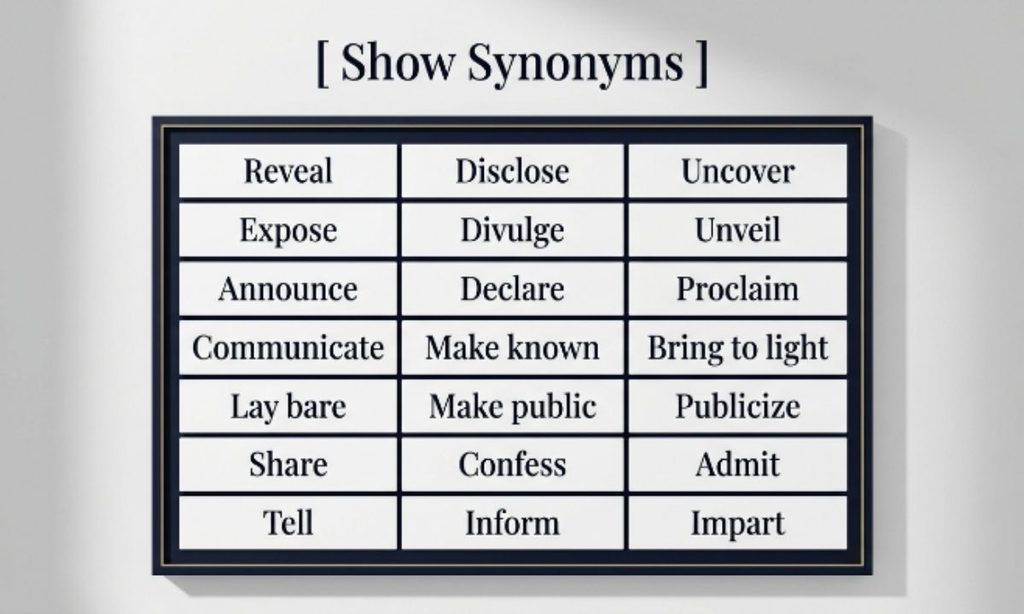
These replace “show” when information, feelings, or facts become known.
7. Reveal
Meaning: Reveal means to make something known that wasn’t known before, often information or a fact.
It’s a clean, versatile word that fits almost any context needing disclosure.
- The report reveals a sharp increase in customer complaints.
- She finally revealed the reason behind her decision.
When It Fits: News writing, storytelling, or general disclosure.
8. Disclose
Meaning: Disclose means to formally share information that was previously private or confidential.
It has a more official tone than “reveal,” often implying an obligation to share.
- The company must disclose any financial risks to investors.
- He disclosed his conflict of interest before the vote.
When It Fits: Legal, financial, or corporate communication.
9. Uncover
Meaning: Uncover means to discover and bring to light something that was hidden or unknown.
It suggests effort or investigation, not just casual disclosure.
- Researchers uncovered new evidence about the ancient settlement.
- The audit uncovered several accounting errors.
When It Fits: Research, journalism, or investigative contexts.
10. Divulge
Meaning: Divulge means to share information, often something sensitive, that was meant to stay private.
It carries a slightly formal or cautious tone, useful when secrecy was expected.
- She refused to divulge the identity of her source.
- He divulged the company’s plans during the interview.
When It Fits: Formal writing involving secrecy or sensitive information.
11. Manifest
Meaning: Manifest means to become clearly visible or apparent, usually through an outward sign.
It leans formal and abstract, often used for feelings, symptoms, or qualities rather than physical objects.
- Her anxiety began to manifest in small physical habits.
- The problem manifested itself during the final testing phase.
When It Fits: Academic, medical, or psychological writing.
12. Betray
Meaning: Betray, in this sense, means to unintentionally reveal a feeling or thought through expression or behavior.
It captures a subtle, involuntary kind of revealing that “show” alone doesn’t emphasize.
- His voice betrayed his nervousness during the interview.
- Her expression betrayed a flicker of doubt.
When It Fits: Creative writing or describing subtle emotional cues.
Show Synonyms for Prove or Demonstrate
These replace “show” when evidence supports a claim.
13. Demonstrate
Meaning: Demonstrate means to make something clear through evidence, explanation, or a practical example.
It’s one of the most versatile academic and professional alternatives to “show.”
- The study demonstrates a clear link between sleep and focus.
- She demonstrated the new software to the whole team.
When It Fits: Reports, research papers, or presentations.
14. Prove
Meaning: Prove means to establish something as true beyond doubt, using solid evidence or logic.
It’s a stronger claim than “demonstrate,” so use it only when the evidence is conclusive.
- The results prove the theory was correct all along.
- He proved his innocence with a clear alibi.
When It Fits: Formal arguments or conclusive findings.
15. Establish
Meaning: Establish means to demonstrate something firmly enough that it becomes accepted as fact or standard.
It works well when the goal is long-term acceptance, not just a single instance of proof.
- The report establishes a clear connection between diet and health.
- The company established its reputation over two decades.
When It Fits: Formal writing, research, or long-term claims.
16. Substantiate
Meaning: Substantiate means to support a claim with solid evidence or documentation.
It’s a precise, formal word, useful when you need to signal that a claim isn’t just assumed.
- The lawyer substantiated her argument with witness testimony.
- He couldn’t substantiate the rumor with any facts.
When It Fits: Legal, academic, or fact-checking contexts.
17. Verify
Meaning: Verify means to confirm that something is true or accurate, often through checking or testing.
It emphasizes the process of confirmation rather than the original claim itself.
- The team verified the results before publishing the study.
- Please verify your identity before continuing.
When It Fits: Technical, security, or fact-checking writing.
18. Confirm
Meaning: Confirm means to state or show that something is true, often removing doubt about an earlier claim.
It’s simple and direct, fitting both formal and everyday writing.
- The test results confirm what the doctor suspected.
- She confirmed the meeting time by email.
When It Fits: General writing, emails, or everyday confirmations.
Show Synonyms for Explain or Teach
These replace “show” when someone helps another person understand something.
19. Explain
Meaning: Explain means to make an idea, process, or situation understandable through words.
It’s the most direct, widely applicable alternative when teaching through description rather than action.
- She explained the new policy during the staff meeting.
- Can you explain how this feature works?
When It Fits: Everyday communication or instructional writing.
20. Illustrate
Meaning: Illustrate means to clarify a point using an example, comparison, or visual aid.
It works well when the goal is to make something concrete rather than purely proving it.
- The chart illustrates how sales changed over the year.
- He used a simple analogy to illustrate the concept.
When It Fits: Educational content, reports, or presentations.
21. Instruct
Meaning: Instruct means to give someone clear, authoritative directions on how to do something.
It carries more formality than “explain,” often implying a structured lesson or command.
- The manual instructs users to restart the device first.
- She instructed the new hires on safety procedures.
When It Fits: Manuals, training materials, or formal directions.
22. Coach
Meaning: Coach means to guide someone through learning a skill, usually through ongoing support and correction.
It adds a personal, encouraging tone that “instruct” or “explain” don’t carry.
- He coached the intern through her first client call.
- She coaches new employees on public speaking.
When It Fits: Mentorship, training, or skill-building contexts.
23. Clarify
Meaning: Clarify means to make a confusing point easier to understand by removing ambiguity.
It’s especially useful when the issue is confusion, not lack of information.
- Let me clarify what I meant by that comment.
- The teacher clarified the assignment instructions after questions came up.
When It Fits: Correcting misunderstandings or simplifying complex points.
24. Walk Through
Meaning: Walk through means to explain something step-by-step, often in a hands-on or sequential way.
It signals patience and structure, which is useful for complex or unfamiliar tasks.
- Let me walk you through the setup process.
- She walked the client through each stage of the contract.
When It Fits: Tutorials, onboarding, or technical support.
Show Synonyms for Guide or Lead
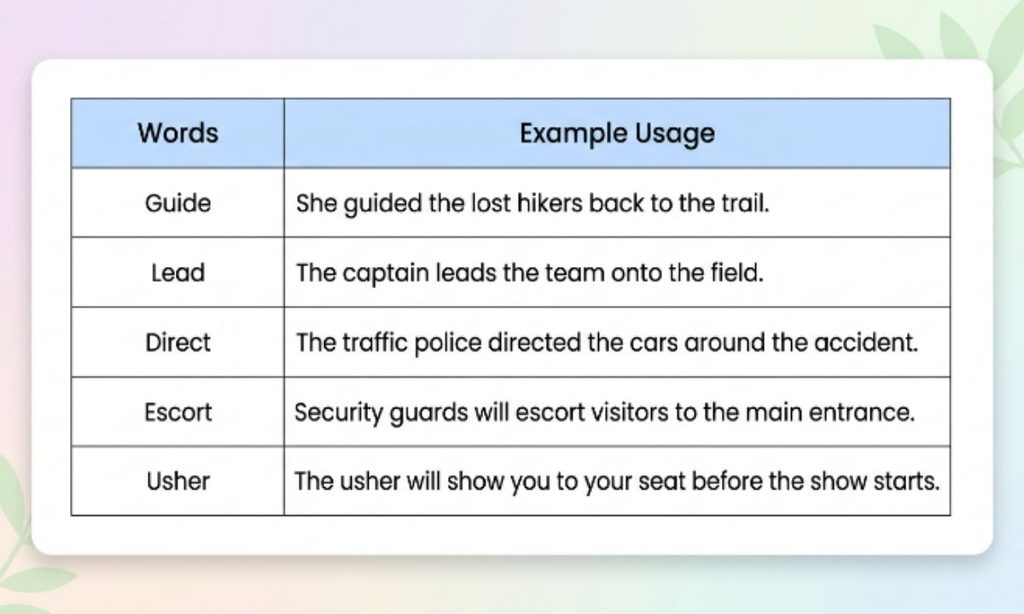
These replace “show” when someone leads another person somewhere.
25. Guide
Meaning: Guide means to lead someone while offering direction, advice, or assistance along the way.
It suggests care and support, not just directions.
- She guided the new employees through their first week.
- The ranger guided the group along the trail.
When It Fits: Mentorship, tours, or supportive leadership.
26. Lead
Meaning: Lead means to go ahead of someone and direct their path or actions.
It’s a simple, strong word that works in both literal and figurative situations.
- He led the team through a difficult project.
- She led us straight to the meeting room.
When It Fits: General leadership or physical direction.
27. Escort
Meaning: Escort means to accompany someone, often for safety, courtesy, or formality.
It adds a layer of responsibility, suggesting protection or official duty.
- Security escorted the visitor to the main office.
- He offered to escort her to the car after the event.
When It Fits: Formal, safety-related, or courteous situations.
28. Usher
Meaning: Usher means to formally direct someone to a specific place, often a seat or entrance.
It’s associated with hospitality and events, giving it a polished, service-oriented feel.
- The staff ushered guests to their tables.
- She was ushered into the waiting room.
When It Fits: Events, ceremonies, or hospitality settings.
29. Direct
Meaning: Direct means to point someone toward the correct path, action, or decision.
It’s efficient and neutral, useful when the focus is on giving clear instructions quickly.
- The officer directed traffic around the accident.
- She directed him to the correct department.
When It Fits: Quick instructions or logistical guidance.
30. Conduct
Meaning: Conduct means to formally lead someone through a place or process, often with structure or ceremony.
It reads as more official than “lead,” fitting formal or organized settings.
- The guide conducted us through the historic building.
- She conducted the interview with careful precision.
When It Fits: Formal tours, interviews, or structured processes.
Show Synonyms for Appear or Come Into View
These replace “show” when something becomes visible or arrives.
31. Appear
Meaning: Appear means to become visible or noticeably come into existence.
It’s a simple, flexible word that fits nearly any context involving visibility.
- A strange light appeared on the horizon.
- She appeared at the door just as we were leaving.
When It Fits: General storytelling or descriptive writing.
32. Emerge
Meaning: Emerge means to come out from concealment, obscurity, or a process into open view.
It suggests a gradual or significant transition, not just sudden visibility.
- New evidence emerged during the second investigation.
- The hikers emerged from the forest just before dark.
When It Fits: Gradual developments or dramatic reveals.
33. Show Up
Meaning: Show up means to arrive somewhere, often used casually to describe attendance or presence.
It’s informal and direct, useful in everyday speech and writing.
- He showed up late to the meeting again.
- She showed up with coffee for the whole team.
When It Fits: Casual conversation about attendance or arrival.
34. Materialize
Meaning: Materialize means to appear suddenly or unexpectedly, often used for something that seemed uncertain before.
It adds a slightly dramatic tone, useful when the appearance feels surprising.
- The opportunity materialized just when we needed it most.
- A solution finally materialized after weeks of testing.
When It Fits: Describing unexpected outcomes or sudden developments.
35. Surface
Meaning: Surface means for something to become known or visible after being hidden or unnoticed.
It works especially well for information, memories, or issues that resurface over time.
- New details surfaced after the initial report was published.
- Old tensions surfaced during the family gathering.
When It Fits: Slow-building reveals or resurfacing issues.
36. Arrive
Meaning: Arrive means to reach a destination or point, often used for people, events, or conclusions.
It’s a plain, dependable word that works in both literal and figurative contexts.
- The guests arrived right on time.
- The committee finally arrived at a decision.
When It Fits: Straightforward arrival or conclusion.
Show Synonyms for a False Appearance or Pretense
These replace the noun “show” when it means a fake or misleading front.
37. Pretense
Meaning: Pretense means a false reason or appearance used to hide the real truth.
It signals intentional deception, which makes it useful in contexts involving dishonesty.
- He agreed to the meeting under the pretense of discussing budgets.
- Their friendliness turned out to be nothing but pretense.
When It Fits: Describing insincere motives or hidden intentions.
38. Facade
Meaning: Facade means an outward appearance that hides the true nature of something underneath.
It’s often used for people or situations that look fine on the surface but aren’t.
- Behind the calm facade, she was completely overwhelmed.
- The company’s success was largely a facade.
When It Fits: Describing appearances that don’t match reality.
39. Sham
Meaning: Sham means something fake presented as genuine, often used to describe a deceptive event, product, or claim.
It carries a stronger, more critical tone than “pretense” or “facade.”
- The investigation revealed the charity was a complete sham.
- Critics called the trial a sham from the start.
When It Fits: Strong criticism of fraudulent situations.
40. Charade
Meaning: Charade means an obvious pretense that fools no one, often used when the deception is transparent.
It works well when the falseness is almost comical or painfully clear.
- Everyone in the room could see through the charade.
- The polite conversation felt like a charade after everything that happened.
When It Fits: Describing an unconvincing act or obvious pretense.
41. Front
Meaning: Front means an outward identity or appearance used to disguise the real situation, often in a business or criminal context.
It’s a compact, versatile word for describing cover stories or disguises.
- The shop was just a front for illegal activity.
- He put up a brave front despite the bad news.
When It Fits: Describing disguises, cover-ups, or emotional masking.
42. Guise
Meaning: Guise means an outward appearance adopted to conceal true identity, purpose, or intention.
It’s slightly formal and often used with “under the guise of” to describe hidden motives.
- The scam operated under the guise of a charity fundraiser.
- He approached her under the guise of asking for directions.
When It Fits: Formal or narrative writing about disguised intentions.
Formal vs. Informal Alternatives
| Register | Good Choices |
| Formal | Demonstrate, substantiate, establish, disclose, manifest |
| Neutral | Display, reveal, explain, present, indicate |
| Informal | Show up, point out, lay out, turn up |
This is a quick gut check before you finalize a sentence. If you’re writing a report, lean formal. If you’re texting a coworker, the informal column reads more naturally.
Fixing Weak “Show” Phrasing
Two phrases show up constantly in writing, and both can usually be sharpened.
“The data shows…” → The data indicates, suggests, confirms, or reveals
“This shows that…” → This suggests, establishes, illustrates, or confirms that
Neither swap is automatic. “Indicates” is softer than “proves,” so match the word to how strong your evidence actually is.
Common Phrases That Use “Show”
A few expressions with “show” work fine as idioms and don’t need replacing:
- Show up – arrive somewhere
- Show off – display something in a boastful way
- Steal the show – attract more attention than anyone else
- For show – done only for appearance, not sincerity
- Run the show – be in charge of an operation
Frequently Asked Questions
What is a formal synonym for “show” in academic writing?
Use “demonstrate,” “establish,” or “substantiate” for a more formal, evidence-based tone.
What’s the difference between “show” and “reveal”?
“Show” is neutral and general, while “reveal” implies something was previously hidden or unknown.
What’s a good alternative for “the data shows”?
Try “the data indicates,” “suggests,” or “confirms,” depending on how strong the evidence is.
Is “exhibit” the same as “show”?
“Exhibit” is more formal and typically used for public, artistic, or evidentiary display rather than everyday use.
What’s another word for a fake show or pretense?
“Facade,” “sham,” or “charade” all work well to describe a false or misleading appearance.
Conclusion
“Show” covers a lot of ground, from putting something on display to proving a claim to leading someone down a hallway. That range is exactly why one word rarely does the job well in careful writing. Use this list to match your sentence to the sense you actually mean, and your writing will read more precisely every time.

[…] 42 Show Synonyms: Better Words for Every Meaning and Context […]