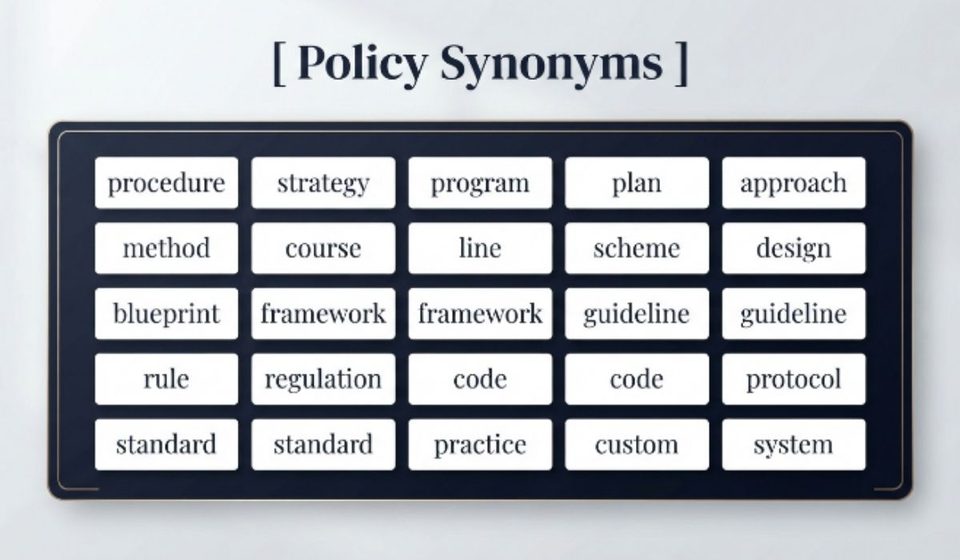

You’ve written “policy” four times in the same memo and it’s starting to sound like a form letter. The word does a lot of heavy lifting in business and government writing, which is exactly why it gets repetitive fast. There are dozens of sharper alternatives sitting right next to it, each one built for a slightly different job.
What “Policy” Actually Means
“Policy” isn’t one idea. It stretches across three distinct meanings, and knowing which one you’re using changes which synonym will actually work.
Policy as an Official Plan or Course of Action
This is the sense you meet every day: company policy, government policy, return policy. It describes a set way of doing things, agreed on ahead of time and applied consistently. This is where almost all of the synonyms in this guide live.
Policy as Good Judgment (Older Sense)
Older texts use “policy” to mean prudence or sound judgment, as in “you should have exercised more policy in that decision.” You’ll rarely see this sense today outside of literature, but it explains why some dictionaries list words like “discretion” and “wisdom” as synonyms.
Policy as an Insurance Document
“Insurance policy” is its own fixed phrase. Nobody swaps “policy” out here, since the word is doing legal, contractual work. It’s worth knowing this sense exists, but it doesn’t need a synonym list of its own.
Why It’s Worth Knowing Alternatives to “Policy”
There are three practical reasons to build a bigger vocabulary here:
Precision: “Policy,” “procedure,” and “regulation” are not interchangeable. Using the exact word avoids confusion about whether something is a suggestion or a rule.
Variety: Legal, HR, and government documents repeat “policy” constantly. A varied vocabulary keeps writing readable instead of monotonous.
Tone control: “Guideline” sounds softer than “mandate.” Choosing the right word can shift how strict or flexible a document feels, even before anyone reads the fine print.
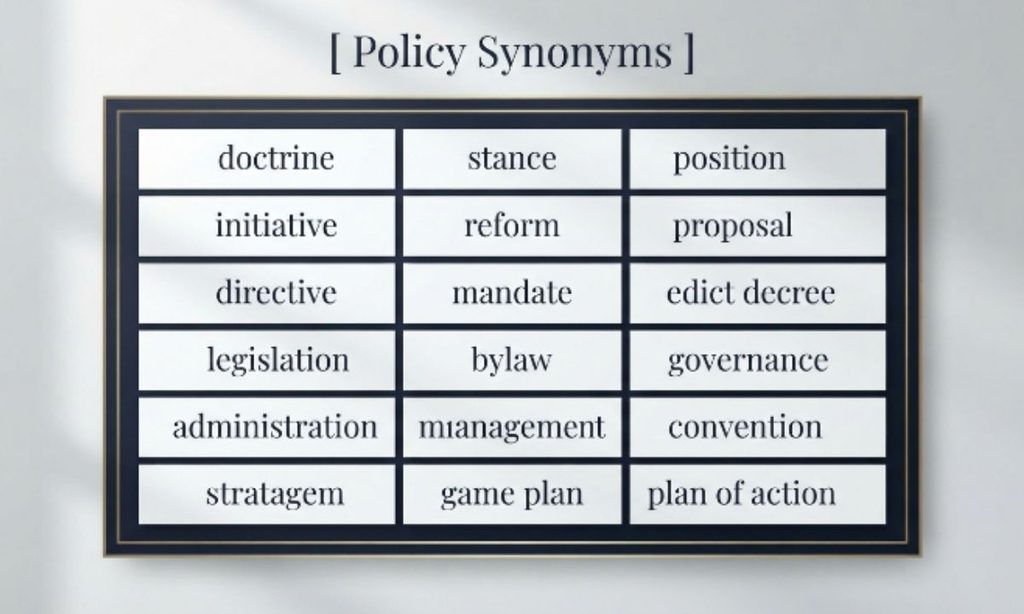
35 Alternatives to “Policy” (With Examples and Best Use)
Procedure
Meaning: A defined, step-by-step way of carrying out a task. Where “policy” states the rule, “procedure” explains how to follow it. It gives readers something concrete to act on, which builds trust that instructions were actually thought through rather than left vague.
Examples:
- The new hire had to complete the onboarding procedure before her first shift.
- Our return procedure requires a receipt and the original packaging.
When It Fits: Employee handbooks, operations manuals, and any document that walks someone through specific steps.
Strategy
Meaning: A high-level plan aimed at a long-term goal, rather than a fixed rule. “Strategy” signals direction and intent, which makes a plan feel purposeful instead of arbitrary. It works well when you want to show that decisions are tied to a bigger picture.
Examples:
- The company’s pricing strategy shifted after the market downturn.
- Our marketing strategy focuses on repeat customers rather than new ones.
When It Fits: Business plans, leadership discussions, and anywhere long-term direction matters more than day-to-day rules.
Plan
Meaning: A simple, general word for an intended course of action. “Plan” is plainer and more approachable than “policy,” which makes it useful when you want a document to feel less bureaucratic.
Examples:
- The city released its transportation plan for the next decade.
- We have a plan in place for handling customer complaints.
When It Fits: Casual or internal communication where formal language would feel stiff.
Approach
Meaning: The general way someone tackles a problem or situation, without necessarily being formalized into a rule. It’s a softer word that leaves room for judgment, which can make a message feel more collaborative than commanding.
Examples:
- Our approach to remote work has changed since the pandemic.
- The teacher’s approach to discipline is calm and consistent.
When It Fits: Discussions about mindset or method rather than fixed regulations.
Method
Meaning: A specific, repeatable way of doing something, usually more technical or precise than “approach.” It works well when accuracy and consistency matter more than flexibility.
Examples:
- The lab follows a strict method for testing water samples.
- Our billing method hasn’t changed in five years.
When It Fits: Technical, scientific, or process-heavy writing.
Guideline
Meaning: A recommended, non-binding suggestion for how to act. “Guideline” carries less weight than “policy” and signals flexibility rather than a hard rule. It communicates trust in the reader’s judgment while still offering direction.
Examples:
- The dress code is more of a guideline than a strict rule.
- Follow the safety guidelines when operating this equipment.
When It Fits: Anywhere you want to advise rather than mandate.
Rule
Meaning: A specific, enforceable instruction, usually one part of a larger policy. It’s blunt and direct, which makes it clear and hard to misread.
Examples:
- The house rule is no shoes past the front door.
- Company rules require badges to be visible at all times.
When It Fits: Short, specific instructions that leave no room for interpretation.
Regulation
Meaning: A formal, often legally enforceable rule set by an authority. “Regulation” carries more legal weight than “policy” and implies real consequences for non-compliance. It signals seriousness and accountability.
Examples:
- New safety regulations went into effect this year.
- The factory failed to meet environmental regulations.
When It Fits: Legal, compliance, or government contexts where enforcement matters.
Protocol
Meaning: A precise, often official set of steps followed in a specific situation, especially in technical, medical, or diplomatic settings. “Protocol” implies exactness and consequences for skipping steps.
Examples:
- The hospital follows a strict protocol for handling emergencies.
- Diplomatic protocol required a formal greeting first.
When It Fits: Medical, technical, or ceremonial situations where precision is critical.
Standard
Meaning: A benchmark or expected level of quality or behavior. “Standard” focuses on the outcome expected rather than the steps to get there, which gives it a results-oriented feel.
Examples:
- The company holds every vendor to the same quality standard.
- Safety standards vary from country to country.
When It Fits: Quality control, industry benchmarks, and performance expectations.
Practice
Meaning: A habitual or customary way of doing something, whether formally written down or not. “Practice” feels grounded in real experience rather than theory, which gives it a practical, trustworthy tone.
Examples:
- It’s standard practice to confirm appointments a day in advance.
- Best practice suggests backing up files weekly.
When It Fits: Industry norms and everyday routines that aren’t strictly enforced rules.
Framework
Meaning: A structured system of rules or ideas that supports decision-making without dictating every detail. “Framework” suggests flexibility within boundaries, which appeals to readers who want structure without feeling boxed in.
Examples:
- The new framework gives managers room to make local decisions.
- Our ethical framework guides how we handle client data.
When It Fits: Complex situations that need structure but also room for judgment.
Blueprint
Meaning: A detailed plan meant to be followed closely, borrowed from architecture. “Blueprint” implies careful design and forethought, giving a plan a sense of craftsmanship and intention.
Examples:
- The report offers a blueprint for reducing city traffic.
- Their business blueprint focuses on slow, sustainable growth.
When It Fits: Ambitious plans that need to sound carefully designed rather than improvised.
Directive
Meaning: An official instruction issued from a position of authority, usually expecting immediate compliance. “Directive” is more commanding than “policy,” making clear that this isn’t optional.
Examples:
- Management issued a directive requiring all reports by Friday.
- The court’s directive changed how the agency processes claims.
When It Fits: Top-down instructions where compliance isn’t up for discussion.
Mandate
Meaning: An authoritative order or requirement, often tied to a legal or official source. “Mandate” carries a sense of obligation stronger than most other words on this list.
Examples:
- The vaccine mandate applied to all hospital staff.
- Voters gave the new mayor a clear mandate for reform.
When It Fits: Legal, governmental, or clearly authorized requirements.
Doctrine
Meaning: A formal set of beliefs or principles that guides action, often used in political, religious, or military contexts. “Doctrine” implies a deeper ideological foundation than a simple rule.
Examples:
- The country’s foreign policy follows a doctrine of non-intervention.
- Company doctrine discourages public criticism of competitors.
When It Fits: Ideological, political, or deeply held institutional beliefs.
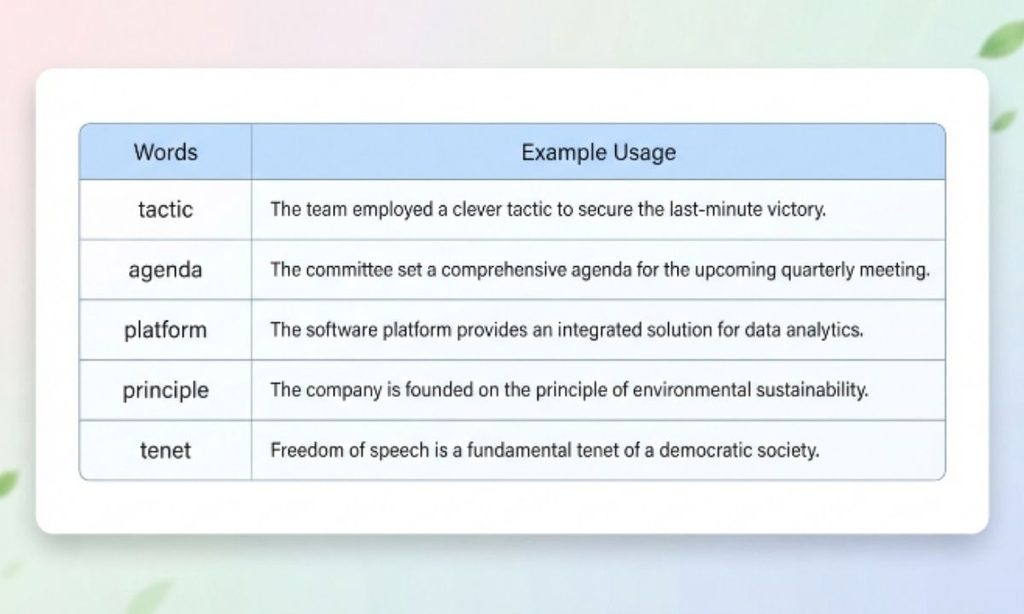
Principle
Meaning: A fundamental truth or rule that shapes behavior, often unwritten but widely respected. “Principle” gives a decision moral or ethical weight rather than just procedural weight.
Examples:
- Honesty is a core principle at this company.
- We operate on the principle that customers come first.
When It Fits: Ethical or values-based writing rather than procedural documents.
Stance
Meaning: A position taken on a particular issue, often used in debates or public discussions. “Stance” communicates opinion and commitment rather than a formal rule.
Examples:
- The council’s stance on new development has softened recently.
- Our stance on remote work hasn’t changed since 2022.
When It Fits: Public statements, debates, or opinion-driven contexts.
Position
Meaning: Similar to “stance,” describing an official viewpoint or decision on an issue. It’s slightly more formal and neutral than “stance.”
Examples:
- The committee’s position on funding remains unclear.
- We’ve taken a firm position against outsourcing support.
When It Fits: Formal statements summarizing an organization’s view.
Code
Meaning: A structured, often written set of rules governing conduct, frequently tied to ethics or professional behavior. “Code” implies a complete, organized system rather than a single rule.
Examples:
- Every employee signs the company’s code of conduct.
- The building must meet local fire code requirements.
When It Fits: Ethics, conduct, and construction or safety contexts.
Law
Meaning: A rule created and enforced by a governing authority, with legal consequences for violation. “Law” carries the strongest weight of any word here, since breaking it has formal repercussions.
Examples:
- The new law requires seatbelts in the back seat.
- It’s against the law to drive without insurance.
When It Fits: Government and legal writing where enforcement is guaranteed.
Legislation
Meaning: A body of laws formally passed by a governing body. “Legislation” is more institutional than “law,” pointing to the process of lawmaking itself.
Examples:
- The legislation passed after months of debate.
- New legislation will affect how schools handle student data.
When It Fits: Political and governmental writing about the lawmaking process.
Bylaw
Meaning: A rule adopted by an organization to govern its own internal affairs, common in associations, clubs, and local governments. “Bylaw” signals a smaller, self-governed scope than national law.
Examples:
- The homeowners’ association updated its bylaws last spring.
- City bylaws restrict parking on this street overnight.
When It Fits: Local, organizational, or association-level rules.
Governance
Meaning: The overall system or process by which an organization is directed and controlled. “Governance” points to the structure behind decision-making, not a single rule.
Examples:
- Strong governance kept the nonprofit financially stable.
- Corporate governance standards have tightened since the scandal.
When It Fits: Discussions about leadership structure and oversight.
Standard Operating Procedure (SOP)
Meaning: A documented, repeatable process used to ensure consistency, common in operations and manufacturing. “SOP” signals precision and reliability, especially in technical settings.
Examples:
- The warehouse follows an SOP for every incoming shipment.
- Update the SOP whenever equipment changes.
When It Fits: Operations, manufacturing, and process documentation.
Game Plan
Meaning: An informal way to describe a strategy, often used in casual business or sports-influenced language. It feels energetic and action-oriented rather than bureaucratic.
Examples:
- We need a game plan before the client call tomorrow.
- Her game plan for the launch was simple but effective.
When It Fits: Informal meetings, pep talks, or casual planning discussions.
Initiative
Meaning: A new plan or effort launched to achieve a specific goal, often implying fresh energy or a starting point. “Initiative” suggests momentum and forward motion.
Examples:
- The city launched a new recycling initiative this month.
- Our diversity initiative has already changed hiring practices.
When It Fits: New programs or efforts being introduced.
Measure
Meaning: A specific action taken to achieve a result, often in response to a problem. “Measure” implies a deliberate, targeted step rather than a broad rule.
Examples:
- The government introduced new measures to curb inflation.
- Safety measures were added after the accident.
When It Fits: Responses to specific problems or emergencies.
Proposal
Meaning: A suggested plan or course of action, not yet finalized or approved. “Proposal” signals that a decision is still open, which invites discussion rather than compliance.
Examples:
- The budget proposal will be reviewed next week.
- Her proposal for flexible hours got approved.
When It Fits: Early-stage plans still under consideration.
Agenda
Meaning: A set of goals or priorities an individual or group intends to pursue. “Agenda” can be neutral or slightly loaded, often implying a broader, sometimes political intent.
Examples:
- Climate change topped the summit’s agenda.
- The new CEO has an ambitious agenda for growth.
When It Fits: Political, organizational, or meeting-focused writing.
Platform
Meaning: A public statement of goals or principles, especially in political contexts. “Platform” implies something meant to be shared and campaigned on, not just followed internally.
Examples:
- The candidate’s platform focused on affordable housing.
- The party’s platform hasn’t changed much in a decade.
When It Fits: Political campaigns and public declarations of intent.
Custom
Meaning: A long-established practice, often unwritten, followed because of tradition rather than formal instruction. “Custom” carries a sense of history and shared habit.
Examples:
- It’s local custom to greet shopkeepers before browsing.
- Company custom is to celebrate work anniversaries with lunch.
When It Fits: Cultural or traditional practices without formal enforcement.
System
Meaning: An organized set of rules or methods working together toward a common purpose. “System” emphasizes structure and interconnection rather than a single rule.
Examples:
- The new filing system saves everyone time.
- Our grading system rewards improvement, not just results.
When It Fits: Descriptions of interconnected processes rather than isolated rules.
Tenet
Meaning: A core belief or principle held by a group, often central to its identity. “Tenet” gives a rule philosophical or ideological weight.
Examples:
- Transparency is a key tenet of our business model.
- One tenet of the movement is nonviolent protest.
When It Fits: Ideological, philosophical, or values-driven writing.
Convention
Meaning: An accepted, widely followed way of doing something, often based on tradition rather than formal rule-making. “Convention” implies broad agreement rather than top-down authority.
Examples:
- It’s convention to knock before entering an office.
- Naming conventions vary between programming languages.
When It Fits: Widely accepted norms rather than enforced rules.
Antonyms Worth Knowing
Sometimes the clearest word is the opposite of “policy” entirely.
| Sense | Antonyms |
| Plan/Order | disorganization, chaos, randomness, inconsistency |
| Judgment/Prudence | indiscretion, recklessness, carelessness, thoughtlessness |
How to Choose the Right Word
Three questions narrow the choice fast:
Is it enforceable? Use “law,” “regulation,” or “mandate” for anything with real consequences. Use “guideline” or “practice” when compliance is optional.
Is it new or established? “Initiative” and “proposal” suit fresh plans. “Custom” and “convention” suit long-standing habits.
Who’s the audience? Legal and government writing favors “regulation,” “directive,” and “legislation.” Internal business writing often works better with “procedure,” “approach,” or “framework.”
A simple test: if removing the word would change whether someone could get in trouble, reach for a stronger term like “regulation” or “mandate.” If not, a softer word like “guideline” or “practice” usually fits better.
Frequently Asked Questions
What is another word for policy?
“Procedure,” “guideline,” and “regulation” are common substitutes, chosen based on how formal or enforceable the rule is.
What is the difference between policy and procedure?
A policy states the rule or intent, while a procedure explains the specific steps for following it.
What is the difference between policy and regulation?
A policy is often set internally by an organization, while a regulation is typically imposed and enforced by a governing authority.
What is a synonym for company policy?
“Internal guideline,” “company procedure,” or “organizational rule” all work well in place of “company policy.”
What’s a softer word for policy when writing internal guidance?
“Guideline” or “practice” both suggest recommended behavior rather than a strict, enforceable rule.
Final Thought
“Policy” is a workhorse word, but it can’t carry every sentence on its own without starting to feel repetitive or vague. Once you separate the enforceable rules from the recommended practices and the fresh initiatives from the long-standing customs, the right synonym becomes obvious, and your writing ends up clearer for it.