

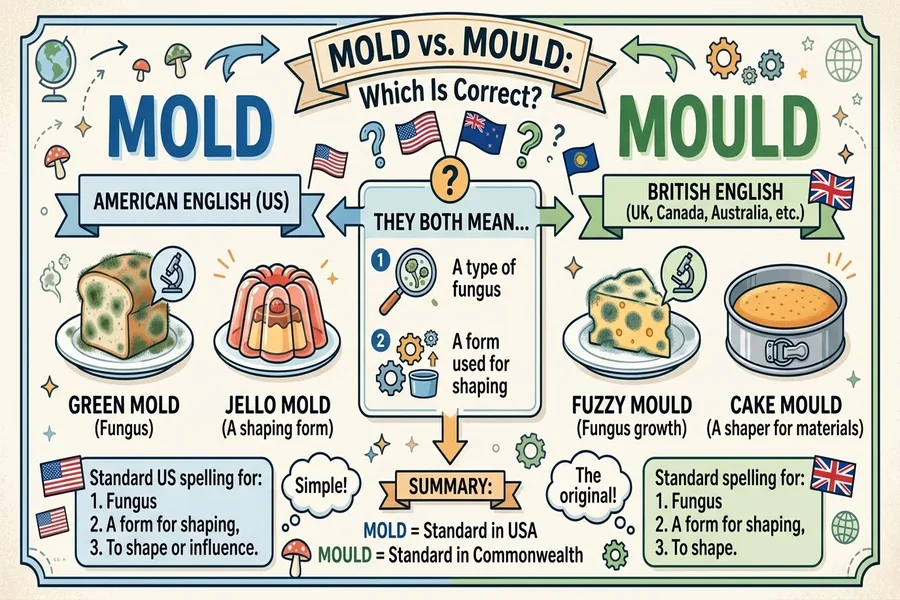
When comparing mold vs mould many people wonder whether these words have different meanings. The answer is simple. Both words refer to the same thing but their spelling depends on the type of English being used.
Mold is the preferred spelling in American English. Mould is the standard spelling in British English and several other English-speaking countries.
The difference may seem small but it can matter when writing articles or preparing professional documents. Using the correct spelling helps your content feel natural to readers in a particular country.
Both words can describe a type of fungus that grows in damp environments. They can also refer to a container or shape used to form materials such as plastic or metal.
Understanding the difference between mold and mould makes it easier to use these words correctly. This guide explains their meanings and spelling rules along with examples and common questions.
What Does Mold Mean?
Mold is the American English spelling of a word with several meanings. It is commonly used to describe a type of fungus that grows in moist conditions.
Mold can appear on food and walls as well as other surfaces. It often develops when moisture and suitable temperatures allow fungal spores to grow.
Some types of mold are useful. They are involved in producing certain cheeses and medicines. Other types can damage buildings or spoil food.
The word mold also has a meaning related to shaping materials. A mold is a hollow container or form into which a substance is poured or pressed.
For example a manufacturer may use a mold to create plastic parts. A baker may use a mold to shape chocolate or other food products.
In American English mold is the standard spelling in both situations. Writers generally use it in everyday communication and professional documents.
What Does Mould Mean?
Mould is the British English spelling of the same word. It has the same meanings as mold and is used in countries that follow British spelling conventions.
In the United Kingdom people commonly write mould when referring to fungal growth on walls or food.
The word is also used for objects that help shape materials. A mould can be used to produce a specific design or form.
For example a British manufacturer may use a mould to create a plastic component. A homeowner may notice mould growing in a damp bathroom.
The spelling mould is also common in Australia and New Zealand. It is used in many other regions where British English influences writing.
There is no difference in pronunciation or meaning between mold and mould. The spelling simply reflects the English variety being used.
Mold vs Mould: The Main Difference
The main difference between mold and mould is regional spelling.
American English generally uses mold while British English uses mould. Both forms are correct and neither is more accurate than the other.
The difference follows a wider spelling pattern in English. American English often removes the letter u from words that traditionally contain it in British English.
Examples include color and colour as well as favor and favour.
Mold and mould follow the same pattern. The American spelling is shorter while the British spelling retains the letter u.
| Word | American English | British English |
|---|---|---|
| Fungus | Mold | Mould |
| Shaping container | Mold | Mould |
| Past tense | Molded | Moulded |
| Present participle | Molding | Moulding |
| Mold removal | Mold removal | Mould removal |
The meaning remains the same in each case. Writers should choose the spelling that matches their audience.
Mold vs Mould in American and British English
American English and British English have developed different spelling conventions over time.
In the United States mold is used in newspapers and books as well as business communication. American dictionaries generally list mold as the preferred spelling.
In the United Kingdom mould is the standard form. British publications and educational materials normally use mould.
Australia and New Zealand also commonly follow the British spelling. Canada may use either form depending on the word and the publication style.
For writers who publish online the target audience is especially important. A website focused on American readers should normally use mold. A website focused on British readers should use mould.
Consistency is more important than choosing one spelling for every situation. A document that uses American English should not switch between mold and mould without a clear reason.
The same rule applies to related words such as molded and moulded.
Mold vs Mould Examples in Everyday Sentences
Examples can make the spelling difference easier to understand.
In American English a person might write:
- Mold appeared on the bread after several days.
- The bathroom wall has black mold.
- The company uses a mold to shape plastic parts.
- The chocolate was poured into a heart-shaped mold.
- The furniture was molded into a curved design.
In British English the same sentences would use mould instead of mold.
For example:
- Mould appeared on the bread after several days.
- The bathroom wall has black mould.
- The company uses a mould to shape plastic parts.
- The chocolate was poured into a heart-shaped mould.
- The furniture was moulded into a curved design.
These examples show that the spelling changes but the sentence structure and meaning stay the same.
Mold vs Mould in Science and Industry
The words mold and mould are used in many scientific and industrial fields.
In biology mold refers to certain types of fungi. These organisms grow through networks of microscopic filaments and may produce spores.
Scientists study molds because they play important roles in nature. They help break down organic materials and return nutrients to the environment.
Some molds are also useful in medicine and food production. Penicillin was developed from a mold and certain cheeses depend on specific molds for their flavor and texture.
In manufacturing a mold is a tool used to shape a material. It may be made from metal or another durable substance.
Manufacturers use molds in processes such as injection molding and casting. These methods help create products with consistent shapes and dimensions.
American technical writing generally uses molding. British technical writing commonly uses moulding.
The spelling difference does not change the scientific or industrial process.
Mold vs Mould: Common Mistakes to Avoid
One common mistake is thinking that mold and mould refer to different types of fungus. They do not. Both words describe the same general concept.
Another mistake is using both spellings in one article without a reason. This can make the writing appear inconsistent.
Writers sometimes assume that mould is incorrect because it contains an extra letter. However mould is perfectly correct in British English.
The opposite mistake also happens. Some American writers may think mold is a spelling error because they are more familiar with mould.
It is also important not to confuse mold with mildew. Mildew is a term commonly used for certain types of fungal growth. Although the words are related they are not always interchangeable in technical contexts.
A final mistake is overlooking related spellings. If you choose mold you should generally use molded and molding. If you choose mould you should generally use moulded and moulding.
How to Choose the Correct Spelling for Your Content
Choosing between mold and mould is easy when you know who will read your content.
If your audience is mainly in the United States use mold. This spelling will feel familiar to American readers and matches common American style guides.
If your audience is in the United Kingdom use mould. British readers generally expect this spelling in everyday and professional writing.
For international websites it is useful to choose one spelling style and apply it consistently. Many websites use American English because of their target market or editorial guidelines.
Search engine optimization can also influence spelling choices. People often search using the spelling they know from their region.
If your article targets American users then mold may be the better keyword. If it targets British users then mould may be more appropriate.
You can also mention both forms naturally when writing an article about the spelling difference. This helps readers understand that both words are correct.
Frequently Asked Questions About Mold vs Mould
1. Is mold or mould correct?
Both are correct. Mold is the standard American English spelling while mould is the standard British English spelling.
2. Does mold mean something different from mould?
No. Both words have the same meanings. They can refer to fungal growth or a container used to shape materials.
3. Which spelling is used in the United States?
American English uses mold. The related forms are molded and molding.
4. Which spelling is used in the United Kingdom?
British English uses mould. The related forms are moulded and moulding.
5. Is mould used in Australia?
Yes. Australian English generally follows the British spelling and uses mould.
6. Is mold a type of fungus?
Yes. Mold is a general term for certain fungi that grow in suitable conditions. Some molds are useful while others can cause food spoilage or damage to buildings.
7. What is the difference between mold and mildew?
Mold is a broad term for certain fungal growths. Mildew commonly refers to particular types of fungi that grow on surfaces. The exact distinction can depend on the context.
8. Should I use mold or mould for SEO?
Choose the spelling that matches your target audience. American readers generally search for mold while British readers commonly use mould.
9. Can I use mold and mould in the same article?
Yes when discussing spelling differences or addressing multiple regional audiences. Otherwise it is best to maintain one spelling style throughout the article.
Final Thought
Mold vs mould is a simple example of how American and British English can use different spellings for the same word.
Mold is preferred in the United States while mould is common in the United Kingdom and other countries that follow British English.
Both spellings are correct and both carry the same meaning. The best choice depends on your audience and the style of English you want to use.
For clear writing choose one spelling and stay consistent. Whether you write about fungal growth or manufacturing materials understanding this small difference can make your content more professional and easier to read.
