
The word “change” shows up everywhere. We use it for weather, plans, moods, jobs, relationships, and almost everything in between. That’s exactly the problem. When one word has to cover so much ground, it starts to feel flat.
Using different words for the same idea makes your writing and speech feel more alive. It also helps you say exactly what you mean. “Change” can mean a small tweak or a total transformation, and English gives you dozens of words that capture that difference precisely. This guide walks through 30 of them, one at a time, with real examples you can actually use.
What Does “Change” Really Mean?
At its core, “change” means to become different or to make something different than it was before.
Here’s a simple example. Someone says, “The weather changed suddenly.” That just means the weather was one way, and now it’s another way. Simple enough.
But that same sentence could become “the weather shifted,” “the weather turned,” or “the weather transformed,” and each version carries a slightly different feeling. That’s the real value of synonyms. They let you match the word to the moment.
Why Look for Alternatives to “Change”?
“Change” is a useful word, but it’s also a tired one. When you use it in every sentence, your writing starts to sound repetitive, and readers notice.
There’s also a precision problem. “Change” is vague. It doesn’t tell your reader whether something shifted slightly or was completely rebuilt from scratch. A resume that says you “changed a process” sounds far weaker than one that says you “overhauled a process.” The right synonym adds detail your reader actually needs without adding extra words.
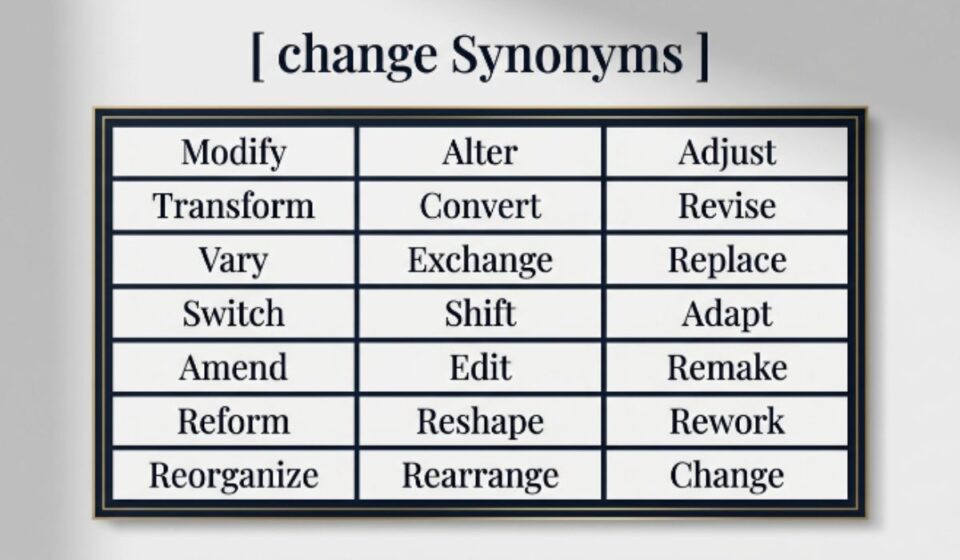
30 Synonyms for “Change” and How to Use Them
Transform
Meaning: To transform means to change something so completely that it becomes almost unrecognizable from its original form. It’s one of the strongest words on this list, and it carries real weight. Use it when the shift is deep, not surface-level. It works well in stories about personal growth, business turnarounds, or anything with a dramatic before-and-after.
Example: Two years of therapy helped him transform the way he handles conflict.
When It Fits: Great for describing major life changes, career pivots, or big personal milestones.
Shift
Meaning: A shift is a change in position, direction, or focus, usually smaller and more gradual than a transformation. It suggests movement rather than a complete overhaul. People often use this word when talking about attitudes, priorities, or trends that move over time. It feels natural in both casual and professional writing.
Example: Our marketing strategy shifted toward video content this quarter.
When It Fits: Ideal for describing gradual trends, evolving opinions, or strategic pivots at work.
Alter
Meaning: To alter something means to make it different in a specific, often small way, while its basic identity stays intact. It’s a precise word, commonly used in tailoring, legal documents, and technical writing. It signals a deliberate adjustment rather than a random or emotional one.
Example: She altered the contract slightly before sending it back for approval.
When It Fits: Useful in formal or technical contexts, like editing documents or adjusting plans.
Modify
Meaning: Modify means to adjust or tweak something, usually to improve it or make it fit a new purpose. It’s a calm, neutral word with no emotional charge, which makes it a favorite in business and technical settings. It implies control, not chaos.
Example: The team modified the app’s layout after reading user feedback.
When It Fits: Perfect for workplace updates, software changes, or process improvements.
Revise
Meaning: To revise is to review something and make changes to correct or improve it, often used for writing, plans, or estimates. It carries a sense of thoughtfulness, as if the change came after careful reconsideration rather than a snap decision.
Example: The editor asked her to revise the introduction before final publishing.
When It Fits: Common in writing, editing, and academic or professional feedback situations.
Convert
Meaning: “Convert” means to change something from one form, purpose, or state into another. It’s frequently used for physical transformations, like converting a room into an office, or belief-based ones, like converting to a new opinion. There’s a clear sense of before and after.
Example: They converted the old garage into a small home gym.
When It Fits: Great for describing physical renovations or a switch from one system to another.
Adjust
Meaning: To adjust is to make a small change so something fits better or works more smoothly. It’s a gentle, low-stakes word, often used for fine-tuning rather than major overhauls. It suggests responsiveness and flexibility.
Example: He adjusted his schedule to make time for morning workouts.
When It Fits: Works well for everyday routines, minor plan changes, or small corrections.
Evolve
Meaning: Evolve describes a gradual, natural change that happens over time, often for the better. It carries a sense of progress and growth rather than sudden disruption. This word feels organic, almost like the change was inevitable rather than forced.
Example: Her leadership style has evolved a lot since she started managing people.
When It Fits: Ideal for describing long-term personal, professional, or product development.
Adapt
Meaning: To adapt means to adjust to new conditions or circumstances, often in response to something outside your control. It highlights flexibility and resilience rather than choice. This word often shows up when someone responds well to a challenge.
Example: The restaurant adapted quickly when indoor dining shut down.
When It Fits: Perfect for describing responses to unexpected situations or environments.
Transition
Meaning: Transition refers to the process of changing from one state, stage, or system to another, often over a defined period. It implies a journey with a clear starting point and ending point, not just a single moment of change.
Example: The company is transitioning to a fully remote work model next year.
When It Fits: Common for career moves, organizational changes, or life stage shifts.
Reform
Meaning: To reform means to improve something, often a system, policy, or organization, by making significant changes to how it works. It carries a slightly formal, institutional tone and often implies fixing something flawed.
Example: Lawmakers voted to reform the outdated tax code.
When It Fits: Best suited for policy, institutional, or systemic discussions.
Revamp
Meaning: Revamp means to give something a significant update or improvement, often to make it more modern or effective. It’s a slightly energetic word, often used when something old gets a fresh new look or function.
Example: The brand revamped its entire website design last month.
When It Fits: Great for design updates, rebranding, or refreshing outdated systems.
Rearrange
Meaning: To rearrange is to change the position or order of things without necessarily changing what those things are. It’s commonly used for physical spaces or schedules, and it suggests reorganization rather than replacement.
Example: We rearranged the furniture to make the living room feel bigger.
When It Fits: Useful for describing physical spaces, schedules, or priority lists.
Restructure
Meaning: Restructure means to organize something in a new way, usually to make it function more effectively. It’s frequently used in business contexts, especially when describing changes to teams, departments, or financial arrangements.
Example: The company restructured its sales department after the merger.
When It Fits: Fits naturally in business, finance, and organizational contexts.
Vary
Meaning: To vary means to differ or change from one instance to another, often used to describe something that isn’t consistent. It suggests diversity or fluctuation rather than a single, deliberate transformation.
Example: Prices vary depending on the season and location.
When It Fits: Works well when describing differences across time, groups, or conditions.
Switch
Meaning: “Switch” means to replace one thing with another, often quickly and with a sense of decisiveness. It’s a casual, everyday word that people use constantly in conversation. There’s usually a clear “from this to that” structure behind it.
Example: I switched from coffee to green tea a few months ago.
When It Fits: Perfect for casual conversation about habits, preferences, or routines.
Amend
Meaning: To amend means to make small, formal corrections or improvements, usually to a document, agreement, or law. It has a legal, official tone and implies precision rather than emotion.
Example: The board voted to amend the company bylaws.
When It Fits: Best for legal, contractual, or formal document contexts.
Update
Meaning: “Update” means to bring something up to date with the latest information, technology, or standards. It’s one of the most commonly used words in modern communication, especially around software, information, or news.
Example: Please update your contact details before the deadline.
When It Fits: Ideal for tech, workplace communication, and everyday information sharing.
Overhaul
Meaning: Overhaul means to thoroughly examine and change something, usually because it needs major repair or improvement. It’s a strong word that implies the previous version wasn’t working well at all. There’s real intensity behind it.
Example: The mechanic recommended a complete engine overhaul.
When It Fits: Great for describing major fixes, whether mechanical, organizational, or personal.
Fluctuate
Meaning: “Fluctuate” describes irregular, back-and-forth change, often used for things that rise and fall unpredictably. It suggests instability rather than steady progress, and it’s frequently paired with numbers or measurable data.
Example: Her mood tends to fluctuate depending on how much sleep she gets.
When It Fits: Useful for describing markets, emotions, weather, or anything inconsistent.
Mutate
Meaning: To mutate means to change in form or nature, often unexpectedly or as part of a natural process. It’s most familiar in biology, but it also works metaphorically for ideas or situations that shift into something different over time.
Example: The original plan mutated into something none of us recognized.
When It Fits: Fits scientific writing or figurative descriptions of unpredictable change.
Diversify
Meaning: Diversify means to make something more varied by adding different elements to it. It’s often used in finance and business, but it applies anywhere variety improves the outcome, from skills to income sources to interests.
Example: She diversified her investment portfolio to reduce risk.
When It Fits: Best for finance, business strategy, or expanding a range of options.
Reshape
Meaning: “Reshape” means to change the form, structure, or direction of something, often in a way that leaves a lasting impact. It’s a thoughtful word, commonly used when describing influence over ideas, industries, or identities.
Example: The pandemic reshaped how people think about remote work.
When It Fits: Great for describing long-term societal, cultural, or industry-wide shifts.
Turn
Meaning: Turn is a simple, everyday word for a change in direction, condition, or outcome. It’s incredibly versatile and shows up constantly in casual speech, often describing something unexpected happening.
Example: The conversation took an unexpected turn halfway through dinner.
When It Fits: Natural in storytelling, casual conversation, and everyday updates.
Improve
Meaning: “Improve” specifically means to change something for the better. Unlike neutral words like “modify,” this one carries a built-in positive judgment. It works well when the direction of the change matters as much as the change itself.
Example: His communication skills improved a lot after joining the debate club.
When It Fits: Perfect for progress reports, feedback, and personal growth stories.
Replace
Meaning: “Replace” means to remove something and put something else in its place. It’s a definitive word, implying the original thing is gone entirely, not just adjusted. There’s no ambiguity about what happened.
Example: We replaced the old printer with a faster model.
When It Fits: Fits situations involving substitutions, upgrades, or clear-cut swaps.
Innovate
Meaning: To innovate means to introduce new ideas, methods, or products that change how something is done. It has a forward-looking, energetic tone and often implies creativity behind the change, not just adjustment.
Example: The startup innovated its way into a crowded market.
When It Fits: Great for business, technology, and creative industry contexts.
Refashion
Meaning: “Refashion” means to remake or redesign something into a new form, often reusing existing elements freshly. It’s less common in everyday speech but adds a slightly creative, deliberate tone when used well.
Example: She refashioned her grandmother’s old coat into a modern jacket.
When It Fits: Works well for creative projects, fashion, and repurposing old items.
Rebuild
Meaning: Rebuild means to construct something again after it was damaged, broken, or dismantled. It implies effort and intention, often after a setback. This word carries emotional weight beyond just physical structures.
Example: They spent months rebuilding trust after the disagreement.
When It Fits: Ideal for recovery stories, relationships, or literal reconstruction.
Redirect
Meaning: Redirect means to change the course or focus of something, usually deliberately. It’s often used when energy, attention, or resources move from one place to another for a specific reason.
Example: The coach redirected the team’s focus toward defense for the second half.
When It Fits: Useful for coaching, leadership, and situations requiring a change in focus.
Which Alternative Should You Use?
The right word depends on the setting, so here’s a quick breakdown.
- For work and professional writing: modify, restructure, revise, update, overhaul
- For emails: update, adjust, amend, revise
- For friends and casual chats: switch, turn, shift
- For school and academic writing: revise, alter, adapt, evolve
- For everyday conversation: change up, switch, adjust, turn
A simple rule helps here. The more formal the setting, the more precise and neutral your word should be. The more casual the setting, the more natural and conversational it can sound.
Common Mistakes People Make
Using “transform” for small changes. Saying you “transformed” your desk setup when you just moved a lamp makes the word lose its punch. Save it for genuinely big shifts.
Confusing “alter” with “replace.” Altering something means adjusting it while keeping its core identity. Replacing it means swapping it entirely. Mixing these up creates confusion about what actually happened.
Overusing “update” in casual speech. “Update” works great in emails and tech contexts, but it sounds stiff in a relaxed conversation with a friend. Casual words like “switch” or “change up” fit better there.
Choosing overly formal words in casual writing. Using “restructure” to describe rearranging your closet sounds unnatural. Match the weight of the word to the weight of the situation.
Repeating the same synonym too often. Swapping “change” for “shift” and then using “shift” ten times isn’t really solving the repetition problem. Rotate between a few different options.
Quick Guide Table
Beyond the 30 words above, here are 15 more alternatives worth knowing, each with a quick note on where it fits best. This table is handy when you need a fast reference instead of a full explanation.
| Phrase | Formal | Casual | Conversation | |
| Tweak | No | Yes | Sometimes | Yes |
| Alter course | Yes | No | Yes | Sometimes |
| Rework | Yes | Sometimes | Yes | Sometimes |
| Renovate | Yes | No | Yes | No |
| Recast | Yes | No | Sometimes | No |
| Shake up | No | Yes | No | Yes |
| Flip | No | Yes | No | Yes |
| Pivot | Yes | Sometimes | Yes | Sometimes |
| Refine | Yes | Sometimes | Yes | Sometimes |
| Remodel | Yes | No | Sometimes | No |
| Rejig | No | Yes | No | Yes |
| Transmute | Yes | No | No | No |
| Recondition | Yes | No | Sometimes | No |
| Vamp up | No | Yes | Sometimes | Yes |
| Freshen up | Sometimes | Yes | Sometimes | Yes |
Conclusion
“Change” is a useful word, but it’s not the only word. With 30 alternatives like these, you can match your language to the exact size, tone, and setting of whatever’s shifting. The next time something changes, pick the word that actually says what you mean.