
Good writing changes shape depending on who reads it. The same idea can sound stiff in an email and natural in a text message. Word choice makes that shift possible.
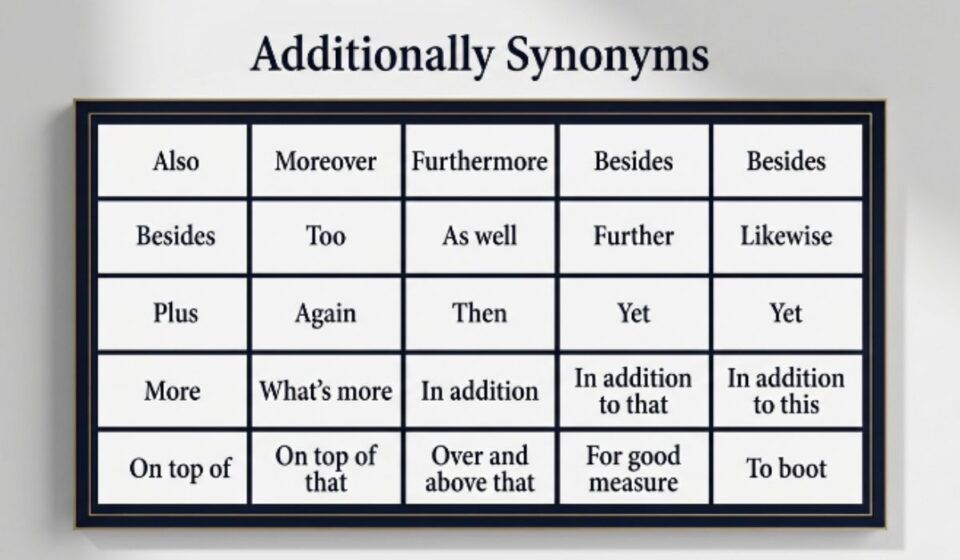
When you know several ways to add a point, your writing feels less repetitive and more like a real person talking. This guide gives you 25 practical alternatives to “additionally,” each with a clear meaning, a real example, and a situation where it fits best.
What Does “Additionally” Really Mean?
“Additionally” is a simple word. It tells the reader that a new point is coming, and that point supports or extends what was just said. Nothing more, nothing less.
Picture a manager finishing a project update. She writes, “The report is ready. Additionally, the client approved the budget.” The second sentence builds on the first and adds useful context, so the reader never feels like the writing jumped somewhere new.
Why Look for Alternatives to “Additionally”?
“Additionally” works fine once or twice. The trouble starts when it shows up in every paragraph.
Repeating the same connector makes writing sound mechanical, almost like a checklist rather than a conversation. Readers notice the pattern, even without realizing why the writing feels flat.
There’s also a tone problem. “Additionally” leans formal, so it can sound out of place in a friendly email or a casual chat. Swapping it out lets you match your tone to your audience instead of forcing every sentence into the same formal box.
Variety also signals confidence. A writer who has more than one way to add a point comes across as more fluent and more in control of the language.
25 Synonyms for “Additionally” and How to Use Them
Also
Meaning: A short, everyday word that adds a related point without any extra weight. It works almost everywhere because it doesn’t call attention to itself. Readers barely notice it, which is exactly the point. It keeps writing smooth and easy to follow, especially when you’re listing several ideas back to back.
Example: She finished her degree early and also picked up a part-time job.
When It Fits: Everyday writing, casual updates, and simple lists.
Furthermore
Meaning: A formal connector that strengthens an argument by adding a stronger or related point. It signals that the next sentence isn’t just extra information but a point that reinforces what came before. Use it when each sentence needs to build a case, but not in every paragraph.
Example: The proposal cuts costs. Furthermore, it improves delivery times.
When It Fits: Reports, essays, and formal arguments.
Moreover
Meaning: Similar to “furthermore,” but slightly more emphatic when introducing an important additional point. It works well when the second point matters as much as the first, or even more. Writers use it to shift from a smaller detail to a bigger one.
Example: The software is faster. Moreover, it costs less to maintain.
When It Fits: Business writing and formal comparisons.
Besides
Meaning: Adds a point that supports a decision or opinion, often with a slightly conversational tone. It works well when you’re explaining a reason behind something. It feels less rigid than “furthermore” or “moreover” and closes an argument naturally.
Example: I don’t need a new laptop. Besides, this one still works fine.
When It Fits: Conversations and casual explanations.
As well
Meaning: A simple addition placed at the end of a sentence rather than the beginning. It’s one of the easiest substitutes to use because it doesn’t require restructuring a sentence. It’s a good default choice, and it sounds natural in speech.
Example: He speaks French and Spanish as well.
When It Fits: Everyday writing and quick additions.
Too
Meaning: A short, casual word placed at the end of a sentence to add a related point. It’s one of the most natural-sounding options in spoken English. It keeps sentences light and works well in short, informal messages.
Example: She loved the movie. I did too.
When It Fits: Texts, casual chats, and short replies.
In addition
Meaning: A slightly more formal version of “additionally” that works well at the start of a sentence. It signals a clear, structured addition, which makes it useful in writing that needs to stay organized. It’s a safe, professional default that rarely sounds out of place.
Example: The team hit its sales target. In addition, customer satisfaction improved.
When It Fits: Business emails and formal summaries.
What’s more
Meaning: Adds a point that feels like a pleasant surprise or a bonus detail. It carries a slightly upbeat tone, which makes it useful when the added information is good news. It gives writing a bit of energy instead of sounding purely informational.
Example: The apartment has a great view. What’s more, it’s close to the subway.
When It Fits: Marketing copy and enthusiastic writing.
Plus
Meaning: A casual, quick way to add a point, often used mid-conversation. It feels relaxed and spontaneous, almost like a side thought. It suits informal writing where the tone should feel unplanned.
Example: The hotel is cheap. Plus, it’s right next to the beach.
When It Fits: Casual writing, social media, and friendly emails.
On top of that
Meaning: Adds a point that feels like it’s piling onto an already strong situation. It works especially well when listing several benefits or several problems in a row. It gives a sense of accumulation that’s common in spoken English and casual storytelling.
Example: The flight got delayed. On top of that, they lost my luggage.
When It Fits: Storytelling and casual complaints or praise.
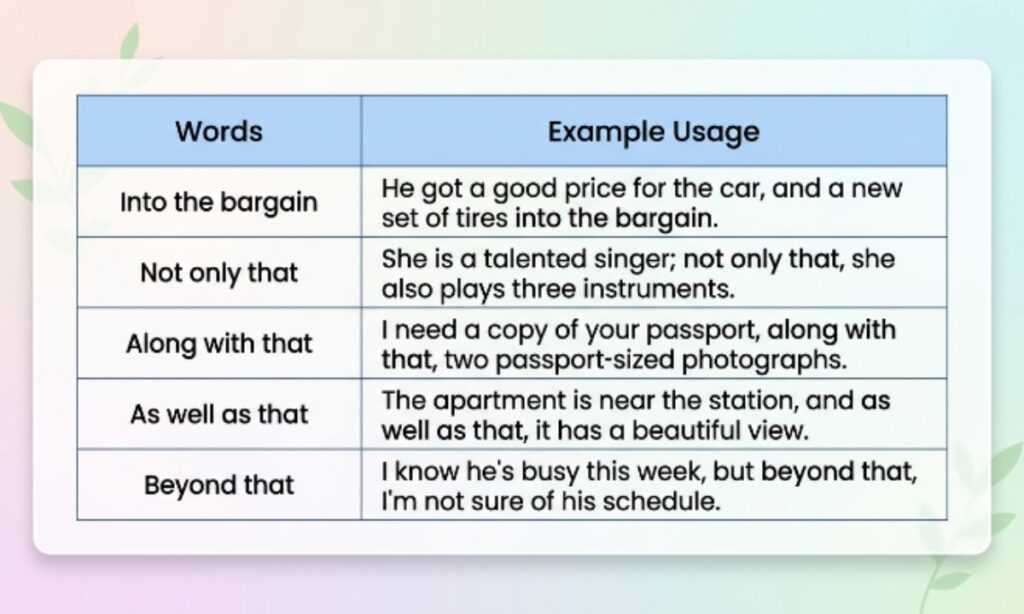
Not only that
Meaning: Signals that an already impressive point is about to get even stronger. It builds anticipation, which makes the next sentence feel important. Writers use it to build momentum, almost like a small reveal.
Example: She won the award. Not only that, she got a scholarship too.
When It Fits: Storytelling, speeches, and persuasive writing.
Along with that
Meaning: Connects a supporting detail directly to the main point, without much formality. It works well when the added point feels naturally tied to what came before, almost inseparable from it. It’s a good middle-ground choice between formal and casual writing.
Example: The job offers a higher salary. Along with that, it includes better benefits.
When It Fits: Semi-formal writing and workplace communication.
To boot
Meaning: An old-fashioned but charming way to add a final, often surprising detail. It works best at the end of a sentence and gives writing a slightly playful or old-world tone. It’s not common in business writing, so save it for casual or creative pieces.
Example: The car is fast and fuel-efficient to boot.
When It Fits: Creative writing and light-hearted conversation.
Not to mention
Meaning: Introduces an additional point while pretending it’s almost too obvious to bring up. It creates a slightly dramatic effect, since it draws attention to something by claiming it barely needs mentioning. It works especially well when listing impressive or overwhelming details.
Example: The venue is beautiful, not to mention affordable.
When It Fits: Reviews, recommendations, and persuasive writing.
By the same token
Meaning: Adds a point that follows the same logic or pattern as the one before it. It works well when two ideas share the same reasoning, even if they’re about different topics. It fits naturally into explanatory or analytical writing.
Example: The policy protects employees. By the same token, it protects the company.
When It Fits: Analytical writing and explanations.
Further
Meaning: A short, formal word used to introduce one more supporting detail. It sounds slightly more official than “also” or “too,” making it useful in legal, academic, or technical writing. Use it in structured, methodical writing, but sparingly.
Example: The contract outlines payment terms. Further, it specifies delivery dates.
When It Fits: Legal documents and technical writing.
Again
Meaning: Introduces a repeated or related point, often used to reinforce something already discussed. It works well when circling back to reinforce an earlier idea from a new angle. It’s less about new information and more about strengthening a point already made.
Example: The design is efficient. Again, this saves the company money long-term.
When It Fits: Structured writing and detailed explanations.
Coupled with that
Meaning: Shows that two factors combine to create a bigger overall effect. It works well when explaining cause and effect, especially when more than one factor is involved. It shows an outcome depends on multiple factors, not just one.
Example: Rising costs, coupled with low demand, hurt the company’s profits.
When It Fits: Business analysis and cause-effect explanations.
In conjunction with that
Meaning: A formal phrase showing that two actions or ideas happen together. It works well in technical or procedural writing, where precision matters more than tone. It suits structured, professional communication.
Example: The company launched a new app. In conjunction with that, it updated its privacy policy.
When It Fits: Corporate announcements and formal reports.
Correspondingly
Meaning: Adds a point that matches or aligns with what was just described. It works especially well when showing that two things move in the same direction, like cause and result. It’s common in data-driven or comparative writing.
Example: Sales increased. Correspondingly, the company hired more staff.
When It Fits: Reports, analysis, and data-based writing.
Adding to that
Meaning: A natural, conversational way to build on a point someone just made. It sounds like something you’d say out loud, which makes it useful in discussions, meetings, or informal writing. It keeps the tone friendly and collaborative.
Example: The plan looks solid. Adding to that, the timeline seems realistic too.
When It Fits: Team discussions and casual professional writing.
Alongside that
Meaning: Shows that two things exist or happen at the same time, without one overshadowing the other. It works well when describing parallel developments, like two projects moving forward together. It suits professional writing that needs to stay neutral and clear.
Example: The team improved efficiency. Alongside that, employee satisfaction went up.
When It Fits: Workplace updates and progress reports.
For another thing
Meaning: Introduces a new reason in a list, often used when explaining several points in a row. It works well in spoken-style writing, especially when listing reasons for a decision. It feels natural and unforced, almost like thinking out loud.
Example: I’m not taking the job. For another thing, the commute is too long.
When It Fits: Casual explanations and everyday conversations.
In similar fashion
Meaning: Adds a point that follows the same style or approach as something mentioned earlier. It works well when comparing two methods, actions, or outcomes that share a pattern. It’s useful when explaining processes or comparing similar situations.
Example: The first store cut prices. Similarly, competitors followed within weeks.
When It Fits: Comparative writing and business explanations.
On top of everything else
Meaning: Adds a final point after a long list, often to emphasize how much is already happening. It works well when a situation already feels full or overwhelming, and one more detail pushes it further. It adds emotional weight and signals the list is reaching its peak. Example: The printer broke, the meeting ran late, and on top of everything else, it started raining. When It Fits: Storytelling and expressive, informal writing.
Which Alternative Should You Use?
The right word depends on where you’re writing, not just what you’re saying.
- Work reports: “furthermore,” “moreover,” or “in addition.”
- Emails: “in addition,” “along with that,” or “as well.”
- Friends and casual chats: “plus,” “too,” or “on top of that.”
- School essays: “furthermore,” “moreover,” or “correspondingly.”
- Everyday conversation: “also,” “besides,” or “for another thing.”
When in doubt, match the word’s formality to the situation. A casual word in a formal report feels careless; a stiff word in a text feels cold.
Common Mistakes
- Using formal connectors in casual writing. “Furthermore” in a text to a friend feels stiff.
- Repeating one synonym too often. Swapping “additionally” for “moreover” every time just creates a new pattern to get tired of.
- Placing end-of-sentence words at the start. “Too” and “as well” usually sound wrong at the beginning.
- Ignoring punctuation. Words like “furthermore” and “moreover” almost always need a comma right after.
- Skipping the meaning check. Words like “again” or “correspondingly” carry a slightly different shade of meaning and don’t fit every context.
Quick Guide Table
Here are 15 more alternatives worth knowing, beyond the main 25. Some suit formal writing; others fit better in a quick chat or an email. Use this table as a fast reference when you’re unsure which tone a word carries.
| Phrase | Formal | Casual | Conversation | |
| Likewise | Yes | No | Yes | Rarely |
| Over and above that | Yes | No | Yes | Rarely |
| What is more | Yes | No | Yes | No |
| In like manner | Yes | No | Rarely | No |
| Another thing to note | No | Yes | Yes | Yes |
| Along the same lines | Yes | Yes | Yes | Yes |
| In tandem with that | Yes | No | Yes | No |
| As an added point | Yes | No | Yes | Rarely |
| Similarly | Yes | Rarely | Yes | Rarely |
| And also | No | Yes | Rarely | Yes |
| Beyond that | Yes | Yes | Yes | Yes |
| On another note | No | Yes | Yes | Yes |
| To add to this | Yes | No | Yes | Rarely |
| In the same vein | Yes | No | Yes | Rarely |
| As a bonus | No | Yes | Rarely | Yes |
Conclusion
Swapping out “additionally” isn’t about avoiding one word forever. It’s about giving your writing more range so it fits the moment, whether that’s a formal report or a quick message to a friend. Keep a few of these alternatives in mind, and your writing will start to feel more natural almost immediately.