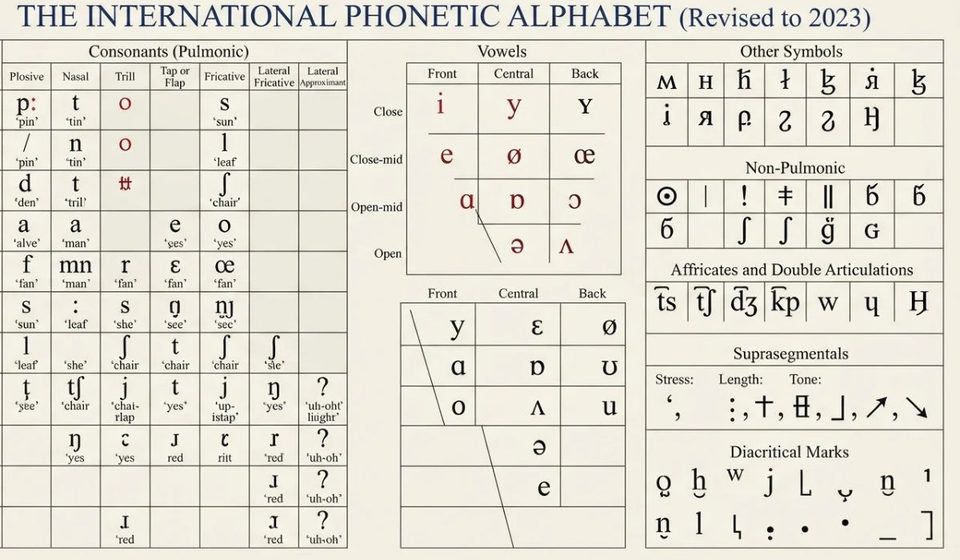

Every language sounds different from how it’s spelled. English proves this every day. The words “though,” “through,” and “tough” all end in “-ough,” yet none of them rhyme. The International Phonetic Alphabet fixes this problem. It gives every distinct speech sound its own symbol, no matter the language. This guide breaks down the chart, the symbols, and the skills you need to actually use it.
What Is the International Phonetic Alphabet?
The International Phonetic Alphabet, or IPA, is a standardized system of symbols that represents the sounds of spoken language. Linguists created it to solve a simple but persistent problem. Regular spelling does not tell you exactly how a word sounds.
The International Phonetic Association maintains the alphabet and its official chart. This is not a crowdsourced tool. The association follows a formal process for every change. A member first proposes a change. The proposal then appears in the association’s journal. After that, the council votes on it. Only approved changes become official.
The core idea behind the IPA is simple: one symbol represents one sound. Say a word out loud. Each distinct sound in that word gets its own symbol. You do not have to guess. Silent letters do not create confusion. Regional spelling differences do not get in the way.
However, the “one symbol, one sound” rule can change depending on your goal. Linguists use broad transcriptions for general purposes. They use narrow transcriptions when they need to capture fine details of pronunciation.
We will cover that distinction below. Most guides skip this important difference, but it helps you understand how linguists actually use the IPA.
Why the IPA Exists
Spelling Doesn’t Match Pronunciation
English is the clearest example of this mismatch. Look at the letter “u”:
“u” in rule sounds like /u/
“u” in put sounds like /ʊ/
“u” in cut sounds like /ʌ/
Same letter, three different sounds. Now flip it around. The sound /i/ shows up in bead, tree, key, and chic. Four different spellings, one identical sound. Regular alphabets weren’t built to track sound this precisely. IPA was.
The Same Letters Mean Different Things in Different Languages
A letter’s sound depends entirely on which language you’re reading. The letter “j” is a good example:
- In French, “j” usually sounds like /ʒ/, as in joie
- In Spanish, “j” usually sounds like /x/ or /h/, as in ajo
- In English, “j” sounds like /dʒ/, as in judge
Without a universal system, transcribing pronunciation across languages would require a new set of rules for every single one.
Some Sound Differences Are Nearly Invisible
Native speakers often don’t notice details in their own speech. Take the English “p” sound in pan versus span. They’re spelled with the same letter, but the “p” in pan carries a small puff of air (aspiration) that the “p” in span doesn’t. IPA can capture that difference with a diacritic: [pʰ] versus [p].
Spanish shows a similar pattern. The word dedo (“finger”) is transcribed [ˈde.ðo]. The two “d” letters represent two different sounds. The second one, appearing between vowels, softens into [ð], the same sound that starts the English word them.
A Brief History of the IPA
| Year | What Happened |
| 1886 | The International Phonetic Association forms in Paris. Paul Passy and a group of language teachers lead its formation. |
| 1888 | The first version of the phonetic alphabet appears in print. |
| 1897 | The founding group formally adopts the name International Phonetic Association. |
| 1999 | The Handbook of the International Phonetic Association is published. It formalizes the process for approving changes to the chart. |
| 2005 | The chart receives its most recent addition of a new symbol. |
| 2012 | The IPA chart becomes freely available under a Creative Commons license (CC BY-SA 3.0). |
| 2015 | The Association releases updated chart files in fonts that include IPA Kiel and DejaVu Sans. |
The earliest designers of the alphabet followed a small set of clear principles. They wanted one sign for each sound. They also wanted each symbol to keep the same sound value across languages.
They preferred ordinary Roman letters whenever possible. This made the alphabet easier to recognize and use. They also preferred symbol shapes that gave a visual clue about the sounds they represented.
These principles still shape the IPA chart today. They help explain why the chart uses familiar letters for many sounds while relying on specially designed symbols for others.
How to Read IPA Transcription
This is the part most guides rush through, and it’s exactly where readers get stuck. Two symbols do most of the heavy lifting in IPA: slashes and brackets.
/slashes/ mark a phonemic transcription. This shows the general sound category a speaker intends, without every fine physical detail. Example: /pɪn/.
[square brackets] mark a phonetic transcription. This captures the exact physical sound a speaker produces, including small details like aspiration. Example: [pʰɪn].
Here’s why that distinction matters. In English, the “p” in pin is aspirated: [pʰɪn]. The “p” in spin is not: [spɪn]. Both belong to the same phoneme, /p/, but they’re physically different sounds. Linguists call these two versions allophones of the same phoneme.
Phoneme vs. Phone
- A phoneme is a category of sound that changes meaning when swapped. Swap /p/ for /b/ in pat, and you get a different word, bat.
- A phone is the actual, physical sound a speaker produces, down to the last detail.
Knowing this difference helps you understand why dictionaries sometimes show slightly different transcriptions for the same word. They’re often choosing between broad and narrow detail, not disagreeing about pronunciation.
Other Symbols You’ll See in Transcription
| Symbol | Meaning |
| . | Syllable boundary |
| ˈ | Primary stress (comes before the stressed syllable) |
| ˌ | Secondary stress |
| ː | Extra vowel or consonant length |
| ‿ | Linking between words |
| ⟨ ⟩ | Represents ordinary spelling, not sound |
A quick worked example: the word “Tennessee” transcribes as /ˌtɛnəˈsi/. The primary stress falls on the last syllable, and a secondary stress falls on the first.
How the IPA Chart Is Organized
The chart isn’t a random list of characters. It’s organized by how your mouth physically produces each sound. Once you understand the layout, memorizing individual symbols gets much easier.
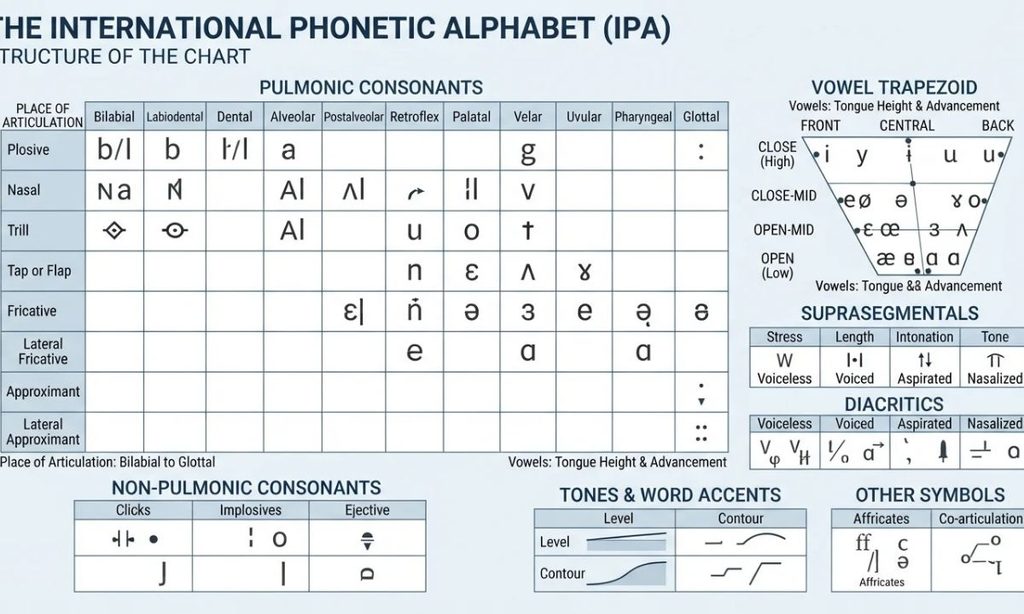
Consonants: Manner and Place of Articulation
Manner of articulation describes how airflow gets shaped or blocked:
- Plosive: full closure, then release. Example: /b/ in bad.
- Nasal: air escapes through the nose. Example: /m/ in mad.
- Fricative: air squeezes through a narrow gap, creating friction. Example: /s/ in sip.
- Affricate: a plosive followed immediately by a fricative. Example: /tʃ/ in check.
- Approximant: articulators come close but don’t fully block airflow. Example: /w/ in wit.
Place of articulation describes where in your mouth the sound happens. On the chart, sounds made toward the front (lips) sit on the left. Sounds made toward the back (throat) sit on the right.
| Place | Example Sound | Example Word |
| Bilabial (both lips) | /b/, /m/ | bad, mad |
| Alveolar (tongue near upper gum ridge) | /d/, /n/ | dig, not |
| Postalveolar | /ʃ/ | shop |
| Velar (back of tongue, soft palate) | /k/, /g/ | cup, guy |
| Glottal (throat) | /h/ | house |
Voicing is the third piece. Consonant cells on the chart often pair two sounds made the same way, at the same place, but differing in whether your vocal folds vibrate. In these pairs, the voiceless sound sits on the left, and the voiced sound sits on the right.
Try this test: put your fingers on your throat and say /s/, then /z/. Both are alveolar fricatives made the same way in your mouth. The only difference is that /z/ vibrates your vocal folds and /s/ doesn’t. You’ll feel the difference immediately.
Vowels: Height, Backness, and Rounding
The vowel chart works like a rough map of your mouth’s interior, viewed from the side.
- Height measures how high your tongue sits. /i/ in bead is a high vowel. /æ/ in bad is a low vowel.
- Backness measures how far forward or back your tongue sits. /i/ and /ɛ/ are front vowels. /u/ and /o/ are back vowels.
- Rounding measures lip shape. /u/ in root is rounded. /i/ in bead is unrounded.
A simple way to feel these differences: say /i/ then /æ/ back to back, and notice your jaw drop. Then say /i/ then /u/, and notice your tongue pull backward.
Sounds Beyond the Core Chart
The IPA covers more than the sounds in its core chart. It also includes symbols and marks for sounds that need extra detail. These features help linguists describe pronunciation with greater precision.
Non-pulmonic consonants: These sounds do not rely on lung airflow. They include clicks, which occur in languages such as Zulu and Xhosa. They also include ejectives, which occur in Quechuan and Kartvelian languages.
Diacritics: These are small marks that linguists add to a symbol to give it a more specific meaning. For example, [pʰ] marks an aspirated sound. [n̩] marks a syllabic sound. [t̪] marks a dental sound. [l̥] marks a devoiced sound. [ã] marks a nasalized sound.
Suprasegmentals: These symbols represent features that extend across sounds or syllables. They include stress, length, and rhythm.
Tone letters: These symbols mark pitch patterns. Tonal languages use these patterns to distinguish words or meanings. Examples include Chinese, Vietnamese, Punjabi, and Cherokee.
Most spoken languages, including English, rely almost entirely on pulmonic consonants. These consonants use airflow from the lungs. As a result, you usually will not need the non-pulmonic section when you study English.
You only need to study non-pulmonic sounds when you work with a specific language that uses them. This includes languages that use clicks or ejectives.
Explore More Grammar Guide
Transferred vs Transfered: Which Spelling Is Correct?
Nosey vs Nosy: Which Spelling Is Correct?
Goodmorning or Good Morning: Which Spelling Is Correct?
Loose vs Lose: The Complete Guide to Using Each Word Correctly
English IPA Symbols With Examples
This table covers the sounds you’ll run into most often in General American English.
Consonants
| Symbol | Example Words |
| /p/ | pit, lip |
| /b/ | bit, tub |
| /t/ | tip, sit |
| /d/ | dig, sad |
| /k/ | cup, sky |
| /g/ | guy, bag |
| /m/ | my, jam |
| /n/ | not, ran |
| /ŋ/ | sing, finger |
| /tʃ/ | check, etch |
| /dʒ/ | just, judge |
| /f/ | fish, cuff |
| /v/ | vowel, leave |
| /θ/ | thigh, breath |
| /ð/ | thy, father |
| /s/ | sip, mass |
| /z/ | zip, jazz |
| /ʃ/ | shop, wish |
| /ʒ/ | genre, beige |
| /h/ | house, ahead |
| /w/ | wit, swap |
| /j/ | yes, young |
| /r/ | rip, water |
| /l/ | lap, pull |
Vowels and Diphthongs
| Symbol | Example Words |
| /i/ | feet, seat |
| /ɪ/ | sit, gym |
| /eɪ/ | late, say |
| /ɛ/ | let, best |
| /æ/ | cat, mad |
| /ʌ/ | but, trust |
| /ə/ | comma, the |
| /u/ | goose, rude |
| /ʊ/ | foot, took |
| /oʊ/ | boat, no |
| /ɔ/ | bought, launch |
| /ɑ/ | not, father |
| /aɪ/ | buy, isle |
| /aʊ/ | cow, mouth |
| /ɔɪ/ | soil, boy |
Frequently Confused Symbols
- /θ/ vs. /ð/: both are “th” sounds. /θ/ is voiceless (thigh); /ð/ is voiced (thy).
- /ʃ/ vs. /ʒ/: /ʃ/ is voiceless (shop); /ʒ/ is voiced (genre).
- /ŋ/ vs. /n/: /ŋ/ ends in the back of the mouth (sing); /n/ ends at the gum ridge (sun).
- /ɪ/ vs. /i/: /ɪ/ is shorter and more relaxed (sit); /i/ is longer and tenser (seat).
- /ə/ vs. /ʌ/: /ə/ (schwa) only appears in unstressed syllables (comma); /ʌ/ appears in stressed syllables (but).
American English vs. British English Transcription
Dictionaries do not always use the same transcription for the same word. That does not mean one of them made a mistake. Different transcriptions often reflect real differences between accents.
American English is largely rhotic. This means speakers pronounce the “r” sound wherever the spelling includes it. For example, car appears as /kɑr/.
British Received Pronunciation is largely non-rhotic. Speakers do not pronounce the “r” sound unless a vowel follows it. For example, car appears as /kɑː/.
Many American dictionaries use /r/ instead of the technically more precise /ɹ/. They make this choice to keep transcriptions easier to read.
The cot-caught merger affects many American speakers. These speakers pronounce /ɑ/ and /ɔ/ the same way. British speakers generally keep these two sounds distinct.
None of these differences makes one transcription system “correct.” Each system can reflect a particular accent or transcription practice.
The important point is to check which accent a chart or dictionary represents. Do that before you compare its transcription with another source. Otherwise, you may mistake a genuine accent difference for an error.
How to Read a Dictionary Pronunciation Entry
Here’s a quick walkthrough using the word “photography.”
- Spelling: photography
- U.S. transcription: /fəˈtɑɡrəfi/
- U.K. transcription: /fəˈtɒɡrəfi/
- Stress: the primary stress mark (ˈ) falls before the second syllable
- Key symbols: /ə/ (schwa) appears twice, in unstressed syllables. The vowel in the stressed syllable differs by accent: /ɑ/ in American English, /ɒ/ in British English.
Once you can walk through an entry like this, most dictionary pronunciation guides stop looking like code.
How to Use IPA to Improve Your Pronunciation
Start with your target language’s sound inventory only. English uses roughly 44 sounds. Spanish uses roughly 24. No language uses the entire IPA chart, so don’t try to learn all of it at once.
Compare your native language to your target language. Identify shared sounds first, then isolate the new ones. Sometimes a “shared” sound shows up in a new position or gets spelled differently, which is exactly the kind of detail IPA is built to flag.
Practice minimal pairs. Words like ship and sheep differ by a single sound. Drilling pairs like this trains your ear to hear distinctions your native language might not mark.
Say it, record it, compare it. Say the sound, record yourself, then compare it to a native audio sample. Your ear will catch differences your mouth doesn’t yet feel.
Use interactive tools regularly. Clickable IPA charts with audio let you hear a symbol on demand instead of guessing from a textbook description.
Common Mistakes Learners Make With IPA
- Trying to memorize the entire 107-symbol chart before starting any real practice.
- Assuming a symbol always sounds the same regardless of dialect or context.
- Skipping audio and relying on written symbols alone.
- Ignoring stress marks, which can change meaning just as much as individual sounds.
What IPA Can and Can’t Do
IPA is a precise tool, but it isn’t magic. Keep a few limits in mind:
IPA only works if you already know the sound each symbol represents. The symbols themselves don’t teach you pronunciation from scratch.
Real speech varies by speaker, accent, speech rate, and surrounding sounds (a process called coarticulation). No chart captures every variation.
A chart listing a sound doesn’t mean every language uses it. The chart is a shared inventory across all documented languages, not a requirement for any single one.
Audio remains essential. Reading a symbol and hearing a symbol are two different skills, and most learners need both.
Frequently Asked Questions
How many symbols are in the International Phonetic Alphabet?
The modern IPA includes 107 segmental letters, plus diacritics and additional marks for stress, length, and tone.
Does every language use all IPA symbols?
No. Each language uses only a subset of the full chart; English uses roughly 44 sounds, for example.
Is IPA the same in American and British English?
The symbols are shared, but transcriptions differ because the accents pronounce certain sounds, like “r,” differently.
What does the schwa symbol mean?
The schwa, written /ə/, represents the short, neutral vowel sound heard in unstressed syllables, like the “a” in comma.
What’s the difference between a phoneme and a phone?
A phoneme is a sound category that changes word meaning, while a phone is the exact physical sound a speaker produces.
Conclusion
The International Phonetic Alphabet exists because ordinary spelling cannot fully represent the way people actually speak.
Once you understand how the chart organizes sounds by manner, place, voicing, height, backness, and rounding, the symbols become much easier to understand.
They no longer look like a foreign code. Instead, they work as a practical map of speech sounds. You can use this map for dictionary lookups, language learning, and serious pronunciation practice.