
Lots of people pause before typing this word. They wonder if it needs an “a” or an “i.” The confusion is completely understandable, because the word sounds different than it looks. This guide settles the question once and for all. You’ll learn the correct spelling, why the mistake happens, and how to never make it again.
Quick Answer: Is It Definitely or Definately?
The correct spelling is definitely. “Definately” is not a word at all — it’s simply a common misspelling. No major dictionary recognizes it as a valid alternative.
Here’s the short version:
Definitely — correct spelling, means “without doubt” or “certainly”
Definately — incorrect, a frequent typo
Defiantly — a real word, but it means something entirely different (in a rebellious way)
If you remember nothing else from this article, remember this: there is no letter “a” anywhere in definitely.
How Do You Spell Definitely?
The letter-by-letter spelling is:
D-E-F-I-N-I-T-E-L-Y
Notice the pattern. Two “e”s and two “i”s, arranged as E-I-I-E once you strip out the consonants. That alternating vowel pattern is one of the easiest ways to check your spelling at a glance.
A few quick facts about the word’s structure:
- It contains 10 letters
- It has 4 syllables
- It is built from three parts: de + finite + ly
That third point matters more than most people realize, and we’ll come back to it in the next section.
What Does Definitely Mean?
Definitely is an adverb. It expresses certainty, confidence, or a firm agreement. Depending on context, it can mean:
- Without any doubt
- Certainly or surely
- In a definite, assured manner
- A strong “yes” in casual conversation
- A strong “no” when paired with “not”
It’s flexible. You can use it to confirm a fact, back up an opinion, or simply agree with enthusiasm.
Example sentences:
- She will definitely finish the report by Friday.
- That restaurant is definitely worth trying.
- I definitely did not eat the last cookie.
- “Are you coming to the party?” “Definitely!”
- He definitely understands the assignment.
Notice how the word can modify a verb (“will definitely finish”), an adjective (“definitely worth”), or stand completely on its own as a one-word reply (“Definitely!”).
Is Definitely an Adjective or an Adverb?
Definitely is always an adverb. It never functions as an adjective. The adjective form is definite, which means clear, fixed, or exact.
Here’s how the family works:
| Word | Part of Speech | Meaning |
| Definite | Adjective | Clear, exact, fixed |
| Definitely | Adverb | Certainly, without doubt. |
| Definitively | Adverb | Conclusively, in a final way |
The adverb suffix “-ly” is what turns the adjective “definite” into “definitely.” That transformation is the whole key to spelling it correctly, which brings us to the next section.
Why Is It Definitely Spelled With “I” Instead of “A”?
This is the real root of the problem, and it comes down to pronunciation, not logic.
When people say “definitely” out loud, the second “i” often gets swallowed. It turns into a soft, unstressed sound — something closer to “uh” than a crisp “ih.” Spoken quickly, the word can sound like “def-uh-nit-lee” or “def-nit-lee.”
Because that unstressed vowel is so faint, many writers guess at the spelling based on sound alone. And English has plenty of words where an unstressed vowel really is spelled with “a” — think accurately, immediately, or approximately. Writers borrow that pattern and accidentally apply it to definitely.
The problem is that those comparison words have a valid base form:
- Accurate → accurately
- Immediate → immediately
- Approximate → approximately
But there is no English word “definate.” The base adjective is definite, not “definate.” So the “a” spelling has no grammatical foundation to stand on — it’s a guess that happens to feel familiar.
The takeaway: don’t spell definitely by ear. Spell it by word family.
The Best Memory Trick: Finite Is Inside Definitely
This is the single most effective way to lock in the correct spelling.
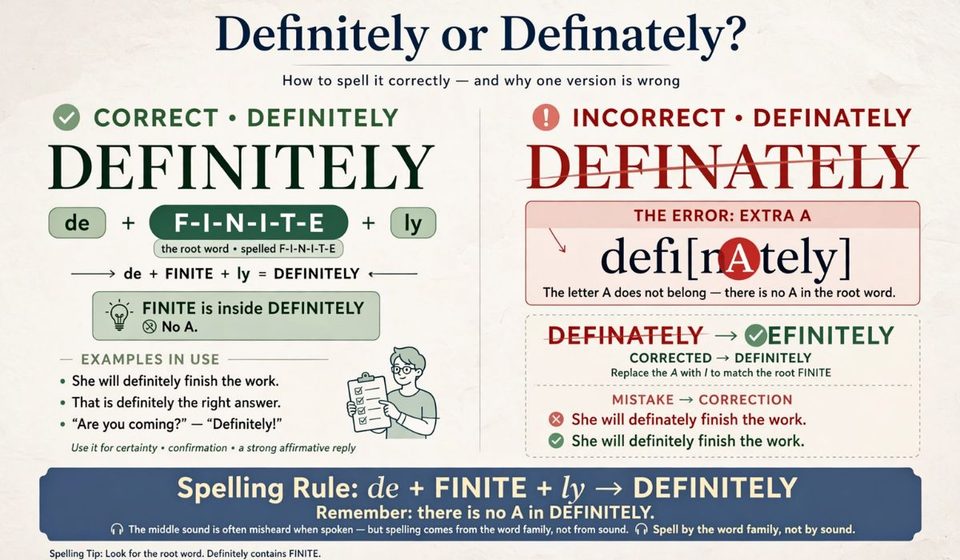
Look closely at the middle of the word: de-FINITE-ly. The word “finite” — meaning limited or bounded — sits right in the center. And “finite” is spelled with two clear “i”s, which most people already get right without thinking.
So the logic works like this:
- Start with finite (f-i-n-i-t-e)
- Add de to the front
- Add ly to the end
- Result: de-finite-ly
Because “finite” naturally has two “i”s, this trick makes the correct spelling almost automatic. Once you see finite hiding inside definitely, it’s hard to unsee it.
Other Helpful Mnemonics
If the “finite” trick doesn’t click for you, try one of these instead.
Definite + ly: Just remember that definitely is built from the adjective “definite” plus the suffix “-ly.” The stem never changes.
The “no A” rule: Definitely contains zero instances of the letter “a.” If you’ve written an “a” anywhere in the word, stop and fix it.
“In it” trick: The letters “in it” appear in the middle of the word — de-fin-it-ely. Picture something “in it” to jog your memory.
Sentence mnemonic: Some teachers use playful phrases built from the letter sequence D-E-F-I-N-I-T-E-L-Y to help students memorize it letter by letter, especially for younger learners.
Vowel pattern: Say the vowels out loud in order — e, i, i, e. Practicing this pattern a few times helps it stick.
Try a few and stick with whichever one sticks fastest for you. There’s no single “correct” mnemonic — only the one that works for your brain.
How Do You Pronounce Definitely?
Standard pronunciation, broken into syllables, looks like this:
def-uh-nit-lee (four syllables)
In more formal phonetic notation, it’s typically written as /ˈdɛfənɪtli/. A few notes on pronunciation:
The stress falls on the first syllable: DEF-uh-nit-lee
The second syllable’s vowel is reduced and unstressed
Pronunciation can vary slightly between American, British, and Australian English, but the reduced middle syllable is consistent across accents
This is exactly why relying on sound alone leads to spelling mistakes. The unstressed syllable simply doesn’t give your ear enough information to guess the correct letter. Spelling by word family — not by ear — is the more reliable method.
Definitely Versus Definately
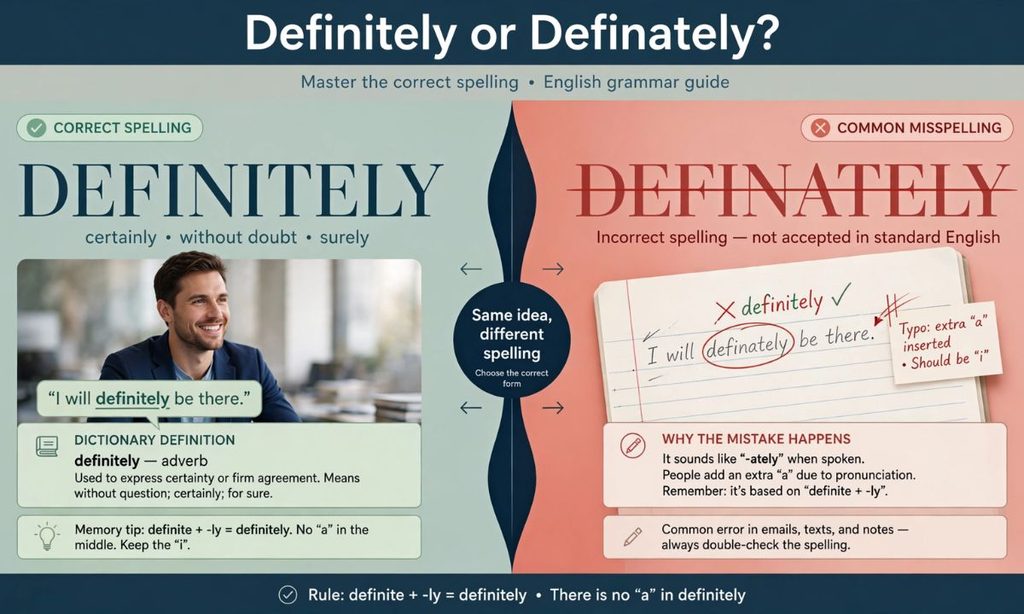
Let’s be direct about this one: “definately” is not a word. It doesn’t appear in any standard dictionary, and it has no accepted use in formal or informal English.
It’s a phonetic misspelling, caused entirely by the pronunciation issue explained above. Some style guides list it among the most commonly misspelled English words, alongside similar reduced-vowel errors.
Common variations of the same mistake include:
Definately
Definatly
Definetly
Definitly
Definently
Defanitely
Defenitely
Deffinitely
Definatley
Every one of these is incorrect. If you catch yourself typing any of them, stop, picture the word “finite,” and rebuild the spelling from there.
Definitely Versus Defiantly
This mix-up deserves its own section because it’s a different kind of mistake — a word-confusion problem, not just a typo.
Defiantly is a completely different, correctly spelled word. It means acting in a bold, resistant, or rebellious way.
| Word | Meaning | Example |
| Definitely | Certainly, without doubt. | She’s definitely coming to dinner. |
| Defiantly | Rebelliously, with resistance | He crossed his arms defiantly and refused to move. |
Here’s an interesting wrinkle: older spell-checking software sometimes “corrected” the typo “definately” into “defiantly” instead of “definitely.” That produced strange, unintended sentences — a writer meaning to express certainty would suddenly sound rebellious instead. This kind of wrong-but-real-word autocorrect substitution has a nickname in editing circles: the Cupertino effect, named after early spell-checkers that famously turned “co-operation” into “Cupertino.”
Quick memory trick for defiantly: notice the letters “ant” in the middle — defi-ANT-ly. Picture a stubborn ant refusing to budge. That’s defiance. Definitely, by contrast, has no “a” at all.
Definitely Versus Definitively
This pair is subtler, and even careful writers mix them up.
Definitely expresses certainty or confidence about something.
Definitively expresses a final, authoritative, or conclusive determination — often used in legal, scientific, or formal contexts.
Compare:
- “I’m definitely going to the meeting.” (personal certainty)
- “The court ruled definitively on the matter.” (final, authoritative decision)
If you’re describing your own confidence or agreement, use “definitely.” If you’re describing something that has been conclusively settled or proven, “definitively” is the stronger, more precise choice.
Common Misspellings and Error Types
It helps to understand why a mistake happens, not just that it happened. Here’s a breakdown of the typical error categories:
Wrong vowel: definately (a instead of i)
Missing letter: definatly (dropped “e”)
Dropped syllable: definetly, definitly
Extra letter: deffinitely (doubled consonant)
Wrong word entirely: defiantly (confused with a different word)
Letter transposition: definatley
Once you recognize which type of error you’re prone to, it’s much easier to proofread for it specifically.
Explore More Grammar Guide
Their, There, or They’re? Spelling Rules and Examples
“To Bad” or “Too Bad”: Which Spelling Is Correct?
Synonyms for Definitely
Depending on tone and context, you can swap in one of these:
For certainty:
- Certainly
- Surely
- Clearly
- Absolutely
- Without a doubt
- Unequivocally
- Positively
For casual agreement:
- For sure
- Of course
- Hands down
- By all means
Formal writing tends to favor “certainly,” “clearly,” or “without a doubt.” Casual speech leans on “for sure” or the shorthand “def,” which should be reserved for texting and never used in professional writing.
How to Use Definitely in a Sentence
Here are examples across different registers and tones:
Formal / academic:
- The results definitely support the original hypothesis.
- This policy will definitely affect small businesses.
Professional / email:
- I’ll definitely have the draft ready by Monday.
- We can definitely accommodate that request.
Casual conversation:
- That movie was definitely worth watching.
- I’m definitely getting pizza tonight.
Negative form:
- I definitely did not agree to that.
- This is definitely not the right approach.
As a one-word reply:
- “Want to grab coffee?” “Definitely.”
Spell-Checker and Autocorrect Limitations
Don’t fully outsource this to your software. Spell-checkers are helpful, but they have blind spots:
They may not flag “definately” if it resembles another accepted word
They sometimes swap it for the wrong word entirely, like “defiantly”
They rarely catch a correctly spelled word used in the wrong context
A quick proofreading habit: after accepting any autocorrect suggestion, reread the full sentence. Make sure the suggested word actually fits the meaning you intended. This one habit catches the majority of Cupertino-style errors before they reach a reader.
Quick Spelling Checklist
Run through this list any time you’re unsure:
- [ ] Does it contain the word “finite” in the middle? (de-finite-ly)
- [ ] Is there zero instances of the letter “a”?
- [ ] Are there exactly two “i”s?
- [ ] Does it end in “-ely,” not “-ately”?
- [ ] Are you confusing it with “defiantly” or “definitively”?
If you can check every box, you’ve spelled it correctly.
Frequently Asked Questions
Is it definitely or definately?
“Definitely” is correct; “definately” is a common misspelling with no dictionary recognition.
Is “definately” a real word?
No — it does not appear in any standard English dictionary.
How many “i”s are in definitely?
Two, and there is no letter “a” anywhere in the word.
What’s the difference between definitely and defiantly?
Definitely means “certainly,” while defiantly means “in a rebellious or resistant way” — they are unrelated in meaning.
What’s the easiest way to remember the spelling?
Notice that the word “finite” sits inside definitely: de-finite-ly.
Conclusion
Getting “definitely” right comes down to one simple shift in thinking: stop spelling it by ear and start spelling it by word family. The moment you see “finite” hiding inside “definitely,” the confusion tends to disappear for good. Keep the “no A” rule in your back pocket, double-check autocorrect suggestions before you hit send, and watch out for its rebellious look-alike, “defiantly.” With those habits in place, you’ll spell this word correctly — definitely — every single time.