
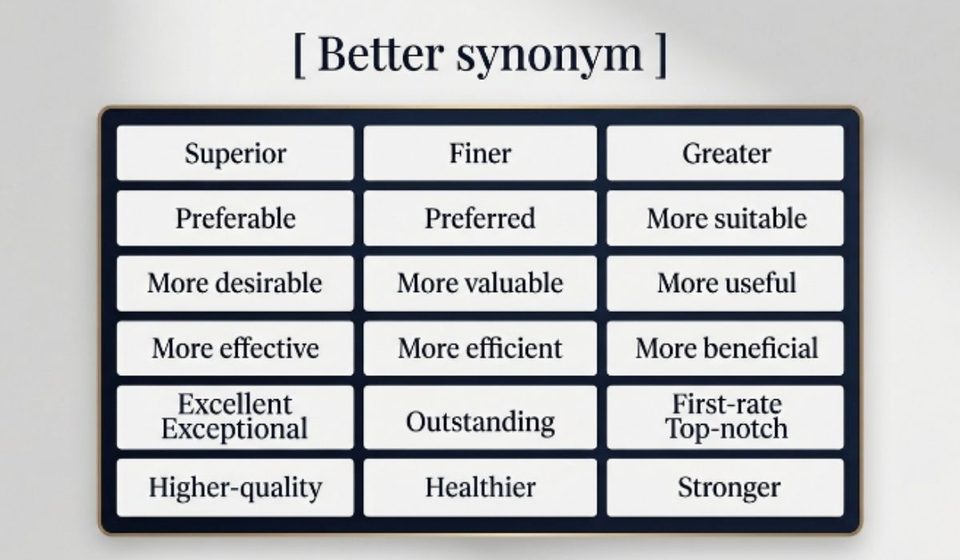

“Better” is one of the most overused words in English, and it rarely says what you actually mean. Do you mean higher quality, improved health, or greater skill? Each sense of “better” has its own family of substitutes, and picking the wrong one can blur your point. This guide sorts 35 alternatives by exactly what “better” means in your sentence.
What Is Another Word for “Better”?
There’s no single answer, because “better” changes meaning depending on context. Superior, finer, and preferable fit quality comparisons. Healthier and recovering fit health. More effective fits performance. Surpass and exceed fit competition. The right word depends on which sense of “better” you’re replacing — not on finding one universal substitute.
Better Meaning “Higher Quality”
Superior
Meaning: Of a higher standard or rank than something else.
Superior signals confidence and authority in a comparison. It works well in professional writing, but it can sound arrogant if overused in casual conversation, so save it for moments where the quality gap genuinely matters.
Examples:
- The new engine offers superior fuel efficiency.
- Her superior grasp of the material impressed the panel.
When It Fits: Product comparisons, performance reviews, and formal writing.
Finer
Meaning: Of subtly higher quality, often referring to detail or craftsmanship.
Finer suggests refinement rather than a dramatic improvement. It carries a quiet elegance that works well when describing craftsmanship, taste, or small but meaningful distinctions.
Examples:
- This fabric has a finer weave than the last one.
- He has a finer ear for melody than most composers.
When It Fits: Describing craftsmanship, taste, or subtle quality differences.
Exceptional
Meaning: Unusually excellent, well beyond the ordinary standard.
This word carries real weight — it tells the reader something stands far above average. Use it sparingly so it keeps its impact, especially in reviews, recommendations, or praise.
Examples:
- The chef delivered an exceptional tasting menu.
- Her exceptional work ethic earned her a promotion.
When It Fits: Reviews, recommendations, and standout achievements.
Preferable
Meaning: More desirable or suitable when choosing between options.
“Preferable” frames a choice rather than an absolute judgment. It softens a comparison, making it useful when you want to recommend something without dismissing the alternative entirely.
Examples:
- A direct flight is preferable to one with two layovers.
- Working remotely is preferable for her productivity.
When It Fits: Recommendations and comparisons between two reasonable options.
Premium
Meaning: Of a superior grade, often associated with higher price or exclusivity.
Premium carries a marketing tone. It works well in product and service writing but can feel like a sales pitch in everyday conversation, so use it deliberately.
Examples:
- The premium package includes priority support.
- They only serve premium ingredients in the restaurant.
When It Fits: Marketing copy and product descriptions.
First-Rate
Meaning: Of the highest class or quality available.
First-rate has a confident, slightly old-fashioned charm. It’s a strong compliment that reads well in both professional praise and everyday conversation.
Examples:
- The hotel offered first-rate service from check-in to checkout.
- He’s a first-rate negotiator in high-stakes deals.
When It Fits: Praise for service, skill, or performance.
Top-Notch
Meaning: Excellent, at the very top of its category.
Top-notch is casual and upbeat. It fits everyday conversation and informal writing far better than academic or legal contexts, where it would feel out of place.
Examples:
- The customer support team was top-notch all week.
- She did a top-notch job organizing the event.
When It Fits: Casual reviews, conversation, and informal praise.
Better Meaning: “Greater in Amount”
Greater
Meaning: Larger in size, degree, or amount.
Greater focuses purely on quantity or magnitude, not quality. It’s precise and neutral, which makes it a safe, clear choice in data-driven or analytical writing.
Examples:
- The second batch showed greater consistency in testing.
- She has a greater understanding of the market than her peers.
When It Fits: Analytical writing, reports, and quantity comparisons.
Larger
Meaning: Bigger in physical size or scale.
Larger is strictly about size. It avoids any quality implication, so it’s the right word whenever “better” is really just describing something bigger.
Examples:
- The company moved into a larger office this year.
- A larger sample size gave more reliable results.
When It Fits: Physical size comparisons and statistical writing.
More
Meaning: A greater quantity, extent, or degree.
More is the simplest, most flexible substitute for the quantity sense of “better.” It’s plain and direct, which makes it useful in nearly any everyday sentence about amount.
Examples:
- It takes more than an hour to reach downtown by bus.
- She spends more time reading than watching television.
When It Fits: Everyday comparisons of quantity, time, or degree.
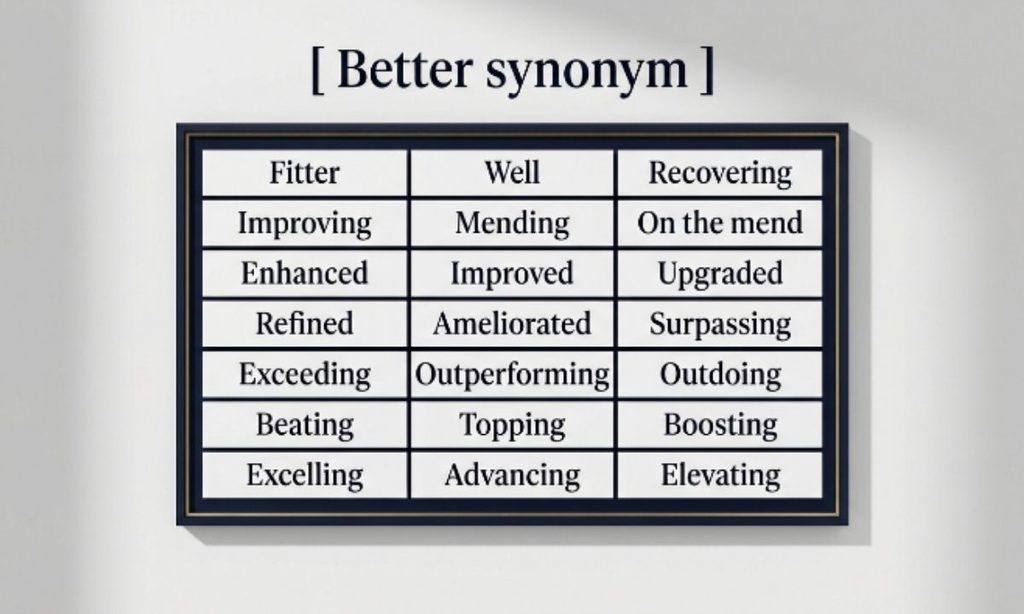
Better Meaning “Improved in Health”
Healthier
Meaning: In a more physically sound or improved condition.
Healthier speaks directly to physical wellbeing. It’s warm and reassuring, which makes it a natural choice when describing recovery, lifestyle changes, or general wellness.
Examples:
- She feels healthier since she started walking daily.
- A healthier diet reduced his blood pressure significantly.
When It Fits: Health updates, wellness writing, and casual conversation.
Fitter
Meaning: In improved physical condition, often related to strength or stamina.
Fitter emphasizes physical capability rather than general wellness. It fits fitness contexts especially well, where strength and endurance matter more than general recovery.
Examples:
- He’s fitter now than he was five years ago.
- Regular training made the whole team noticeably fitter.
When It Fits: Fitness, sports, and physical training contexts.
Recovering
Meaning: In the process of returning to good health after illness or injury.
Recovering signals progress without claiming full health yet. It’s honest and hopeful at the same time, which makes it useful in medical updates and personal news.
Examples:
- She’s recovering well after the surgery last week.
- The patient is recovering faster than doctors expected.
When It Fits: Medical updates and health-related conversations.
On the Mend
Meaning: Gradually recovering from illness or injury.
This phrase has a gentle, reassuring tone. It works well in informal conversation when you want to share good news about someone’s health without sounding clinical.
Examples:
- Grandpa’s on the mend after his knee surgery.
- The whole family was on the mend by the weekend.
When It Fits: Casual conversation and informal health updates.
Convalescent
Meaning: Recovering from illness, typically over an extended period of rest.
Convalescent is formal and somewhat clinical. It fits medical or historical writing better than casual speech, where it can sound overly technical.
Examples:
- The convalescent patient was moved to a quieter ward.
- He spent his convalescent weeks reading in the garden.
When It Fits: Medical writing and formal health narratives.
Better Meaning “More Effective”
More Effective
Meaning: Producing better results or achieving a goal more successfully.
This phrase is precise and outcome-focused. It works well in business and technical writing because it tells the reader exactly what improved: the result, not just the general quality.
Examples:
- The new marketing strategy proved more effective than the old one.
- A shorter meeting format is more effective for busy teams.
When It Fits: Business writing, strategy discussions, and performance reports.
More Efficient
Meaning: Achieving a result with less waste of time, effort, or resources.
More efficient highlights resourcefulness rather than just outcome. It’s especially useful in operational and technical writing, where saving time or cost is the real point.
Examples:
- The updated software runs a more efficient process.
- A more efficient workflow saved the team hours each week.
When It Fits: Operations, technology, and process-improvement writing.
More Beneficial
Meaning: Producing a greater positive effect or advantage.
This phrase emphasizes value gained rather than raw performance. It fits advice-driven writing, especially health, finance, or lifestyle content, where the benefit matters most.
Examples:
- Walking after meals is more beneficial than sitting still.
- A diversified portfolio is more beneficial in the long run.
When It Fits: Advice columns, health writing, and financial guidance.
More Suitable
Meaning: Better matched to a particular purpose or situation.
More suitable focuses on fit, not overall superiority. It’s a practical, neutral word that works well when recommending an option based on context rather than quality alone.
Examples:
- This chair is more suitable for long work sessions.
- A smaller car is more suitable for city driving.
When It Fits: Recommendations based on purpose or specific needs.
Better as an Adverb: Doing Something in a Better Way
More Thoroughly
Meaning: In a more complete or detailed manner.
This phrase signals depth and attention to detail. It works well in academic and professional writing when describing careful, comprehensive effort rather than speed.
Examples:
- She reviewed the contract more thoroughly this time.
- Please explain the process more thoroughly in your report.
When It Fits: Academic writing, reports, and detailed instructions.
More Skillfully
Meaning: With greater ability or technique.
More skillfully highlights craft and expertise. It’s a strong compliment in creative or technical fields, where execution and technique matter as much as the result.
Examples:
- The pianist played the piece more skillfully than before.
- He handled the negotiation more skillfully this time.
When It Fits: Creative, technical, or performance-based praise.
More Advantageously
Meaning: In a way that creates a favorable position or benefit.
This phrase is strategic in tone. It fits business and competitive contexts where the goal is gaining ground, not just doing something well.
Examples:
- The company positioned its product more advantageously this quarter.
- She negotiated more advantageously than her competitors.
When It Fits: Business strategy and competitive positioning.
Better as a Verb: Synonyms for Improving Something
Improve
Meaning: To make or become better in quality, condition, or performance.
Improve is the most natural, all-purpose replacement for “better” as a verb. It works in nearly any context, from casual conversation to formal reports, without sounding forced.
Examples:
- The team worked hard to improve customer satisfaction scores.
- Practicing daily helped her improve her writing skills.
When It Fits: Everyday speech and general professional writing.
Enhance
Meaning: To increase the quality, value, or attractiveness of something already good.
Enhance implies building on an existing strength rather than fixing a flaw. It’s a polished word that fits marketing, design, and professional writing especially well.
Examples:
- The new lighting enhances the room’s atmosphere.
- Adding data visuals can enhance a presentation significantly.
When It Fits: Marketing, design, and professional presentations.
Refine
Meaning: To improve something by making small, precise adjustments.
“Refine” suggests careful, incremental improvement rather than a major overhaul. It’s useful when describing polish, precision, or the fine-tuning stage of a project.
Examples:
- She refined her pitch after getting feedback from mentors.
- The team refined the design over several rounds of testing.
When It Fits: Editing, design, and iterative improvement work.
Ameliorate
Meaning: To make a difficult, unjust, or unpleasant situation more bearable.
Ameliorate carries a formal, almost academic tone. It fits situations involving hardship or systemic problems, rather than everyday quality improvements.
Examples:
- New policies helped ameliorate working conditions in the factory.
- The program aims to ameliorate poverty in rural areas.
When It Fits: Formal, academic, or policy-related writing.
Upgrade
Meaning: To improve something, often by replacing it with a newer or superior version.
“Upgrade” implies a clear before-and-after change, often involving technology or systems. It’s direct and modern, making it a natural fit for tech and product writing.
Examples:
- We upgraded our software to improve loading speed.
- She upgraded her laptop before starting the new job.
When It Fits: Technology, products, and system improvements.
Rectify
Meaning: To correct or fix a mistake or problem.
Rectify focuses on fixing something wrong rather than general improvement. It has a formal tone that suits legal, business, or corrective writing.
Examples:
- The company moved quickly to rectify the billing error.
- He rectified the mistake before anyone else noticed.
When It Fits: Formal writing about correcting errors or problems.
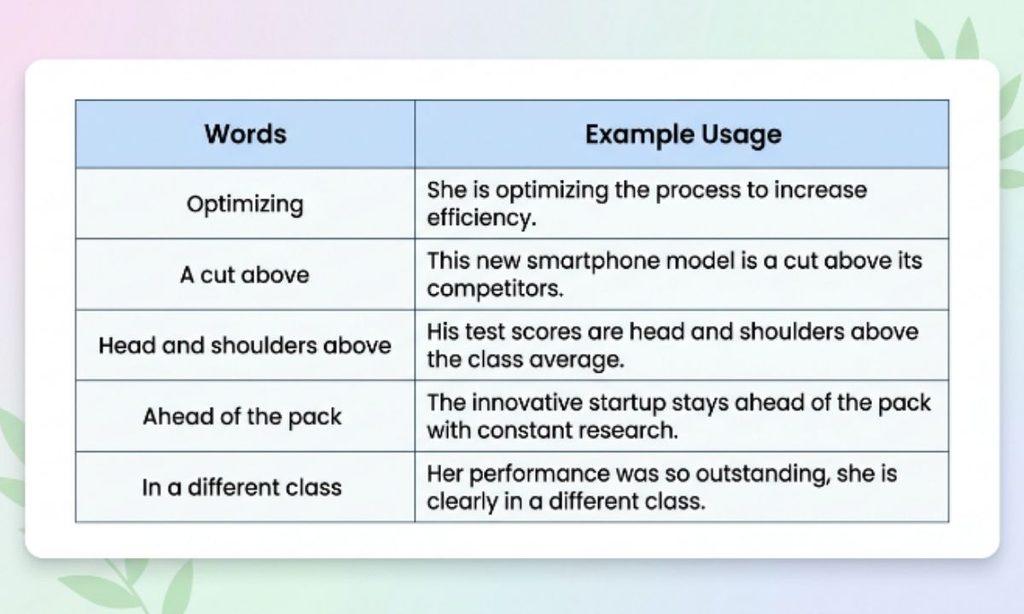
Better Meaning: “Outperform”
Surpass
Meaning: To go beyond or exceed a previous level, standard, or competitor.
Surpass has a triumphant tone. It works well when describing records, achievements, or milestones, giving the sentence a clear sense of accomplishment.
Examples:
- Sales this quarter surpassed every previous record.
- Her final score surpassed everyone else’s in the class.
When It Fits: Achievements, records, and performance milestones.
Exceed
Meaning: To go beyond a set expectation, limit, or requirement.
“Exceed” is common in business and performance writing. It’s precise and measurable, which makes it ideal when comparing results against a specific target.
Examples:
- The project exceeded its original budget projections.
- Her performance exceeded her manager’s expectations.
When It Fits: Business reports and performance evaluations.
Outperform
Meaning: To perform better than someone or something else in direct comparison.
Outperform is competitive and results-focused. It’s a strong fit for sports, finance, and business writing where direct comparison drives the point home.
Examples:
- The new model outperformed its predecessor in every test.
- Their team outperformed rivals throughout the season.
When It Fits: Sports, finance, and competitive business writing.
Eclipse
Meaning: To surpass someone or something so completely that it overshadows them.
Eclipse suggests total dominance. It’s a vivid, almost dramatic word, useful when one achievement or figure completely overshadows another in significance.
Examples:
- Her debut album eclipsed the success of her first single.
- The new stadium eclipsed the old one in every respect.
When It Fits: Dramatic or narrative writing about major achievements.
Better as a Noun
Elder
Meaning: A person of higher rank, status, or seniority, often due to age or experience.
Elders carry respect and social weight. It fits situations involving hierarchy, tradition, or generational authority, rather than everyday comparisons of ability.
Examples:
- The village elders made the final decision on the dispute.
- He was raised to respect his elders in every conversation.
When It Fits: Discussions of hierarchy, tradition, or generational respect.
Upper Hand
Meaning: A position of advantage or control in a competitive situation.
This phrase captures a power shift. It’s vivid and easy to picture, making it a natural fit for storytelling, sports commentary, and business strategy writing.
Examples:
- Negotiators gained the upper hand after presenting new data.
- The home team had the upper hand for most of the match.
When It Fits: Competitive, strategic, or narrative writing.
Edge
Meaning: A slight but meaningful advantage over competitors or alternatives.
Edge is short, punchy, and modern. It works especially well in business and marketing writing, where even a small advantage is worth highlighting.
Examples:
- Their pricing strategy gave them an edge over competitors.
- A strong resume can give job seekers a real edge.
When It Fits: Business writing, marketing, and competitive comparisons.
Better Synonyms by Tone
| Tone | Example Words |
| Everyday and Neutral | better, improve, more, greater |
| Professional and Business | more effective, upgrade, edge, exceed |
| Academic and Formal | ameliorate, rectify, more thoroughly |
| Informal and Conversational | top-notch, on the mend, first-rate |
| Promotional and Marketing | premium, enhance, superior |
Better vs. Improve vs. Ameliorate
These three words look similar but carry different weight.
Better (verb) often describes making an already acceptable situation less unsatisfying—” He tried to better his living conditions.”
“Improve” usually implies fixing a recognized lack or need — “she wants to improve her writing.”
Ameliorate is formal and typically applies to harsh or unjust conditions — “the reforms helped ameliorate poverty.”
Choosing between them comes down to formality and severity: use “improve” for everyday change, and save “ameliorate” for serious or systemic problems.
Common Phrases With “Better”
- For the better — describes a positive change: “The new policy changed things for the better.”
- Get the better of — to gain an advantage over someone: “Nerves got the better of her before the interview.”
- Better off — in a more favorable position: “They’re better off renting for now.”
- Had better — a strong recommendation or warning: “You had better leave before traffic builds up.”
Words to Use Carefully
Some “better” substitutes carry hidden risk.
- Superlative and par excellence sound elevated and can feel out of place in casual writing.
- Top-notch and a cut above are conversational and may seem too casual in formal reports.
- Ameliorate can sound overly academic if used for minor, everyday improvements.
- Vague claims like “better results” or “better service” say little on their own — specify what actually improved, such as “faster response times” or “lower error rates.”
Frequently Asked Questions
What is a formal synonym for better?
“Superior,” “preferable,” and “ameliorate” (as a verb) all work well in formal writing.
What is another word for better quality?
“Superior,” “finer,” and “premium” all describe higher quality.
What is another word for feeling better?
“Recovering,” “on the mend,” and “improving” all describe a positive change in health.
What is the difference between “better” and “improve”?
“Better” often describes making something already acceptable less unsatisfying, while “improve” usually implies fixing a clear lack or need.
Is better an adjective, adverb, noun, or verb?
“Better” can function as all four, depending on the example: “a better plan” (adjective), “she sings better” (adverb), “get the better of” (noun), and “to better oneself” (verb).
Conclusion
“Better” is flexible, but that flexibility is exactly why it needs a precise substitute in strong writing. Once you separate the quality, quantity, health, performance, and advantage senses of “better,” choosing the right word—whether it’s “superior,” “more effective,” “recovering,” or outperform — becomes a quick, confident decision rather than a guessing game.

[…] Better Synonym Guide: 35 Precise Alternatives by Meaning […]