
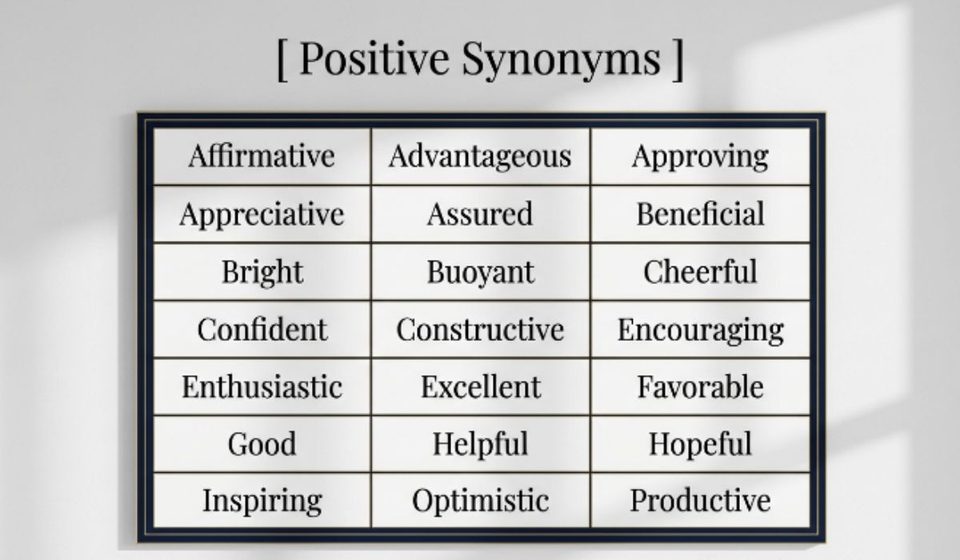

Ever notice how “positive” gets used for everything? A good mood, a proven fact, a helpful comment, a “yes” vote. One word, five different jobs. That’s exactly why picking the right synonym matters more than most people realize.
What Does “Positive” Mean?
“Positive” isn’t a single idea. It shifts meaning depending on what you’re describing.
Here are the core senses people actually mean when they say it:
An attitude or mood that’s optimistic and upbeat.
A result or outcome that’s beneficial.
A feeling of certainty about something you believe.
Proof or evidence that removes doubt.
An affirmative answer, like a “yes” or approval.
A technical reading, like a test that detected something.
A noun for advantages, as in “the positives and negatives.”
Swapping in the wrong synonym for the wrong meaning is where most writing goes sideways. “Beneficial” doesn’t work for a certainty statement. “Conclusive” doesn’t work for describing someone’s mood. Context decides the word.
Why Context Matters When Choosing a Synonym
Before picking a replacement, ask what you’re actually describing:
Is it an emotion or outlook? Use words like “optimistic” or “hopeful.”
Is it a result or effect? Use beneficial, productive, or advantageous.
Is it personal belief? Use “confident,” “certain,” or “assured.”
Is it proof? Use conclusive, definitive, or confirmed.
Is it an agreement? Use affirmatively or approvingly.
Is it a scientific reading? Use a detector or a reactant.
Getting this right makes your writing sound more precise, not just more varied.
Best Synonyms for Positive by Meaning
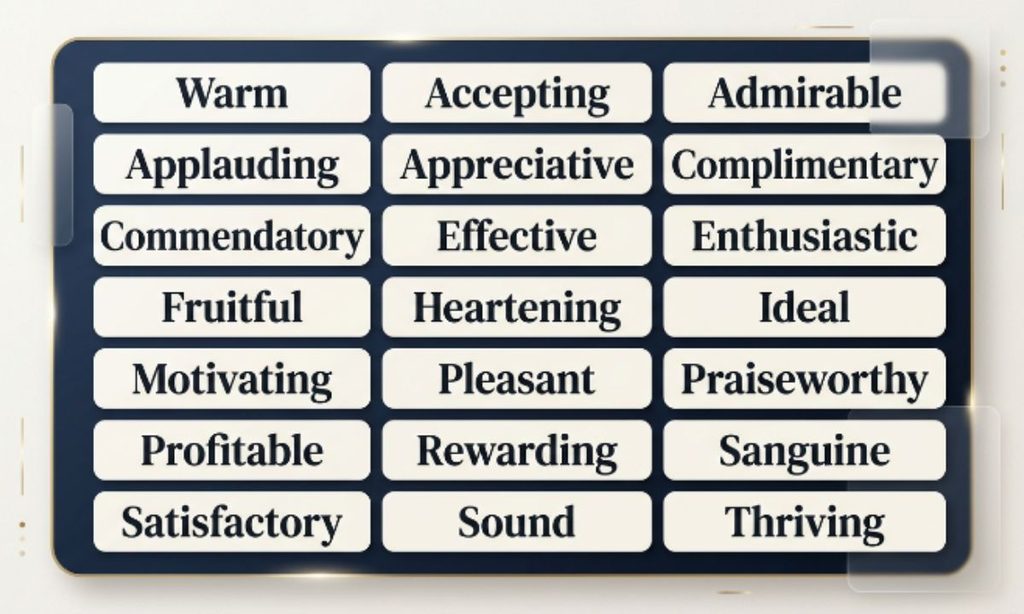
Below are 35 alternatives, grouped by the meaning they best serve. Each one includes what it really conveys, how it lands emotionally, and when it fits naturally.
Favorable
Meaning: Favorable describes something that works in someone’s favor, like a review, decision, or set of conditions.
It carries a formal, measured tone. Using favorable instead of positive signals shows that you’re evaluating something objectively, not just expressing enthusiasm. It works well in business, legal, and journalistic writing where neutrality matters.
- The board reached a favorable decision on the merger.
- Investors reacted to the favorable earnings report.
When It Fits: Business updates, reviews, or any situation involving a judgment call.
Encouraging
Meaning: Encouraging describes something that gives someone hope or motivation to keep going.
This word adds warmth that “positive” often lacks. It suggests support directed at a person, not just a neutral observation. Use it when you want your writing to feel personally motivating rather than clinical.
- Her coach gave encouraging feedback after the tough loss.
- The early test results were encouraging for the research team.
When It Fits: Coaching, mentorship, or any message meant to lift someone’s spirits.
Supportive
Meaning: Supportive describes an attitude or response that backs someone up, emotionally or practically.
It emphasizes relationship and care over simple approval. Supportive language tells the reader that someone is standing behind them, which builds trust faster than a generic “positive” comment ever could.
- Her family stayed supportive throughout the whole process.
- The manager was supportive of the team’s new idea.
When It Fits: Personal relationships, workplace feedback, and team dynamics.
Complimentary
Meaning: “Complimentary” describes praise or a favorable remark about someone’s work or qualities.
This word leans formal and is often used in professional or written feedback. It works especially well when you want to describe specific praise rather than a general good mood.
- The reviewer left a complimentary note about the service.
- His complimentary remarks boosted the team’s morale.
When It Fits: Reviews, performance feedback, or written recognition.
Appreciative
Meaning: “Appreciative” describes a response that shows gratitude or recognition of value.
It shifts the focus toward acknowledgment rather than simple approval. This word works well when someone isn’t just saying “good job” but genuinely recognizing effort or worth.
- The audience gave an appreciative round of applause.
- She wrote an appreciative message thanking her mentor.
When It Fits: Thank-you notes, recognition speeches, and gratitude-focused writing.
Optimistic
Meaning: “Optimistic” describes a mindset that expects good outcomes in the future.
This is one of the clearest replacements when “positive” refers to someone’s outlook. It’s forward-looking by definition, which makes it more precise than a generic “positive attitude.”
- She stayed optimistic despite the setbacks.
- Analysts are optimistic about next quarter’s growth.
When It Fits: Describing someone’s mindset, forecasts, or hopeful expectations.
Upbeat
Meaning: Upbeat describes a cheerful, energetic tone or mood.
It’s more casual than optimistic and works well in everyday conversation. Upbeat suggests visible energy, not just quiet hope, so it’s a good fit when describing someone’s demeanor.
- He gave an upbeat summary of the trip.
- The whole office had an upbeat vibe on Friday.
When It Fits: Casual writing, social settings, and descriptions of tone or mood.
Hopeful
Meaning: “Hopeful” describes a feeling of wanting and expecting something good to happen.
It carries slightly more vulnerability than optimism. Hopeful acknowledges uncertainty while still leaning toward a good outcome, which makes it feel more honest in emotional writing.
- They remained hopeful about the surgery’s success.
- We’re hopeful the new policy will help.
When It Fits: Personal stories, uncertain situations, and emotionally honest writing.
Buoyant
Meaning: Buoyant describes a lively, resilient kind of optimism that bounces back from setbacks.
This word adds a sense of energy and recovery that flatter synonyms miss. It works well for describing markets, moods, or people who stay upbeat despite difficulty.
- The team’s buoyant spirit carried them through the playoffs.
- Consumer confidence remained buoyant despite the slowdown.
When It Fits: Describing resilience, market conditions, or a team’s morale.
Bright
Meaning: Bright describes a promising or hopeful outlook, especially about the future.
It’s a simple, everyday word that avoids sounding formal. Bright works especially well in short, punchy statements about potential or promise.
- Her future looks bright after the promotion.
- Things are looking bright for the new product line.
When It Fits: Everyday conversation and short, optimistic statements.
Beneficial
Meaning: Beneficial describes something that produces a good or helpful effect.
This is the go-to replacement when “positive” refers to a result or impact, not a feeling. It’s precise and works well in both academic and professional writing.
- Regular exercise is beneficial for long-term health.
- The policy change proved beneficial for small businesses.
When It Fits: Describing effects, results, or outcomes of an action or decision.
Constructive
Meaning: “Constructive” describes feedback or criticism that’s meant to help someone improve.
This word carries a specific promise: the input is useful, not just kind. It’s important not to confuse constructive with purely complimentary, since constructive feedback can include criticism as long as it’s helpful.
- Her manager gave constructive feedback on the report.
- The workshop focused on constructive criticism techniques.
When It Fits: Performance reviews, editing feedback, and improvement-focused conversations.
Productive
Meaning: “Productive” describes something that leads to useful results or progress.
It works well when describing meetings, conversations, or efforts that accomplished something concrete. “Productive” is more results-oriented than “beneficial,” which can describe passive effects too.
- We had a productive discussion about next steps.
- The team’s productive week moved the project forward.
When It Fits: Meetings, work sessions, and any activity measured by output.
Advantageous
Meaning: “Advantageous” describes something that gives someone an edge or benefit over an alternative.
This word fits situations involving comparison or strategy. It signals a competitive or practical benefit rather than an emotional or moral one.
- The new location is advantageous for shipping costs.
- Signing early was advantageous for the company.
When It Fits: Business strategy, negotiations, and comparative decisions.
Worthwhile
Meaning: “Worthwhile” describes something that justifies the time, effort, or cost put into it.
It carries a practical, grounded tone. “Worthwhile” works well when you want to affirm that an effort paid off, without sounding overly enthusiastic.
- The training was worthwhile despite the long hours.
- It’s a worthwhile investment for the long run.
When It Fits: Reflecting on effort, time, or investment decisions.
Sound
Meaning: Sound describes something well-founded, reasonable, or reliable, often used for decisions or advice.
This word signals judgment and reliability rather than enthusiasm. It’s a strong fit for professional or technical writing where credibility matters more than tone.
- The committee made a sound financial decision.
- Her advice was sound and well-researched.
When It Fits: Financial, legal, or technical writing involving judgment calls.
Confident
Meaning: “Confident” describes a strong personal belief in something, often based on experience or evidence.
It’s the clearest replacement when “positive” describes certainty about your own judgment. “Confident” implies self-assurance, which reads differently than simple factual certainty.
- She felt confident about her presentation.
- The coach was confident the team would win.
When It Fits: Describing personal belief, self-assurance, or expectations.
Certain
Meaning: “Certain” describes an absence of doubt, usually because the evidence clearly supports it.
This word is more neutral than confident, since it doesn’t necessarily involve personal feeling. It’s the go-to word when “positive” is being used to mean “sure.”
- He was certain he’d left the keys at home.
- We’re certain the results are accurate.
When It Fits: Statements of fact, confirmations, and everyday certainty.
Assured
Meaning: “Assured” describes confidence that comes from reassurance or a guarantee, often given by someone else.
It suggests a slightly more formal or externally validated kind of certainty than “confident.” Use it when the certainty has some outside backing, not just personal instinct.
- She felt assured after speaking with the doctor.
- Investors were assured the funds were secure.
When It Fits: Situations involving reassurance, guarantees, or outside confirmation.
Convinced
Meaning: “Convinced” describes a state of being persuaded, usually after considering evidence or an argument.
This word implies a process: someone moved from doubt to belief. It’s useful when you want to show that certainty was earned, not just assumed.
- The jury was convinced by the evidence.
- I’m convinced this is the right approach.
When It Fits: Persuasive writing, arguments, and decision-making narratives.
Resolute
Meaning: Resolute describes firm, unwavering determination or certainty, even under pressure.
It adds strength and steadiness that plain “positive” doesn’t capture. This word works best when describing someone holding firm to a belief or decision despite challenges.
- He remained resolute despite the criticism.
- Her resolute leadership steadied the team.
When It Fits: Leadership writing, challenges, and descriptions of firm resolve.
Conclusive
Meaning: “Conclusive” describes evidence or results that settle a question beyond reasonable doubt.
This is the strongest word for describing proof. It shouldn’t be swapped with favorable or optimistic meanings, since “conclusive” is strictly about evidence, not attitude.
- The lab tests were conclusive.
- Researchers found conclusive proof of the link.
When It Fits: Scientific findings, investigations, and evidence-based claims.
Definitive
Meaning: Definitive describes something final and authoritative, leaving no room for further debate.
It’s slightly stronger than conclusive in tone, often used for rulings, verdicts, or authoritative statements. It signals that the matter is closed.
- The court issued a definitive ruling.
- This is the definitive guide to the topic.
When It Fits: Legal writing, authoritative statements, and final decisions.
Unequivocal
Meaning: Unequivocal describes a statement or fact that’s completely clear, with no ambiguity at all.
This word works well when you want to emphasize that there’s zero room for misinterpretation. It’s stronger and more formal than “clear” or “certain.”
- Her answer was unequivocal.
- The data provided unequivocal support for the theory.
When It Fits: Formal writing, statements, and situations requiring zero ambiguity.
Indisputable
Meaning: Indisputable describes a fact so well-established that it can’t reasonably be argued against.
It’s a strong word for evidence-based writing, implying that any counterargument would fail. Use it carefully, since overuse can make writing sound overly absolute.
- The results were indisputable.
- It’s an indisputable fact that costs rose.
When It Fits: Fact-based arguments and strongly supported claims.
Confirmed
Meaning: “Confirmed” describes something verified as true, often through testing, investigation, or an official source.
This word works especially well for technical or scientific writing, where “positive” often just means something was detected or verified.
- The diagnosis was confirmed by a second test.
- Officials confirmed the report was accurate.
When It Fits: Medical, technical, and news-related confirmations.
Affirmative
Meaning: “Affirmative” describes a “yes” response, agreement, or approval, especially in formal or procedural settings.
This word fits the noun sense of “positive” when it means an approving answer or vote. It’s more formal than a plain “yes.”
- The committee gave an affirmative vote.
- She responded in the affirmative.
When It Fits: Formal responses, votes, and procedural agreements.
Agreeable
Meaning: “Agreeable” describes something acceptable or pleasant to accept or a person willing to go along with something.
It’s a softer, more everyday word for approval. It works well for describing personalities or casual agreements, not formal proceedings.
- He seemed agreeable to the new schedule.
- The terms were agreeable to both sides.
When It Fits: Casual negotiations, personality descriptions, and informal agreement.
Approving
Meaning: Approving describes a reaction that expresses support or acceptance of something.
This word works well for describing a response or expression, like a nod or comment, rather than a formal decision. It’s warmer than “affirmative” but less personal than “supportive.”
- She gave an approving nod.
- Critics were approving of the film’s ending.
When It Fits: Reactions, reviews, and expressions of acceptance.
Reassuring
Meaning: Reassuring describes something that reduces worry or restores confidence.
This word focuses on the emotional relief a message provides, not just its content. It’s especially useful when the “positive” news is meant to calm someone down.
- The doctor’s reassuring tone put her at ease.
- It was reassuring to hear the flight was on time.
When It Fits: Comforting messages, health updates, and calming communication.
Sanguine
Meaning: Sanguine describes a cheerfully confident and optimistic temperament, especially in difficult situations.
It’s a more literary or formal word than “optimistic,” often used to describe someone’s underlying disposition rather than a passing mood. Use it sparingly in casual writing.
- He remained sanguine despite the delays.
- Her sanguine outlook rarely wavered.
When It Fits: Formal, literary, or character-focused writing.
Effective
Meaning: Effective describes something that successfully produces the intended result.
This word is precise and outcome-focused, useful when “positive” refers to something working as planned. It avoids vague praise in favor of measurable success.
- The new strategy proved effective.
- Her effective communication resolved the conflict quickly.
When It Fits: Business results, strategies, and measurable outcomes.
Detectable
Meaning: Detectable describes something that can be measured, identified, or found through testing.
This word belongs to the technical and scientific sense of “positive,” like a positive test result. It’s neutral, not automatically good or bad, and should replace “positive” carefully in medical contexts.
- Trace amounts were detectable in the sample.
- The virus was detectable within 48 hours.
When It Fits: Lab results, medical testing, and scientific measurement.
Reactive
Meaning: Reactive describes a substance or test result that shows a response during testing.
Like “detectable,” this word is neutral and technical. It’s specifically useful in medical or chemical contexts where “positive” doesn’t imply anything favorable at all.
- The sample tested reactive for the antibody.
- A reactive result requires further confirmation.
When It Fits: Medical and laboratory testing contexts.
Upside
Meaning: “Upside” describes a benefit or advantage, often used as a noun the way “positives” describes good points.
This word fits informal writing where you’re listing pros and cons. It’s a natural swap for “the positives” when discussing benefits versus drawbacks.
- The main upside of the plan is lower cost.
- There’s an upside to working remotely.
When It Fits: Pros-and-cons discussions and casual business writing.
Positive vs. Similar Words: Quick Comparisons
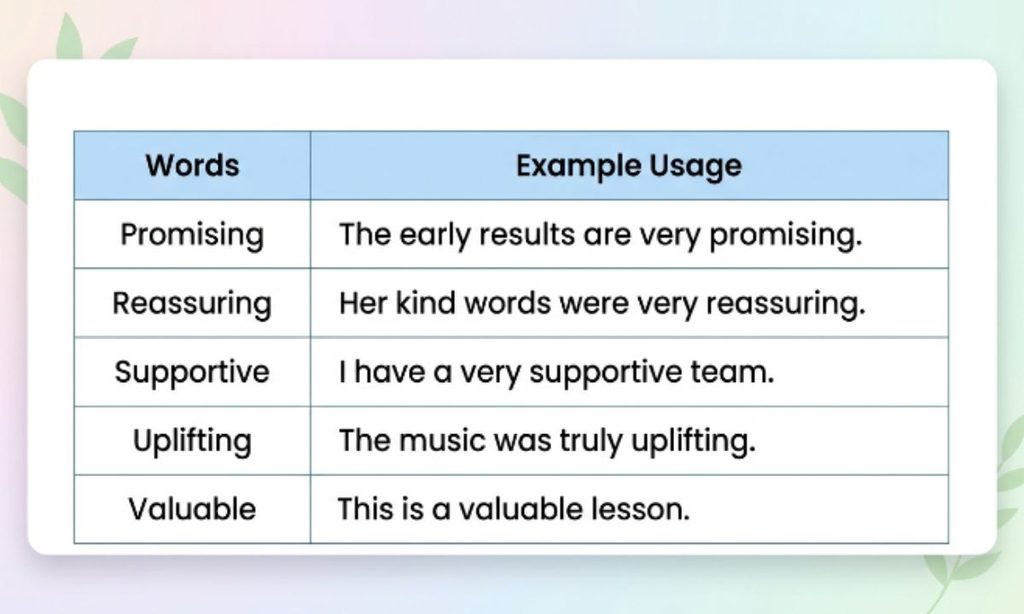
Some synonyms get confused with each other constantly. Here’s a fast way to tell them apart.
| Word Pair | Key Difference |
| Positive vs. Optimistic | “Positive” is broad; “optimistic” specifically means expecting good things in the future. |
| Positive vs. Favorable | “Favorable” is more formal and often used for decisions, reviews, or conditions. |
| Positive vs. Confident | Confident is personal belief in yourself; positive can describe anything, including facts. |
| Positive vs. Constructive | Constructive can include criticism, as long as it helps; “positive” implies only approval. |
| Positive vs. Conclusive | Conclusive is strictly about proof and evidence, not mood or attitude. |
Antonyms of “Positive” by Meaning
Opposites help clarify meaning just as much as synonyms do:
- Opposite of favorable: unfavorable, adverse
- Opposite of optimistic: pessimistic, doubtful
- Opposite of beneficial: harmful, damaging
- Opposite of certain: uncertain, doubtful
- Opposite of conclusive: inconclusive, ambiguous
- Opposite of affirmative: negative, dissenting
Frequently Asked Questions
What is another word for positive?
Common alternatives include favorable, beneficial, optimistic, certain, and affirmative, depending on the exact meaning you need.
What is a formal synonym for positive?
Favorable, conclusive, and affirmative all work well in formal or professional writing.
What is another word for positive feedback?
Constructive, complimentary, or encouraging feedback are strong alternatives depending on the tone you want.
What is a synonym for positive impact?
“Beneficial impact” or “favorable impact” both capture the same meaning clearly.
Can “positive” mean “certain” or “proven”?
Yes, in that sense the better replacements are certain, confident, conclusive, or confirmed, depending on the context.
Conclusion
“Positive” works fine in casual conversation, but strong writing needs precision, and precision means matching the word to the exact meaning you intend. Whether you’re describing a mood, a result, a fact, or a “yes,” there’s a sharper word available than the catch-all default. Use the 35 alternatives above to make your writing clearer, more specific, and a lot less repetitive.


[…] 35 Positive Synonyms: Better Words for Every Context […]