
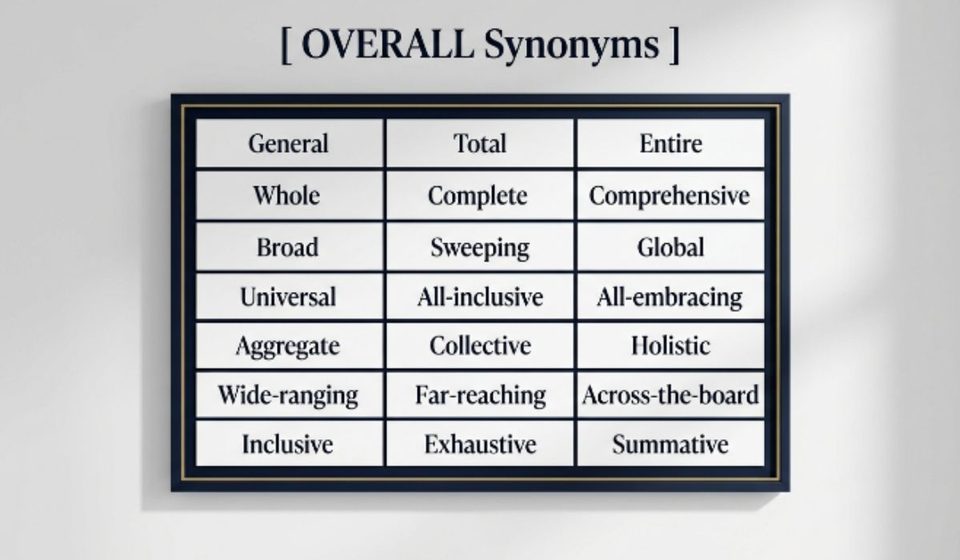

Say “overall” enough times in one document, and it starts to feel like a filler word. But it’s actually doing several different jobs at once, and most writers never notice the switch. Once you see the pattern, choosing a sharper word becomes easy.
What Does “Overall” Mean?
“Overall” isn’t one word with one job. It shifts meaning depending on what you’re summarizing.
Here are the core senses people actually mean when they use it:
As a whole or in general — a summary judgment across everything considered.
Total, entire, or complete — covering every part with nothing left out.
Broad or wide-ranging—general in scope, not detailed.
Prevailing or majority-held — the common or dominant view.
Collectively or together—describing a combined, system-wide action.
Mostly or mainly — a qualified generalization, not an absolute one.
Swap the wrong synonym into the wrong sense and your sentence loses precision fast. “Comprehensive” doesn’t work where you mean “mostly.” “Prevailing” doesn’t work where you mean “entire.” Context decides the word.
Why Context Matters When Choosing a Synonym
Before replacing “overall,” ask what you’re actually describing:
Are you summarizing a conclusion? Use generally, on the whole, or all in all.
Are you describing complete coverage? Use total, entire, or comprehensive.
Are you describing scope without detail? Use broad, sweeping, or far-reaching.
Are you describing a majority view? Use prevailing, predominant, or widespread.
Are you describing combined action? Use collectively or across the board.
Are you making a qualified statement? Use mostly, mainly, or largely.
This distinction is what separates a precise sentence from a vague one.
Best Synonyms for Overall by Meaning
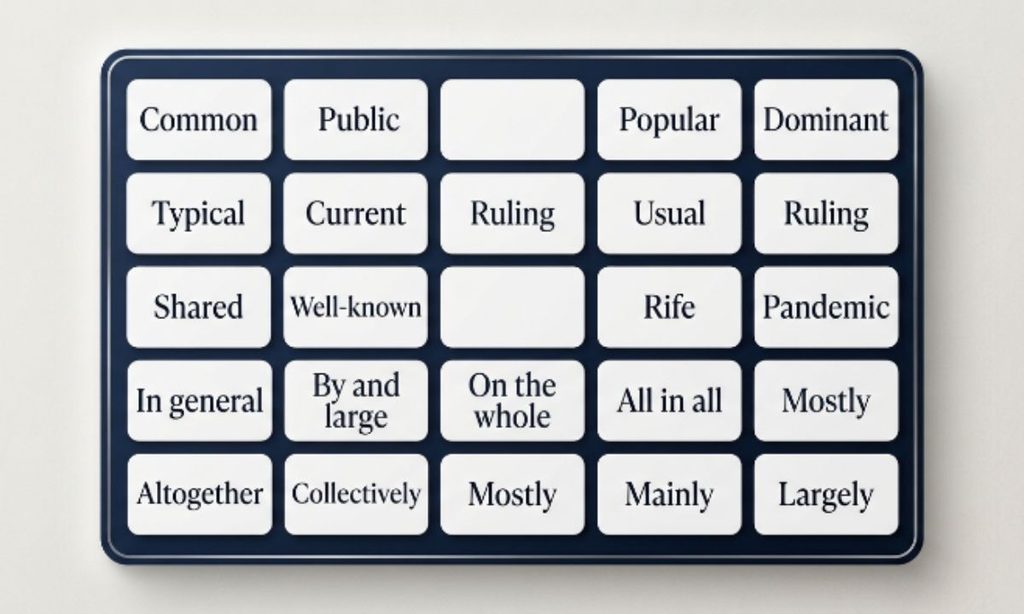
Below are 40 alternatives, grouped by the sense they best serve. Each one includes its real meaning, the tone it adds, and when it fits naturally.
Generally
Meaning: Generally describes a broad statement that’s typically true, without claiming it applies in every case.
It softens a claim just enough to sound accurate rather than absolute. Using “generally” instead of “overall” signals that you’re speaking in broad strokes on purpose. It works well in everyday writing and casual analysis.
- Generally, the product performs well under heavy use.
- The weather here is generally mild in spring.
When It Fits: Everyday writing, casual summaries, and soft generalizations.
On the Whole
Meaning: “On the whole” describes a conclusion reached after weighing everything together.
This phrase leans slightly more formal than “generally” and works well when you’re wrapping up a mixed set of observations. It signals a balanced judgment rather than a single impression.
- On the whole, the trip went smoothly.
- On the whole, customer feedback has been positive.
When It Fits: Summaries, reviews, and closing statements in reports.
All in All
Meaning: “All in all” describes a final, summarizing judgment after considering the details.
It has a conversational, wrap-up feel that works better in speech or informal writing than in academic text. It tells the reader you’re closing the topic with a bottom-line take.
- All in all, it was a good year for the company.
- All in all, the event went better than expected.
When It Fits: Casual writing, spoken summaries, and closing remarks.
By and Large
Meaning: By and large describes something true in most cases, with minor exceptions.
This phrase carries a slightly old-fashioned but still common tone. It works well when you want to acknowledge exceptions exist without listing them.
- By and large, the reviews have been favorable.
- By and large, employees support the new policy.
When It Fits: General statements that allow for minor exceptions.
Altogether
Meaning: “Altogether” describes something considered as a complete whole, or entirely.
It can mean “in total” or “completely,” so context matters. This word feels slightly formal and works well in both summary statements and emphatic ones.
- Altogether, the project took six months.
- The plan was altogether different from what we expected.
When It Fits: Totals, summaries, and emphatic statements.
In Essence
Meaning: In essence, it describes the core or fundamental point, stripped of detail.
This phrase signals that you’re distilling something down to its most important idea. It works well when you want to simplify a complex explanation into one clear takeaway.
- In essence, the plan reduces costs while maintaining quality.
- In essence, she disagreed with the entire proposal.
When It Fits: Simplifying complex ideas or summarizing an argument.
Essentially
Meaning: Essentially describes the fundamental truth of something, setting aside minor details.
It’s a precise way to say “at its core” without extra words. This works well in both technical and everyday writing when you want to cut straight to the point.
- Essentially, the two proposals offer the same outcome.
- The device is essentially a smaller version of the original.
When It Fits: Technical explanations and simplifying comparisons.
All Things Considered
Meaning: “All things considered” describes a conclusion reached after weighing every relevant factor.
This phrase explicitly signals thoroughness. It works especially well when your conclusion might seem surprising without the reminder that you accounted for everything first.
- All things considered, the decision was the right one.
- All things considered, the launch went well.
When It Fits: Balanced conclusions and decisions involving trade-offs.
In Summary
Meaning: “In sum” describes a brief, final summary of a longer explanation.
This phrase is concise and works especially well at the end of a paragraph or report section. It signals to the reader that a wrap-up is coming.
- In sum, the results support our original hypothesis.
- In sum, the strategy needs revisiting.
When It Fits: Report conclusions and academic writing.
On Balance
Meaning: “On balance” describes a judgment made after weighing both positives and negatives.
This phrase is useful when a decision or opinion isn’t clear-cut. It signals fairness, showing that you considered both sides before landing on your conclusion.
- On balance, the benefits outweigh the risks.
- On balance, the policy has helped more than it’s hurt.
When It Fits: Balanced arguments and decisions with real trade-offs.
Total
Meaning: Total describes a complete amount or sum, with nothing left out.
This is the clearest replacement when “overall” refers to a quantity or full amount. It’s precise and works especially well in financial or statistical contexts.
- The total cost came to $4,200.
- Total attendance exceeded expectations.
When It Fits: Numbers, budgets, and quantities.
Entire
Meaning: “Entire” describes something whole, with every part included.
This word emphasizes completeness rather than quantity. It works well when describing a full process, group, or period of time rather than a number.
- The entire team worked through the weekend.
- She read the entire report before the meeting.
When It Fits: Describing the wholeness of a group, process, or duration.
Whole
Meaning: “Whole” describes something complete and undivided.
It’s a simple, everyday word that works well in casual writing. “Whole” often pairs naturally with time periods, groups, or physical objects.
- The whole neighborhood showed up for the event.
- We spent the whole afternoon reviewing the plan.
When It Fits: Everyday writing and casual descriptions of completeness.
Complete
Meaning: “Complete” describes something with all necessary parts present, with nothing missing.
This word emphasizes finished, full coverage. It’s a strong fit when describing a process, report, or set of data that has no gaps.
- The complete dataset is available in the appendix.
- Her complete recovery took several months.
When It Fits: Reports, processes, and anything defined by having no gaps.
Full
Meaning: “Full” describes something containing the maximum amount, with nothing left to add.
This word is short, direct, and works especially well in everyday and business writing. It suggests capacity being reached, not just completeness.
- The team gave a full account of the incident.
- We need the full picture before deciding.
When It Fits: Everyday and business writing describing completeness.
Aggregate
Meaning: Aggregate describes a total formed by combining several smaller amounts.
This word is specifically quantitative and works best in statistics, finance, or research. It shouldn’t be swapped into a summary sentence that isn’t about numbers.
- The aggregate score placed her in the top tier.
- Aggregate demand rose in the third quarter.
When It Fits: Statistics, finance, and combined numerical totals.
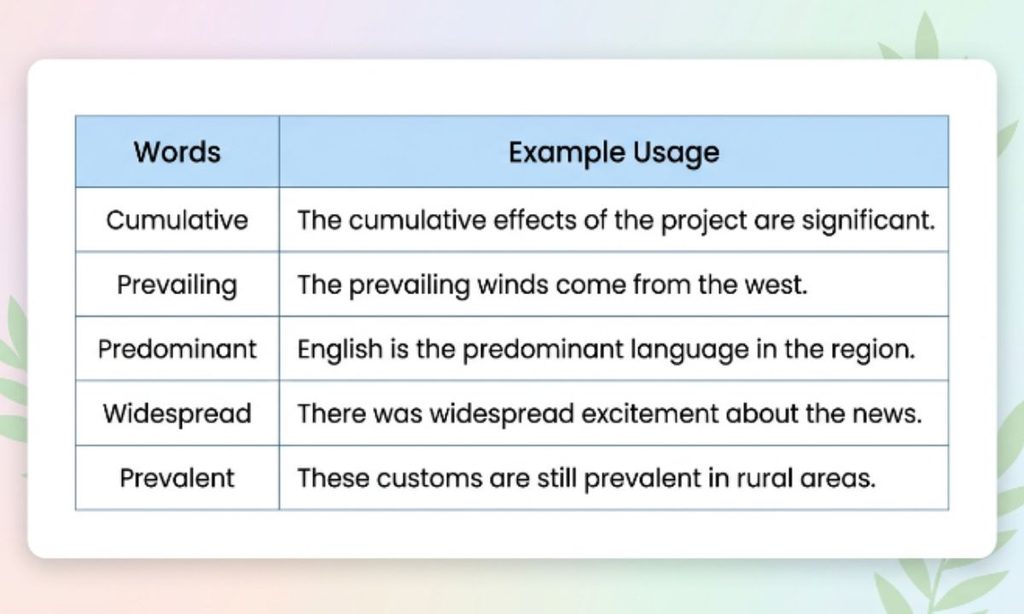
Cumulative
Meaning: Cumulative describes something that builds up over time through repeated addition.
This word emphasizes a process of accumulation, not a single fixed total. It’s especially useful when describing effects, scores, or results that grow across multiple instances.
- The cumulative effect of small changes added up.
- Her cumulative GPA improved each semester.
When It Fits: Describing effects or totals that build over time.
Exhaustive
Meaning: Exhaustive describes something thorough to the point of covering every possible detail.
This word signals extreme thoroughness, sometimes to the point of excess. It works well in research or investigative contexts where nothing was left unchecked.
- The team conducted an exhaustive review of the data.
- Her exhaustive research covered every angle.
When It Fits: Research, investigations, and highly thorough reviews.
All-Inclusive
Meaning: All-inclusive describes something that covers every relevant item or group, leaving nothing out.
This word works well in both practical contexts, like pricing, and abstract ones, like policy scope. It signals that nothing extra needs to be added.
- The resort offers an all-inclusive package.
- The policy takes an all-inclusive approach to eligibility.
When It Fits: Pricing, packages, and inclusive policy language.
Comprehensive
Meaning: “Comprehensive” describes something that covers all necessary elements thoroughly and in detail.
This word carries a formal, thorough tone and works especially well for reports, plans, or reviews. It signals depth as well as breadth.
- The team delivered a comprehensive analysis.
- Her comprehensive plan addressed every department.
When It Fits: Reports, plans, and formal reviews.
Broad
Meaning: “Broad” describes something wide in scope but light on specific detail.
This word is the clearest replacement when “overall” refers to scope, not completeness. It signals that you’re speaking in general terms on purpose.
- The proposal offers a broad outline of the plan.
- We took a broad look at industry trends.
When It Fits: General outlines, summaries, and scope-focused statements.
Wide-Ranging
Meaning: Wide-ranging describes something that covers many different topics or areas.
This word emphasizes variety and breadth rather than depth. It’s a strong fit for discussions, policies, or reforms that touch multiple areas at once.
- The interview covered wide-ranging topics.
- Wide-ranging reforms reshaped the industry.
When It Fits: Discussions, policies, and multi-topic coverage.
Sweeping
Meaning: Sweeping describes something large in scale, often implying dramatic or extensive change.
This word adds intensity that plainer synonyms lack. It works especially well when describing reforms, statements, or changes with significant impact.
- Sweeping changes followed the new leadership.
- She made a sweeping generalization about the industry.
When It Fits: Major reforms, dramatic change, and impactful decisions.
Far-Reaching
Meaning: Far-reaching describes something with effects that extend well beyond its immediate context.
This word emphasizes consequence and impact rather than just scope. It’s especially useful when describing decisions or policies with long-term ripple effects.
- The decision had far-reaching consequences.
- Far-reaching reforms changed how the agency operates.
When It Fits: Long-term impact and consequential decisions.
Extensive
Meaning: Extensive describes something large in size, amount, or scope.
This word works well for describing research, damage, experience, or coverage. It’s neutral in tone and fits both formal and everyday writing.
- She has extensive experience in the field.
- The storm caused extensive damage.
When It Fits: Experience, damage, research, and general scope.
Panoramic
Meaning: Panoramic describes a wide, all-encompassing view, often used figuratively for perspective.
This word adds a vivid, visual quality that plainer synonyms don’t have. It works especially well in descriptive or narrative writing about perspective.
- The report offers a panoramic view of the market.
- Her panoramic understanding of the issue impressed the board.
When It Fits: Descriptive, narrative, or perspective-focused writing.
Overarching
Meaning: “Overarching” describes a central idea or principle that connects and governs smaller parts.
This word is useful for describing goals, themes, or strategies that unify multiple smaller elements. It signals hierarchy, not just scope.
- The overarching goal is to improve retention.
- An overarching theme ran through the entire report.
When It Fits: Strategy, goals, and unifying themes.
Global
Meaning: Global describes something that applies everywhere or affects the entire system, not just one part.
Outside of geography, this word works well in technical and business writing to mean system-wide. It signals scope without geographic limits.
- The update applies a global change to all settings.
- Global demand for the product kept rising.
When It Fits: Technical settings, business scope, and system-wide changes.
Holistic
Meaning: Holistic describes an approach that considers the whole system rather than isolated parts.
This word signals a specific philosophy: that pieces only make sense in relation to the whole. It works especially well in health, education, and strategic planning contexts.
- The clinic takes a holistic approach to treatment.
- Their holistic strategy considered every department.
When It Fits: Health, education, and whole-system strategy.
All-Encompassing
Meaning: “All-encompassing” describes something that includes every relevant element without exception.
This word is strong and absolute, so it should be used carefully. It works best when the completeness genuinely has no gaps.
- The training covers an all-encompassing set of skills.
- Their all-encompassing review left nothing unchecked.
When It Fits: Rare cases where coverage is genuinely total.
Prevailing
Meaning: Prevailing describes the view, condition, or trend that’s currently dominant.
This word signals what’s true right now, with the implication that it could shift. It’s especially useful for describing opinions, conditions, or market trends.
- The prevailing opinion favors the new approach.
- Prevailing wage rates rose across the region.
When It Fits: Opinions, trends, and current dominant conditions.
Predominant
Meaning: Predominant describes something that’s the most common or influential among several options.
This word works well when comparing multiple factors and identifying which one stands out most. It’s more precise than “main” or “biggest.”
- The predominant concern was cost, not quality.
- Blue was the predominant color in the design.
When It Fits: Comparisons where one factor clearly leads.
Widespread
Meaning: Widespread describes something found or happening across a large area or among many people.
This word emphasizes reach and distribution rather than intensity. It’s a strong fit for describing trends, beliefs, or problems that touch many places at once.
- Widespread flooding affected several counties.
- The idea gained widespread support quickly.
When It Fits: Trends, problems, and broadly distributed conditions.
Prevalent
Meaning: “Prevalent” describes something common or frequently occurring within a particular context.
This word is often used in research, health, and social contexts to describe how often something appears. It’s more clinical in tone than “common.”
- The condition is prevalent among older adults.
- Remote work became prevalent after the shift.
When It Fits: Research, health data, and frequency-based descriptions.
Universal
Meaning: “Universal” describes something that applies to everyone or everything without exception.
This word is absolute, so it should be reserved for genuinely exceptionless cases. It signals total agreement or applicability, not just a majority.
- The rule applies on a universal basis.
- There was near-universal agreement on the decision.
When It Fits: Exceptionless rules and near-total agreement.
Dominant
Meaning: Dominant describes something more powerful, common, or influential than the alternatives around it.
This word works well in competitive or comparative contexts, such as markets, traits, or strategies. It implies a position of strength, not just frequency.
- The company holds a dominant position in the market.
- Caution was the dominant emotion in the room.
When It Fits: Competitive comparisons and positions of strength.
General
Meaning: “General” describes something broad or non-specific, applying to most cases rather than every detail.
This word is the most neutral, everyday replacement for the “broad” sense of overall. It works well when precision isn’t the point.
- She gave a general summary of the findings.
- The consensus favored the new plan.
When It Fits: Everyday summaries where exact detail isn’t needed.
Typical
Meaning: “Typical” describes something that represents the usual or expected pattern.
This word emphasizes normalcy rather than dominance. It’s a strong fit when describing standard behavior, results, or conditions.
- The results were typical for this time of year.
- A typical response takes about two days.
When It Fits: Describing standard, expected patterns or outcomes.
Collectively
Meaning: Collectively describes something done or considered together, as a group rather than individually.
This word emphasizes joint action or combined effect. It works especially well when describing teams, groups, or systems acting as one unit.
- Collectively, the departments exceeded their targets.
- The team collectively decided to change direction.
When It Fits: Group actions and combined outcomes.
Across the Board
Meaning: “Across the board” describes something applied uniformly to every part of a group or system.
This phrase signals consistency and fairness in application. It works especially well for policies, raises, or changes affecting everyone equally.
- The company issued across-the-board pay increases.
- Prices rose across the board this quarter.
When It Fits: Uniform policies and system-wide consistency.
Mostly
Meaning: Mostly describes something true for the largest part, with some exceptions remaining.
This is the clearest everyday replacement for the “qualified generalization” sense of overall. It’s casual, direct, and easy to understand.
- The team mostly agreed with the new plan.
- The weekend was mostly relaxing.
When It Fits: Everyday writing and casual, qualified statements.
Largely
Meaning: Largely describes something true to a significant degree, though not entirely.
This word is slightly more formal than “mostly” and works well in professional or analytical writing. It signals a strong majority without claiming totality.
- The project was largely successful.
- Her argument was largely convincing.
When It Fits: Professional writing and analytical summaries.
Overall vs. Similar Words: Quick Comparisons
Some of these synonyms get confused constantly. Here’s a fast way to tell them apart.
| Word Pair | Key Difference |
| Overall vs. Generally | Generally leans toward “usually”; overall often means a final, summed-up judgment. |
| Overall vs. Total | “Total” is strictly quantitative; “overall” can describe quality or scope too. |
| Overall vs. Comprehensive | “Comprehensive” implies depth and detail; “overall” can stay vague on purpose. |
| Overall vs. Broad | “Broad” specifically means a wide scope without detail; “overall” is more flexible. |
| Overall vs. Sweeping | Sweeping implies scale and impact, not just summary judgment. |
| Overall vs. Holistic | “Holistic” implies a specific whole-system philosophy, not just totality. |
| Overall vs. Aggregate | Aggregate is numerical and additive; overall can be qualitative. |
| Overall vs. Mostly | “Mostly” is a qualified generalization; “overall” can mean “total completeness” instead. |
Antonyms of “Overall” by Meaning
Opposites help sharpen meaning just as much as synonyms do:
- Opposite of total/complete: partial, incomplete
- Opposite of broad: narrow, specific
- Opposite of widespread: limited, localized
- Opposite of comprehensive: fragmented, restricted
- Opposite of collective: individual, isolated
- Opposite of universal: exclusive, exceptional
Frequently Asked Questions
What is another word for overall?
Common alternatives include “generally,” “total,” “comprehensive,” “broad,” and “predominant,” depending on the exact meaning you need.
What is a formal synonym for overall?
“Comprehensive,” “aggregate,” and “predominantly” all work well in formal or academic writing.
What is another word for overall performance?
Cumulative performance or general performance both capture the same summary meaning clearly.
What is a synonym for overall cost?
“Total cost” or “aggregate cost” are the most precise replacements for a quantity-based meaning.
Can “overall” be used as an adverb?
“Yes” as an adverb typically means “in general” or “considering everything,” similar to “generally” or “on the whole.”
Conclusion
“Overall” is useful precisely because it’s flexible, but that flexibility is also why it gets vague fast. Whether you’re summarizing a conclusion, describing a total, outlining a broad scope, naming a dominant trend, or making a qualified statement, there’s a sharper word available than the default. Use the 40 alternatives above to make your writing clearer, more precise, and far less repetitive.

[…] 40 Overall Synonyms: Better Words for Every Meaning […]