
Quick question: when you “share” a meal, “share” a stake in a company, and “share” bad news, are you really doing the same thing? Not even close. English asks one small word to cover giving, dividing, owning, and confiding, and that’s a lot to ask. This guide breaks “share” into its real meanings and hands you 30 sharper alternatives to match.
What “Share” Actually Means
“Share” isn’t one concept. It’s at least four.
As a verb, it can mean giving someone part of what you have, dividing something between people, taking part in an experience, or telling someone something private. As a noun, it can mean your piece of a whole, like a bill or an inheritance, or a legal stake in a business, like company stock.
That’s the root of the confusion. “We share the rent” and “I own shares in the company” use the same word for two very different relationships to money. Picking the right synonym starts with figuring out which of these four jobs you actually need done.
Why Precision Matters Here
“Share” gets overused because it’s flexible, but flexible words are vague words. If you write “we shared the work,” a reader has to guess whether you mean you split it evenly, you both pitched in loosely, or you handed off part of it entirely.
Using a more specific word fixes that instantly.
- It removes ambiguity between dividing, owning, and participating.
- It matches formal contexts (finance, legal writing) with formal vocabulary.
- It keeps repetitive writing from feeling monotonous.
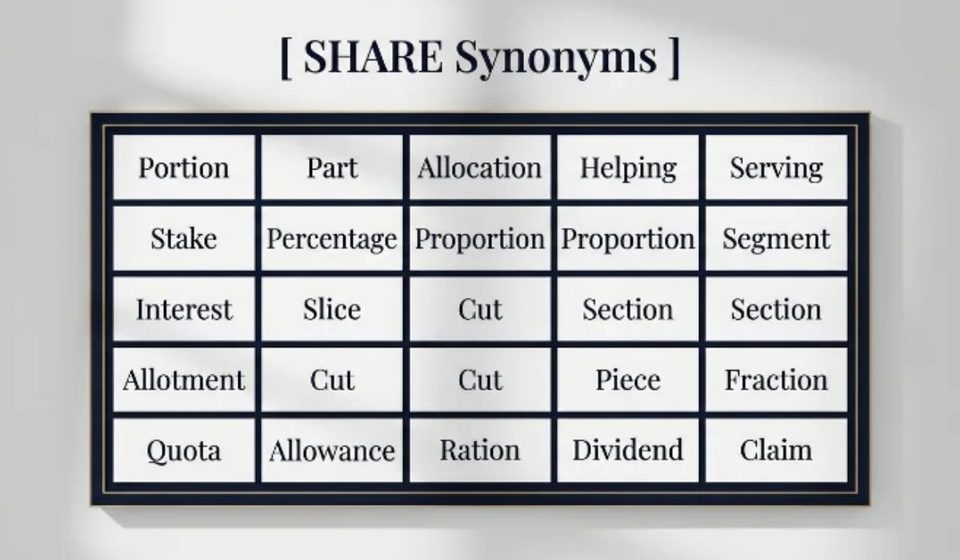
Below are 30 alternatives, organized into five practical groups: portion and division, ownership and stake, participation, distribution as an action, and communication or disclosure. Each entry includes a plain meaning, a short note on tone, two example sentences, and the everyday moment where it fits best.
Words for Portion and Division
These describe a specific piece of something larger, usually money, food, or responsibility.
Portion
Meaning: A part of something that has been separated from the whole. Portion is neutral and works almost anywhere, from restaurant plates to research grants. It doesn’t imply how the division happened, just that a piece exists on its own. That neutrality makes it a safe, versatile substitute for “share” in most writing.
Examples:
- Each department received its portion of the annual budget.
- She ate only a small portion of the dessert before pushing it away.
When It Fits: Describing a piece of food, money, or resources without implying fairness or process.
Allotment
Meaning: A portion specifically assigned or designated to someone. Allotment carries a sense of official assignment, like something was measured out on purpose by an authority or system. It fits bureaucratic, agricultural, or administrative writing better than casual conversation.
Examples:
- Each farmer received a water allotment based on acreage.
- The department exceeded its printing allotment by March.
When It Fits: Government, workplace resource planning, or formal budgeting contexts.
Quota
Meaning: A fixed portion someone is expected to meet or is entitled to. Quota implies a target or limit, not just a piece of something. It’s the right word when the portion is tied to performance or restriction rather than simple division.
Examples:
- The sales team hit its quota two weeks early.
- Immigration policy set a strict annual quota.
When It Fits: Sales, performance tracking, or policy-related writing.
Allowance
Meaning: A set amount given regularly or for a specific purpose. Allowance suggests something recurring and often modest, given by someone with authority over the resource: a parent, an employer, a budget system. It has a gentler, more personal tone than quota.
Examples:
- His monthly allowance for gas and food ran out by the twentieth.
- The airline gives a baggage allowance of one checked bag.
When It Fits: Personal finance, parenting, or recurring budget limits.
Slice
Meaning: A defined piece of something, often used loosely and informally. Slice is casual and visual, borrowed from cutting food, and it works well when you want writing to feel relaxed rather than technical. It also pairs naturally with metaphor, like “slice of the market.”
Examples:
- The startup claimed a growing slice of the delivery market.
- Everyone got a fair slice of the profits.
When It Fits: Informal or conversational writing, especially around business growth or competition.
Cut
Meaning: A person’s portion, especially of money or profit. Cut has an edge to it, slightly transactional, sometimes even implying negotiation or a deal. It reads as informal and works well in business or entertainment contexts.
Examples:
- The agent takes a fifteen percent cut of every deal.
- After expenses, her cut of the sale was smaller than expected.
When It Fits: Business deals, freelance work, informal money conversations.
Ration
Meaning: A fixed portion allocated under scarcity or strict control. Ration signals limitation. It’s the right word when supply is tight, and portions are being deliberately restricted, not just divided for convenience.
Examples:
- Each household received a weekly ration of clean water during the drought.
- Soldiers were given a strict food ration.
When It Fits: Situations involving scarcity, historical writing, or emergency planning.
Fraction
Meaning: A small part of a larger whole. Fraction emphasizes smallness more than fairness or process. It’s useful when you want to highlight how little something is compared to the total.
Examples:
- He only paid a fraction of what the repair actually cost.
- A fraction of the audience stayed for the Q&A.
When It Fits: Emphasizing a small amount relative to a bigger picture.
Words for Ownership and Financial Stake
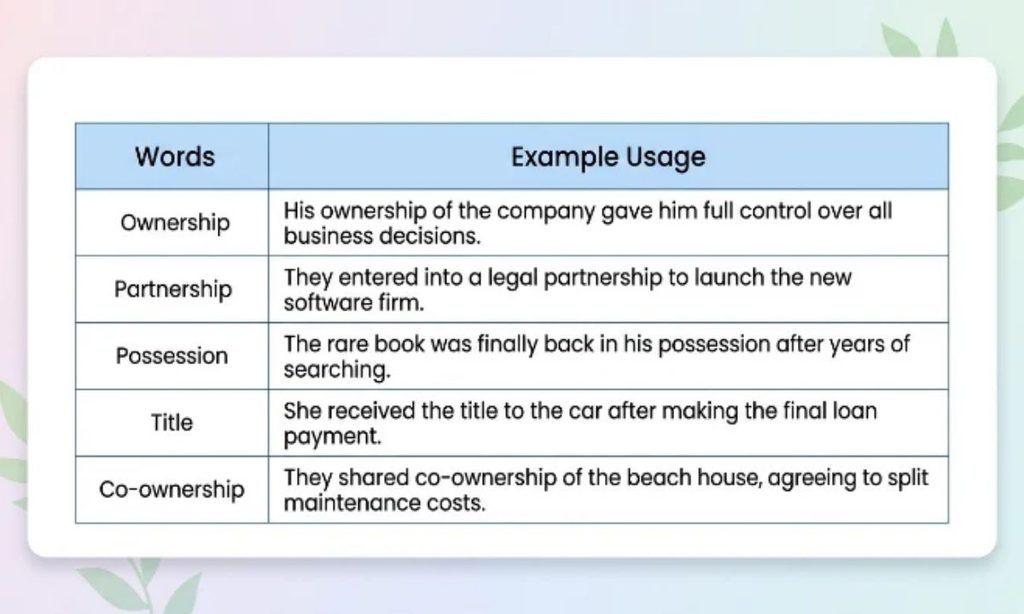
These describe a legal or financial interest in something, most often used in business writing.
Stake
Meaning: A financial or personal interest in the outcome of something. Stake works for both money and emotional investment. It’s precise in business writing but flexible enough to describe personal involvement too, which makes it more versatile than “share” in a financial sense.
Examples:
- She sold her stake in the restaurant after five years.
- He has a real stake in whether the project succeeds.
When It Fits: Business ownership, partnerships, or describing personal investment in an outcome.
Interest
Meaning: A legal or financial right in property, a business, or an agreement. Interest is more formal and legally precise than “stake.” It’s the word contracts and legal documents reach for, so it fits professional and legal writing better than casual speech.
Examples:
- The bank holds a security interest in the property.
- She retained a minority interest in the company after stepping down.
When It Fits: Legal documents, contracts, and formal business writing.
Equity
Meaning: Ownership value in a company or property, often expressed as a percentage. Equity is specific to finance and real estate. It measures value, not just involvement, which makes it distinct from stake or interest.
Examples:
- Employees received equity as part of their compensation package.
- Rising home prices increased their equity significantly.
When It Fits: Startup compensation, real estate, and financial planning.
Dividend
Meaning: A portion of profit distributed to shareholders. “Dividend” is narrow and specific: it only describes profit-sharing tied to ownership. It won’t substitute for “share” outside financial writing, but it’s the precise term when that’s the topic.
Examples:
- The company paid its first dividend in three years.
- Investors watched the dividend yield closely.
When It Fits: Investing, corporate finance, shareholder communication.
Ownership
Meaning: The state of legally possessing something, in whole or in part. Ownership is broader than stake or equity. It can describe full or partial control and works outside strictly financial contexts too, including responsibility and accountability.
Examples:
- She took full ownership of the failed launch.
- Partial ownership of the building came with the inheritance.
When It Fits: Business, property, or describing accountability for a project or outcome.
Holding
Meaning: An asset or investment someone possesses, often part of a larger portfolio. Holding is a term from investment writing. It implies one piece among several, useful when describing diversified ownership rather than a single stake.
Examples:
- His largest holding was in renewable energy stocks.
- The fund reduced its holdings in tech companies last quarter.
When It Fits: Investment portfolios, financial reporting.
Words for Participation
These describe taking part in an experience, activity, or outcome without necessarily involving money.
Participate
Meaning: To take part in an activity or event. “Participate” is plain, formal-neutral, and safe in almost any context. It emphasizes involvement over feeling or ownership, which makes it a clean substitute when “share” is describing joint activity.
Examples:
- Every employee was invited to participate in the survey.
- She chose to participate in the marathon for charity.
When It Fits: Events, activities, surveys, or group involvement.
Partake
Meaning: To take part in something, often food, drink, or an experience. Partake has an old-fashioned, slightly formal charm. It works especially well around meals or shared experiences where “participate” would feel too clinical.
Examples:
- Guests were invited to partake in the evening’s festivities.
- He rarely partakes in office gossip.
When It Fits: Social gatherings, meals, or lightly formal writing.
Contribute
Meaning: To give something, like effort, money, or ideas, as part of a joint effort. “Contribute” emphasizes what someone adds to a shared pool, rather than what they take from it. It’s especially useful in teamwork and collaborative writing.
Examples:
- Every team member contributed ideas during the brainstorm.
- She contributed generously to the fundraiser.
When It Fits: Teamwork, collaborative projects, charitable giving.
Take Part
Meaning: To join in an activity alongside others. This phrase is casual and conversational, an easy stand-in for “participate” in everyday speech without sounding stiff.
Examples:
- Hundreds of students took part in the walkout.
- He decided to take part in the neighborhood cleanup.
When It Fits: Everyday conversation, community events, casual writing.
Involve Oneself
Meaning: To become actively engaged in something, often deliberately. This phrase signals intentional effort; someone chose to step in, rather than being included automatically. It suits writing about proactive engagement.
Examples:
- She involved herself in every stage of the renovation.
- He rarely involves himself in office politics.
When It Fits: Describing someone’s deliberate, active engagement in a project or issue.
Words for the Act of Distributing
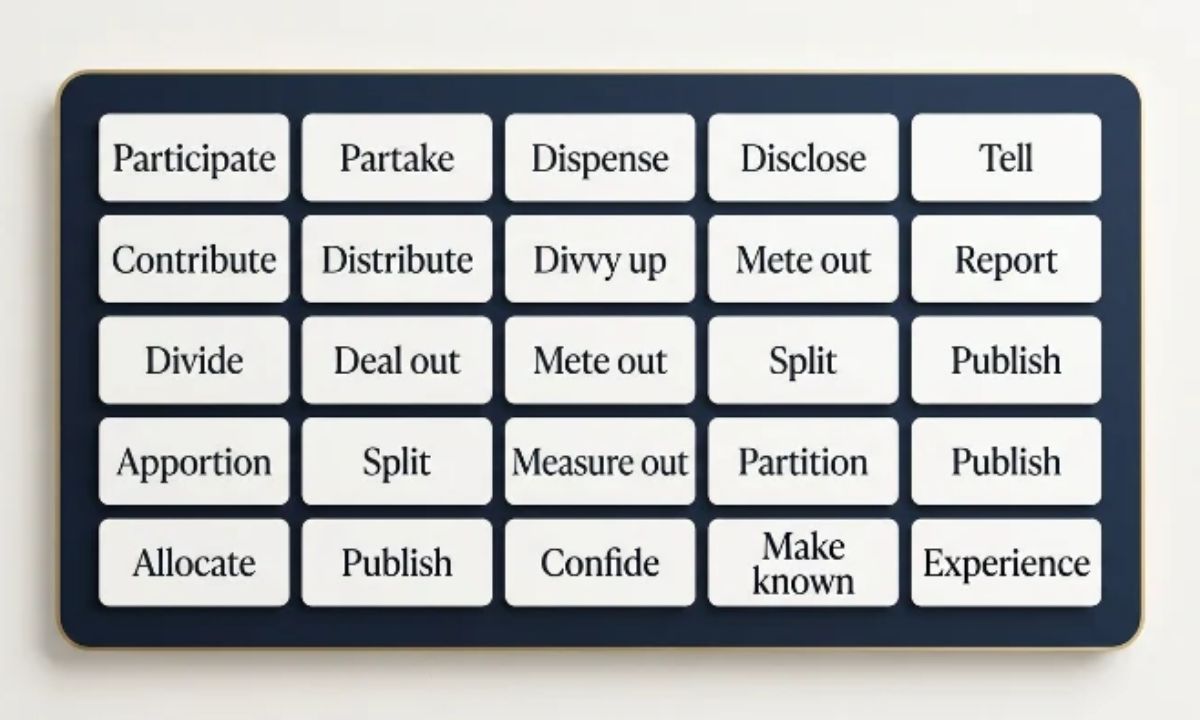
These describe the process of dividing something among multiple people or parts.
Distribute
Meaning: To give out portions of something to multiple recipients. “Distribute” is broad and practical, common in logistics, business, and everyday organizing. It describes the action of dividing without specifying fairness or method.
Examples:
- Volunteers distributed food packages across the neighborhood.
- The manager distributed the workload evenly across the team.
When It Fits: Logistics, resource allocation, and everyday task division.
Allocate
Meaning: To officially designate a portion of something for a specific purpose. “Allocate” feels planned and deliberate, common in budgeting and project management. It’s more formal than “distribute” and implies a decision-making process.
Examples:
- The board allocated funds for the new building.
- She allocated two hours a day to writing.
When It Fits: Budgeting, time management, and project planning.
Apportion
Meaning: To divide something and assign portions according to a plan or rule. “Apportion” is formal and slightly legal in tone. It implies careful, rule-based division rather than casual splitting.
Examples:
- Seats in Congress are apportioned based on population.
- The estate was apportioned according to the will.
When It Fits: Legal, political, or formal financial contexts.
Divvy Up
Meaning: To divide something informally among a group. Divvy up is casual, almost playful, and works well in relaxed writing where “apportion” or “allocate” would feel out of place.
Examples:
- The roommates divvied up the chores for the week.
- They divvied up the leftover pizza before heading home.
When It Fits: Casual conversation, informal group arrangements.
Deal Out
Meaning: To distribute something to each person in turn, like cards. “Deal out” has a rhythmic, sequential feel, giving something to each person one at a time. It’s vivid and works well in narrative or descriptive writing.
Examples:
- He dealt out the assignments one by one at the meeting.
- The teacher dealt out worksheets as students settled in.
When It Fits: Sequential distribution, storytelling, and classroom or group settings.
Words for Communication and Disclosure
These describe telling others something, rather than dividing or owning anything.
Disclose
Meaning: To reveal information that was previously private or unknown. “Disclose” is formal and often used in legal, financial, or professional writing, where revealing information carries weight or obligation.
Examples:
- The company disclosed the data breach within 48 hours.
- She disclosed her salary during the negotiation.
When It Fits: Legal, financial, or professional situations involving sensitive information.
Confide
Meaning: To tell someone something private, trusting them to keep it safe. Confide carries emotional weight and intimacy. It implies trust between two people, not just information transfer, making it distinct from more neutral disclosure words.
Examples:
- She confided in her sister about the job offer.
- He rarely confides in coworkers about personal matters.
When It Fits: Personal relationships and emotional or private conversations.
Disseminate
Meaning: To spread information widely to many people. Disseminate is formal and large-scale, common in media, research, and public communication. It’s the right word when information is being broadcast, not shared one-on-one.
Examples:
- The agency disseminated the safety guidelines to every branch office.
- Researchers disseminated their findings at the conference.
When It Fits: Public communication, research, and organizational announcements.
Choosing the Right Word
Here’s a quick way to match “share” to the right synonym, based on what you’re really describing.
| If you mean… | Reach for |
| A piece of money, food, or work | Portion, slice, cut, ration |
| Legal or financial ownership | Stake, interest, equity, holding |
| Joining in an activity | Participate, partake, contribute |
| The act of dividing something | Distribute, allocate, apportion, divvy up |
| Telling someone something | Disclose, confide, disseminate |
Common Mistakes to Avoid
- Mixing up stake and share in finance. A “stake” is your interest in a company; “share” more often refers to the actual unit of stock.
- Using formal words in casual writing. “Apportion” and “moiety” belong in legal or academic contexts, not text messages.
- Treating “confide” and “disclose” as identical. “Confide” implies trust and privacy; “disclose” implies formal or obligated revelation.
- Overusing “share” for social media actions. “Post,” “circulate,” or “repost” are often more precise than “share” when describing online activity.
Frequently Asked Questions
What is another word for share?
“Portion,” “part,” and “distribute” are common general alternatives, depending on whether you mean a piece, a stake, or an action.
What is a stronger word for share?
“Apportion,” “allocate,” and “disseminate” carry more formal or deliberate weight than the everyday word “share.”
What is the opposite of share?
Withhold, keep, and monopolize are common opposites, each describing a refusal to divide or give.
What’s the difference between share, stake, and interest?
“Share” often refers to a unit of ownership, “stake” to your overall investment or involvement, and “interest” to a formal legal right in something.
What are common phrases that use “share”?
Common ones include “fair share,” “lion’s share,” “share of the market,” and “share your thoughts.”
Final Thoughts
“Share” is doing four or five jobs at once, and most writing would be clearer if it picked the right one. Whether you’re describing a slice of a bill, a stake in a business, participation in an event, or a secret told in confidence, there’s a more precise word waiting. Keep this list on hand, match the word to the meaning, and your writing will read sharper and say exactly what you mean.