

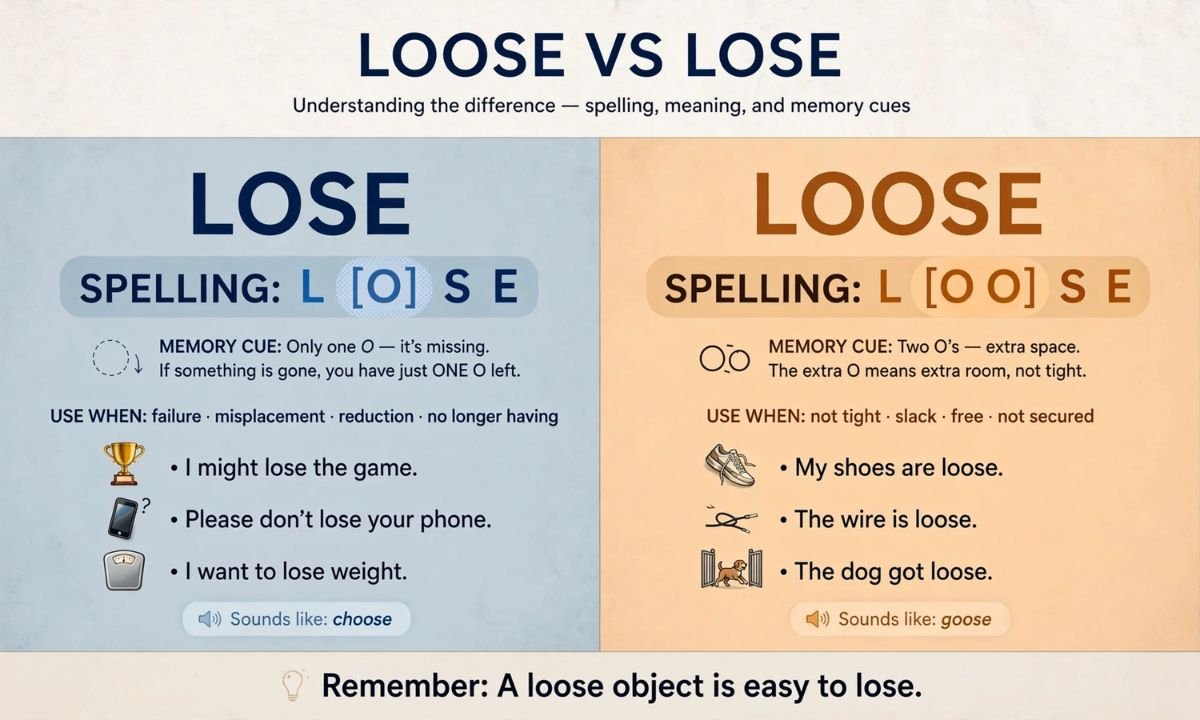
Mixing up “loose” and “lose” is one of the most common writing slips in English. The words look almost identical, but they mean completely different things. One is usually a describing word. The other is almost always an action word. This guide breaks down the meaning, grammar, pronunciation, and real-world examples of both, so you never have to second-guess your spelling again.
Lose vs Loose: What Each Word Actually Means
Here’s the short version before we go deep.
Lose is a verb. It means to fail at something, misplace something, or stop having something.
Loose is usually an adjective. It means something is not tight, not fixed in place, or not exact.
- “I always lose my umbrella.” (verb, misplace)
- “This shirt is too loose.” (adjective, not tight)
That single distinction, action versus description, solves most mix-ups on its own. But there’s more nuance worth knowing, especially if you write for work, school, or a wider audience.
What Does “Lose” Mean?
“Lose” almost always functions as a verb. It carries a handful of related meanings, and knowing all of them helps you spot it in context faster.
Fail to win
- Lose a game, a race, an election, or an argument.
- “Our team might lose tonight if the rain keeps up.”
Misplace something
- Lose your keys, your phone, or a document.
- “I always lose my glasses in the same three rooms.”
Stop having something
- Lose a job, access, trust, or a customer.
- “She lost her login access after the system update.”
Have less of something
- Lose weight, time, confidence, or interest.
- “He lost interest in the project after the budget cuts.”
Lose control of a feeling or situation
- Lose your temper, your patience, your nerve, or your focus.
- “Try not to lose your temper during the meeting.”
Get rid of or escape something
- Lose a tail, a habit, or lose yourself in a book.
- “I lost myself in that novel for an entire weekend.”
Across every one of these senses, “lose” describes something happening, not a physical state.
What Does “Loose” Mean?
“Loose” is most often an adjective, but it also has a lesser-known verb form. Both are worth understanding.
Loose as an Adjective
Not tight
- Loose shoes, loose pants, a loose fit.
- “These jeans feel loose after the wash.”
Not firmly attached
- A loose screw, a loose tooth, a loose wire, a loose button.
- “The doorknob is loose again.”
Free or unrestrained
- A dog running loose, hair worn loose.
- “The dog got loose while the gate was open.”
Not exact or strict
- A loose translation, a loose schedule, a loose estimate.
- “That’s a pretty loose interpretation of the contract.”
Relaxed or informal
- A loose atmosphere, a loose conversation.
Loose as a Verb (the Rare Meaning)
This is where most guides fall short. “Loose” can also be a verb meaning to release or set free. It’s uncommon in everyday speech but shows up in specific contexts.
- “They loosed the hounds at dawn.”
- “The archer loosed an arrow toward the target.”
- “Workers loosed the bolts before removing the panel.”
If you’re not writing about archery, hunting, or older or formal English, you’ll rarely need this sense. But knowing it exists helps you recognize it when you see it, instead of assuming it’s a typo.
Loose as a Noun or Adverb
Two rare uses round out the picture:
Noun: In archery, “the loose” refers to the moment an arrow is released.
Adverb: In phrases like “hang loose,” meaning to relax or stay calm.
You won’t need these often, but they explain why some idioms use “loose” in ways that seem grammatically odd at first glance.
How to Pronounce Loose and Lose
Spelling similarity aside, these words sound nothing alike, and that’s actually a useful clue.
| Word | Sound | Rhymes With |
| Loose | /luːs/ (soft “s” sound) | goose, moose, juice |
| Lose | /luːz/ (hard “z” sound) | choose, shoes, news |
Here’s a trick worth remembering: loose ends with an “s” sound, lose ends with a “z” sound. Say both words out loud in a sentence you’re unsure about. If it sounds like “z,” you want lose. If it sounds like “s,” you want loose.
Pronunciation alone won’t stop every spelling mistake, since most people write faster than they think about sound. But pairing sound with meaning makes the difference stick.
The Quick Grammar Test: Action or Description?
If you only remember one rule, make it this one.
- Is the word describing a noun or a condition? Use loose. (“a loose wire,” “the rope is loose”)
- Is the word describing an action of losing, misplacing, or failing? Use lose. (“I’ll lose the game,” “don’t lose your keys”)
- Does the sentence mean “release” or “set free”? Use loose, as a verb. (“loose the arrow”)
A simpler shortcut: loose usually sits next to a noun or after words like “is,” “feels,” or “seems.” Lose usually sits right before an object, like a noun you’re losing.
- “The belt is loose.” (loose + linking verb)
- “I’ll lose the belt if I’m not careful.” (lose + object)
Losing vs Loosing: The Difference Nobody Explains Well
This is one of the biggest gaps across most explanations online, and it trips up more people than the base words themselves.
Losing is the present participle of “lose.” It relates to failure, misplacement, or reduction.
- “I keep losing my train of thought.”
- “She’s losing weight steadily.”
Loosing is the present participle of “loose” used as a verb. It means releasing or setting free.
- “The falconer is loosing the bird.”
- “They’re loosing the ropes on the sail.”
In everyday writing, “losing” is the word you almost always want. “Loosing” only applies when you’re specifically talking about the act of releasing something.
Full Word-Form Table
| Base Form | Past Tense | Present Participle | Meaning |
| Lose | Lost | Losing | Fail, misplace, or no longer have |
| Loose | Loosed | Loosing | Release or set free |
Keep this table handy the next time you’re editing a document. It clears up almost every confusing form in one glance.
Loose vs Lose Examples by Situation
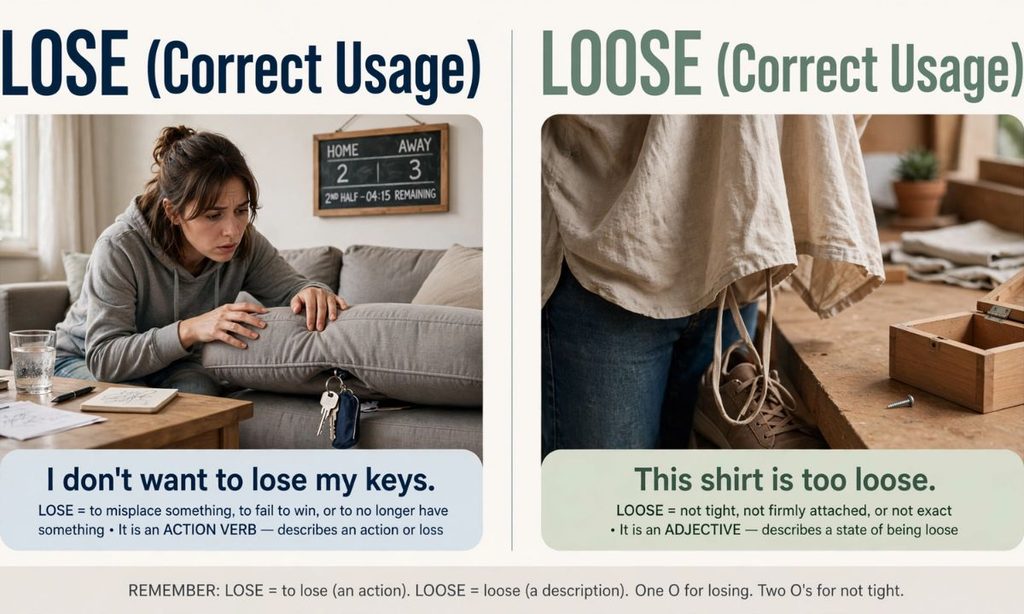
Seeing both words used across everyday contexts makes the rule easier to apply on the spot.
Everyday objects
- Loose change rattles in your pocket. You lose change if it falls through a hole.
- Loose papers slide off a desk. You lose papers if you can’t find them again.
Clothing
- Your shirt feels loose after you lose a few pounds.
- Loose shoes can slip off; you don’t want to lose one on a hike.
Technology
- A loose cable causes a bad connection. You lose your internet when the connection drops entirely.
- A loose battery cover can fall off. You lose data if a file isn’t saved.
Sports and competition
- Loose equipment is a safety issue on the field.
- You lose the match if the other team scores more points.
Health and fitness
- People often write “loose weight” by mistake. The correct phrase is always lose weight.
- After losing weight, your old clothes may become loose.
Academic and professional writing
- A loose definition lacks precision. Losing data, credibility, or funding are separate, more serious problems.
- “Our research relies on a loose correlation between the two variables” describes a weak statistical link, not a random typo.
Explore More Grammar Guide
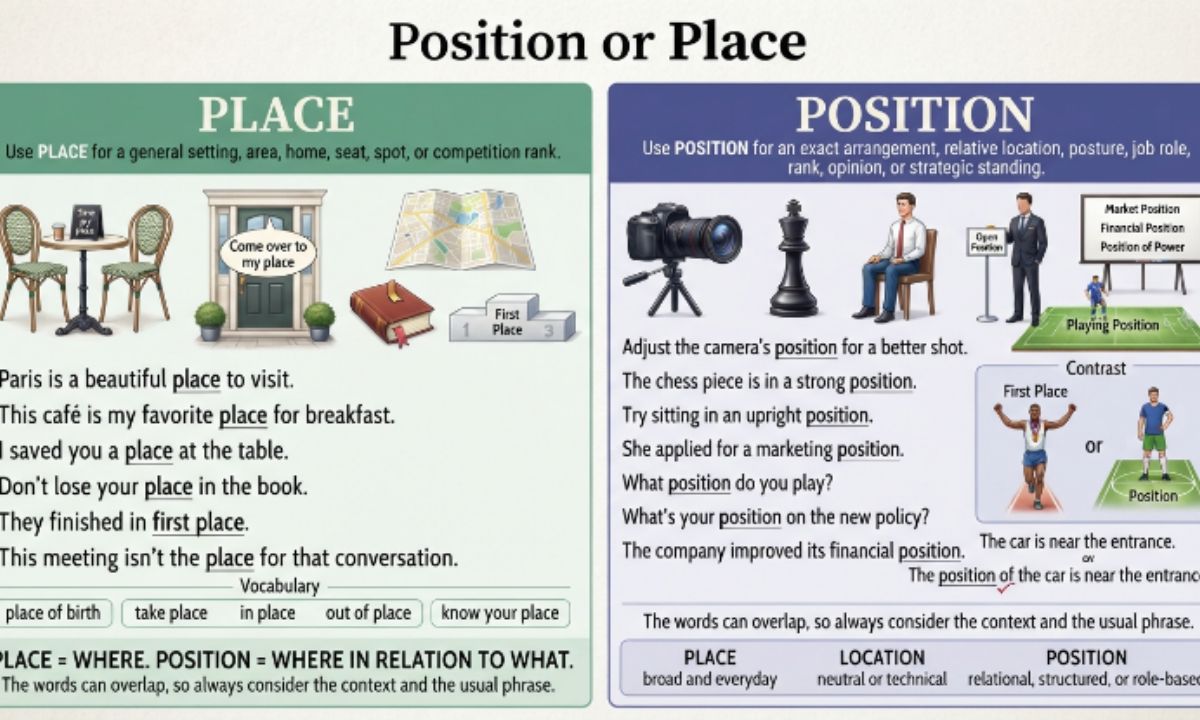
Position or Place: What’s the Real Difference?
Becuase vs. Because: Which Spelling Is Actually Correct?
“To Bad” or “Too Bad”: Which Spelling Is Correct?
Common Mistakes to Avoid
These errors show up constantly in emails, essays, and social posts. Spotting the pattern helps you catch them in your own writing.
❌ “I don’t want to loose my keys.” → ✅ lose my keys
❌ “My pants are too lose.” → ✅ too loose
❌ “I am loosing weight.” → ✅ losing weight
❌ “The dog got lose.” → ✅ got loose
❌ “We might loose the game.” → ✅ lose the game
❌ “The wire feels lose.” → ✅ feels loose
Why does this keep happening? A few reasons:
- The words look almost identical, off by one letter.
- Autocorrect sometimes “fixes” one into the other.
- Writers type fast and don’t pause to check the sound in their head.
- The adjective-versus-verb distinction isn’t always taught clearly.
Common Phrases and Idioms With “Lose”
These expressions use “lose” in figurative ways that go beyond literal loss.
Lose one’s temper — become angry
Lose one’s mind — act irrationally
Lose one’s way — become lost or directionless
Lose heart — become discouraged
Lose one’s nerve — become afraid to act
Lose count — forget a running total
Lose face — damage your reputation
Lose track of — stop keeping up with something
Lose sleep over — worry excessively about something
Lose out — miss an opportunity
Common Phrases and Idioms With “Loose”
- Loose change — small coins
- Loose ends — unfinished details
- Loose cannon — an unpredictable person
- Loose-lipped — talks too freely, often about secrets
- Hang loose — relax, stay calm
- Fast and loose — reckless or dishonest behavior
- All hell breaks loose — sudden chaos
A quick note on tone: a few older idioms, like describing someone as having “a screw loose,” can come across as dismissive or unkind when applied to a real person. If you’re writing for a professional or sensitive audience, plainer phrasing like “acting unpredictably” or “not thinking clearly” is usually the safer choice.
Easy Ways to Remember the Difference
If the rules above feel like a lot to hold onto, these shortcuts do the heavy lifting.
Count the O’s. Loose has two O’s, and it describes something with extra room, like a loose sleeve. Lose has one O, and something is missing, just like the letter.
Rhyme it out. Loose rhymes with goose. Lose rhymes with choose.
Ask “action or description?” If the word is doing something (an action), it’s lose. If it’s describing a state, it’s loose.
Remember: a loose object is easy to lose. This single sentence links both words together in a way that’s hard to forget.
Loose vs Lose: Quick Comparison Table
| Feature | Lose | Loose |
| Part of speech | Verb | Mostly adjective (rarely a verb) |
| Pronunciation | /luːz/ (z sound) | /luːs/ (s sound) |
| Core meaning | Fail, misplace, no longer have | Not tight, not fixed, not exact |
| Example | Lose your keys | A loose button |
| Past tense | Lost | Loosed |
| Present participle | Losing | Loosing |
Frequently Asked Questions
Is it “lose weight” or “loose weight”?
It’s always “lose weight.” “Loose” cannot function as this kind of verb in standard English.
Is “loosing” a real word?
Yes, but it means releasing or setting something free, not failing or misplacing something.
Can “loose” ever be a verb?
Yes, though rarely. It means to release, as in “loose an arrow” or “loose the dogs.”
Are loose and lose homophones?
No. They’re close in spelling but pronounced differently: loose ends in an “s” sound, lose ends in a “z” sound.
What’s the past tense of lose?
The past tense of lose is “lost,” as in “I lost my wallet yesterday.”
Final Thoughts
Loose and lose look almost the same on paper, but they play very different roles in a sentence. Lose is about action, failure, or misplacement. Loose is about a state of not being tight, fixed, or exact, with a rare verb sense meaning to release. Once you anchor the difference to sound, part of speech, and a few memorable examples, the mix-up stops happening, and your writing reads cleaner for it.

2 Comments
Pingback: Too vs To vs Two: How to Use Each Word Correctly
Pingback: International Phonetic Alphabet: Chart, Symbols, and How to Read It